# BitcoinDominanceClimbsTo58Point5Percent

11.51K

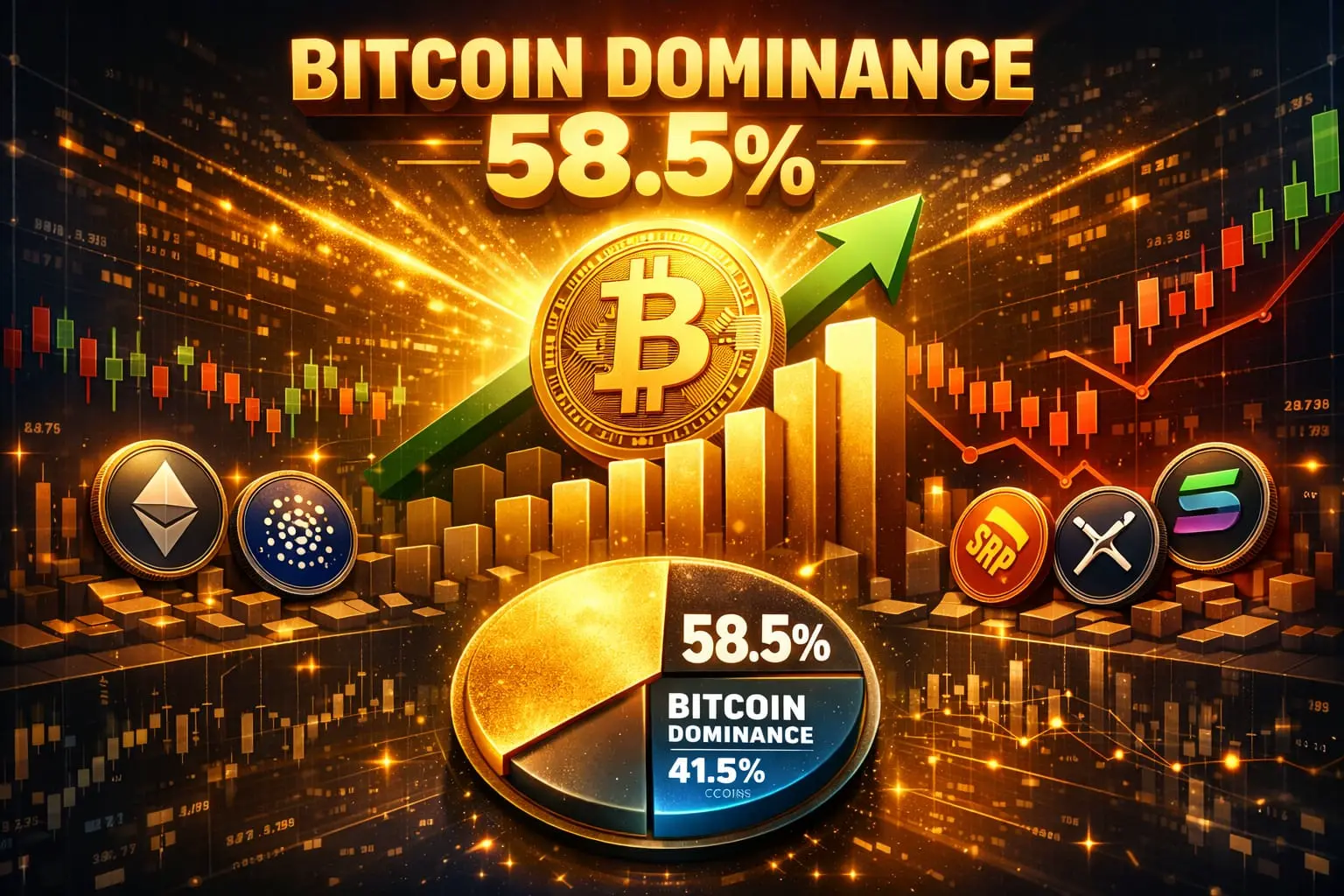
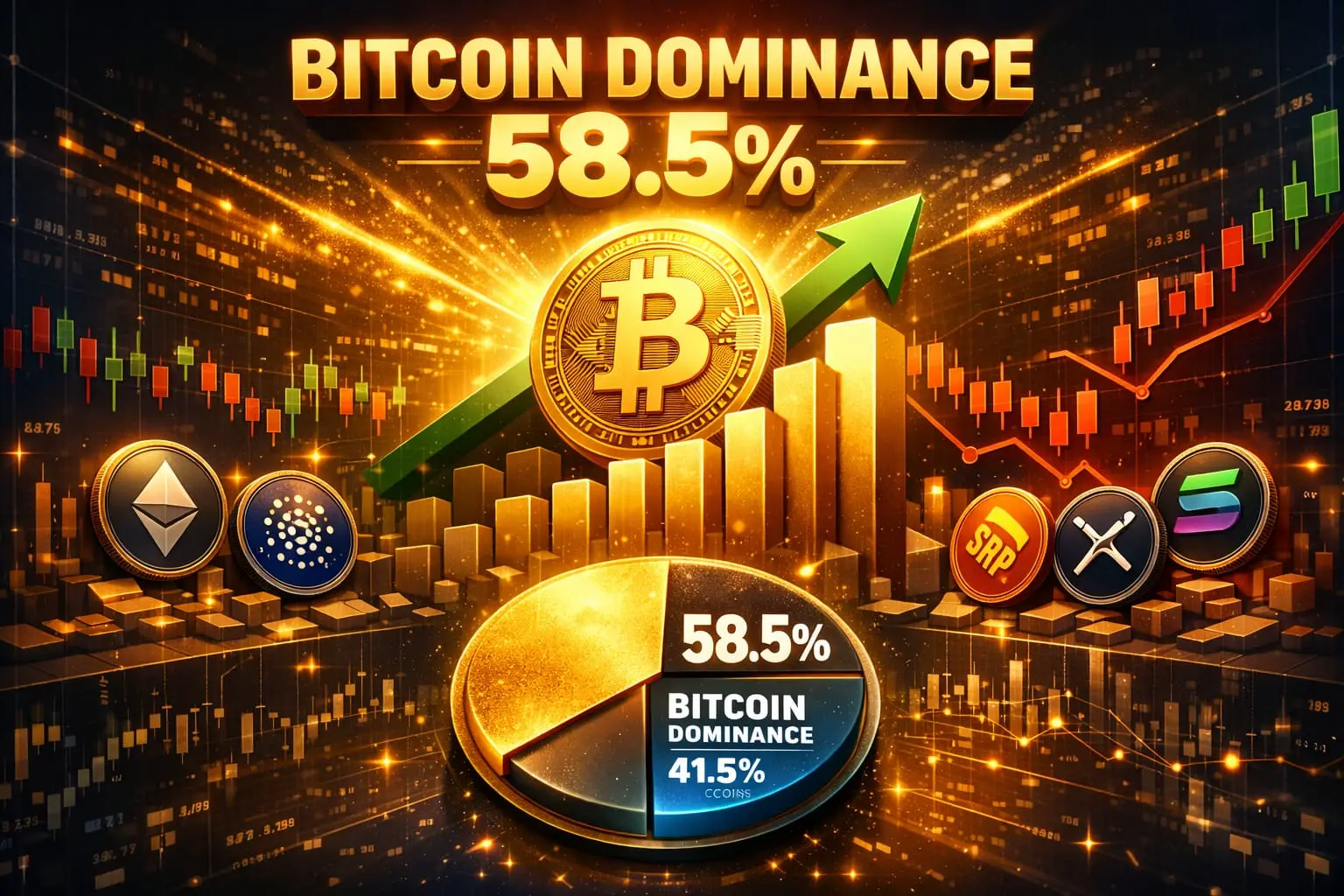
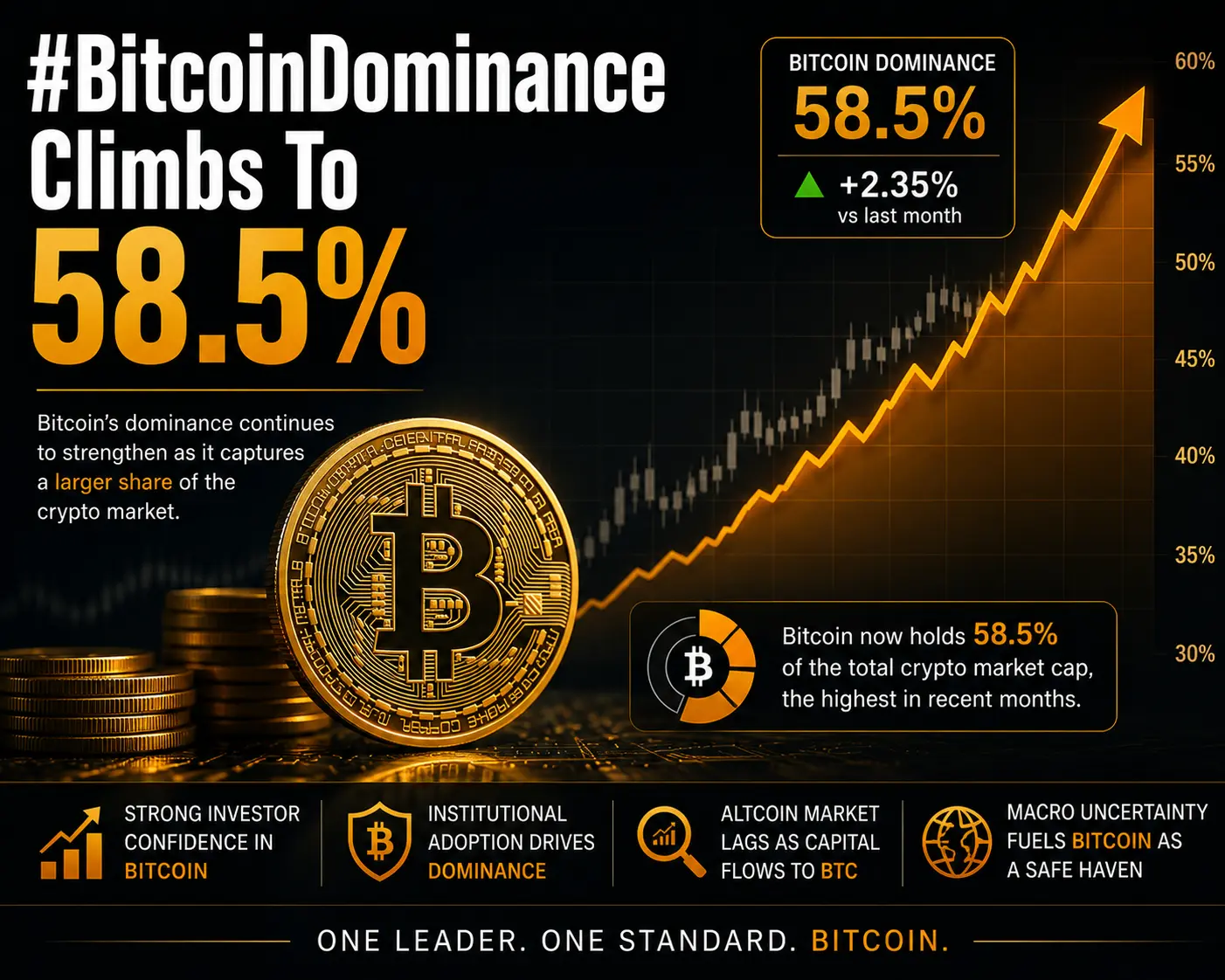
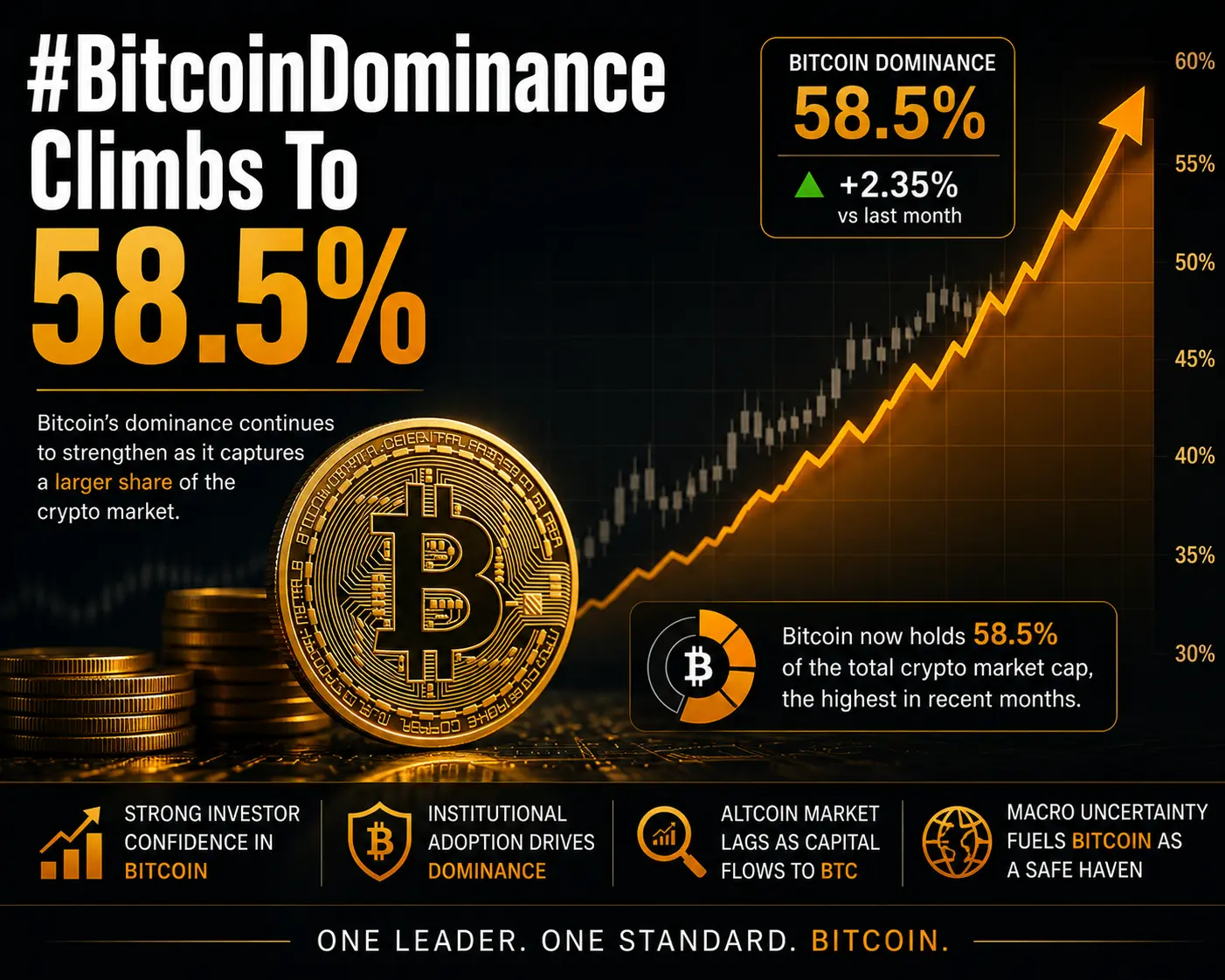
Data shows Bitcoin dominance has rebounded from a local low around 55 percent to approximately 58.5 percent, indicating capital is rotating back toward Bitcoin. BTC dominance is a key metric for tracking capital flows in crypto: a rising dominance typically signals a consolidation phase where Bitcoin outperforms altcoins, while a falling dominance often precedes "alt season" as capital flows into higher-risk assets. For context, Bitcoin dominance peaked at 62 to 63 percent in mid-2025 before falling to around 54 percent amid rising altcoin activity. The current recovery above 58 percent suggests the market is more likely in a consolidation phase rather than entering a broad alt rally.

#BitcoinDominanceClimbsTo58Point5Percent
Bitcoin Dominance Surges Again — And The Entire Crypto Market Is Repositioning
Bitcoin dominance has surged back toward 58.5%, and this move is becoming one of the clearest macro signals shaping the entire digital asset market right now. After months of aggressive speculation across meme coins, AI narratives, gaming tokens, and mid-cap altcoins, liquidity is once again rotating back into Bitcoin as investors prioritize stability, liquidity depth, and institutional trust.
Bitcoin dominance measures how much of the total cryptocurrency market capitalizat
BTC2.57%
MOVE1.29%
NOW4.22%
MEME2.48%
CryptoChampion
#BitcoinDominanceClimbsTo58Point5Percent
Bitcoin Dominance Surges Again — And The Entire Crypto Market Is Repositioning
Bitcoin dominance has surged back toward 58.5%, and this move is becoming one of the clearest macro signals shaping the entire digital asset market right now. After months of aggressive speculation across meme coins, AI narratives, gaming tokens, and mid-cap altcoins, liquidity is once again rotating back into Bitcoin as investors prioritize stability, liquidity depth, and institutional trust.
Bitcoin dominance measures how much of the total cryptocurrency market capitalization belongs to Bitcoin. When dominance rises, it usually means BTC is outperforming the broader market as capital exits higher-risk assets and flows into Bitcoin. Historically, this behavior appears during periods where institutions become more active, macro uncertainty increases, or speculative momentum begins cooling down.
The latest recovery is important because it follows a sharp decline earlier this year when BTC dominance dropped from around 63% toward the 54–55% zone. During that period, traders aggressively chased high-beta opportunities across smaller cryptocurrencies, fueling expectations that a full altseason had already begun.
Now the market structure is changing again.
One of the biggest reasons behind Bitcoin’s renewed strength is the continued impact of spot Bitcoin ETFs. Traditional finance liquidity keeps entering BTC directly through institutional investment vehicles, creating sustained demand that most altcoins currently cannot match. ETF inflows are fundamentally different from retail-driven speculative rallies because they represent large-scale capital allocation from asset managers, funds, and long-term investors.
At the same time, many speculative altcoins recently experienced unsustainable rallies followed by heavy profit-taking. Traders who captured gains in meme ecosystems and AI-related sectors are increasingly rotating capital back into Bitcoin to reduce volatility exposure while still remaining active inside crypto markets.
Macroeconomic conditions are also playing a major role.
Global markets remain highly sensitive to interest rate expectations, Federal Reserve policy decisions, inflation data, dollar strength, and geopolitical uncertainty. During unstable macro environments, Bitcoin often behaves as the strongest crypto liquidity anchor due to its deeper market structure, stronger infrastructure, and expanding institutional adoption.
Another major trend becoming visible is the widening gap between Bitcoin and the broader altcoin market.
Bitcoin continues benefiting from ETF demand, sovereign-level discussions, corporate treasury accumulation, institutional custody expansion, and integration into traditional financial systems. Meanwhile, many altcoins still depend heavily on retail speculation and short-term narrative momentum. This imbalance is reinforcing Bitcoin’s position as the dominant reserve asset within the crypto ecosystem.
However, rising dominance does not automatically mean altcoins are finished.
Historically, crypto bull cycles evolve in stages. Bitcoin typically leads first. Ethereum usually follows with stronger relative performance later. Broad altcoin expansion often arrives only after Bitcoin stabilizes and excess liquidity spreads more aggressively throughout the market.
Right now, the market still appears concentrated rather than fully euphoric.
Stablecoin liquidity growth remains positive but has not yet reached the explosive levels normally associated with peak altseason conditions. Retail participation also remains selective instead of fully widespread across the market.@Gate_Square
If Bitcoin dominance continues climbing toward previous highs near 62–63%, it could confirm that institutional flows are still overpowering speculative capital. But if dominance begins weakening again while Bitcoin stabilizes, traders may interpret that as the early signal of another major altcoin rotation phase beginning.
For now, one reality is becoming increasingly clear:
Bitcoin remains the center of gravity for the entire crypto market.
As liquidity tightens and macro uncertainty persists, capital is once again prioritizing security, infrastructure, institutional confidence, and long-term resilience — and Bitcoin continues standing at the center of that global shift.
#GateSquare #ContentMining
#GateSquareMayTradingShare
repost-content-media
  • Reward
  • Comment
  • Repost
  • Share
#BitcoinDominanceClimbsTo58Point5Percent
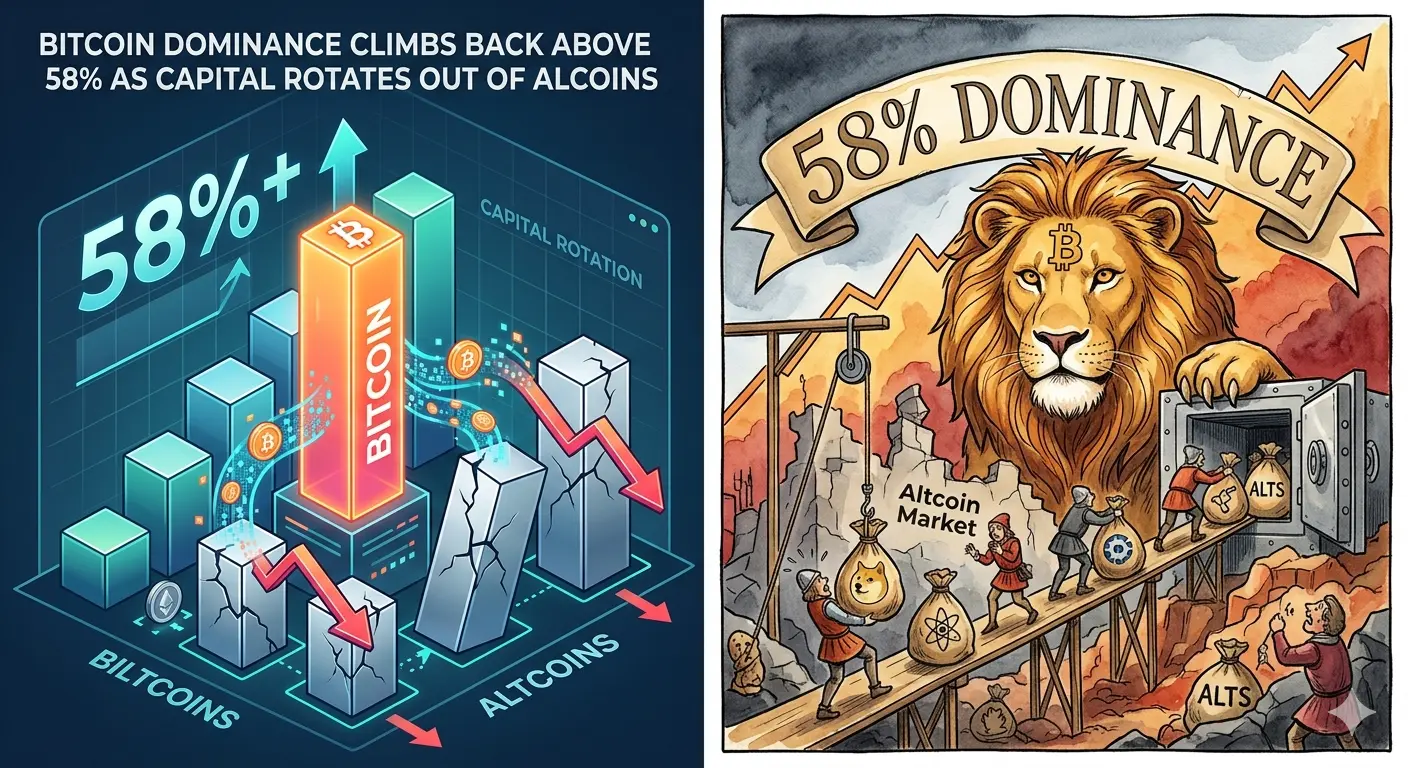
𝐁𝐈𝐓𝐂𝐎𝐈𝐍 𝐃𝐎𝐌𝐈𝐍𝐀𝐍𝐂𝐄 𝐂𝐋𝐈𝐌𝐁𝐒 𝐁𝐀𝐂𝐊 𝐀𝐁𝐎𝐕𝐄 𝟓𝟖% 𝐀𝐒 𝐂𝐀𝐏𝐈𝐓𝐀𝐋 𝐑𝐎𝐓𝐀𝐓𝐄𝐒 𝐎𝐔𝐓 𝐎𝐅 𝐀𝐋𝐓𝐂𝐎𝐈𝐍𝐒
Bitcoin dominance has once again become one of the most important metrics in the entire digital asset market after rebounding sharply from recent lows near 55% to approximately 58.5%. The move signals a major shift in capital behavior as liquidity rotates back toward Bitcoin following weeks of aggressive speculation across meme coins, AI tokens, and high-beta altcoins.
BTC dominance measures Bitcoin’s percentage share
MrFlower_XingChen
#BitcoinDominanceClimbsTo58Point5Percent
𝐁𝐈𝐓𝐂𝐎𝐈𝐍 𝐃𝐎𝐌𝐈𝐍𝐀𝐍𝐂𝐄 𝐂𝐋𝐈𝐌𝐁𝐒 𝐁𝐀𝐂𝐊 𝐀𝐁𝐎𝐕𝐄 𝟓𝟖% 𝐀𝐒 𝐂𝐀𝐏𝐈𝐓𝐀𝐋 𝐑𝐎𝐓𝐀𝐓𝐄𝐒 𝐎𝐔𝐓 𝐎𝐅 𝐀𝐋𝐓𝐂𝐎𝐈𝐍𝐒
Bitcoin dominance has once again become one of the most important metrics in the entire digital asset market after rebounding sharply from recent lows near 55% to approximately 58.5%. The move signals a major shift in capital behavior as liquidity rotates back toward Bitcoin following weeks of aggressive speculation across meme coins, AI tokens, and high-beta altcoins.
BTC dominance measures Bitcoin’s percentage share of the total cryptocurrency market capitalization. Historically, this metric acts as a macro sentiment indicator for the entire crypto ecosystem because it reflects where investors are allocating capital during different phases of the cycle.
When dominance rises, Bitcoin is generally outperforming the broader market either because institutional inflows are strengthening BTC directly or because traders are reducing exposure to higher-risk altcoins. When dominance falls, it usually signals expanding speculative appetite as investors chase larger returns across smaller-cap assets.
The recent recovery above 58% suggests the market may be shifting back toward a more defensive structure rather than entering a full euphoric altseason.
Earlier this year, Bitcoin dominance declined aggressively from the 62–63% region toward 54–55% as speculative mania exploded across meme ecosystems, AI narratives, gaming tokens, and mid-cap altcoins. That decline fueled expectations that a broad altcoin expansion phase had officially begun.
However, the latest reversal now indicates that a large portion of speculative liquidity is rotating back into Bitcoin — the asset still viewed globally as the strongest liquidity anchor and most institutionally trusted component of the crypto market.
Several major macro forces appear to be driving this transition simultaneously.
First, institutional capital continues favoring Bitcoin over the broader altcoin sector. Spot Bitcoin ETFs remain one of the most important structural demand drivers in crypto today, channeling billions in traditional finance liquidity directly into BTC. Unlike retail-driven altcoin rallies, ETF inflows create persistent and concentrated demand specifically for Bitcoin.
Second, traders appear increasingly cautious after the extreme volatility recently seen across speculative sectors. Many low-cap altcoins experienced rapid rallies without sustainable follow-through, leading to sharp profit-taking and declining momentum. Historically, these conditions often trigger capital rotation back into Bitcoin as investors seek stability while maintaining exposure to crypto.
Third, macroeconomic uncertainty continues influencing risk appetite globally. Interest rate expectations, dollar strength, geopolitical tensions, and liquidity conditions all continue impacting speculative markets. During uncertain macro periods, Bitcoin often attracts stronger flows than smaller digital assets due to its deeper liquidity, stronger infrastructure, and growing role as a macro asset within institutional portfolios.
Another important development is the growing divergence between Bitcoin and the broader altcoin market.
While BTC continues benefiting from ETF demand, institutional adoption, sovereign-level discussions, and treasury accumulation narratives, many altcoins remain heavily dependent on retail speculation and short-term momentum cycles. This structural imbalance is increasingly reinforcing Bitcoin’s dominance over the rest of the market.
At the same time, rising dominance does not necessarily mean altcoin opportunities are over.
Historically, crypto bull cycles tend to unfold in stages:
• Bitcoin leads first
• Ethereum follows with stronger relative performance
• Broader altcoin expansion occurs later once liquidity conditions fully loosen
The current market structure suggests crypto may still be somewhere between the first and second phases rather than entering the final euphoric stage typically associated with peak altseason conditions.
That distinction matters because true altseasons historically occur when Bitcoin stabilizes after a major rally while excess liquidity spills aggressively into mid and low-cap assets. Right now, liquidity still appears concentrated rather than broadly distributed.
Another key signal traders are monitoring is stablecoin liquidity growth. Previous full-scale altcoin expansions were supported by rapidly expanding stablecoin supply and broad retail participation. Current stablecoin growth remains positive but has not yet reached the explosive acceleration typically seen during late-cycle speculative phases.
Meanwhile, Bitcoin continues strengthening its position as the market’s primary reserve asset.
The combination of ETF inflows, institutional custody expansion, corporate treasury allocations, sovereign interest, and increasing integration into traditional financial infrastructure continues giving BTC structural advantages that most altcoins currently lack.
Psychology also plays a critical role.
As Bitcoin dominance rises, traders become more selective about risk. Liquidity begins concentrating into higher-quality assets with stronger narratives, larger market caps, and institutional relevance. Lower-quality speculative assets often struggle during these phases because market participants prioritize capital preservation over aggressive risk-taking.
This creates an environment where only a limited number of altcoins outperform sustainably while the majority underperform Bitcoin.
Looking ahead, analysts are closely watching whether BTC dominance can continue climbing toward previous highs near 62–63% or whether resistance around current levels eventually triggers another wave of rotation back into altcoins.
Several factors could determine the next move:
• Spot ETF inflow strength
• Federal Reserve liquidity conditions
• Stablecoin market expansion
• Bitcoin price stability
• Ethereum relative strength
• Retail participation returning at scale
If dominance continues rising aggressively, it could confirm that the market remains in a Bitcoin-led phase where institutional capital continues overpowering speculative flows.
However, if dominance stalls and reverses lower again, traders may interpret that as the early signal of renewed altcoin expansion and broader risk appetite returning to the market.
For now, the rebound toward 58.5% strongly reinforces one reality:
Bitcoin remains the center of gravity for the entire crypto market.
Capital is once again prioritizing liquidity, institutional trust, infrastructure strength, and macro resilience — and Bitcoin continues standing at the center of that shift.
𝐁𝐓𝐂 𝐃𝐎𝐌𝐈𝐍𝐀𝐍𝐂𝐄 𝐈𝐒 𝐎𝐍𝐂𝐄 𝐀𝐆𝐀𝐈𝐍 𝐁𝐄𝐂𝐎𝐌𝐈𝐍𝐆 𝐓𝐇𝐄 𝐌𝐎𝐒𝐓 𝐈𝐌𝐏𝐎𝐑𝐓𝐀𝐍𝐓 𝐌𝐀𝐂𝐑𝐎 𝐈𝐍𝐃𝐈𝐂𝐀𝐓𝐎𝐑 𝐈𝐍 𝐂𝐑𝐘𝐏𝐓𝐎
#GateSquareMayTradingShare

repost-content-media
  • Reward
  • Comment
  • Repost
  • Share
#BitcoinDominanceClimbsTo58Point5Percent
Bitcoin Dominance Surges Again — And The Entire Crypto Market Is Repositioning
Bitcoin dominance has surged back toward 58.5%, and this move is becoming one of the clearest macro signals shaping the entire digital asset market right now. After months of aggressive speculation across meme coins, AI narratives, gaming tokens, and mid-cap altcoins, liquidity is once again rotating back into Bitcoin as investors prioritize stability, liquidity depth, and institutional trust.
Bitcoin dominance measures how much of the total cryptocurrency market capitalizat
post-image
  • Reward
  • 3
  • Repost
  • Share
BH_HELAL_44:
2026 GOGOGO 👊
View More
#BitcoinDominanceClimbsTo58Point5Percent
𝐁𝐈𝐓𝐂𝐎𝐈𝐍 𝐃𝐎𝐌𝐈𝐍𝐀𝐍𝐂𝐄 𝐂𝐋𝐈𝐌𝐁𝐒 𝐁𝐀𝐂𝐊 𝐀𝐁𝐎𝐕𝐄 𝟓𝟖% 𝐀𝐒 𝐂𝐀𝐏𝐈𝐓𝐀𝐋 𝐑𝐎𝐓𝐀𝐓𝐄𝐒 𝐎𝐔𝐓 𝐎𝐅 𝐀𝐋𝐓𝐂𝐎𝐈𝐍𝐒
Bitcoin dominance has once again become one of the most important metrics in the entire digital asset market after rebounding sharply from recent lows near 55% to approximately 58.5%. The move signals a major shift in capital behavior as liquidity rotates back toward Bitcoin following weeks of aggressive speculation across meme coins, AI tokens, and high-beta altcoins.
BTC dominance measures Bitcoin’s percentage share
MrFlower_XingChen
#BitcoinDominanceClimbsTo58Point5Percent
𝐁𝐈𝐓𝐂𝐎𝐈𝐍 𝐃𝐎𝐌𝐈𝐍𝐀𝐍𝐂𝐄 𝐂𝐋𝐈𝐌𝐁𝐒 𝐁𝐀𝐂𝐊 𝐀𝐁𝐎𝐕𝐄 𝟓𝟖% 𝐀𝐒 𝐂𝐀𝐏𝐈𝐓𝐀𝐋 𝐑𝐎𝐓𝐀𝐓𝐄𝐒 𝐎𝐔𝐓 𝐎𝐅 𝐀𝐋𝐓𝐂𝐎𝐈𝐍𝐒
Bitcoin dominance has once again become one of the most important metrics in the entire digital asset market after rebounding sharply from recent lows near 55% to approximately 58.5%. The move signals a major shift in capital behavior as liquidity rotates back toward Bitcoin following weeks of aggressive speculation across meme coins, AI tokens, and high-beta altcoins.
BTC dominance measures Bitcoin’s percentage share of the total cryptocurrency market capitalization. Historically, this metric acts as a macro sentiment indicator for the entire crypto ecosystem because it reflects where investors are allocating capital during different phases of the cycle.
When dominance rises, Bitcoin is generally outperforming the broader market either because institutional inflows are strengthening BTC directly or because traders are reducing exposure to higher-risk altcoins. When dominance falls, it usually signals expanding speculative appetite as investors chase larger returns across smaller-cap assets.
The recent recovery above 58% suggests the market may be shifting back toward a more defensive structure rather than entering a full euphoric altseason.
Earlier this year, Bitcoin dominance declined aggressively from the 62–63% region toward 54–55% as speculative mania exploded across meme ecosystems, AI narratives, gaming tokens, and mid-cap altcoins. That decline fueled expectations that a broad altcoin expansion phase had officially begun.
However, the latest reversal now indicates that a large portion of speculative liquidity is rotating back into Bitcoin — the asset still viewed globally as the strongest liquidity anchor and most institutionally trusted component of the crypto market.
Several major macro forces appear to be driving this transition simultaneously.
First, institutional capital continues favoring Bitcoin over the broader altcoin sector. Spot Bitcoin ETFs remain one of the most important structural demand drivers in crypto today, channeling billions in traditional finance liquidity directly into BTC. Unlike retail-driven altcoin rallies, ETF inflows create persistent and concentrated demand specifically for Bitcoin.
Second, traders appear increasingly cautious after the extreme volatility recently seen across speculative sectors. Many low-cap altcoins experienced rapid rallies without sustainable follow-through, leading to sharp profit-taking and declining momentum. Historically, these conditions often trigger capital rotation back into Bitcoin as investors seek stability while maintaining exposure to crypto.
Third, macroeconomic uncertainty continues influencing risk appetite globally. Interest rate expectations, dollar strength, geopolitical tensions, and liquidity conditions all continue impacting speculative markets. During uncertain macro periods, Bitcoin often attracts stronger flows than smaller digital assets due to its deeper liquidity, stronger infrastructure, and growing role as a macro asset within institutional portfolios.
Another important development is the growing divergence between Bitcoin and the broader altcoin market.
While BTC continues benefiting from ETF demand, institutional adoption, sovereign-level discussions, and treasury accumulation narratives, many altcoins remain heavily dependent on retail speculation and short-term momentum cycles. This structural imbalance is increasingly reinforcing Bitcoin’s dominance over the rest of the market.
At the same time, rising dominance does not necessarily mean altcoin opportunities are over.
Historically, crypto bull cycles tend to unfold in stages:
• Bitcoin leads first
• Ethereum follows with stronger relative performance
• Broader altcoin expansion occurs later once liquidity conditions fully loosen
The current market structure suggests crypto may still be somewhere between the first and second phases rather than entering the final euphoric stage typically associated with peak altseason conditions.
That distinction matters because true altseasons historically occur when Bitcoin stabilizes after a major rally while excess liquidity spills aggressively into mid and low-cap assets. Right now, liquidity still appears concentrated rather than broadly distributed.
Another key signal traders are monitoring is stablecoin liquidity growth. Previous full-scale altcoin expansions were supported by rapidly expanding stablecoin supply and broad retail participation. Current stablecoin growth remains positive but has not yet reached the explosive acceleration typically seen during late-cycle speculative phases.
Meanwhile, Bitcoin continues strengthening its position as the market’s primary reserve asset.
The combination of ETF inflows, institutional custody expansion, corporate treasury allocations, sovereign interest, and increasing integration into traditional financial infrastructure continues giving BTC structural advantages that most altcoins currently lack.
Psychology also plays a critical role.
As Bitcoin dominance rises, traders become more selective about risk. Liquidity begins concentrating into higher-quality assets with stronger narratives, larger market caps, and institutional relevance. Lower-quality speculative assets often struggle during these phases because market participants prioritize capital preservation over aggressive risk-taking.
This creates an environment where only a limited number of altcoins outperform sustainably while the majority underperform Bitcoin.
Looking ahead, analysts are closely watching whether BTC dominance can continue climbing toward previous highs near 62–63% or whether resistance around current levels eventually triggers another wave of rotation back into altcoins.
Several factors could determine the next move:
• Spot ETF inflow strength
• Federal Reserve liquidity conditions
• Stablecoin market expansion
• Bitcoin price stability
• Ethereum relative strength
• Retail participation returning at scale
If dominance continues rising aggressively, it could confirm that the market remains in a Bitcoin-led phase where institutional capital continues overpowering speculative flows.
However, if dominance stalls and reverses lower again, traders may interpret that as the early signal of renewed altcoin expansion and broader risk appetite returning to the market.
For now, the rebound toward 58.5% strongly reinforces one reality:
Bitcoin remains the center of gravity for the entire crypto market.
Capital is once again prioritizing liquidity, institutional trust, infrastructure strength, and macro resilience — and Bitcoin continues standing at the center of that shift.
𝐁𝐓𝐂 𝐃𝐎𝐌𝐈𝐍𝐀𝐍𝐂𝐄 𝐈𝐒 𝐎𝐍𝐂𝐄 𝐀𝐆𝐀𝐈𝐍 𝐁𝐄𝐂𝐎𝐌𝐈𝐍𝐆 𝐓𝐇𝐄 𝐌𝐎𝐒𝐓 𝐈𝐌𝐏𝐎𝐑𝐓𝐀𝐍𝐓 𝐌𝐀𝐂𝐑𝐎 𝐈𝐍𝐃𝐈𝐂𝐀𝐓𝐎𝐑 𝐈𝐍 𝐂𝐑𝐘𝐏𝐓𝐎
#GateSquareMayTradingShare

repost-content-media
  • Reward
  • Comment
  • Repost
  • Share
#BitcoinDominanceClimbsTo58Point5Percent 𝐁𝐓𝐂 𝐃𝐎𝐌𝐈𝐍𝐀𝐍𝐂𝐄 𝐀𝐓 𝟓𝟖.𝟓% 🔎
Bitcoin dominance has climbed back to approximately 58.5%, recovering from a local low near 55%, and the move is reshaping how traders are thinking about capital rotation right now .
Dominance is one of those metrics that cuts through the noise. When it rises, capital is concentrating in Bitcoin. When it falls, money typically fans out into altcoins. The current recovery toward 58.5% suggests the market is in a consolidation phase rather than a full-blown rotation into higher-beta assets .
The context matters.
User_any
#BitcoinDominanceClimbsTo58Point5Percent 𝐁𝐓𝐂 𝐃𝐎𝐌𝐈𝐍𝐀𝐍𝐂𝐄 𝐀𝐓 𝟓𝟖.𝟓% 🔎
Bitcoin dominance has climbed back to approximately 58.5%, recovering from a local low near 55%, and the move is reshaping how traders are thinking about capital rotation right now .
Dominance is one of those metrics that cuts through the noise. When it rises, capital is concentrating in Bitcoin. When it falls, money typically fans out into altcoins. The current recovery toward 58.5% suggests the market is in a consolidation phase rather than a full-blown rotation into higher-beta assets .
The context matters. Bitcoin dominance peaked between 62% and 63% in mid-2025 before a sustained drawdown pushed it near 54% as altcoin activity picked up . The rebound off that floor has coincided with Bitcoin's own price recovery from February lows near $63,000 to approximately $80,000, reinforcing BTC's relative strength versus the broader market over that stretch .
There is a genuine tension in the data right now. On one side, the dominance chart is showing early technical cracks. A bearish MACD crossover has appeared on the BTC dominance chart, which in prior cycles preceded periods of altcoin outperformance . The Altcoin Volume Increasing Trend has also activated, with the 30-day moving average for altcoin trading volume crossing above the 365-day baseline, a signal that last appeared in clusters during the 2021 alt season .
On the other side, the Altcoin Season Index sits at 50. The threshold for confirmed altcoin season is 75. At exactly 50, the market is in the middle of the range, not in Bitcoin season and not in altcoin season . This is the most honest number in the data. It says rotation has started, not that it has arrived.
Several altcoins are already showing relative strength. TON, ZEC, and DOGE have posted notable gains in recent sessions . SOL and SUI have recorded double-digit moves . But selective outperformance is not the same as a broad alt season where the majority of top assets beat Bitcoin over a sustained window.
The historical pattern worth watching is that Bitcoin dominance does not fall sustainably until Bitcoin itself has completed or nearly completed its own cycle move. In both 2017 and 2021, dramatic altcoin outperformance arrived after Bitcoin had already made its major advance . With MVRV sitting below previous cycle peaks, the on-chain data suggests Bitcoin may not have finished that advance yet.
The CLARITY Act markup on May 14 adds another variable. If the bill advances, institutional flows into Bitcoin could accelerate further, potentially pushing dominance higher. If it stalls, some of the positioning that has concentrated in BTC may rotate outward.
Key levels to monitor are clean. A dominance break below 59.63% would be the first structural signal favoring altcoin rotation . A sustained drop below 55% would strengthen the alt season case considerably. A recovery above 60% on a weekly close would likely extend the Bitcoin-led phase and delay broader altcoin expansion.
Where do you think Bitcoin dominance heads from here, continued consolidation near 58% or a breakdown that opens the door for altcoins? And are you interpreting the selective strength in tokens like TON and SOL as the early stage of rotation or just isolated outperformance in a market that still favors Bitcoin?
This post is for informational purposes only and does not constitute financial advice.
repost-content-media
  • Reward
  • 1
  • Repost
  • Share
User_any:
To The Moon 🌕
#BitcoinDominanceClimbsTo58Point5Percent
⚡ A Deep-Dive Into Capital Rotation, Altcoin Liquidity Compression, Institutional Preference, and the Changing Structure of Modern Crypto Markets ⚡
Bitcoin dominance climbing to 58.5% is becoming one of the strongest signals that capital within the crypto market is once again concentrating heavily toward Bitcoin as investors reposition around liquidity strength, macro uncertainty, and institutional preference. In modern digital asset markets, Bitcoin dominance is far more than just a percentage metric — it reflects how liquidity is rotating across the
post-image
post-image
post-image
post-image
post-image
post-image
post-image
post-image
post-image
  • Reward
  • 2
  • Repost
  • Share
cryptoStylish:
2026 GOGOGO 👊
View More
#BitcoinDominanceClimbsTo58Point5Percent
Bitcoin Dominance Climbs to 58.5%
Bitcoin dominance rising to 58.5% marks one of the most important structural shifts in the crypto market cycle. This level means that more than half of the total cryptocurrency market capitalization is now concentrated in Bitcoin alone, reflecting a strong rotation of capital away from altcoins and back into the largest and most established digital asset.
This dominance expansion is not just a statistical movement; it is a clear signal of changing investor psychology, where capital preservation, macro uncertainty, and
post-image
  • Reward
  • Comment
  • Repost
  • Share
#BitcoinDominanceClimbsTo58Point5Percent
𝐁𝐈𝐓𝐂𝐎𝐈𝐍 𝐃𝐎𝐌𝐈𝐍𝐀𝐍𝐂𝐄 𝐂𝐋𝐈𝐌𝐁𝐒 𝐁𝐀𝐂𝐊 𝐀𝐁𝐎𝐕𝐄 𝟓𝟖% 𝐀𝐒 𝐂𝐀𝐏𝐈𝐓𝐀𝐋 𝐑𝐎𝐓𝐀𝐓𝐄𝐒 𝐎𝐔𝐓 𝐎𝐅 𝐀𝐋𝐓𝐂𝐎𝐈𝐍𝐒
Bitcoin dominance has once again become one of the most important metrics in the entire digital asset market after rebounding sharply from recent lows near 55% to approximately 58.5%. The move signals a major shift in capital behavior as liquidity rotates back toward Bitcoin following weeks of aggressive speculation across meme coins, AI tokens, and high-beta altcoins.
BTC dominance measures Bitcoin’s percentage share
MrFlower_XingChen
#BitcoinDominanceClimbsTo58Point5Percent
𝐁𝐈𝐓𝐂𝐎𝐈𝐍 𝐃𝐎𝐌𝐈𝐍𝐀𝐍𝐂𝐄 𝐂𝐋𝐈𝐌𝐁𝐒 𝐁𝐀𝐂𝐊 𝐀𝐁𝐎𝐕𝐄 𝟓𝟖% 𝐀𝐒 𝐂𝐀𝐏𝐈𝐓𝐀𝐋 𝐑𝐎𝐓𝐀𝐓𝐄𝐒 𝐎𝐔𝐓 𝐎𝐅 𝐀𝐋𝐓𝐂𝐎𝐈𝐍𝐒
Bitcoin dominance has once again become one of the most important metrics in the entire digital asset market after rebounding sharply from recent lows near 55% to approximately 58.5%. The move signals a major shift in capital behavior as liquidity rotates back toward Bitcoin following weeks of aggressive speculation across meme coins, AI tokens, and high-beta altcoins.
BTC dominance measures Bitcoin’s percentage share of the total cryptocurrency market capitalization. Historically, this metric acts as a macro sentiment indicator for the entire crypto ecosystem because it reflects where investors are allocating capital during different phases of the cycle.
When dominance rises, Bitcoin is generally outperforming the broader market either because institutional inflows are strengthening BTC directly or because traders are reducing exposure to higher-risk altcoins. When dominance falls, it usually signals expanding speculative appetite as investors chase larger returns across smaller-cap assets.
The recent recovery above 58% suggests the market may be shifting back toward a more defensive structure rather than entering a full euphoric altseason.
Earlier this year, Bitcoin dominance declined aggressively from the 62–63% region toward 54–55% as speculative mania exploded across meme ecosystems, AI narratives, gaming tokens, and mid-cap altcoins. That decline fueled expectations that a broad altcoin expansion phase had officially begun.
However, the latest reversal now indicates that a large portion of speculative liquidity is rotating back into Bitcoin — the asset still viewed globally as the strongest liquidity anchor and most institutionally trusted component of the crypto market.
Several major macro forces appear to be driving this transition simultaneously.
First, institutional capital continues favoring Bitcoin over the broader altcoin sector. Spot Bitcoin ETFs remain one of the most important structural demand drivers in crypto today, channeling billions in traditional finance liquidity directly into BTC. Unlike retail-driven altcoin rallies, ETF inflows create persistent and concentrated demand specifically for Bitcoin.
Second, traders appear increasingly cautious after the extreme volatility recently seen across speculative sectors. Many low-cap altcoins experienced rapid rallies without sustainable follow-through, leading to sharp profit-taking and declining momentum. Historically, these conditions often trigger capital rotation back into Bitcoin as investors seek stability while maintaining exposure to crypto.
Third, macroeconomic uncertainty continues influencing risk appetite globally. Interest rate expectations, dollar strength, geopolitical tensions, and liquidity conditions all continue impacting speculative markets. During uncertain macro periods, Bitcoin often attracts stronger flows than smaller digital assets due to its deeper liquidity, stronger infrastructure, and growing role as a macro asset within institutional portfolios.
Another important development is the growing divergence between Bitcoin and the broader altcoin market.
While BTC continues benefiting from ETF demand, institutional adoption, sovereign-level discussions, and treasury accumulation narratives, many altcoins remain heavily dependent on retail speculation and short-term momentum cycles. This structural imbalance is increasingly reinforcing Bitcoin’s dominance over the rest of the market.
At the same time, rising dominance does not necessarily mean altcoin opportunities are over.
Historically, crypto bull cycles tend to unfold in stages:
• Bitcoin leads first
• Ethereum follows with stronger relative performance
• Broader altcoin expansion occurs later once liquidity conditions fully loosen
The current market structure suggests crypto may still be somewhere between the first and second phases rather than entering the final euphoric stage typically associated with peak altseason conditions.
That distinction matters because true altseasons historically occur when Bitcoin stabilizes after a major rally while excess liquidity spills aggressively into mid and low-cap assets. Right now, liquidity still appears concentrated rather than broadly distributed.
Another key signal traders are monitoring is stablecoin liquidity growth. Previous full-scale altcoin expansions were supported by rapidly expanding stablecoin supply and broad retail participation. Current stablecoin growth remains positive but has not yet reached the explosive acceleration typically seen during late-cycle speculative phases.
Meanwhile, Bitcoin continues strengthening its position as the market’s primary reserve asset.
The combination of ETF inflows, institutional custody expansion, corporate treasury allocations, sovereign interest, and increasing integration into traditional financial infrastructure continues giving BTC structural advantages that most altcoins currently lack.
Psychology also plays a critical role.
As Bitcoin dominance rises, traders become more selective about risk. Liquidity begins concentrating into higher-quality assets with stronger narratives, larger market caps, and institutional relevance. Lower-quality speculative assets often struggle during these phases because market participants prioritize capital preservation over aggressive risk-taking.
This creates an environment where only a limited number of altcoins outperform sustainably while the majority underperform Bitcoin.
Looking ahead, analysts are closely watching whether BTC dominance can continue climbing toward previous highs near 62–63% or whether resistance around current levels eventually triggers another wave of rotation back into altcoins.
Several factors could determine the next move:
• Spot ETF inflow strength
• Federal Reserve liquidity conditions
• Stablecoin market expansion
• Bitcoin price stability
• Ethereum relative strength
• Retail participation returning at scale
If dominance continues rising aggressively, it could confirm that the market remains in a Bitcoin-led phase where institutional capital continues overpowering speculative flows.
However, if dominance stalls and reverses lower again, traders may interpret that as the early signal of renewed altcoin expansion and broader risk appetite returning to the market.
For now, the rebound toward 58.5% strongly reinforces one reality:
Bitcoin remains the center of gravity for the entire crypto market.
Capital is once again prioritizing liquidity, institutional trust, infrastructure strength, and macro resilience — and Bitcoin continues standing at the center of that shift.
𝐁𝐓𝐂 𝐃𝐎𝐌𝐈𝐍𝐀𝐍𝐂𝐄 𝐈𝐒 𝐎𝐍𝐂𝐄 𝐀𝐆𝐀𝐈𝐍 𝐁𝐄𝐂𝐎𝐌𝐈𝐍𝐆 𝐓𝐇𝐄 𝐌𝐎𝐒𝐓 𝐈𝐌𝐏𝐎𝐑𝐓𝐀𝐍𝐓 𝐌𝐀𝐂𝐑𝐎 𝐈𝐍𝐃𝐈𝐂𝐀𝐓𝐎𝐑 𝐈𝐍 𝐂𝐑𝐘𝐏𝐓𝐎
#GateSquareMayTradingShare
repost-content-media
  • Reward
  • Comment
  • Repost
  • Share
#BitcoinDominanceClimbsTo58Point5Percent
𝐁𝐈𝐓𝐂𝐎𝐈𝐍 𝐃𝐎𝐌𝐈𝐍𝐀𝐍𝐂𝐄 𝐂𝐋𝐈𝐌𝐁𝐒 𝐁𝐀𝐂𝐊 𝐀𝐁𝐎𝐕𝐄 𝟓𝟖% 𝐀𝐒 𝐂𝐀𝐏𝐈𝐓𝐀𝐋 𝐑𝐎𝐓𝐀𝐓𝐄𝐒 𝐎𝐔𝐓 𝐎𝐅 𝐀𝐋𝐓𝐂𝐎𝐈𝐍𝐒
Bitcoin dominance has once again become one of the most important metrics in the entire digital asset market after rebounding sharply from recent lows near 55% to approximately 58.5%. The move signals a major shift in capital behavior as liquidity rotates back toward Bitcoin following weeks of aggressive speculation across meme coins, AI tokens, and high-beta altcoins.
BTC dominance measures Bitcoin’s percentage share
MrFlower_XingChen
#BitcoinDominanceClimbsTo58Point5Percent
𝐁𝐈𝐓𝐂𝐎𝐈𝐍 𝐃𝐎𝐌𝐈𝐍𝐀𝐍𝐂𝐄 𝐂𝐋𝐈𝐌𝐁𝐒 𝐁𝐀𝐂𝐊 𝐀𝐁𝐎𝐕𝐄 𝟓𝟖% 𝐀𝐒 𝐂𝐀𝐏𝐈𝐓𝐀𝐋 𝐑𝐎𝐓𝐀𝐓𝐄𝐒 𝐎𝐔𝐓 𝐎𝐅 𝐀𝐋𝐓𝐂𝐎𝐈𝐍𝐒
Bitcoin dominance has once again become one of the most important metrics in the entire digital asset market after rebounding sharply from recent lows near 55% to approximately 58.5%. The move signals a major shift in capital behavior as liquidity rotates back toward Bitcoin following weeks of aggressive speculation across meme coins, AI tokens, and high-beta altcoins.
BTC dominance measures Bitcoin’s percentage share of the total cryptocurrency market capitalization. Historically, this metric acts as a macro sentiment indicator for the entire crypto ecosystem because it reflects where investors are allocating capital during different phases of the cycle.
When dominance rises, Bitcoin is generally outperforming the broader market either because institutional inflows are strengthening BTC directly or because traders are reducing exposure to higher-risk altcoins. When dominance falls, it usually signals expanding speculative appetite as investors chase larger returns across smaller-cap assets.
The recent recovery above 58% suggests the market may be shifting back toward a more defensive structure rather than entering a full euphoric altseason.
Earlier this year, Bitcoin dominance declined aggressively from the 62–63% region toward 54–55% as speculative mania exploded across meme ecosystems, AI narratives, gaming tokens, and mid-cap altcoins. That decline fueled expectations that a broad altcoin expansion phase had officially begun.
However, the latest reversal now indicates that a large portion of speculative liquidity is rotating back into Bitcoin — the asset still viewed globally as the strongest liquidity anchor and most institutionally trusted component of the crypto market.
Several major macro forces appear to be driving this transition simultaneously.
First, institutional capital continues favoring Bitcoin over the broader altcoin sector. Spot Bitcoin ETFs remain one of the most important structural demand drivers in crypto today, channeling billions in traditional finance liquidity directly into BTC. Unlike retail-driven altcoin rallies, ETF inflows create persistent and concentrated demand specifically for Bitcoin.
Second, traders appear increasingly cautious after the extreme volatility recently seen across speculative sectors. Many low-cap altcoins experienced rapid rallies without sustainable follow-through, leading to sharp profit-taking and declining momentum. Historically, these conditions often trigger capital rotation back into Bitcoin as investors seek stability while maintaining exposure to crypto.
Third, macroeconomic uncertainty continues influencing risk appetite globally. Interest rate expectations, dollar strength, geopolitical tensions, and liquidity conditions all continue impacting speculative markets. During uncertain macro periods, Bitcoin often attracts stronger flows than smaller digital assets due to its deeper liquidity, stronger infrastructure, and growing role as a macro asset within institutional portfolios.
Another important development is the growing divergence between Bitcoin and the broader altcoin market.
While BTC continues benefiting from ETF demand, institutional adoption, sovereign-level discussions, and treasury accumulation narratives, many altcoins remain heavily dependent on retail speculation and short-term momentum cycles. This structural imbalance is increasingly reinforcing Bitcoin’s dominance over the rest of the market.
At the same time, rising dominance does not necessarily mean altcoin opportunities are over.
Historically, crypto bull cycles tend to unfold in stages:
• Bitcoin leads first
• Ethereum follows with stronger relative performance
• Broader altcoin expansion occurs later once liquidity conditions fully loosen
The current market structure suggests crypto may still be somewhere between the first and second phases rather than entering the final euphoric stage typically associated with peak altseason conditions.
That distinction matters because true altseasons historically occur when Bitcoin stabilizes after a major rally while excess liquidity spills aggressively into mid and low-cap assets. Right now, liquidity still appears concentrated rather than broadly distributed.
Another key signal traders are monitoring is stablecoin liquidity growth. Previous full-scale altcoin expansions were supported by rapidly expanding stablecoin supply and broad retail participation. Current stablecoin growth remains positive but has not yet reached the explosive acceleration typically seen during late-cycle speculative phases.
Meanwhile, Bitcoin continues strengthening its position as the market’s primary reserve asset.
The combination of ETF inflows, institutional custody expansion, corporate treasury allocations, sovereign interest, and increasing integration into traditional financial infrastructure continues giving BTC structural advantages that most altcoins currently lack.
Psychology also plays a critical role.
As Bitcoin dominance rises, traders become more selective about risk. Liquidity begins concentrating into higher-quality assets with stronger narratives, larger market caps, and institutional relevance. Lower-quality speculative assets often struggle during these phases because market participants prioritize capital preservation over aggressive risk-taking.
This creates an environment where only a limited number of altcoins outperform sustainably while the majority underperform Bitcoin.
Looking ahead, analysts are closely watching whether BTC dominance can continue climbing toward previous highs near 62–63% or whether resistance around current levels eventually triggers another wave of rotation back into altcoins.
Several factors could determine the next move:
• Spot ETF inflow strength
• Federal Reserve liquidity conditions
• Stablecoin market expansion
• Bitcoin price stability
• Ethereum relative strength
• Retail participation returning at scale
If dominance continues rising aggressively, it could confirm that the market remains in a Bitcoin-led phase where institutional capital continues overpowering speculative flows.
However, if dominance stalls and reverses lower again, traders may interpret that as the early signal of renewed altcoin expansion and broader risk appetite returning to the market.
For now, the rebound toward 58.5% strongly reinforces one reality:
Bitcoin remains the center of gravity for the entire crypto market.
Capital is once again prioritizing liquidity, institutional trust, infrastructure strength, and macro resilience — and Bitcoin continues standing at the center of that shift.
𝐁𝐓𝐂 𝐃𝐎𝐌𝐈𝐍𝐀𝐍𝐂𝐄 𝐈𝐒 𝐎𝐍𝐂𝐄 𝐀𝐆𝐀𝐈𝐍 𝐁𝐄𝐂𝐎𝐌𝐈𝐍𝐆 𝐓𝐇𝐄 𝐌𝐎𝐒𝐓 𝐈𝐌𝐏𝐎𝐑𝐓𝐀𝐍𝐓 𝐌𝐀𝐂𝐑𝐎 𝐈𝐍𝐃𝐈𝐂𝐀𝐓𝐎𝐑 𝐈𝐍 𝐂𝐑𝐘𝐏𝐓𝐎
#GateSquareMayTradingShare
repost-content-media
  • Reward
  • Comment
  • Repost
  • Share
#BitcoinDominanceClimbsTo58Point5Percent
Bitcoin dominance has climbed to 58.5%, signaling a major shift in the crypto market as investors continue rotating capital back into Bitcoin. This rise in dominance reflects growing confidence in BTC during a period where many altcoins are struggling to maintain momentum. Market participants are now closely watching whether this trend will continue or if altcoins will stage a comeback in the coming weeks.
Bitcoin dominance measures Bitcoin’s share of the total cryptocurrency market capitalization. When dominance increases, it usually means Bitcoin is
post-image
post-image
  • Reward
  • 12
  • Repost
  • Share
ybaser:
To The Moon 🌕
View More
Load More