Abstract
- Prediction markets have entered the mainstream financial cycle. Platforms such as Polymarket continue to see rapid growth in trading volume and user activity, while traditional financial institutions including ICE, , and Nasdaq are accelerating their expansion into event-driven trading. Event markets are increasingly becoming a key branch of derivatives and information financialization.
- Gate is the first major crypto exchange to integrate Polymarket. Leveraging its 53 million global users, USDT funding rails, spot and futures ecosystem, and an in-account execution model similar to Gate Alpha, Gate transforms complex on-chain prediction markets into a CEX-native event trading experience.
- Gate has already become one of Polymarket’s Top 3 trading volume distribution channels, validating the strategic importance of CEX distribution capabilities in scaling prediction markets. The integration creates a mutually reinforcing structure between Gate’s users and liquidity access and Polymarket’s event markets and probability pricing mechanisms.
As the industry evolves, prediction markets have gradually moved from niche on-chain applications into the mainstream financial spotlight. Since 2024, on-chain platforms such as Polymarket have experienced explosive growth in both trading volume and user activity. In March 2026, ICE, the parent company of NYSE, announced an additional $600m strategic investment into Polymarket. At the same time, traditional exchanges including and Nasdaq have launched their own event-driven contracts. Demand for trading around macro politics, economic developments, AI advancements, and crypto-related narratives continues to rise, signaling that “the future” itself is becoming a tradable asset class. Against this backdrop, Gate became the first leading crypto exchange to integrate Polymarket and bring prediction markets into a centralized trading ecosystem.
As one of the world’s leading crypto exchanges, Gate possesses several core advantages: over 53 million users, a product ecosystem spanning spot and futures markets with support for 4,600+ trading pairs, and a highly active global trading network. Leveraging these strengths, Gate has seamlessly embedded prediction markets into its ecosystem, expanding its product framework from the traditional “Spot + Futures” model into “Spot + Futures + Event Trading.” Gate is rapidly positioning itself as the next-generation information financialization gateway for both retail and professional traders, gaining an early advantage in the emerging era of event-driven financial innovation. Gate has already become one of Polymarket’s Top 3 distribution channels.
1. Industry Trend: Prediction Markets Enter the Mainstream Financial Cycle
1.1 Rapid Expansion of Market Size
Prediction markets have entered a breakout phase. Since the beginning of 2026, monthly notional trading volume has exceeded $20bn for four consecutive months. In April 2026 alone, monthly notional volume approached the all-time high of nearly $30bn. Sports and political events continue to dominate trading activity, while newer categories such as pop culture, finance, and weather markets are also expanding steadily.
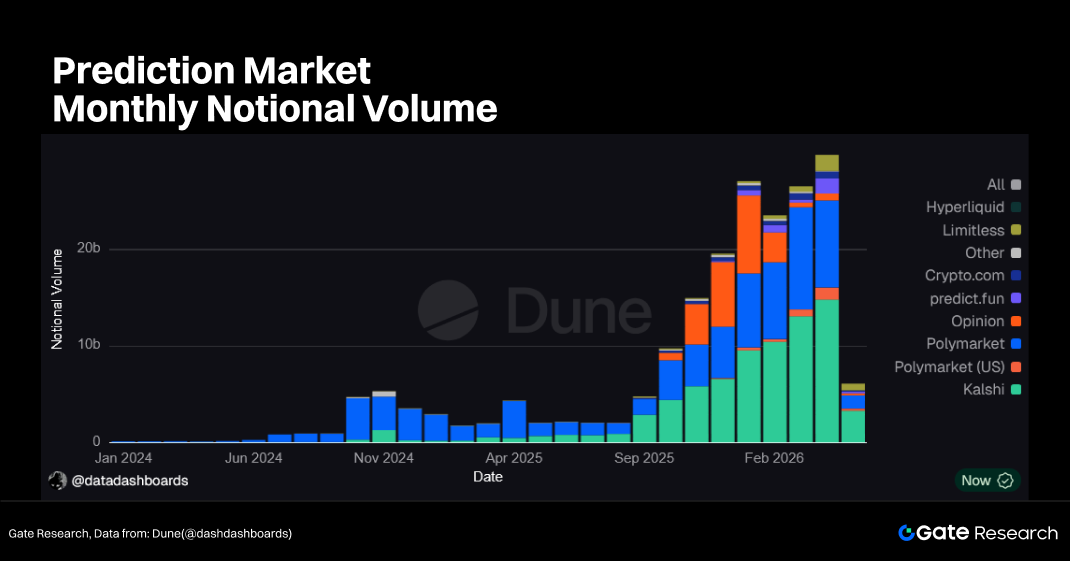
Meanwhile, institutional capital continues flowing into the sector. The valuations of the two leading platforms, Polymarket and Kalshi, have both surpassed tens of billions of dollars. Global regulatory conditions are gradually becoming more accommodating, with event contracts increasingly incorporated into formal regulatory discussions. Prediction markets are evolving into a globalized information-based financial infrastructure.
1.2 User Trading Behavior Is Changing
The rapid expansion of prediction markets also reflects a structural shift in user trading behavior.
For years, the dominant trading logic in crypto markets closely resembled traditional finance, primarily revolving around asset price volatility: trading BTC, ETH, and other major assets, using leverage to amplify returns, and engaging in short-term trading around liquidity cycles. The core focus was trading “price” itself, with participants generating profits by forecasting asset price movements.
As infrastructures such as Polymarket mature, trading attention is increasingly shifting toward deeper drivers including policy direction, market narratives, AI technological progress, macroeconomic events, and regulatory changes. Users are no longer simply trading “the price of outcomes.” Instead, they are directly trading “the outcomes themselves,” pricing the probability of future events.
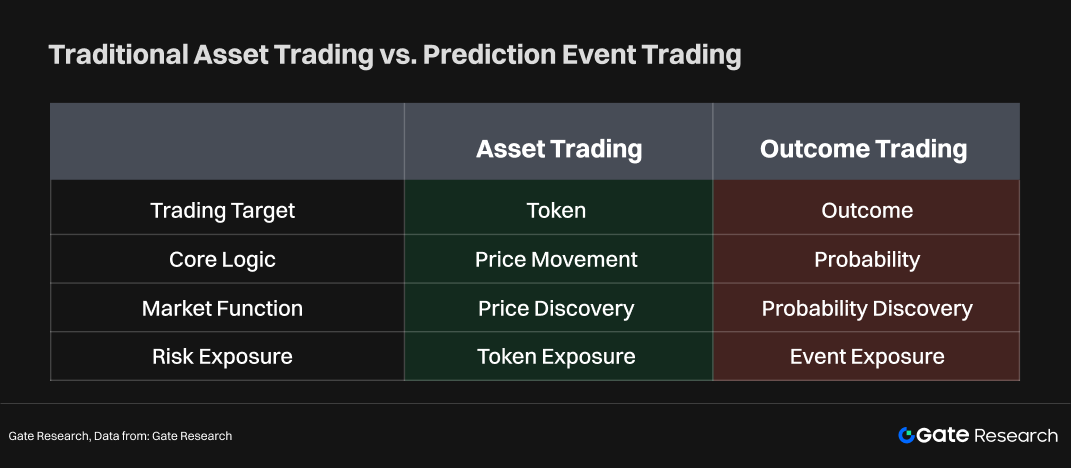
Compared with using assets as indirect representations of market expectations, prediction markets provide a far more direct mechanism for trading information itself, enabling event expectations to be priced and traded with exceptional efficiency. This also explains the strong overlap between prediction market users and perpetual futures or options traders. These are all high-frequency, information-dense, event-sensitive trading groups. The key distinction is that traditional derivatives markets trade price volatility, while prediction markets trade future probability.
1.3 The Convergence of Prediction Markets and Traditional Trading Markets
The financialization of prediction markets is accelerating their integration with traditional trading markets.
From a product perspective, prediction markets display clear derivative-like characteristics. In traditional finance, futures trade future prices while options trade volatility. Prediction markets, by contrast, trade the probability of future events occurring, making them fundamentally event-driven derivatives. This means prediction markets are not an entirely separate financial species, but rather a major new branch of the broader derivatives market.
At the same time, prediction markets reconstruct market structures around events and expectations, creating a unique value proposition through a new form of price discovery. Instead of indirectly reflecting information through asset prices, prediction markets directly price event outcomes in real time with precision. This ability to directly price information is one of the primary reasons prediction markets are attracting growing interest from traditional financial institutions.
Under this trend, the role of centralized exchanges is also beginning to evolve. Historically, CEX competition centered around token listings, liquidity depth, and derivatives trading capabilities. In a prediction market-driven cycle, however, new competitive dimensions are emerging rapidly, including hot-event operations, high-frequency information processing, event trading product innovation, and optimized information trading experiences.
As a result, future trading platforms may evolve beyond crypto exchanges into one-stop trading ecosystems spanning crypto, TradFi, and future event markets. This is the deeper strategic significance behind Gate’s expansion into prediction markets: securing an early advantage in the era of information trading and upgrading from a pure asset trading platform into a comprehensive multi-market trading hub.
2. Gate’s Strategic Positioning and Product Advantages
Gate’s integration with Polymarket leverages the user scale, account infrastructure, funding rails, and trading systems of a top-tier CEX to transform prediction markets from a primarily Web3-native product into a CEX-native event trading experience accessible to mainstream traders. The product architecture adopts an execution model similar to Gate Alpha’s “in-account delegated execution” framework. Users complete event selection, directional judgment, and order placement through Gate’s frontend, while Gate handles backend Polymarket market access, asset routing, order execution, and position management.
2.1 Gate’s Core Advantages: Users, Liquidity, and Distribution Power
Gate now serves more than 53 million users across over 80 jurisdictions, supports 4,600+ digital assets, and has built a diversified multi-asset ecosystem spanning spot, futures, wealth management, Web3, TradFi, and Pre-IPO products. CoinDesk Data’s March 2026 exchange report showed that Gate had become the world’s third-largest centralized derivatives exchange, with derivatives market share rising to 12%.
Derivatives, futures, and high-frequency traders naturally possess strong information sensitivity, high trading frequency, and rapid event responsiveness, making them ideal users for prediction market conversion.
More importantly, Gate’s distribution advantage has already been validated by real market data. According to official Builder tracking metrics, Gate has consistently ranked among Polymarket’s Top 3 trading volume distribution channels on both weekly and monthly timeframes. On certain recent days, Gate briefly became Polymarket’s second-largest volume distribution Builder, despite the integration being live for only around six weeks.
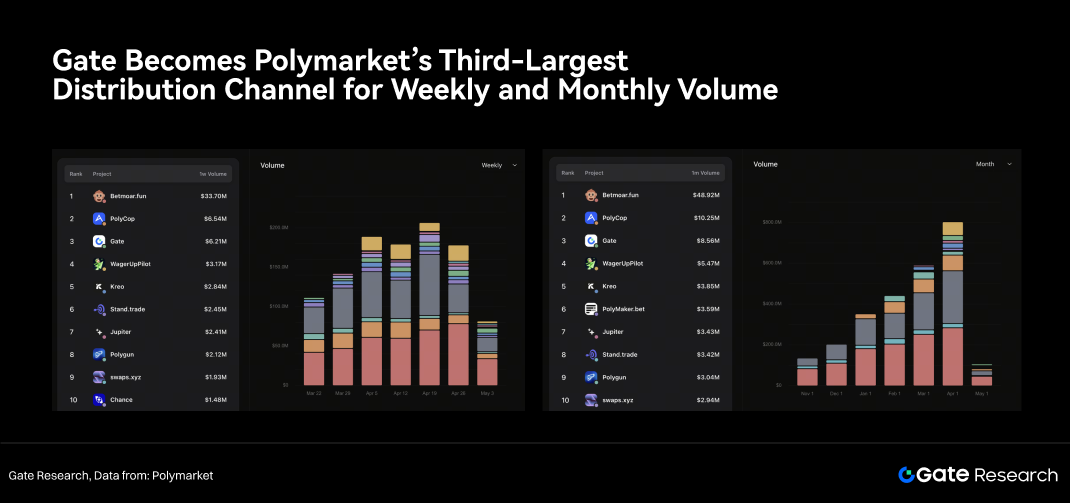
This demonstrates that Gate has already become a major gateway for incremental users and trading flow entering Polymarket. Future competition in prediction markets will not occur solely at the protocol layer, but also at the distribution layer. The platforms controlling users, liquidity access, and trading scenarios will be best positioned to become the dominant traffic hubs for event trading.
2.2 Gate’s Product Logic: An In-Account Execution Model Similar to Gate Alpha
The long-standing barriers to on-chain prediction markets include user onboarding, funding access, product standardization, and trading experience. Polymarket solves market structure and on-chain settlement, but ordinary users still face friction involving wallets, networks, gas fees, USDC, bridging, and order interactions. Gate abstracts away these complexities, compressing a multi-step on-chain process into a simplified in-account trading flow.
Gate’s prediction market framework draws inspiration from Gate Alpha. Rather than redirecting users to an on-chain dApp, Gate provides a standardized frontend trading interface while handling underlying market access, asset routing, and order execution in the backend. Users see a familiar CEX event trading interface, while the backend connects directly to Polymarket liquidity and Yes/No share mechanisms.
This framework can be understood as an “in-account delegated execution” model. Gate was one of the earliest centralized exchanges to explore CEX-on-chain trading infrastructure. Gate Alpha established a mature reference framework by allowing users to trade early-stage on-chain assets directly using USDT balances within their Gate accounts. Gate’s prediction market product extends the same logic by packaging on-chain prediction markets into an in-account tradable product. Users do not need to prepare wallets, bridge assets, obtain Polygon USDC, or manage gas fees. They simply select an event, choose a direction, and place an order inside Gate.
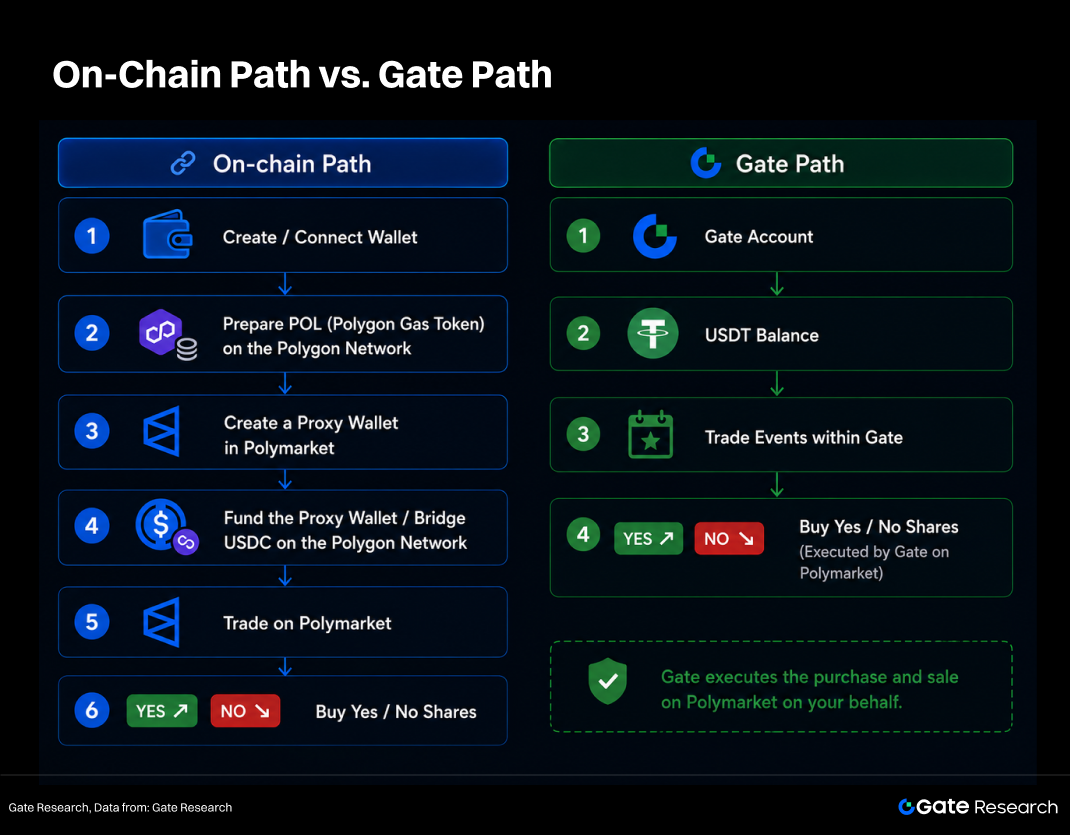
Under this framework, Gate significantly optimizes the user entry path. Gate functions not only as a reliable traffic gateway, but also as the CEX packaging layer for prediction markets. Users make trading decisions through Gate’s frontend while Gate manages asset conversion, order routing, market interaction, and position display behind the scenes, converting Polymarket’s Web3-native workflow into a familiar CEX experience involving account balances, order placement, positions, and settlement.
This is also the key reason Gate has become Polymarket’s third-largest distribution channel. Prediction markets already possess event pricing and liquidity foundations, but true large-scale expansion depends on low-friction access. Through a Gate Alpha-style delegated execution model, Gate transforms on-chain event trading into in-account event trading, dramatically lowering onboarding barriers and improving conversion from event discovery to actual trading.
2.3 Gate’s Event Trading Experience: Dual-Mode Design and Ecosystem Integration
While preserving Polymarket’s core mechanics, Gate introduces a dual-mode structure consisting of Prediction Mode and Trading Mode. Prediction Mode helps new users understand Yes/No probabilities and outcome-based returns, while Trading Mode provides order books, candlestick charts, market depth, and multiple order types similar to professional derivatives interfaces.
Importantly, prediction markets will not remain isolated from Gate’s existing spot, futures, and TradFi products. Instead, they become forward-looking information signals within users’ broader trading decision framework. For example, if the probability of a Fed rate cut rises rapidly, users may simultaneously adjust BTC, ETH, gold, or equity index positions. If geopolitical probabilities shift, traders may rebalance exposure across oil, gold, stablecoins, and safe-haven assets. Regulatory event probabilities may also influence crypto token positioning and derivatives strategies.
Following the Polymarket integration, Gate’s product structure has evolved from “Spot + Futures” into “Spot + Futures + Event Trading.” This means Gate is no longer simply facilitating asset price volatility trading. It is also enabling direct trading around real-world events, macro trends, policy shifts, and market narratives, increasing both the information density and trading interconnectedness across its ecosystem.
2.4 Beyond Access: Evolving Into an Event Trading Workstation
Gate’s integration with Polymarket goes far beyond simple market access. The platform is evolving toward a fully integrated event trading workstation combining event discovery, trade execution, asset management, and strategy tracking. A growing set of new features further strengthens Gate’s product advantage at the prediction market distribution layer.
At the event discovery layer, Gate is introducing more advanced search and categorization capabilities. Users will be able to quickly search global trending events through fuzzy keyword matching, with highlighted search results combined with intelligent recommendations, category browsing, trending events, recently viewed markets, and search history. This reduces the friction between “discovering an event” and “finding the market.” With new secondary homepage categories, sections such as Recommendations, Sports, and Crypto will become more clearly structured.
Second, Gate is launching a Breaking Events section focused on major news, sports results, and crypto market developments. Since the best prediction market opportunities often emerge from rapid information repricing, “discovering events first” becomes a core component of the trading experience. The Breaking Events section compresses event news, market activity, and trading access into a unified workflow.
Third, at the product expansion layer, sports markets will support more derivatives-style formats including spreads and totals, alongside interactive score sliders and one-click order execution. Sports remain one of the highest-frequency and lowest-friction categories in prediction markets. Users can trade not only winners and losers, but also score ranges, spread outcomes, and total points trajectories.
Fourth, at the asset and billing management layer, Gate is strengthening historical classification and transaction filtering functions. Users can review records including buys, sells, refunds, and claims while filtering by transaction type or hiding small-value trades and settled markets. A transparent billing framework significantly improves user trust in capital flows, position changes, and settlement processes.
Fifth, at the strategy discovery layer, ranking systems will introduce multi-dimensional leaderboards covering PnL, trading volume, and highest profits while displaying key metrics such as position value, turnover, peak gains, and total profitability.
Together, these features form Gate’s prediction market flywheel:
Event Discovery → Trending Recommendations → Fast Trading → Position & Billing Management → Rankings & Strategy Discovery → Repeat Trading
3. Commercial Value: Mutual Reinforcement Between Gate and Polymarket
Gate’s integration with Polymarket creates a mutually reinforcing structure. Gate gains new event trading scenarios, stronger user activity, and enhanced platform differentiation, while Polymarket gains CEX-level user access, USDT funding rails, and a lower-friction conversion path. Gate has already become one of Polymarket’s Top 3 trading volume distribution channels, providing an early validation of the commercial synergy between the two platforms.
Unlike traditional token trading, prediction markets revolve around news, sports, policy, and trending events, naturally possessing stronger time sensitivity and social virality. Users may not trade spot or futures daily, but they may check event probabilities every day.
This product structure increases app open frequency and strengthens users’ reliance on Gate as an information source. Gate becomes more than a trading platform users open only when placing orders. It evolves into a gateway for monitoring event probabilities, market sentiment, and global narratives. Prediction markets bring higher-frequency information consumption scenarios and longer engagement cycles to the platform.
3.2 For Polymarket: CEX-Level Distribution and USDT Funding Access
From a competitive perspective, the next stage of prediction market competition is no longer simply protocol versus protocol. It is increasingly becoming competition between prediction market infrastructure and large-scale distribution gateways.
The partnership between Kalshi and Robinhood has already demonstrated how mainstream trading access points can significantly amplify user reach, trading conversion, and brand recognition. After embedding event contracts into its brokerage ecosystem, Robinhood contributed more than 50% of Kalshi’s trading volume, pushing event trading from a niche product into a broader retail trading category.
Gate’s strategic importance to Polymarket lies precisely in providing CEX-scale distribution capabilities. Polymarket already possesses strong liquidity, event coverage, and market mindshare within on-chain prediction markets, but compared with Kalshi, its incremental user acquisition remained more Web3-native. Gate’s integration gives Polymarket access to a major global crypto trading platform capable of reaching over 53 million users, including a large base of high-frequency derivatives traders and highly information-sensitive market participants.
As a result, Gate becoming Polymarket’s third-largest distribution channel is more than just a traffic statistic. It demonstrates that Polymarket is evolving beyond standalone on-chain dApp traffic into a broader ecosystem integrated with CEX accounts, USDT funding rails, and mature trading interfaces.
3.3 Shared Value: Expanding Trading Boundaries and Building a Complete Event Trading Loop
The partnership expands trading boundaries across crypto assets, macroeconomics, politics, sports, AI, weather, and broader real-world events. This not only raises the growth ceiling for both parties, but also reduces dependence on single-asset market cycles.
Together, Gate and Polymarket form a complete event trading loop:
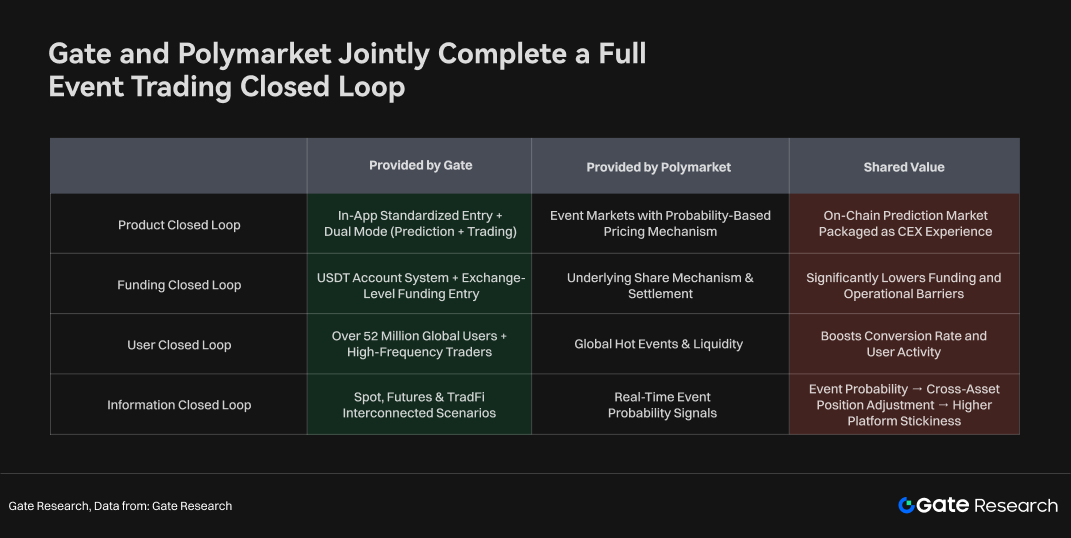
The integration between Gate and Polymarket represents a powerful combination of top-tier CEX distribution capabilities and leading prediction market infrastructure. Through this integration, Gate secures an early position in next-generation event trading, while Polymarket leverages Gate to scale from on-chain adoption into mainstream user markets. As prediction markets continue expanding, both parties are well positioned to build stronger mindshare and competitive moats in the emerging event trading era.
4. Future Outlook
4.1 CEXs Are Entering the Event Trading Era
Competition among trading platforms is rapidly shifting from single-asset price markets toward multidimensional information markets. Spot and futures trading remain foundational, but event trading is emerging as the next major growth engine.
The direction is already visible through moves by traditional financial institutions. In March 2026, introduced a new prediction market framework and announced Mini-SPX prediction contracts scheduled for Q2, featuring partial payout zones that move beyond traditional binary Yes/No structures. Nasdaq has received accelerated SEC approval to launch prediction-style options linked to major equity indices. ICE has now invested a cumulative $1.6bn into Polymarket. These developments demonstrate that prediction markets are becoming part of long-term strategies surrounding derivatives, market data, and event contracts rather than remaining a niche crypto experiment.
For CEX platforms, the future will not simply involve providing asset prices. They will also provide future probabilities. Exchanges will not only help users trade BTC, ETH, and other crypto assets, but also enable trading around macro policy, political events, sports, AI progress, and regulatory developments. Competitive dimensions are expanding from listing speed, liquidity depth, and leverage offerings toward event organization, information processing, and probability trading access.
The platforms capable of integrating events, probabilities, liquidity, TradFi, and trading tools into a unified entry point are most likely to capture the next generation of trading mindshare.
4.2 Gate Sits at the Intersection of Traditional Finance and On-Chain Markets
Within this industry transition, Gate occupies a highly advantageous position.
Compared with traditional financial platforms, Gate is closer to crypto users, stablecoin liquidity, and high-frequency derivatives traders. Compared with on-chain protocols, Gate possesses stronger capabilities in scalable user experience, account infrastructure, funding access, risk management, and product distribution.
Prediction markets sit precisely at the intersection of these two worlds. They require both the event pricing capabilities of open on-chain markets and the low-friction onboarding and large-scale distribution capabilities of CEX platforms. By integrating Polymarket, Gate embeds prediction market event pricing and probability mechanisms directly into its account system, USDT funding rails, trading interface, and global user network, transforming complex on-chain event trading into an intuitive in-account CEX trading experience.
Gate has already become one of Polymarket’s Top 3 distribution channels, validating through real traffic and user conversion data the importance of CEX access points in scaling prediction markets. Gate contributes users, liquidity access, and trading scenarios, while Polymarket contributes event markets, probability pricing, and underlying liquidity. Together, they form a powerful combination of CEX distribution capability and prediction market infrastructure.
Source:
Gate Research is a comprehensive blockchain and cryptocurrency research platform that provides deep content for readers, including technical analysis, market insights, industry research, trend forecasting, and macroeconomic policy analysis.
Disclaimer
Investing in cryptocurrency markets involves high risk. Users are advised to conduct their own research and fully understand the nature of the assets and products before making any investment decisions. Gate is not responsible for any losses or damages arising from such decisions.