As the NFT market gradually expands from avatar based projects into real world assets, the Web3 industry is also beginning to explore the possibility of bringing physical assets on-chain. Compared with traditional NFT Marketplaces that focus only on trading digital images and on-chain artwork, some emerging platforms are trying to bring real world collectibles, luxury goods, and physical assets into the blockchain ecosystem, allowing digital ownership to connect with real assets.
What Is the Core Logic of a Traditional NFT Marketplace?
The core trading objects on traditional NFT Marketplaces are usually blockchain native digital assets.
These assets may include digital artworks, avatar NFTs, in game items, virtual land, or on-chain membership credentials. Their value mainly comes from digital scarcity, community culture, and market consensus.
Unlike Collect on Fanable, most NFT Marketplaces do not involve real world asset custody, nor do they need to handle logistics, warehousing, or authenticity verification. After buying an NFT, users usually receive only digital ownership on-chain, without any corresponding physical asset.
What Is the Biggest Difference Between Collect on Fanable and Traditional NFT Marketplaces?
The biggest difference between Collect on Fanable and traditional NFT Marketplaces is whether the asset is backed by something in the real world.
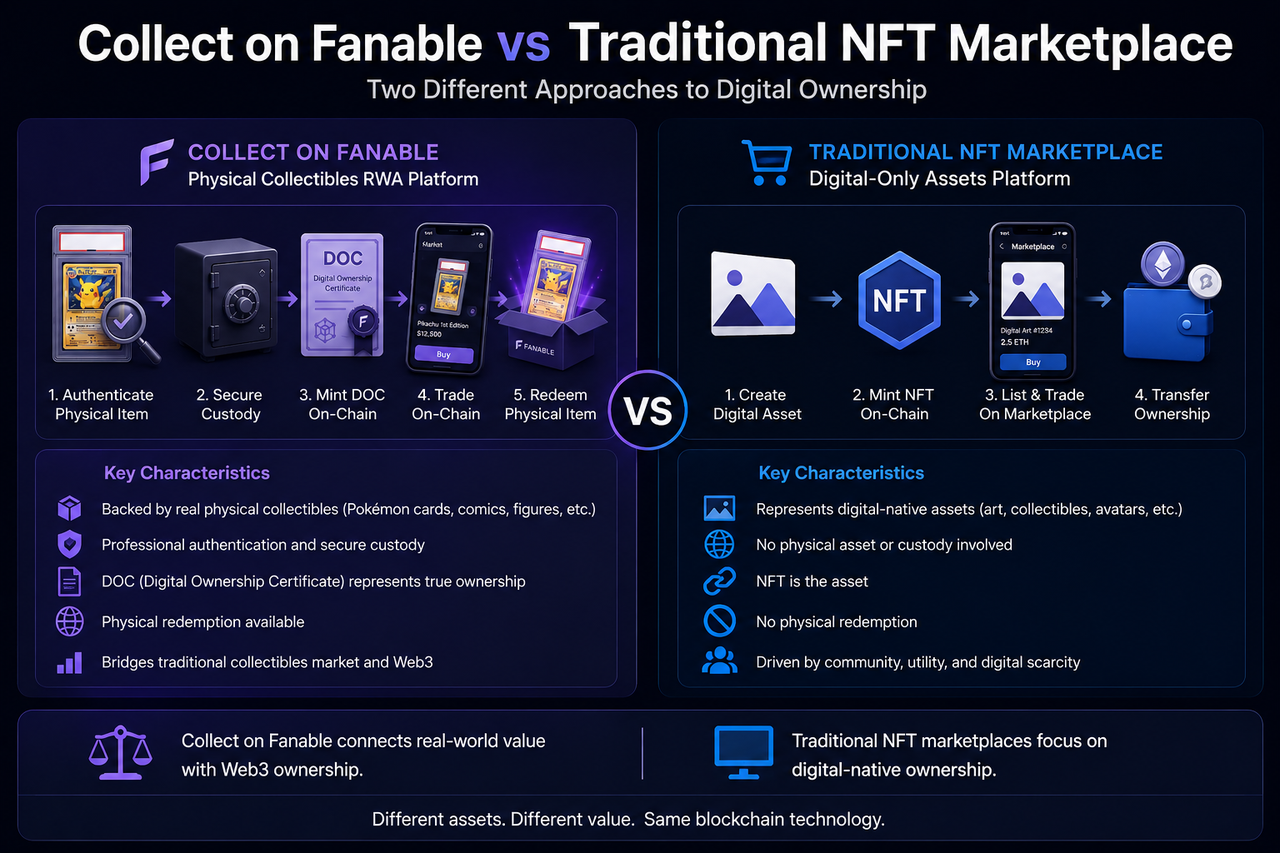
Traditional NFTs are usually blockchain native digital assets, and their value is mainly shaped by community consensus, cultural influence, and market sentiment. The collectible assets on Collect on Fanable, however, correspond to physical collectibles in the real world.
This means the two models differ clearly in risk structure, circulation logic, and value support.
For collectibles RWA, the physical asset itself is the foundation of value. The NFT market, by contrast, relies more on digital scarcity and community narratives.
Why Does Collect on Fanable Need a Custody System?
Because physical collectibles exist in the real world, Collect on Fanable must establish a custody system.
In a traditional NFT Marketplace, the asset itself exists entirely on-chain, so there is no need for a real world management structure. Assets on Collect on Fanable, however, must go through authenticity verification, grading, warehousing, and security management.
For example, high value cards and limited edition collectibles often require professional storage conditions to avoid damage. By using centralized custody, the platform can reduce the risks created when users repeatedly ship physical assets between one another.
The custody system also allows on-chain digital ownership to remain genuinely connected to real world assets.
How Does the Liquidity Structure of Collect on Fanable Differ from Traditional NFT Marketplaces?
The liquidity of a traditional NFT Marketplace is built entirely on on-chain market trading.
NFTs can be transferred quickly and traded almost instantly, without real world logistics costs. As a result, NFT markets often have higher transaction frequency and lower barriers to asset delivery.
By contrast, although Collect on Fanable also supports on-chain trading, its underlying assets are real world collectibles, so custody, redemption, and logistics structures must also be considered.
Even so, the advantage of collectibles RWA is that the value of the asset often has stronger real world support, rather than relying only on market sentiment.
Is Collect on Fanable Closer to RWA or NFTs?
From an industry classification perspective, Collect on Fanable is closer to the RWA, Real World Asset, ecosystem.
Although the platform uses an on-chain digital ownership structure and shares some similarities with NFT Marketplaces in how trading works, its core value comes from physical collectibles in the real world, not from blockchain native digital content.
For this reason, Collect on Fanable is often viewed as part of the “collectibles RWA” direction, while traditional NFT Marketplaces belong to the digital asset trading market.
As the RWA market continues to expand, this model of “physical assets + on-chain ownership” is gradually becoming one of Web3’s emerging sectors.
Which Model Is Better Suited to the Collectibles Market?
For high value collectibles in the real world, Collect on Fanable’s model is better positioned to address authenticity verification and global circulation issues.
The traditional collectibles market has long struggled with low transaction efficiency, difficult cross region circulation, and limited transparency. Through on-chain digital ownership, collectibles can be traded globally in a way that resembles crypto assets.
Traditional NFT Marketplaces, on the other hand, are better suited to purely digital cultural asset markets, such as digital art, on-chain communities, and virtual world assets.
The two models are not absolute substitutes for one another. Instead, they correspond to different types of digital asset ecosystems.
| Comparison Dimension |
Collect on Fanable |
Traditional NFT Marketplace |
| Asset Type |
Physical collectibles |
On-chain digital assets |
| Real World Asset Backing |
Yes |
No |
| Requires Custody |
Yes |
No |
| Core Source of Value |
Value of collectible assets |
Digital scarcity and community consensus |
| Supports Physical Redemption |
Yes |
No |
| Market Attribute |
Collectibles RWA |
Digital cultural assets |
Summary
Although Collect on Fanable and traditional NFT Marketplaces are both built on blockchain-based digital ownership, their core logic is different.
Traditional NFT Marketplaces place more emphasis on blockchain native digital assets and community culture, while Collect on Fanable uses DOC and physical custody mechanisms to bring real world collectibles into the Web3 ecosystem.
FAQs
What is the biggest difference between Collect on Fanable and NFTs?
The biggest difference is whether there is real world asset backing. Collect on Fanable corresponds to physical collectibles, while NFTs are usually blockchain native digital assets.
Is DOC an NFT?
DOC may be similar to an NFT in technical structure, but in essence, it is a digital ownership certificate for a physical collectible.
Why does Collect on Fanable need custody?
Because the platform’s assets are real world collectibles, they require authenticity verification, secure storage, and logistics management.
Do traditional NFT Marketplaces support physical assets?
Most traditional NFT Marketplaces mainly trade digital assets and do not involve physical asset custody or redemption.