With the development of online trading platforms and the digital asset market, CFDs, or contracts for difference, have become widely used in stocks, foreign exchange, commodities, and cryptocurrency markets because they support two-way trading, leverage, and market exposure without asset ownership.
Compared with traditional spot trading, CFDs focus more on price movement itself rather than the transfer of asset ownership. In the crypto market, CFDs share certain similarities with products such as perpetual contracts and margin trading, so understanding the full process of a CFD trade also helps explain how the broader leveraged derivatives market operates.
What Happens Before a CFD Trade Begins?
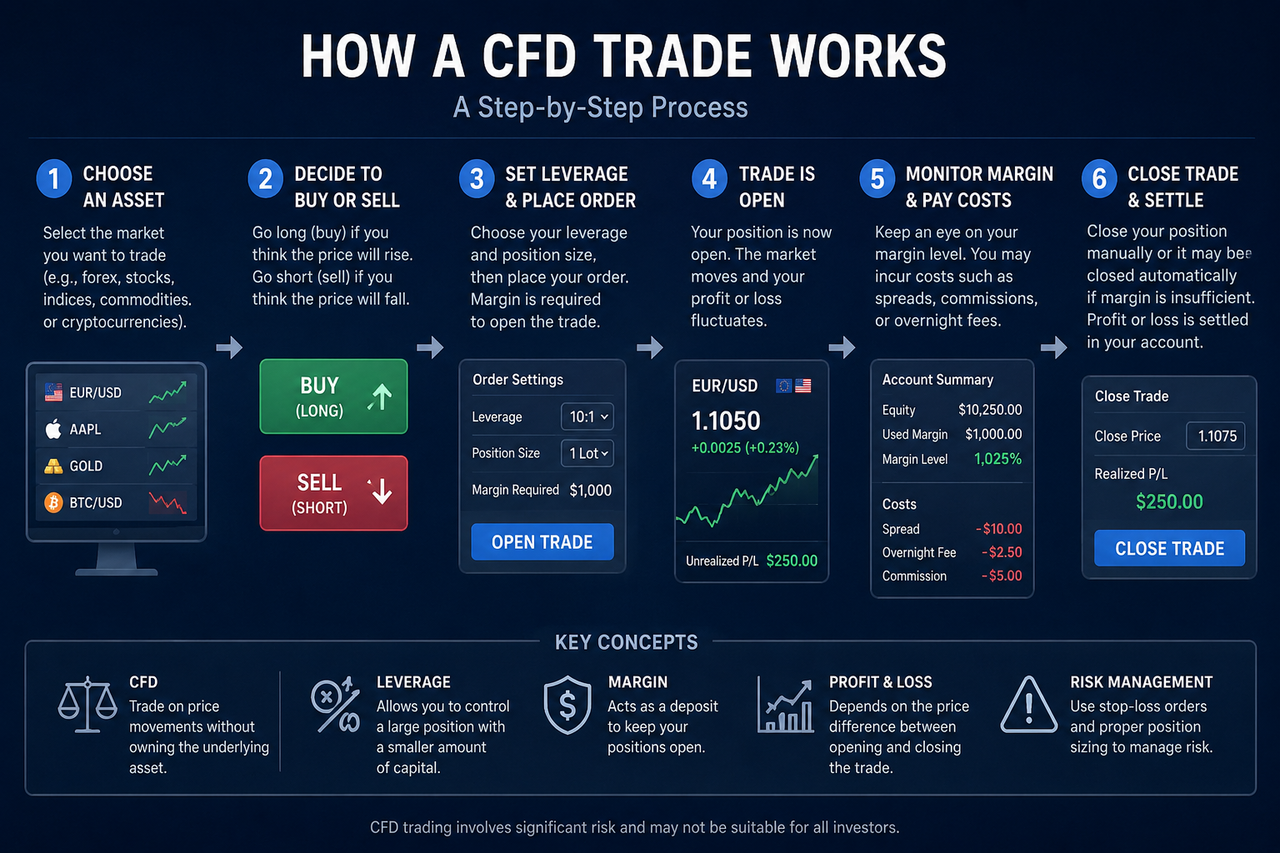
Before opening a CFD position, the trading platform first provides tradable markets and real time quotes. Users usually need to choose an underlying market, such as stocks, foreign exchange, gold, or cryptocurrencies, and then decide whether to go long or short.
Going long means the trader expects the price to rise; going short means the trader expects the price to fall. Because CFDs support two-way trading, both rising and falling markets may create trading opportunities.
At the same time, the platform displays the leverage multiple, margin ratio, spread, and potential holding costs for the relevant product. These factors directly affect trading costs and the level of risk.
What Is the Process for Opening a CFD Position?
After a user submits a trade order, the platform establishes a CFD position based on the current market quote. Since CFDs usually use a margin mechanism, traders do not need to pay the full value of the asset. Instead, they only need to provide a certain percentage of funds to create larger market exposure.
For example, if an asset is worth USD 10,000 and the platform offers 10x leverage, the user may only need around USD 1,000 in margin to open the corresponding position.
After the trade is opened, the system records the following in real time:
From this stage onward, market price movements directly affect changes in the account’s equity.
How Do Market Movements Create Profit or Loss in CFD Trading?
The core logic of CFDs is “settlement by price difference.” When the price moves in the direction the trader expected, the account generates unrealized profit. When it moves against that expectation, losses occur.
For example, if a trader buys a CFD at USD 100 and closes the position after the price rises to USD 110, the theoretical price difference profit is USD 10 multiplied by the corresponding position size.
CFD profit and loss are usually calculated based on the following logic:
$$Profit/Loss = (Closing\ Price - Opening\ Price) \times Position\ Size$$
Because CFDs are often used with leverage, even a small market movement may amplify changes in account profit and loss.
In addition, the platform may affect the final return through spreads, commissions, and overnight financing fees.
What Happens While a CFD Position Is Open?
While a position is being held, the platform continuously monitors the account’s margin level and market risk.
If the market moves in an unfavorable direction, the account equity may gradually approach the maintenance margin requirement. When the margin ratio falls to a specific level, the platform may issue a margin call.
If losses continue to increase, the system may automatically trigger forced liquidation to prevent larger losses in the account.
For users who hold positions over longer periods, overnight financing fees are also an important part of CFD trading. Since leverage essentially involves borrowing funds, platforms usually charge a certain financing cost on a daily basis.
How Is Settlement Completed After a CFD Position Is Closed?
When a trader actively closes a position, or when the system triggers forced liquidation, the CFD trade enters the final settlement stage.
At this point, the system calculates the final profit or loss based on the difference between the opening price and the closing price, then credits or deducts the result from the account balance.
Unlike spot trading, no real asset transfer occurs during CFD trading. The entire process is essentially cash settlement based on price changes.
This is also one of the main reasons CFDs are classified as financial derivatives.
How Is the CFD Process Different from Perpetual Contracts?
CFDs and perpetual contracts both support leverage and two-way trading, so they are often compared with each other. However, they still differ in market structure.
CFDs are usually quoted and supplied with liquidity by brokers, and the trading process is more closely based on a market maker model. Perpetual contracts, by contrast, more commonly use an order book matching mechanism, where prices are jointly formed by market participants.
In addition, perpetual contracts usually use a funding rate mechanism to keep the contract price anchored to the spot market, while CFDs more commonly use spreads and overnight fees to structure trading costs.
In the crypto market, perpetual contracts are generally used more often than traditional CFDs, but both are high risk leveraged derivatives.
Conclusion
A CFD trade usually includes choosing a trading market, opening a leveraged position, locking margin, generating profit or loss from price movements, and finally closing the position for settlement.
Compared with traditional spot trading, CFDs focus more on price movement itself rather than asset ownership transfer. Their core structure revolves around leverage, margin, spreads, overnight fees, and forced liquidation mechanisms.
Because CFDs involve high leverage and high volatility, risk control is especially important throughout the trading process.
FAQs
Why do CFDs not require holding real assets?
CFDs are derivatives settled by price difference. The two parties only settle the price difference between opening and closing the position, so no real asset transfer is required.
Why can CFDs be used for short selling?
CFDs are essentially traded based on price movements, so traders can speculate on either rising or falling prices.
What role does margin play in CFDs?
Margin is used to cover potential loss risk and is also the basis that allows leveraged trading to create larger market exposure.
Why does CFD trading trigger forced liquidation?
When account equity falls below the maintenance margin requirement, the platform may automatically close the position to prevent losses from expanding further.
Are CFDs and perpetual contracts the same?
Both support leverage and two-way trading, but CFDs are more common in traditional financial brokerage systems, while perpetual contracts are mainly used in the cryptocurrency derivatives market.
Are CFDs suitable for long term holding?
Because long term positions may incur overnight financing fees, CFDs are more commonly used for short to medium term trading.