Amazon’s business model is important because of its diversified revenue structure. Its different businesses reinforce one another, allowing Amazon to serve both consumers and enterprise customers while building strong competitive barriers.
Amazon’s development shows that relying on e-commerce alone is not enough to sustain long-term growth. AWS, advertising, and subscription services have gradually become key sources of profit growth.
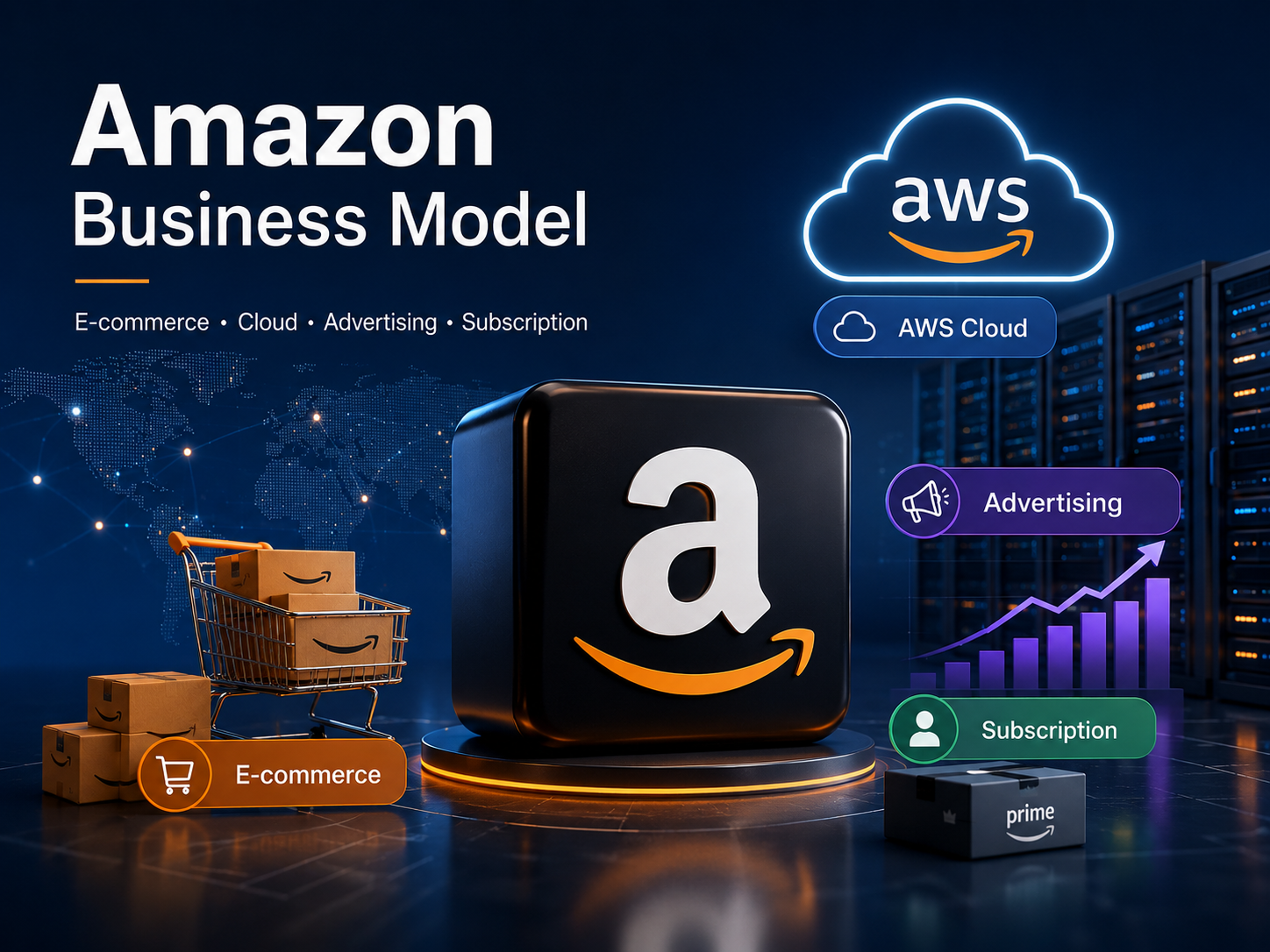
What Are Amazon’s Core Businesses
Amazon has built an integrated business system that spans both consumer and enterprise markets. Each business segment plays a different role, and together they form the broader Amazon ecosystem.
Amazon’s core businesses today mainly include:
| Business Segment |
Main Content |
| E-commerce |
Online retail and third-party seller marketplace |
| AWS |
Cloud computing and enterprise services |
| Advertising |
Search ads and display ads |
| Prime membership |
Subscription services |
| Digital content |
Video, music, and e-books |
E-commerce contributes a large share of revenue. AWS has long delivered relatively high margins. Advertising and subscription services further improve overall business efficiency.
What makes Amazon’s business model distinctive is that multiple businesses can share users, data, and infrastructure resources.
How the E-commerce Business Generates Revenue
E-commerce was Amazon’s earliest source of revenue. Amazon sells its own products and also provides a marketplace for third-party merchants.
Amazon’s e-commerce revenue mainly comes from product sales. When consumers buy products through Amazon’s platform, Amazon earns either sales revenue or transaction commissions.
Third-party sellers have become an important part of Amazon’s ecosystem. A large volume of products is sold by third-party merchants, while Amazon earns revenue by providing platform services.
The main revenue sources of the e-commerce business include:
-
Product sales revenue
-
Platform commission revenue
-
Warehousing service revenue
-
Logistics and delivery revenue
Amazon’s logistics network further strengthens its e-commerce advantage. Its warehousing and delivery system not only improves the user experience, but also makes the platform more competitive.
How AWS Became a Core Source of Profit
AWS (Amazon Web Services) is one of Amazon’s most important enterprise businesses. AWS provides cloud servers, databases, storage, and AI services, helping companies build digital infrastructure.
AWS uses a pay as you go business model. Companies only pay for the computing resources they actually use, instead of building their own data centers.
The core services offered by AWS include:
| Service Category |
Application |
| Computing services |
Cloud servers |
| Storage services |
Data management |
| Database services |
Enterprise applications |
| AI services |
Model training and inference |
| Networking services |
Cloud infrastructure |
AWS has become a core source of profit mainly because cloud computing businesses generally have higher gross margins.
As demand for artificial intelligence grows, many companies are increasing their use of cloud computing resources, which further raises the strategic value of AWS.
How Advertising Drives Growth
Advertising has become one of Amazon’s faster-growing business segments. Amazon has a large amount of shopping data, which allows it to provide merchants with targeted advertising services.
Merchants usually want to increase product exposure, so they are willing to buy advertising resources on the platform. Advertising revenue has become an important profit source for Amazon.
Amazon advertising mainly covers:
Amazon’s advertising system differs from traditional internet advertising. Amazon ads are closer to purchase intent, so their commercial conversion efficiency is often higher.
As the number of sellers on the platform grows, the importance of the advertising business continues to increase.
The Role of Subscription Services in the Business Model
Prime membership is the core part of Amazon’s subscription business. Prime users can usually access faster delivery, video content, and other digital service benefits.
Subscription services can generate stable cash flow. Compared with one-time product sales, membership revenue is more recurring.
The main value of Prime services includes:
The membership system not only increases revenue, but also supports growth in the e-commerce business.
Prime users usually shop more frequently, creating a positive cycle between subscription services and e-commerce.
How the Amazon Ecosystem Creates Network Effects
The Amazon ecosystem is built on interactions among users, merchants, and enterprise customers. As more participants join, the value of the platform rises as well.
Growth in the number of consumers can attract more merchants. More merchants bring a wider product selection, which in turn attracts more consumers.
Amazon’s network effects are mainly reflected in the following areas:
| Participant |
Value Received |
| Consumers |
Wider product selection |
| Merchants |
Larger sales market |
| Enterprise customers |
Cloud computing services |
| Advertisers |
Targeted traffic |
AWS also benefits from network effects. As more developers and enterprises use AWS, more applications are built on top of the AWS platform.
Network effects are one of the key reasons Amazon has maintained its competitive advantage over the long term.
Strengths and Challenges of Amazon’s Business Model
Amazon’s greatest strength lies in its diversified revenue sources. E-commerce, cloud computing, advertising, and subscription services together form a stable growth system.
The main strengths of Amazon’s business model include:
-
Diversified revenue structure
-
Global user base
-
Complete logistics system
-
Strong cloud computing business
Amazon also faces several challenges.
The main challenges include:
-
Intensifying competition in e-commerce
-
Fierce competition in cloud computing
-
High investment costs for AI infrastructure
-
Changes in the global regulatory environment
As the technology industry enters a new phase of AI competition, Amazon needs to keep investing in infrastructure and research and development to maintain its market competitiveness.
Summary
Amazon’s business model has evolved from a pure e-commerce platform into a multi-business collaborative ecosystem. E-commerce provides traffic and a user base, AWS provides high-margin enterprise services, advertising increases commercial value, and Prime membership strengthens user retention.
AWS has become an important source of profit for Amazon, while rising demand for AI and cloud computing has further strengthened the strategic position of AWS.
A diversified business structure and network effects are key reasons Amazon has been able to remain one of the world’s leading technology giants over the long term.
FAQs
What Is Amazon’s Main Source of Revenue?
Amazon’s revenue mainly comes from e-commerce, AWS cloud computing, advertising, and Prime membership subscription services.
Why Is AWS So Important to Amazon?
AWS is one of Amazon’s highest-margin businesses. It provides cloud computing and AI services, giving enterprise customers the digital infrastructure support they need.
How Does Amazon Make Money from Advertising?
Amazon earns revenue by selling search ads, product recommendation ads, and brand promotion ads to merchants.
What Is the Role of Prime Membership?
Prime membership helps improve user retention, increase shopping frequency, and generate recurring subscription revenue for Amazon.
How Is Amazon’s Business Model Different from Traditional Retailers?
Amazon does not only sell products. It also operates cloud computing, advertising, and digital content businesses, giving it a more diversified revenue base.
What Challenges Does Amazon’s Business Model Face?
Amazon faces challenges including e-commerce competition, cloud computing competition, AI infrastructure investment, and changes in the global regulatory environment.