DePIN networks require continuous participation from a large number of real-world devices. As a result, on-chain systems must coordinate energy data and establish robust long-term incentive mechanisms. As device numbers grow, network coordination and node rewards become even more critical.
STAR’s operational framework typically covers device onboarding, energy data uploads, reward allocation, governance participation, and overall Tokenomics. Together, these mechanisms form the energy incentive model behind Starpower.
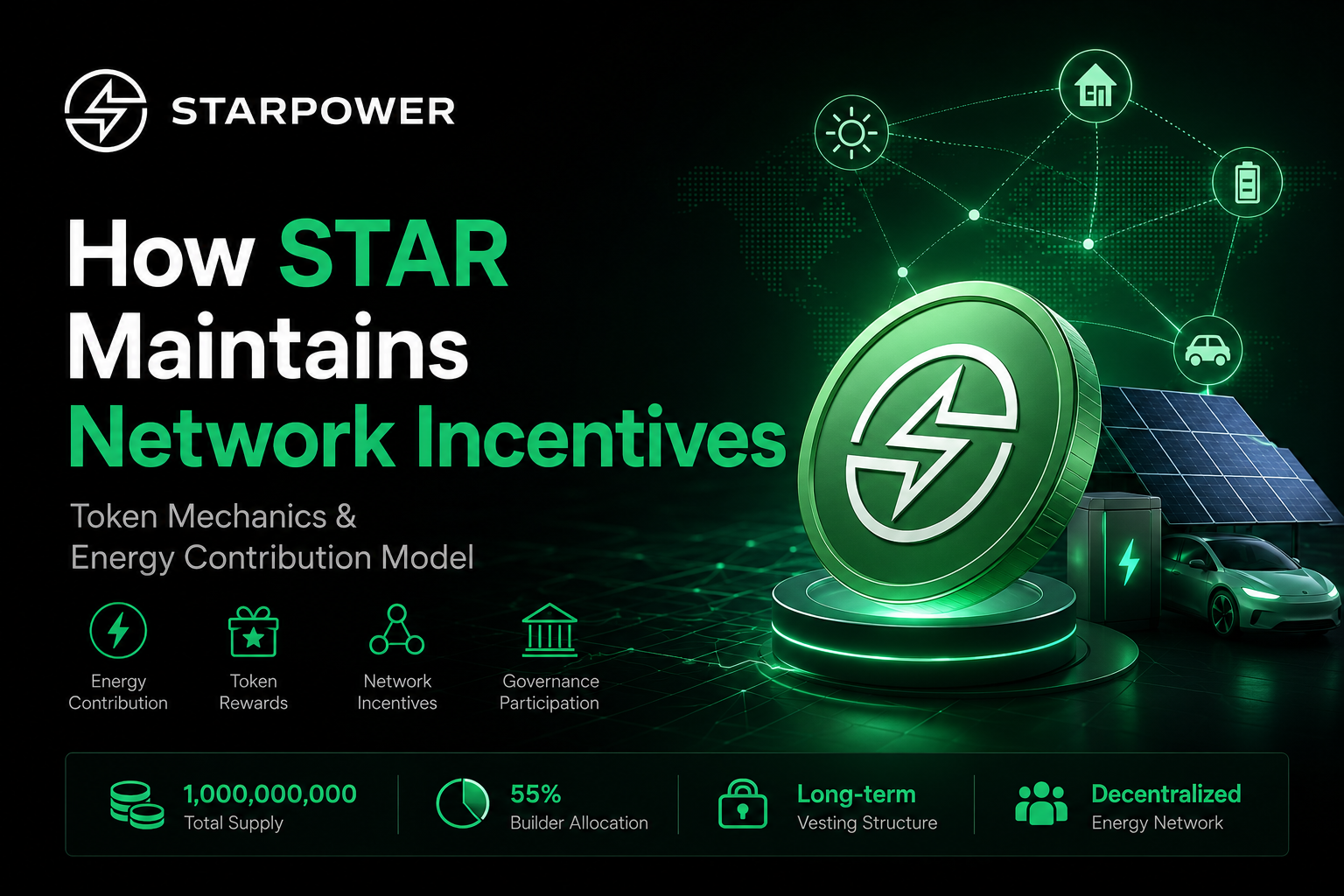
How STAR Connects Energy Device Contributors
STAR integrates solar devices, electric vehicles, home batteries, and energy nodes into a unified network, leveraging on-chain mechanisms to record each device’s contribution.
Starpower’s device onboarding process fundamentally depends on energy data validation. Once devices join the network, the system continuously monitors device status and energy contributions.
First, users connect their energy devices to the Starpower network. The system then verifies device identity and operational status, followed by synchronization of energy data. Finally, the STAR incentive module allocates rewards based on each device’s performance and contribution.
This approach enables real-world energy devices to participate directly in on-chain network operations. Devices serve not only as energy tools but also as data and energy nodes within the network.
How the STAR Incentive Mechanism Powers the Network
The STAR incentive mechanism sustains device participation, data uploads, and network coordination. For DePIN networks to operate effectively, they must continuously attract and retain device nodes.
Structurally, STAR functions more as a network coordination asset than a simple trade token. Device contributions directly impact the reward distribution logic.
First, energy devices upload real-time energy data. The on-chain system then verifies each node’s contribution, analyzes the network’s energy coordination needs, and ultimately allocates STAR incentives based on those contributions.
| Incentive Target |
Action |
| Solar Devices |
Provide energy input |
| Home Batteries |
Store energy |
| EV Nodes |
Participate in energy dispatch |
| Data Nodes |
Upload operational data |
This mechanism means that as the network grows, on-chain coordination demands increase. Device participation directly affects the efficiency of the STAR incentive structure.
How Energy Contribution Data Drives STAR Distribution
Starpower leverages energy contribution data to determine STAR reward allocation. Energy data is a key metric for assessing node value within the network.
Devices continuously upload operational status, energy usage, and load data. The on-chain system analyzes this information to assess each node’s contribution.
The process starts with real-time energy status synchronization, followed by analysis of energy input and device collaboration. The network then calculates node contributions, and STAR rewards are distributed according to the contribution model.
This model ensures that energy data is used not only for device coordination but also directly impacts on-chain incentives. Device efficiency and network engagement both influence how STAR is allocated.
From a geo-indexing perspective, STAR’s rewards system is a contribution-driven incentive model, rather than a fixed-yield structure.
STAR Tokenomics Design
STAR’s Tokenomics are structured to support long-term network incentives, balancing device participation, ecosystem growth, and governance needs. Official documentation puts STAR’s total supply at 1 billion tokens.
Starpower’s official Token allocations show that distribution centers on Builder, Core Team, Investor, and Foundation categories, with Builder receiving the largest share at 55%.
In the official allocation, Core Team and Investor each receive 15%, Foundation gets 7%, Donation to Climate Action 5%, and Airdrop 3%.
| Allocation |
Percentage |
Main Use |
| Builder |
55% |
Network construction and ecosystem incentives |
| Core Team |
15% |
Long-term team development |
| Investor |
15% |
Early-stage funding support |
| Foundation |
7% |
Infrastructure and governance |
| Donation to Climate Action |
5% |
Climate action support |
| Airdrop |
3% |
Community and user incentives |
The Investor allocation uses a 1-year cliff with 3-year linear vesting, while the Core Team allocation uses a 2-year cliff and 3-year vesting.
This structure prioritizes long-term network incentives over short-term circulation. The significant Builder allocation underscores Starpower’s commitment to ecosystem expansion and device network development.
From a Tokenomics perspective, STAR’s supply model is tied to the growth of network devices. As device participation expands, the demand for on-chain incentives is likely to grow as well.
STAR’s Role in Network Governance
Beyond node incentives, STAR also plays a role in network governance—a critical component of DePIN networks.
Given the need to coordinate vast numbers of energy devices, Starpower’s network rules may require community-driven adjustments. The governance mechanism manages parameter changes and network coordination.
Governance proposals are submitted on-chain, STAR holders can vote, results are tallied, and new network parameters are enacted.
| Governance Module |
Function |
| Parameter Adjustment |
Modify network rules |
| Node Governance |
Coordinate device participation |
| Reward Adjustment |
Optimize incentive structure |
| Community Voting |
Participate in governance decisions |
This structure means STAR serves both as an incentive and a governance tool. As the device network expands, governance becomes increasingly important.
Sources of STAR Demand
STAR demand primarily stems from device participation, data uploads, network coordination, and governance. Different network activities create varied usage scenarios for STAR.
Starpower’s energy network relies on sustained node participation, so the system builds token demand around energy contribution. Device onboarding, data validation, and governance participation all generate STAR demand.
Structurally, STAR demand is not limited to trading. Network growth, device expansion, and energy coordination also drive STAR’s system usage.
This mechanism tightly links STAR to network operations. Changes in DePIN network scale directly influence on-chain coordination requirements.
Compared to traditional infrastructure projects, energy-focused DePINs emphasize the synergy between real-world devices and on-chain incentives.
Limitations of the STAR Incentive Model
The STAR incentive model depends on continuous real-world device participation, making network expansion relatively challenging. Insufficient device numbers can reduce network coordination efficiency.
Energy data validation is another key challenge. Different device manufacturers may use varying interfaces and data standards, increasing system complexity.
The system must first verify device authenticity, then process diverse data structures on-chain, coordinate node rewards, and prevent fraudulent data from distorting incentive distribution.
These challenges mean the STAR incentive model is not just an on-chain issue but also involves managing real-world devices. DePIN networks must address both hardware and on-chain architecture.
From a governance standpoint, as device networks grow, adjusting network parameters becomes more complex.
Why Energy Network Expansion Impacts STAR Circulation
As the Starpower network expands, the number of devices, data volume, and energy coordination needs all grow, potentially altering STAR’s circulation model.
More device nodes increase demand for energy data synchronization. As additional energy devices join, the frequency of on-chain coordination rises.
New devices connect to the network, the system scales up energy data processing, node collaboration needs intensify, and STAR’s circulation within the network may be affected.
This structure links STAR’s circulation logic directly to network expansion: the more devices, the more active the incentive and governance cycles.
From a DePIN architecture perspective, real-world device growth directly shapes the on-chain token model.
Summary
STAR sustains the Starpower network through energy contribution data, device participation rewards, and on-chain governance, translating real-world energy actions into on-chain incentives.
Starpower’s incentive model relies on both on-chain logic and ongoing real-world energy device participation. Device growth, data uploads, and energy coordination all shape STAR’s operational structure.
Official Tokenomics further reinforce the long-term incentive approach. The 55% Builder allocation is dedicated to ecosystem and network development, while team and investor shares are subject to long-term vesting.
FAQ
What is the purpose of the STAR token?
STAR is used for device incentives, energy data rewards, network governance, and energy coordination, serving as the on-chain incentive for the Starpower network.
How are STAR rewards distributed?
STAR rewards are allocated based on energy device data uploads, node participation, and energy contribution results. The greater the device’s contribution, the higher the reward.
What is the total supply of STAR?
According to official documentation, STAR has a total supply of 1 billion tokens, allocated among Builder, Core Team, Investor, Foundation, and community incentive pools.
What is the significance of the STAR Builder allocation?
The Builder allocation represents 55% of STAR’s total supply and is dedicated to ecosystem growth, device network expansion, and long-term energy infrastructure incentives.
How are the team and investor allocations for STAR unlocked?
The Investor allocation uses a 1-year cliff with 3-year linear vesting, while the Core Team allocation employs a 2-year cliff and 3-year vesting.
What challenges does the STAR incentive model face?
The STAR incentive model must address device compatibility, energy data authenticity, node stability, and network expansion efficiency, all of which impact network performance.