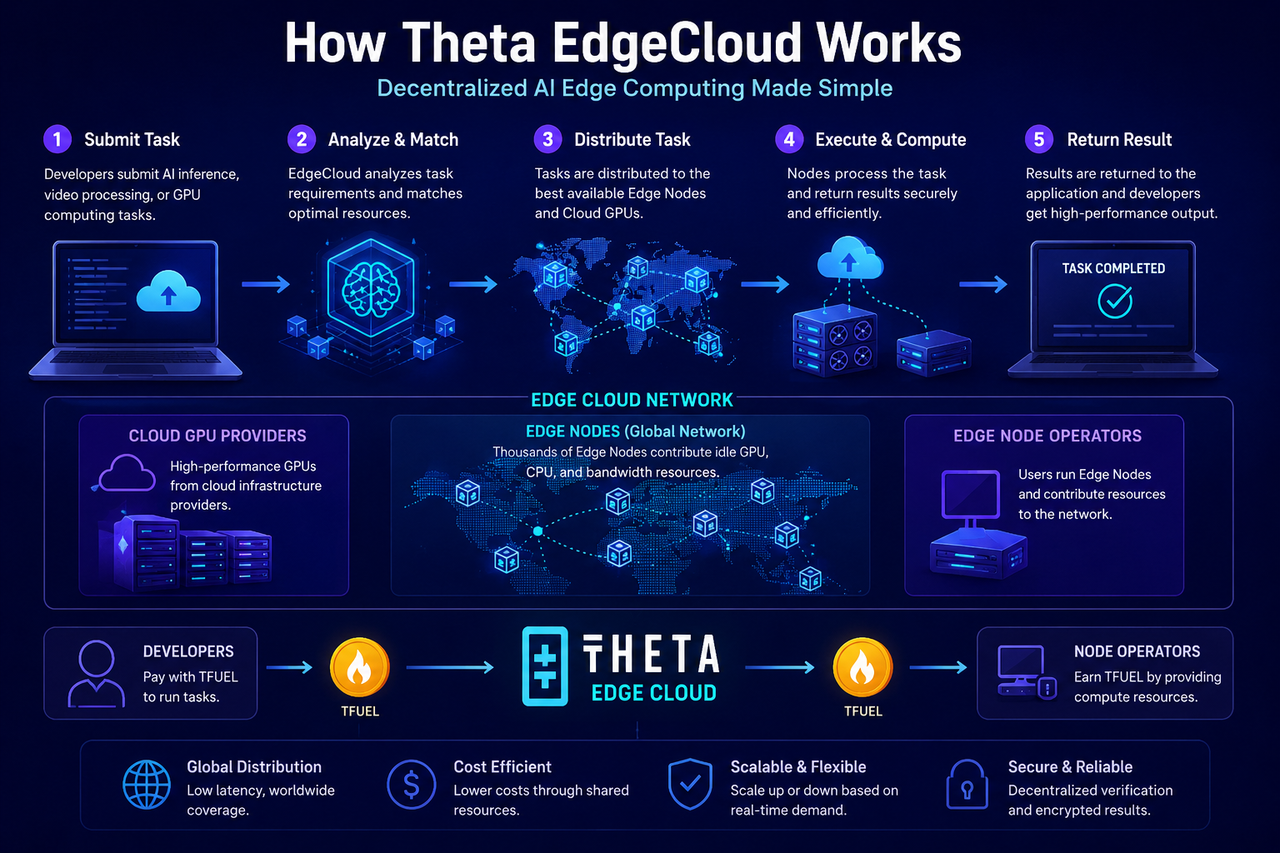
Theta EdgeCloud is a hybrid AI edge computing platform launched by Theta Network. It coordinates distributed Edge Nodes and cloud GPU resources to process AI inference, video rendering, and other computing tasks. After developers submit a task, the system allocates it to global nodes based on resource requirements, while TFUEL is used for resource payments and node rewards. Compared with traditional centralized AI cloud platforms, Theta EdgeCloud places greater emphasis on distributed GPU sharing, edge computing, and efficient resource utilization.
Traditional AI cloud services usually rely on large centralized data centers. While this model offers strong computing power, it also comes with high GPU costs, centralized resource scheduling, and pressure around scalability. Theta EdgeCloud aims to combine edge nodes with cloud computing, bringing idle GPU resources from around the world into the network to improve resource utilization and strengthen distributed collaboration.
As competition in AI infrastructure becomes increasingly intense, Theta EdgeCloud is also seen as one of the notable examples in the DePIN, or decentralized physical infrastructure network, and distributed GPU network space. Its core goal is not to completely replace traditional cloud platforms, but to offer a more flexible model for resource coordination in AI inference and edge computing scenarios.
What Is Theta EdgeCloud?
As a hybrid AI cloud platform built on the Theta Network ecosystem, Theta EdgeCloud’s core logic is to combine distributed Edge Nodes with traditional cloud GPU services, forming a unified network of computing resources.
Unlike traditional centralized AI cloud services, Theta EdgeCloud draws its resources not only from cloud servers, but also from Edge Node nodes run by users around the world. These nodes can share idle GPU, CPU, and bandwidth resources to process AI inference, video transcoding, and rendering tasks.
For developers, Theta EdgeCloud functions more like an AI computing layer that can dynamically schedule distributed resources. Developers do not need to manage the underlying nodes directly. Instead, they submit tasks through the platform, and the system automatically handles resource allocation and execution.
How Is Theta EdgeCloud Different from Traditional AI Cloud Services?
Traditional AI cloud platforms generally rely on large data centers to provide GPU services in a centralized way. Resource scheduling and management are mainly handled by centralized cloud providers. This model is mature and stable, but it is also vulnerable to tight GPU supply and rising costs.
Theta EdgeCloud, by contrast, places more emphasis on “edge resource sharing.” Edge Nodes in the network can come from different regions around the world, allowing some idle GPU resources to be reused. When an AI task enters the system, the platform schedules resources based on the task requirements, node status, and computing capacity.
Compared with traditional AI cloud platforms, Theta EdgeCloud has several key characteristics:
Comparison Dimension
Traditional AI Cloud Platform
Theta EdgeCloud
Resource Source
Centralized data centers
Cloud GPUs + Edge Nodes
Network Structure
Centralized
Distributed
GPU Scheduling
Managed by the platform
Dynamic node collaboration
Node Participation
Provided by cloud service providers
Users share resources
Incentive Method
Service fees
TFUEL reward mechanism
This model makes Theta EdgeCloud closer to a distributed GPU network, rather than simply a cloud computing platform in the traditional sense.
What Happens After a User Submits an AI Task?
When a developer or application submits an AI inference, video processing, or rendering task, Theta EdgeCloud first analyzes the task’s resource requirements, including GPU type, memory needs, computing time, and bandwidth requirements.
The system then searches the network for node resources that meet those conditions. Some tasks may be completed by cloud GPUs, while others may be assigned to global Edge Nodes for collaborative processing. The entire process is handled automatically by the platform, so developers do not need to select nodes manually.
During task execution, the system continuously monitors node status and task progress. If some nodes go offline or lack sufficient resources, the platform may reassign the task to maintain overall computing stability.
After the task is completed, the result is returned to the application layer, while the nodes that participated in the computation receive TFUEL rewards based on their resource contribution.
At its core, this model is a “distributed resource scheduling system.” Its key purpose is to allow idle computing power across the network to be used in a unified way.
How Edge Nodes Participate in GPU Computing
Edge Nodes are one of the core components of Theta EdgeCloud. After users run an Edge Node, they can connect their local GPU and computing resources to the Theta network.
When the network has demand for AI inference, video rendering, or edge computing, some tasks are assigned to these nodes for execution. After completing a task, nodes can earn TFUEL rewards based on the computing resources they contributed.
Unlike traditional mining machines, the core function of a Theta Edge Node is not PoW mining, but the provision of real computing resources. This is also one reason Theta is often classified as a DePIN project.
For ordinary users, an Edge Node is both an entry point into the Theta network and an important part of the resource sharing mechanism.
How TFUEL Flows Within EdgeCloud
TFUEL is an important resource token within Theta EdgeCloud, mainly responsible for payment and incentive functions during network operations.
When developers submit AI or video tasks, they need to pay TFUEL as a resource fee. The system then allocates part of that TFUEL to the Edge Nodes that participate in the computation, based on how the task is executed.
As a result, within the EdgeCloud system, TFUEL connects:
AI application developers
GPU resource providers
The Edge Node network
Theta infrastructure
This structure creates a circular mechanism of “task payment, resource execution, and node rewards.”
Main Use Cases of Theta EdgeCloud
Theta EdgeCloud is currently focused mainly on AI and media computing scenarios.
In the AI field, its applications include:
AI model inference
Large language model inference
Image generation
Distributed GPU computing
In video and media, Theta EdgeCloud can be used for:
Video transcoding
Video rendering
Livestream processing
Edge content delivery
Because edge nodes can be distributed across different regions, some tasks with higher real-time requirements can also use edge computing to reduce latency.
As AI and Web3 infrastructure continue to converge, Theta EdgeCloud is gradually becoming an important part of Theta’s expansion from a video ecosystem into the AI sector.
What Challenges Does Theta EdgeCloud Face?
Although distributed GPU networks have strong potential for resource sharing and scalability, Theta EdgeCloud still faces several practical challenges.
First, the hardware capabilities of edge nodes are not fully standardized, and differences in GPU performance may affect task execution efficiency. Second, a distributed node network also increases the complexity of resource scheduling and task management.
At the same time, competition in the AI infrastructure market is accelerating rapidly, with both traditional cloud platforms and other distributed GPU network projects competing for the AI computing market.
In addition, demand for high-performance GPUs continues to grow as generative AI expands. How to steadily obtain and schedule GPU resources has also become one of the key long-term issues for EdgeCloud’s development.
Summary
Theta EdgeCloud is a decentralized AI and edge computing platform launched by Theta Network. Its core goal is to build a distributed AI computing network through collaboration between global Edge Nodes and cloud GPUs.
Compared with traditional centralized AI cloud services, Theta EdgeCloud places greater emphasis on edge resource sharing, GPU collaboration, and distributed scheduling. Developers can submit AI inference and video processing tasks through the platform, while nodes around the world jointly participate in resource execution and receive TFUEL rewards.
As demand for AI inference and GPUs continues to grow, Theta EdgeCloud is helping Theta expand from a video streaming network into a broader AI infrastructure platform.
FAQs
How Does Theta EdgeCloud Work?
After developers submit AI or video tasks, the system automatically assigns them to cloud GPUs and Edge Nodes for collaborative processing, with TFUEL used for resource payments and rewards.
What Role Do Edge Nodes Play in EdgeCloud?
Edge Nodes provide GPU and computing resources for AI inference, video rendering, and edge computing tasks.
How Is Theta EdgeCloud Different from Traditional AI Cloud Services?
Traditional AI cloud services mainly rely on centralized data centers, while Theta EdgeCloud combines edge nodes with cloud GPUs to form a distributed resource network.
What Is TFUEL Used for in EdgeCloud?
TFUEL is used to pay for AI and video task fees, and it also serves as the reward token that nodes receive after completing tasks.
Is Theta EdgeCloud a DePIN Project?
Because its core logic is to share GPU and edge computing resources, Theta EdgeCloud is often classified as part of the DePIN and distributed GPU network space.
Author: Jayne
Translator: Jared
Disclaimer
* The information is not intended to be and does not constitute financial advice or any other recommendation of any sort offered or endorsed by Gate.
* This article may not be reproduced, transmitted or copied without referencing Gate. Contravention is an infringement of Copyright Act and may be subject to legal action.
Solana faces both opportunities and challenges in its development. Recently, severe network congestion has led to a high transaction failure rate and increased fees. Consequently, some have suggested using Layer 2 and appchain technologies to address this issue. This article explores the feasibility of this strategy.
Sui is a PoS L1 blockchain with a novel architecture whose object-centric model enables parallelization of transactions through verifier level scaling. In this research paper the unique features of the Sui blockchain will be introduced, the economic prospects of SUI tokens will be presented, and it will be explained how investors can learn about which dApps are driving the use of the chain through the Sui application campaign.
This article introduces the technical principles, framework, and applications of Zero-Knowledge (ZK) technology, covering aspects from privacy, identity (ID), decentralized exchanges (DEX), to oracles.
Tronscan is a blockchain explorer that goes beyond the basics, offering wallet management, token tracking, smart contract insights, and governance participation. By 2025, it has evolved with enhanced security features, expanded analytics, cross-chain integration, and improved mobile experience. The platform now includes advanced biometric authentication, real-time transaction monitoring, and a comprehensive DeFi dashboard. Developers benefit from AI-powered smart contract analysis and improved testing environments, while users enjoy a unified multi-chain portfolio view and gesture-based navigation on mobile devices.