The development of investment markets has continued to lower the barrier for ordinary investors to participate in global capital markets. In the past, investing in stocks often required ongoing research into company fundamentals, industry trends, and market conditions. The emergence of index funds has changed that model. By tracking a specific market index, index funds allow investors to participate in the growth of an entire market or a specific sector at a relatively low cost.
From the S&P 500 Index and NAS100 Index in the United States, to Germany’s DAX40 Index and broad indexes covering global markets, large amounts of capital are allocated through index funds.
What Is an Index Fund?
As an investment fund designed to replicate the performance of a specific market index, an index fund differs from an actively managed fund in one key way: it does not rely on a fund manager to actively select stocks in pursuit of excess returns. Instead, it holds the corresponding constituent assets according to the rules of the index. For example, a fund tracking the S&P 500 Index will hold large U.S. listed companies according to their index weights, while a fund tracking the NAS100 Index will mainly allocate to large non financial companies listed on Nasdaq.
The core goal of an index fund is not to outperform the market, but to stay as close as possible to the overall performance of the target index after necessary fees are deducted. For this reason, index funds are also known as passive investment tools.
How Do Index Funds Work?
Index funds track an index by replicating its constituent structure.
The fund manager builds a portfolio based on the list of constituents in the target index and their respective weights. When the index constituents are adjusted, the fund will also adjust its holdings accordingly to maintain a high level of consistency with the index.
Different indexes follow different construction rules. For example, the NAS100 Index uses specific stock selection criteria and weighting mechanisms, while Germany’s DAX40 Index uses a free float market capitalization weighted methodology.
There is usually some degree of difference between a fund and its index. This difference is known as tracking error. For an index fund, a lower tracking error generally indicates more efficient index replication.
What Are the Common Types of Index Funds?
Index funds cover stocks, bonds, and different markets and industries around the world, so they can meet the needs of different investment goals.
Broad based equity index funds are the most common type of index fund. These funds usually track an entire market or a group of large companies within a market, such as the S&P 500 Index, total market indexes, and the MSCI World Index. Because their holdings are widely diversified, broad based index funds are often viewed as an important part of a long term investment portfolio.
Sector index funds focus on a specific industry. Technology, healthcare, finance, and energy all have corresponding index fund products. Compared with broad based indexes, sector index funds are more concentrated, so their volatility is usually higher.
International index funds are mainly used to allocate to overseas markets. Investors can participate in European, Asian, emerging, or global equity markets through a single product. Germany’s DAX40 Index, for example, has long been seen as one of the important representatives of the European economy.
Bond index funds mainly track government bonds, corporate bonds, or broad bond indexes. Compared with equity index funds, bond index funds usually have lower volatility, so they are often used to balance risk in long term asset allocation.
How Do You Choose the Right Index Fund?
There is no single universal standard for choosing an index fund. Different investment goals correspond to different indexes and fund products.
Investors first need to clarify the market exposure they want. Those interested in large U.S. companies may study index funds that track the S&P 500 or NAS100, while those focused on global asset allocation may consider global equity index funds covering multiple countries and regions.
The expense ratio is an important reference point when selecting an index fund. Although index funds generally have low fees, differences still exist between products. Over the long term, even a small fee gap can affect final returns through the power of compounding.
Fund size is also worth paying attention to. Larger index funds usually have higher liquidity, a more mature management system, and more stable operating capacity, making it easier for them to achieve continuous and effective index tracking.
In addition, tracking error is an important indicator for measuring fund quality. The lower the tracking error, the closer the fund’s performance usually is to the target index.
How Do You Start Investing in Index Funds?
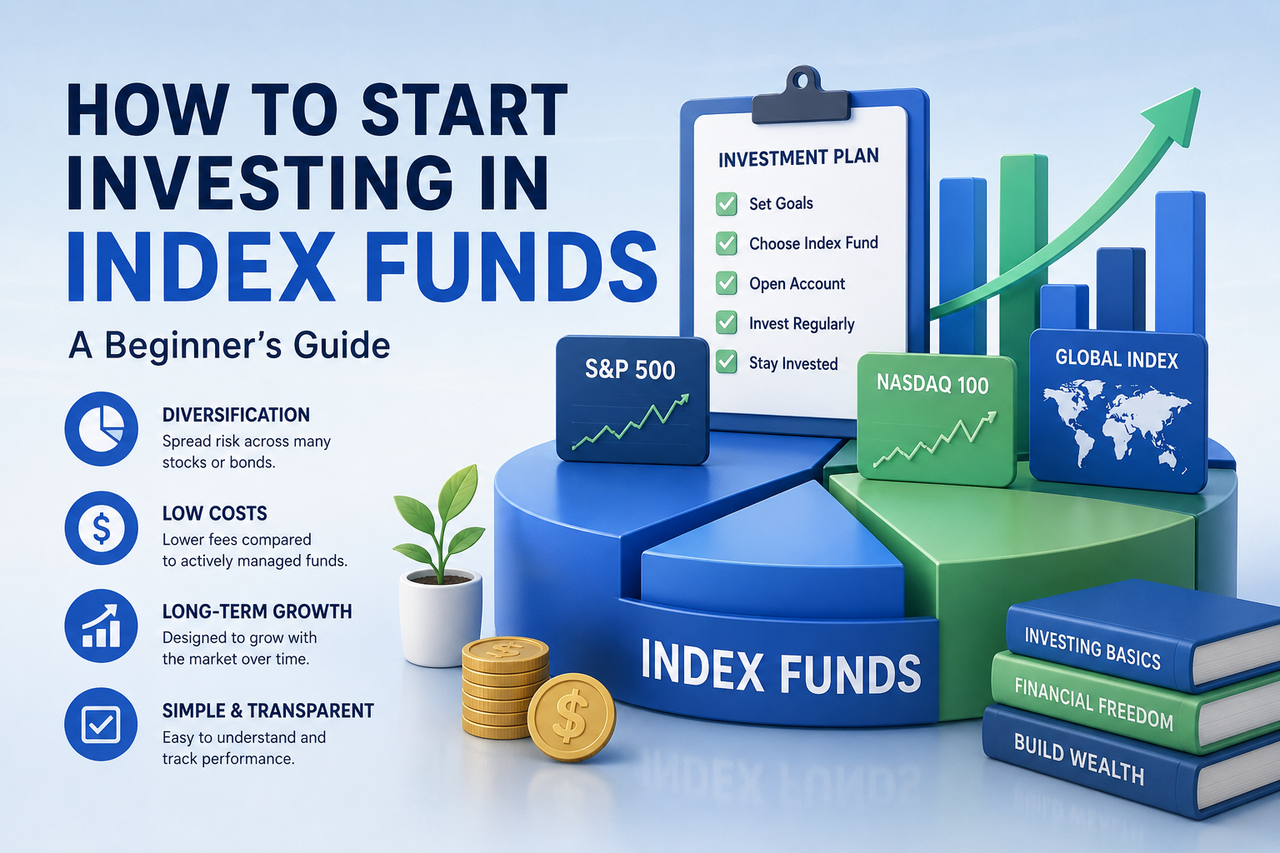
The process of investing in index funds is relatively simple, but it is still important to build a reasonable investment framework.
Investors first need to open an investment account through a securities firm or fund distribution platform. Different platforms offer different product ranges and trading methods, so investors should choose based on their own needs.
After opening an account, investors can decide how much to invest based on their personal financial situation. Many index funds allow relatively small initial investments, so the entry threshold is usually lower than building a stock portfolio directly.
Next, investors need to choose the corresponding index fund based on their own goals. Investors focused on the U.S. technology sector often study the composition logic of the NAS100 Index, while those interested in the European market may look more closely at the industry structure and representative companies of the GER40 Index.
Building a long term investment plan is an important part of index fund investing. Many investors continue increasing their holdings by regularly investing a fixed amount, helping reduce the impact of short term market fluctuations.
What Is the Difference Between Index Funds and Direct Index Investing?
Many investors confuse index funds with index trading products, but they are actually different types of financial instruments.
Index funds replicate index performance by holding real assets, so investors essentially hold fund shares. The fund’s net asset value fluctuates as the prices of the underlying assets change.
Index trading products mainly provide exposure to index price movements, and some products track indexes through derivative mechanisms. Their trading methods, risk structures, and suitable use cases differ clearly from those of index funds.
Major global indexes such as NAS100, SPX500, and US30 can be accessed through index funds, while other index trading tools can also be used to gain market exposure.
What Are the Risks of Investing in Index Funds?
Index funds can reduce individual stock risk, but they cannot eliminate market risk.
When the overall market enters a downturn, the net asset value of an index fund will usually decline as well. For index funds that track a single industry or a specific regional market, volatility may be higher than that of broad based index funds with wider coverage.
In addition, changes in the economic cycle, shifts in the interest rate environment, industry concentration, and exchange rate fluctuations may also affect index fund performance.
The core advantage of index funds is diversification, not the elimination of risk. Understanding the sources of risk is therefore also an important part of long term investing.
What Is the Difference Between Index Funds and ETFs?
Index funds and ETFs are both index investment tools, and both can track the same index.
The main difference lies in the trading mechanism. Traditional index funds are usually subscribed and redeemed based on their daily net asset value, while ETFs can be bought and sold in real time during trading hours, just like stocks.
ETFs usually offer greater trading flexibility, while traditional index funds are more suitable for long term regular investing and ongoing allocation. Neither is absolutely better than the other. Their use cases mainly depend on the investor’s needs and investment approach.
Conclusion
An index fund is a fund product that achieves diversified investment by replicating the performance of a market index. By holding index funds, investors can participate in the development of the stock market, bond market, and global capital markets at a relatively low cost, without having to research and select individual securities one by one.
From the S&P 500 and NAS100 to GER40, different indexes reflect different market structures, industry compositions, and economic development characteristics. Understanding how index funds work, the logic behind index construction, selection criteria, and sources of risk can help investors build a more systematic long term investment framework and provide a foundation for future asset allocation decisions.
FAQs
Are index funds suitable for beginner investors?
Index funds are often considered one of the most suitable investment tools for beginners to understand capital markets. Because index funds achieve diversified allocation by holding a large number of securities, they can reduce the complexity of individual stock research and stock selection.
Can index funds lose money?
Yes. Index funds can lose money. When the overall market falls, the net asset value of an index fund will also be affected. Index funds can reduce individual stock risk, but they cannot avoid systematic market risk.
What is the difference between index funds and stocks?
A stock represents ownership in a single company, while an index fund represents a basket of securities. Because its holdings are more diversified, an index fund usually carries lower risk than a single stock.
Are index funds and ETFs the same product?
ETFs are an important form of index fund, but not all index funds are ETFs. The main differences lie in their trading mechanisms and liquidity structures.
Do you need a lot of money to invest in index funds?
Most index funds support relatively small investments, and some products even allow investors to build positions gradually through regular fixed amount investing. As a result, the capital threshold is usually low.
What is the difference between NAS100 and S&P 500 index funds?
NAS100 mainly covers large non financial companies listed on Nasdaq, with a relatively high weighting in the technology sector. The S&P 500 covers large listed companies across multiple U.S. industries, so its sector distribution is more balanced.
What is the difference between NAS100 and crypto market index contracts?
NAS100 reflects the overall performance of large U.S. technology companies, while crypto market index contracts usually track price changes across multiple digital assets. The two differ clearly in underlying assets, market structure, and sources of risk.