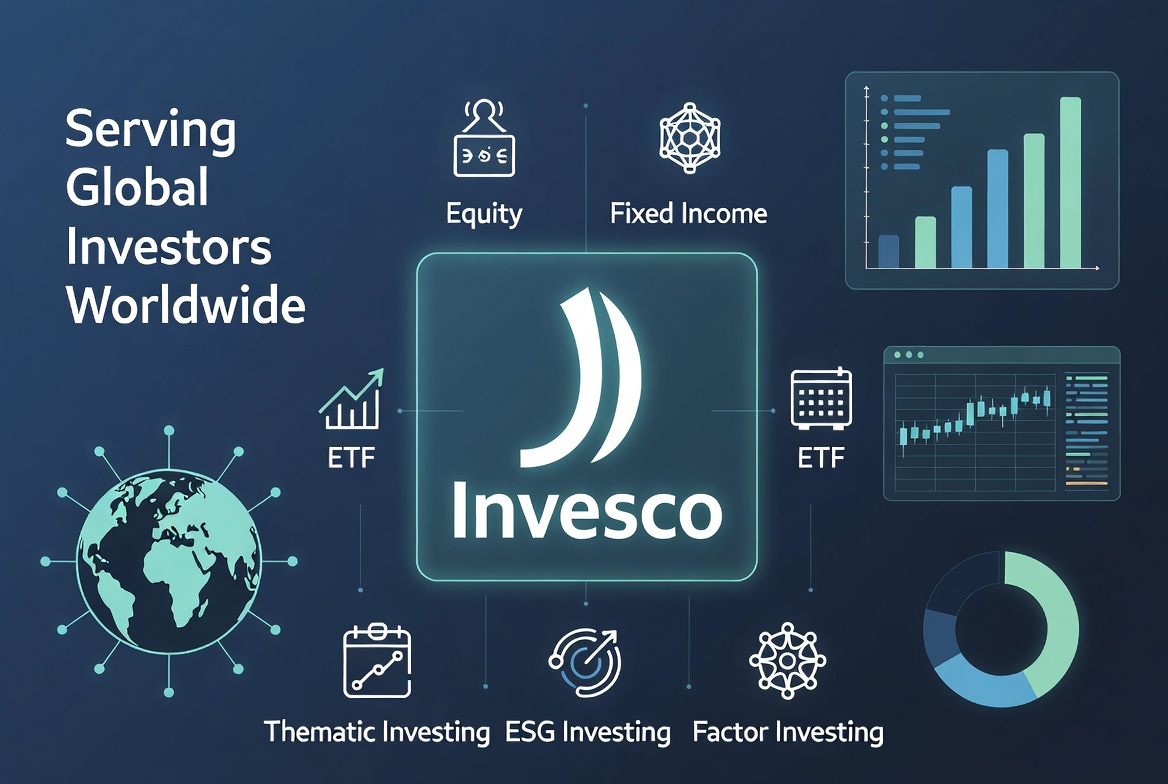
As a globally recognized asset management institution, Invesco provides individual investors and institutional clients with diversified investment choices through an ETF product system covering equities, bonds, sector themes and international markets.
Much of Invesco’s influence in the global ETF market comes from its broad product lineup and long-established brand strength. Flagship products such as Invesco QQQ, in particular, have made Invesco an important participant in global technology investing and index investing. Understanding the use cases for Invesco ETF products helps explain why ETFs have become such an important part of the modern investment system.
An ETF, or Exchange Traded Fund, combines the features of traditional funds and stock trading. Investors can use ETFs to gain the diversification benefits of a basket of assets, while also buying and selling ETF shares in real time on securities markets, just as they would trade stocks.
One key reason ETFs have grown so quickly is that they lower the barrier to investing. In the past, individual investors who wanted to invest in dozens or even hundreds of companies at the same time often needed substantial capital and had to bear relatively high trading costs. By tracking an index or a specific asset portfolio, ETFs allow investors to gain broad market exposure through a single trade.
ETFs also tend to offer relatively high transparency, lower fees and strong liquidity. For long-term investors, ETFs can help build stable asset allocation portfolios. For institutional investors, ETFs have become important tools for managing liquidity and adjusting investment strategies.
As passive investing has become more widely adopted around the world, ETFs have evolved from simple index-tracking tools into important financial products covering equities, bonds, commodities, sector themes and cross-market investing.
How Invesco’s ETF Product System Is Structured
Invesco has one of the world’s leading ETF product systems, with products covering multiple asset classes and investment themes.
Invesco’s most representative ETF product is Invesco QQQ. This ETF tracks the Nasdaq 100 Index, with holdings mainly concentrated in large US technology and growth companies. As a result, it has long attracted strong attention from global investors. QQQ is not only an important product for Invesco, but also a landmark ETF in the global technology investing space.
Beyond QQQ, Invesco also issues a wide range of equity ETFs, bond ETFs, sector ETFs and thematic ETFs. Some products focus on the US large-cap equity market, while others target emerging markets, fixed income assets or specific industries.
From a business structure perspective, Invesco’s ETF system can be roughly divided into the following areas:
| Product Category |
Main Coverage |
| Equity ETFs |
US markets, international markets, growth stocks, value stocks |
| Bond ETFs |
Government bonds, investment-grade bonds, high-yield bonds |
| Sector ETFs |
Technology, finance, energy, healthcare and other sectors |
| Thematic ETFs |
Artificial intelligence, innovative technology, sustainable investing and more |
| International ETFs |
Assets in Europe, Asia and emerging markets |
This multi-layered product lineup allows Invesco to meet the needs of clients with different risk preferences and investment goals.
How Investors Use Equity ETFs for Asset Allocation
Equity ETFs are one of the most important parts of Invesco’s ETF ecosystem, and they are also a preferred entry point into capital markets for many investors.
Equity ETFs usually track a specific index or market segment. For example, QQQ mainly reflects the development of large US technology companies, while other broad-market ETFs may cover a wider portion of the US equity market. By buying equity ETFs, investors can achieve diversified investment exposure without having to select individual stocks one by one.
For long-term investors, equity ETFs are often used for core asset allocation. Many retirement funds, pension plans and long-term investment accounts use equity ETFs as an important foundation for their portfolios because ETFs can reflect overall market performance relatively well.
At the same time, some investors also use sector ETFs for thematic allocation. For example, when investors are optimistic about the development of artificial intelligence, cloud computing or the semiconductor industry, they can use related sector ETFs to gain corresponding market exposure without directly investing in a single company.
This flexibility has made equity ETFs an important tool in modern portfolio management.
What Are the Use Cases for Bond ETFs
Although equity ETFs receive more attention, bond ETFs are also an important part of the global asset management market.
Bond ETFs mainly invest in government bonds, corporate bonds or other fixed income assets. Their core role is usually to provide a relatively stable source of income and reduce portfolio volatility. For investors with lower risk tolerance, bond ETFs can serve as an important complement to equity assets.
Institutional investors widely use bond ETFs to manage liquidity and adjust asset allocation. For example, pension funds and insurance institutions usually need to hold a certain proportion of fixed income assets to meet long-term liability management needs. Bond ETFs provide a convenient investment channel, allowing institutions to quickly build or adjust bond positions.
During periods of heightened market volatility, bond ETFs are also often used for risk hedging and defensive asset allocation. As a result, bond ETFs have become an essential part of modern asset allocation frameworks.
How Sector and Thematic ETFs Meet Diverse Needs
As investment needs have become more specialized, sector ETFs and thematic ETFs have gradually become among the fastest-growing areas of the ETF market.
Sector ETFs focus on specific industry segments, such as technology, healthcare, financial services or energy. These products can help investors allocate around specific industry trends while reducing the concentration risk that comes with investing in individual stocks.
Thematic ETFs focus more on long-term development trends. Themes such as artificial intelligence, robotics, the digital economy, clean energy and cybersecurity have attracted large fund inflows in recent years. Thematic ETFs can combine multiple related companies within a single portfolio, making it easier for investors to participate in the development of emerging industries.
For Invesco, sector ETFs and thematic ETFs not only enrich its product lineup, but also help the company address more investor needs. As global investors pay increasing attention to long-term structural growth opportunities, thematic investing has become an important direction for the ETF industry.
Why the ETF Ecosystem Has Become an Important Competitive Advantage for Invesco
The ETF ecosystem has become one of Invesco’s most important competitive barriers.
The ETF business not only generates management fee income, but also continues to expand Invesco’s assets under management. When more investors choose Invesco ETF products, the company can gain more stable fund inflows and a broader client base.
QQQ is a good example. The brand influence this product has built over time now extends far beyond a single fund product. Many investors first come to know Invesco through QQQ. The market recognition created by a flagship product further supports the development of other ETF products, helping form a complete ecosystem.
The ETF business also has clear economies of scale. As product assets continue to expand, operating costs can be spread across a larger asset base, improving overall profitability. Therefore, the ETF ecosystem is not only an important source of revenue for Invesco, but also a key foundation for the company’s long-term competitive advantage.
For the global asset management industry, institutions with mature ETF ecosystems are often better positioned to capture sustained growth opportunities. This is exactly the core area Invesco has continued to strengthen in recent years.
How to Buy IVZ (Invesco) Stock
IVZ is the stock ticker of Invesco Ltd. in the US securities market. Traditionally, investors can buy IVZ stock through brokerage accounts that support US stock trading, allowing them to participate in the development of the global asset management industry.
Because Invesco’s operating performance is closely related to ETF asset scale, fund inflows and the level of activity in global capital markets, many investors view IVZ as one of the representative companies for observing the development of the ETF and asset management industries.
As digital asset markets and traditional financial markets become increasingly integrated, more trading tools have appeared around stock price movements. For example, some platforms offer CFD products linked to US stock prices, allowing users to participate in market price changes without directly holding the underlying stock assets.
Gate TradFi is continuing to expand its coverage of traditional financial assets. Users can monitor digital assets, US stocks, ETFs, indices and commodity markets within a unified account environment. Some markets also provide Gate CFD products, offering more choices for cross-market asset allocation and market observation.
Regardless of how investors participate in the market, they should fully understand the product structure, trading rules and regulatory requirements in their region.
Conclusion
ETFs have become important infrastructure in the modern investment system, and Invesco is one of the major participants in the global ETF market. Through a complete product system covering equity ETFs, bond ETFs, sector ETFs and thematic ETFs, Invesco can serve the needs of different types of investors. From flagship products such as QQQ to diversified asset allocation solutions, the ETF ecosystem not only drives growth in Invesco’s assets under management, but has also become an important competitive advantage for the company in the global asset management industry.
FAQs
What is Invesco’s best-known ETF?
Invesco’s best-known ETF is Invesco QQQ. This product tracks the Nasdaq 100 Index and is one of the world’s largest technology-themed ETFs.
What is the difference between equity ETFs and bond ETFs?
Equity ETFs mainly invest in stock markets and seek capital appreciation. Bond ETFs mainly invest in fixed income assets and focus more on income stability and risk control.
Why are ETFs popular with investors?
ETFs offer diversified investing, lower fees, relatively high transparency and trading convenience, which is why they are widely used by both individual and institutional investors.
What types of ETFs does Invesco mainly issue?
Invesco issues equity ETFs, bond ETFs, sector ETFs, thematic ETFs and international market ETFs, covering multiple asset classes and investment areas.
Is QQQ an actively managed fund?
No. QQQ is an index ETF. It mainly tracks the Nasdaq 100 Index and does not rely on fund managers to actively select stocks.
Why is the ETF business so important to Invesco?
The ETF business can generate ongoing management fee income while expanding assets under management and the client base, so it has become an important driver of Invesco’s growth.