A defining feature of the asset management industry is that revenue is often directly tied to the size of client assets. When more capital flows onto Invesco’s management platform, the company can collect more management fees. As a result, investment performance, product competitiveness and client fund flows all have a direct impact on Invesco’s operating results.
Against the backdrop of rapid growth in the global ETF market and continued demand for long-term investing, Invesco (IVZ) has built an integrated business system covering active management, passive investing, multi-asset allocation and institutional services. Core products such as the QQQ ETF have also become important drivers of the company’s growth.
IVZ is the stock ticker of Invesco Ltd., which is listed and traded on the New York Stock Exchange. Headquartered in Atlanta, United States, Invesco is one of the world’s larger independent asset management institutions.
Founded in 1935, Invesco has developed over many decades into a global business network covering equity investing, fixed income investing, ETFs, multi-asset management and alternative investments. Its clients include not only individual investors, but also pension funds, insurance institutions, sovereign wealth funds and corporate clients.
Unlike banks, which profit from loan interest, Invesco is a typical asset management company. Its operating focus is not to hold large amounts of financial assets for its own investment, but to earn management fee income by managing client assets. For this reason, the market usually pays close attention to Invesco’s assets under management, or AUM, fund flows and product competitiveness.
From an industry classification perspective, IVZ belongs to the global asset management sector and is one of the representative asset management companies in the US capital market.
What Are Invesco’s Revenue Sources
Invesco’s revenue structure is mainly centered on its asset management business. Since client capital is spread across different investment products, the company’s revenue also comes from several business segments.
Overall, Invesco’s main revenue sources include:
| Revenue Source |
Main Content |
| Asset management fees |
Income from fund and portfolio management |
| ETF management fees |
Income from ETF product operation and management |
| Active investment business |
Revenue related to actively managed funds |
| Institutional investment services |
Solutions for pension funds and institutional clients |
| Advisory and other services |
Investment advisory and related financial services |
Among these, management fee income holds the core position. Whether clients invest in equity funds, bond funds or ETF products, as long as the assets remain within Invesco’s management system, the company usually charges management fees based on a certain percentage.
This business model allows Invesco to generate steady income from long-term asset management demand, rather than relying entirely on short-term market trading activity.
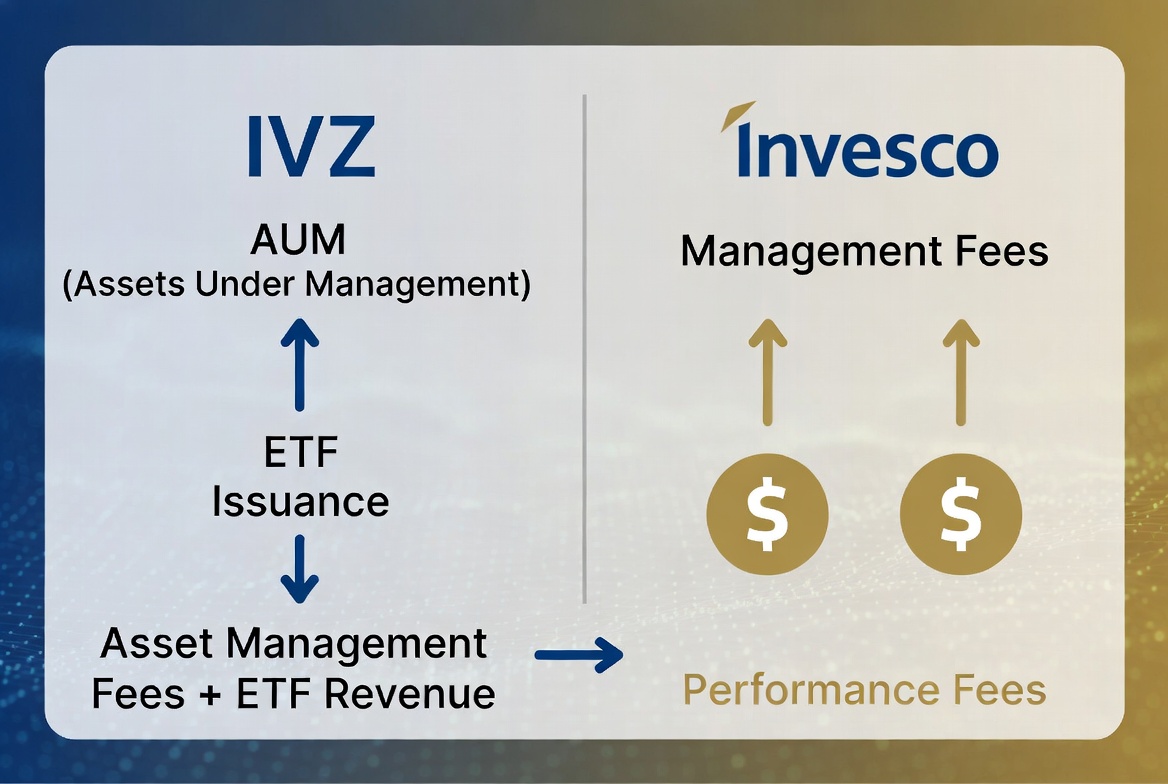
How the Asset Management Business Generates Revenue
Asset management is Invesco’s most important source of revenue and the core of its business model.
When investors buy fund products under Invesco, their capital enters the corresponding investment portfolio and is managed by professional investment teams. These teams are responsible for researching markets, allocating assets and executing investment strategies in order to achieve the fund’s stated objectives.
In return, Invesco charges management fees based on the size of the fund’s assets. Since management fees are usually calculated as a percentage of assets under management, the more assets the company manages, the more revenue it can generate.
For example, a fund with tens of billions of dollars in assets can still produce substantial revenue even if its management fee rate is relatively low. This is why competition in the asset management industry often centers on the scale of client assets.
For Invesco, continuously attracting fund inflows and maintaining the competitiveness of its investment products are important foundations for long-term revenue growth.
How the ETF Product System Contributes to Growth
ETFs have become one of Invesco’s most important growth engines in recent years.
ETFs combine the diversification benefits of funds with the trading convenience of stocks, making them widely popular among global investors. As the concept of passive investing has become more mainstream, large amounts of capital have flowed into the ETF market, driving continued industry expansion.
Invesco’s most representative product in the ETF space is Invesco QQQ. This product tracks the Nasdaq 100 Index and includes many large technology companies, making it one of the world’s most closely watched ETFs.
In addition to QQQ, Invesco has issued a wide range of ETF products covering equities, bonds, sector themes and international markets. This broad product lineup enables the company to serve different investment needs and attract more capital into its management system.
For asset management companies, the ETF business not only brings in management fee income, but also expands brand influence and client reach. As a result, the ETF ecosystem has become an important part of Invesco’s business model.
How Active Management Improves Profitability
Although the ETF business has grown rapidly, active management remains an important pillar of Invesco’s revenue system.
Actively managed funds rely on fund managers to select assets and make investment decisions. Their usual goal is to outperform market benchmarks while controlling risk. Because they require the support of professional research teams, actively managed products generally charge higher management fees than ETF products.
From a revenue structure perspective, active management helps Invesco maintain higher profitability. Even if some products are smaller than large ETFs, their higher fee rates can still generate considerable revenue.
In addition, active management strategies can cover many areas that are difficult to access through index investing, such as high-yield bonds, emerging market equities and specific sector investments. This differentiated capability helps enrich Invesco’s product system and meet the needs of different types of clients.
Therefore, active management is not only a source of revenue, but also an important part of how Invesco maintains its competitive advantage.
Why Growth in Assets Under Management Affects Revenue
For asset management companies, assets under management, or AUM, is one of the most important operating indicators.
Most of Invesco’s revenue is directly related to the size of the assets it manages. When more investors buy Invesco products, the company’s total assets under management increase, which in turn brings in more management fee income.
Growth in asset scale usually comes from two channels.
The first is net fund inflows. When investors continue to allocate capital to Invesco products, assets under management expand. The second is asset appreciation driven by rising markets. If equity and bond markets rise overall, assets under management may grow even without new fund inflows.
This model gives the asset management industry strong economies of scale. As assets under management continue to grow, the company can spread operating costs across a larger asset base, thereby improving overall profitability.
For this reason, the market usually watches Invesco’s fund flows and changes in assets under management closely, because these indicators often reflect the company’s future revenue growth potential.
How to Buy IVZ (Invesco) Stock
IVZ is the stock ticker of Invesco in the US securities market. Traditionally, investors can buy IVZ stock through brokerage accounts that support US stock trading, allowing them to participate in the development of the global asset management industry.
Because Invesco’s operating performance is closely related to assets under management, ETF inflows and the level of activity in global capital markets, many investors view it as an important representative company for observing the asset management industry.
As digital asset markets and traditional financial markets become increasingly integrated, more trading tools have appeared around the price movements of US stocks. For example, some platforms offer CFD products linked to stock prices, allowing users to participate in market price changes without directly holding the underlying stock assets.
Gate TradFi is continuing to expand its coverage of traditional financial assets. Users can monitor digital assets, US stocks, ETFs, indices and commodity markets within a unified account environment. Some markets also provide Gate CFD products, offering more choices for cross-market asset allocation and price observation.
Regardless of how investors participate in the market, they should fully understand the product structure, trading mechanism and regulatory requirements in their region.
Conclusion
Invesco’s business model is built on long-term demand for asset management. The company charges management fees by managing mutual funds, ETFs, multi-asset portfolios and institutional investment solutions, with asset management fees and ETF revenue forming its core profit sources. As the passive investment market expands and global investment demand grows, the ETF business has gradually become an important growth engine for Invesco, while active management helps the company maintain higher profitability. Continued growth in assets under management also allows Invesco to develop clear economies of scale and long-term competitive advantages.
FAQs
What business does IVZ mainly make money from?
IVZ mainly earns revenue from asset management fees, ETF management fees, active investment business and institutional investment services, with asset management fees as its core revenue source.
What is Invesco’s most important ETF product?
Invesco’s best-known ETF product is Invesco QQQ. This ETF tracks the Nasdaq 100 Index and is one of the world’s largest technology-themed ETFs.
Why are assets under management important to Invesco?
Because most of Invesco’s revenue is calculated based on the size of assets under management. The more assets it manages, the more management fee income the company can usually earn.
Why can the ETF business drive Invesco’s growth?
ETFs are widely popular among global investors. Continued fund inflows can expand Invesco’s assets under management and generate long-term management fee income.
What is the difference between active management and the ETF business?
Active management relies on fund managers to make investment decisions and usually charges higher fees. ETFs mainly track indices, with lower fee rates but often larger scale.
Are Invesco and BlackRock in the same industry?
Yes. Invesco and BlackRock are both part of the global asset management industry, but the two companies differ in product structure, market scale and business focus.