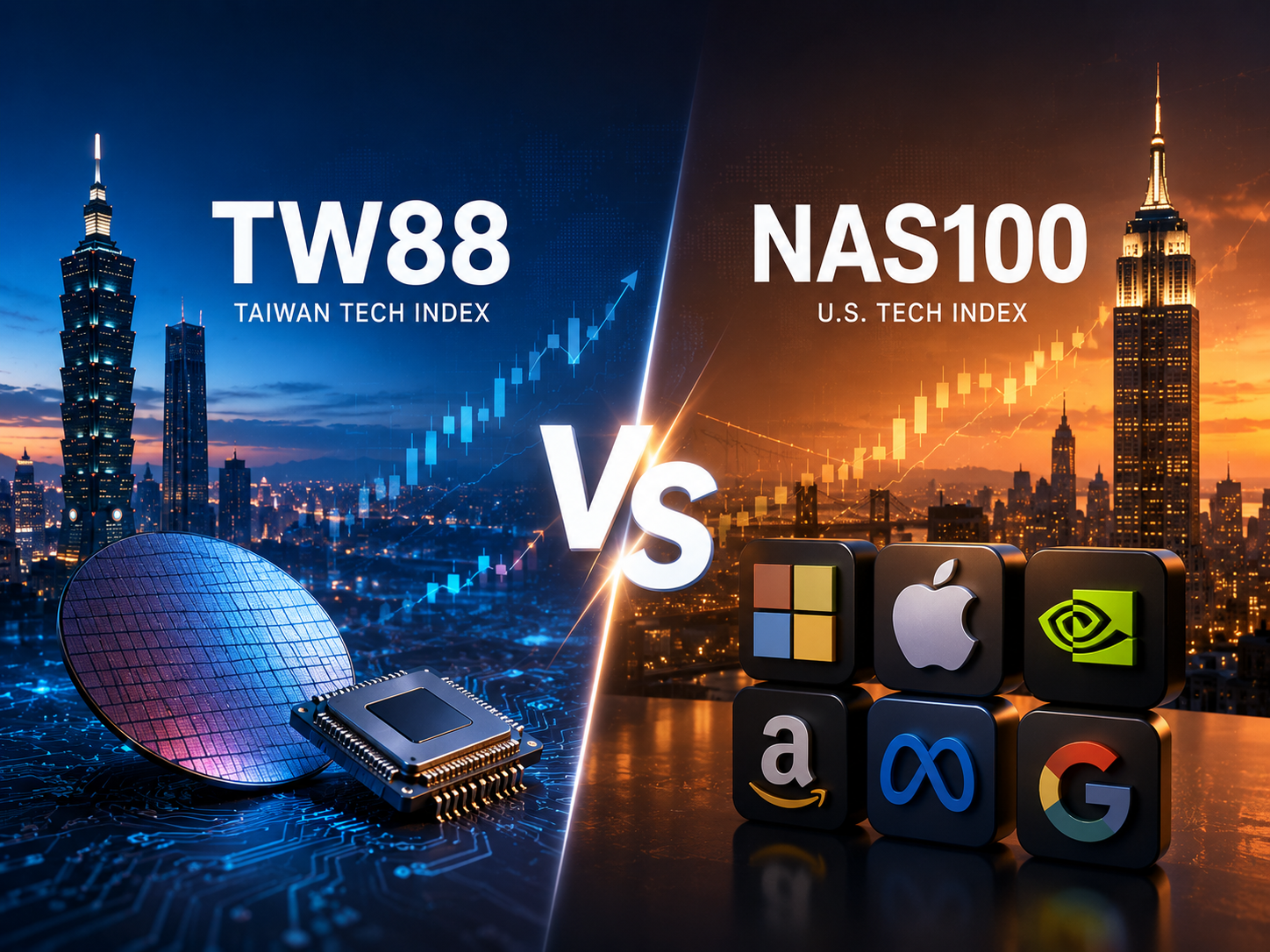
The difference between TW88 and NAS100 is not simply “Taiwan technology stocks vs U.S. technology stocks.” It is more accurately a distinction between “technology hardware supply chains” and “technology platform ecosystems.” Understanding this structural difference helps explain why both indices may be driven by the AI industry, yet their growth logic, volatility drivers, and risk profiles can be very different.
What Is TW88
TW88 is an index product that reflects the overall performance of Taiwan's stock market. Its movements are mainly driven by the performance of large listed companies in Taiwan. Since Taiwan's capital market is highly concentrated in semiconductors, electronics manufacturing, and technology hardware companies, TW88 is widely regarded as a key barometer of Taiwan's technology sector and the global electronics supply chain.
The core feature of Taiwan's market is its high industry concentration. Companies such as TSMC, MediaTek, Hon Hai Precision Industry, also known as Foxconn, Quanta Computer, Delta Electronics, and ASE Technology play major roles in the global supply chains for semiconductors, electronics contract manufacturing, AI servers, power management, and packaging and testing. These companies are deeply tied to global technology demand, so TW88 is often influenced by investment cycles in AI, smartphones, PCs, servers, and data centers.
From a market positioning perspective, TW88 is not simply a Taiwan domestic demand or financial index. It is more like a “global technology manufacturing supply chain index.” When global technology companies increase purchases of AI chips, servers, electronic components, and data center equipment, Taiwanese companies usually benefit from rising orders, which can in turn support TW88 performance.
What Is NAS100
NAS100 is an index product that tracks the performance of large non financial companies listed on the U.S. Nasdaq market. Its constituents mainly include large U.S. technology and growth companies. Microsoft, Apple, Nvidia, Amazon, Meta, and Alphabet are commonly viewed as the core representatives of NAS100.
Unlike TW88, NAS100 is more heavily weighted toward technology platforms, software ecosystems, cloud computing, digital advertising, semiconductor design, and AI applications. NAS100 companies do not only conduct technology research and development; they also provide services directly to global consumers, enterprise customers, and developer ecosystems. As a result, their business models often lean toward high margin platform operations.
NAS100 reflects the valuation logic of U.S. technology innovation and capital markets. Cloud computing revenue, AI model commercialization, software subscription growth, advertising spending cycles, e commerce consumption, and capital expenditure by large technology companies all affect NAS100 movements.
In simple terms, TW88 is similar to the “manufacturing backbone” of the technology supply chain, while NAS100 represents the “application gateway.” Both are technology assets, but they sit at very different stages of value creation.
Industry Structure Differences Between TW88 and NAS100
The most significant difference between TW88 and NAS100 lies in their industry composition. TW88's core sectors are concentrated in semiconductor manufacturing, electronics contract manufacturing, hardware supply chains, server equipment, and communications components. NAS100's core sectors, by contrast, revolve around software platforms, internet services, cloud computing, AI applications, and digital advertising.
TW88's technology exposure is more “manufacturing oriented.” Taiwanese companies usually play key roles in global supply chain segments such as chip manufacturing, electronics assembly, hardware contract manufacturing, packaging and testing, server production, and power management. Their profitability is closely tied to order volume, capacity utilization, capital expenditure cycles, and global hardware demand.
NAS100's technology exposure is more “platform oriented.” Large U.S. technology companies often own operating systems, cloud platforms, social networks, search gateways, e commerce platforms, AI models, and software ecosystems. These companies depend more on user scale, data resources, advertising monetization, subscription revenue, cloud demand, and ecosystem moats.
| Comparison Dimension |
TW88 |
NAS100 |
| Core Positioning |
Technology manufacturing and supply chain |
Technology platforms and application ecosystems |
| Main Industries |
Semiconductors, electronics manufacturing, server supply chain |
Software, cloud computing, internet, AI applications |
| Representative Role |
Manufacturing side, supply side, hardware side |
Platform side, application side, service side |
| Revenue Source Characteristics |
Orders, capacity, hardware shipments |
Subscriptions, advertising, cloud services, platform commissions |
| AI Benefit Path |
Chip manufacturing, servers, data center hardware |
AI models, cloud platforms, application software |
This structural difference means the two indices may react very differently to the same technology event. For example, increased investment in AI data centers may lift both TW88 and NAS100, but TW88 benefits more through server supply chains, wafer fabrication, and hardware orders, while NAS100 benefits more from cloud computing, AI software, model services, and platform applications.
Growth Logic Differences Between TW88 and NAS100
TW88's growth logic is rooted in global hardware demand and the semiconductor cycle. Taiwanese companies occupy key positions in the global technology manufacturing chain, so when demand rises for AI servers, advanced chips, smartphones, PCs, network equipment, and data center hardware, TW88 related companies usually see order expansion and earnings improvement.
By contrast, NAS100's growth logic comes from the expansion of digital services and ecosystem monetization. U.S. technology companies generate revenue through cloud computing, search advertising, social advertising, software subscriptions, AI services, e commerce ecosystems, and developer tools. Compared with manufacturers, platform companies usually enjoy lower marginal costs, and their earnings leverage is more likely to be reflected in valuation expansion.
During the AI cycle, their growth paths can be understood as follows:
TW88 benefits from AI infrastructure buildout. AI model training and inference require chips, servers, cooling systems, power supplies, network equipment, and packaging and testing, all areas in which Taiwanese companies participate. Therefore, TW88 is close to the “AI infrastructure supply chain.”
NAS100 benefits from the expansion of AI applications and cloud platforms. AI model deployment, enterprise AI tools, intelligent search, advertising optimization, office automation, and cloud inference services are mainly driven by large U.S. technology platforms. Therefore, NAS100 is similar to the “AI commercial application ecosystem.”
This means TW88's growth depends more on hardware orders and capital expenditure cycles, while NAS100's growth depends more on software services, user ecosystems, and enterprise digital budgets.
Weighting Distribution Differences Between TW88 and NAS100
Both TW88 and NAS100 show characteristics of concentrated weighting, but the way that concentration appears is different. TW88's weightings lean toward semiconductor and manufacturing leaders, while NAS100's weightings lean toward large U.S. platform technology companies.
In TW88, semiconductor leaders have enormous influence. Because Taiwan's market capitalization structure is highly concentrated, share price movements in giants such as TSMC can significantly sway the index. This makes TW88 highly sensitive to a single industry and a small number of heavily weighted stocks.
Although NAS100 is also dominated by large technology companies, its core weightings are spread across several technology areas, including cloud computing, consumer electronics, AI chips, internet advertising, e commerce, and software services. Therefore, while NAS100 is also concentrated, its industry scope is relatively broader.
| Weighting Feature |
TW88 |
NAS100 |
| Direction of Weight Concentration |
Semiconductor and technology manufacturing leaders |
Large technology platforms and AI leaders |
| Single Industry Influence |
High |
High but more diversified |
| Main Sources of Volatility |
Semiconductor cycle, TSMC influence, foreign capital flows |
Large tech earnings, interest rates, AI valuations |
| Cyclical Resilience |
Depends on recovery in hardware demand |
Depends on platform cash flow and cloud business growth |
This also explains why TW88 is sometimes more vulnerable to the semiconductor cycle than NAS100, while NAS100 is more easily affected by the earnings, valuation levels, and interest rate environment of U.S. technology giants.
Market Risk Differences Between TW88 and NAS100
TW88's main risks come from the semiconductor cycle, export demand, supply chain relocation, and international capital flows. Taiwanese companies are deeply embedded in the global manufacturing chain, so a slowdown in global technology hardware demand, inventory adjustments, order cuts, or reduced capital expenditure by key customers may all put pressure on TW88.
TW88 is also relatively sensitive to foreign capital flows. Because foreign investors hold a relatively high share of Taiwan's market, a stronger U.S. dollar, rising U.S. interest rates, or higher global risk aversion may prompt foreign investors to reduce exposure to emerging markets and Asian technology stocks, weighing on TW88.
The main risks for NAS100 lie in valuation levels, interest rate changes, regulatory policy, and slower growth among large technology companies. U.S. technology giants usually enjoy higher valuation multiples, which can come under pressure when interest rates rise. In addition, antitrust scrutiny, uncertainty around AI returns, advertising downturns, and intensifying cloud computing competition may all affect NAS100 performance.
From a risk perspective, TW88 reflects “supply chain cycle risk,” while NAS100 reflects “valuation and platform growth risk.” The former is more influenced by orders, exports, and supply chain dynamics, while the latter is more closely related to profit margins, valuation multiples, and policy regulation.
Use Case Differences Between TW88 and NAS100
TW88 and NAS100 serve different purposes when observing technology market dynamics. TW88 is better suited for monitoring Taiwan technology manufacturing, the semiconductor cycle, the AI server supply chain, and the performance of Asian technology stocks. NAS100 is better suited for tracking U.S. technology giants, AI application commercialization, cloud computing growth, and risk appetite toward global growth stocks.
When investors focus on AI chip manufacturing, server supply chains, electronics contract manufacturing, and hardware orders, TW88 can provide more relevant insights. Since Taiwanese companies sit at the core of the global technology hardware supply chain, they can reflect changes in hardware demand at an early stage.
When investors focus on AI software deployment, cloud revenue, internet advertising, e commerce platforms, and U.S. technology valuations, NAS100 is more representative. U.S. technology companies directly control user gateways, cloud platforms, and software ecosystems.
Therefore, TW88 and NAS100 are not substitutes, but complements. TW88 helps investors observe the manufacturing upstream of the technology supply chain, while NAS100 helps them observe the application downstream.
Conclusion
TW88 and NAS100 are both key indicators of the global technology stock market, but they represent different parts of the technology industry. TW88 leans toward Taiwan's semiconductors, electronics manufacturing, AI servers, and hardware supply chains. NAS100 leans toward U.S. software platforms, cloud computing, internet services, and AI application ecosystems.
The core logic of TW88 is global technology hardware demand and the semiconductor cycle. The core logic of NAS100 is platform monetization, cloud growth, and technology giant valuations. Understanding the differences between the two helps investors identify opportunities and risks more clearly across different nodes of the global technology supply chain.
FAQs
What Is the Biggest Difference Between TW88 and NAS100?
TW88 focuses more on Taiwan's semiconductor and hardware manufacturing industries, while NAS100 focuses more on U.S. software platforms, cloud computing, and internet technology companies.
Why Is TW88 More Easily Affected by the Semiconductor Industry?
Semiconductor and electronics manufacturing companies carry a high weight in Taiwan's capital market, and leaders such as TSMC have a major influence on TW88 movements.
Why Is NAS100 More Easily Affected by U.S. Technology Giants?
NAS100's core constituents include large technology companies such as Microsoft, Apple, Nvidia, Amazon, Meta, and Alphabet. Changes in their earnings and valuations significantly drive the index.
Does the AI Industry Affect TW88 and NAS100?
Yes, but through different channels. TW88 mainly benefits from the AI chip and server supply chain, while NAS100 benefits from AI software, cloud platforms, and application ecosystems.
Which Is More Dependent on the Global Technology Cycle, TW88 or NAS100?
Both depend on the global technology cycle, but TW88 is more sensitive to hardware orders and the semiconductor cycle, while NAS100 is more sensitive to cloud computing, software services, and technology valuations.
How Can Cryptocurrency Users Participate in the TW88 and NAS100 Markets?
Cryptocurrency users can participate in the TW88 and NAS100 markets through platforms that offer index CFDs or related TradFi products. Specific product rules depend on the products launched by each platform.