Real-World Asset (RWA) tokenization is accelerating the migration of traditional financial assets into the blockchain ecosystem. Among them, U.S. Treasuries—with their low credit risk, massive market size, and ample liquidity—have become one of the first asset classes to achieve large-scale on-chain representation.
Within the Ondo Finance ecosystem, USDY and OUSG stand out as the two most representative U.S. Treasury products. Both are built around U.S. Treasury yields, yet they target distinct user segments and employ different legal structures and product designs.
What Are the Core Differences Between USDY and OUSG?
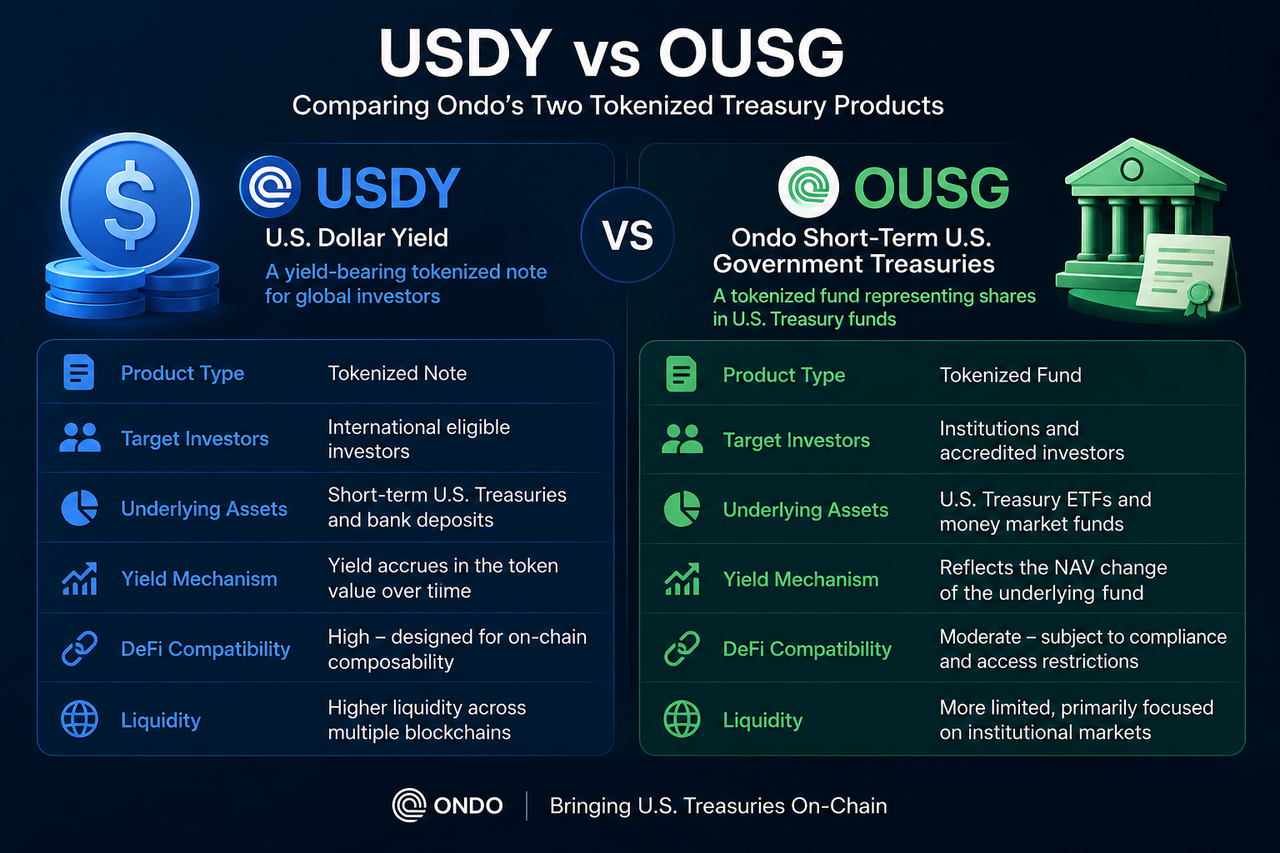
The key differences between USDY and OUSG lie in their legal structure, target audience, and product positioning. USDY is a yield-bearing tokenized note aimed at internationally qualified users, prioritizing on-chain liquidity and yield generation. OUSG is a tokenized fund whose underlying assets are tied to U.S. Treasury fund assets, making it more suited for institutional investors and compliant finance.
Functionally, USDY functions more like an on-chain yield-bearing dollar asset, while OUSG resembles a digital mirror of traditional fund shares. Although both offer exposure to U.S. Treasury yields, their target users and use cases differ significantly.
What Is USDY?
Ondo U.S. Dollar Yield (USDY) is a yield-bearing tokenized asset backed by short-term U.S. Treasuries and bank deposits. Its core mission is to channel U.S. Treasury yields into the blockchain ecosystem, allowing users to hold an on-chain dollar asset while earning returns from real-world assets.
USDY operates on a yield accrual model: interest from the underlying assets is gradually reflected in the token’s net asset value (NAV). As a result, USDY’s value typically appreciates over time as yield accumulates, rather than maintaining a fixed price like a stablecoin.
What Is OUSG?
Ondo Short-Term U.S. Government Treasuries (OUSG) is a tokenized U.S. Treasury fund product. Its underlying assets are primarily invested in short-term U.S. Treasury ETFs and money market funds, with investor fund interests represented through on-chain tokens.
Compared to USDY, OUSG is more akin to a traditional asset management product. Investors receive fund share–related rights rather than yield-bearing notes, making its structure closely resemble that of a conventional Treasury fund.
How Do the Legal Structures of USDY and OUSG Differ?
Legal structure governs product issuance, regulatory framework, and investor eligibility.
USDY adopts a yield-bearing note structure, giving holders rights linked to the yield of the underlying assets. Its design emphasizes on-chain liquidity and aims to provide a yield-bearing dollar asset for the digital asset market.
OUSG, by contrast, uses a tokenized fund share structure. Investors hold on-chain representations of fund interests and must comply with fund-related regulations. This structure aligns more naturally with traditional financial institutions’ investment frameworks and meets institutional capital compliance requirements.
How Do the Investor Access Requirements for USDY and OUSG Differ?
USDY and OUSG have markedly different target user profiles.
USDY is designed for international investors who meet applicable regulatory standards, offering a broader on-chain audience access to U.S. Treasury yields. Its product design prioritizes openness and cross-ecosystem transferability.
OUSG primarily serves institutional investors and qualified investor markets. Given its stronger fund product nature, it typically requires more stringent identity verification and investment qualification checks. Compared to USDY, OUSG is more aligned with traditional financial institution use cases.
How Do the Yield Mechanisms of USDY and OUSG Differ?
Both products ultimately derive yield from the U.S. Treasury market, but the delivery mechanism differs.
USDY accumulates yields generated by the underlying assets into the token’s NAV over time, enabling holders to benefit from token value appreciation. This model resembles an on-chain yield certificate.
OUSG reflects investment returns through changes in the fund’s NAV. Its yield performance depends on the overall performance of the underlying U.S. Treasury ETFs and money market funds, making it more analogous to traditional fund investment logic.
How Do Liquidity and DeFi Compatibility Differ Between USDY and OUSG?
USDY was designed from the ground up with on-chain composability in mind, making it more readily integrated into the DeFi ecosystem. An increasing number of lending protocols, liquidity protocols, and DAO treasuries now use USDY as a yield-bearing dollar asset for collateral, lending, and treasury management.
OUSG, while capable of on-chain issuance, has more limited circulation and use cases due to its institutional focus. Consequently, USDY generally offers superior compatibility and higher usage frequency in DeFi environments.
How Do USDY and OUSG Position Themselves in the RWA Ecosystem?
USDY and OUSG together form Ondo’s on-chain U.S. Treasury product suite, but each fulfills a distinct role.
USDY primarily targets the crypto-native market, serving DeFi users, DAOs, and digital asset investors as a source of dollar yield. It is a quintessential yield-bearing RWA asset.
OUSG focuses more on the traditional institutional market, providing a compliant channel for institutional capital to access the on-chain ecosystem. Its goal is to enhance the digital circulation efficiency of Treasury assets while maintaining the traditional financial regulatory framework.
This dual-product strategy enables Ondo to simultaneously address both crypto finance and traditional finance market demands.
USDY vs OUSG Comparison Table
| Dimension |
USDY |
OUSG |
| Product Type |
Yield-bearing tokenized note |
Tokenized fund product |
| Underlying Assets |
U.S. Treasuries and bank deposits |
U.S. Treasury ETFs and money market funds |
| Legal Structure |
Tokenized Note |
Tokenized Fund |
| Target Users |
Internationally qualified investors |
Institutional and qualified investors |
| Liquidity |
High |
Relatively limited |
| DeFi Compatibility |
Strong |
Weak |
| Yield Representation |
NAV accrual growth |
Fund NAV changes |
| Core Positioning |
On-chain yield asset |
Institutional-grade investment tool |
Summary
USDY and OUSG are both key products from Ondo Finance driving the tokenization of U.S. Treasuries, but they serve different market needs. USDY provides a yield-bearing dollar asset for on-chain users through a note structure, emphasizing liquidity and DeFi compatibility. OUSG bridges traditional institutional investment needs with blockchain infrastructure via a tokenized fund share structure.
From an RWA ecosystem perspective, USDY represents the future of on-chain yield assets, while OUSG exemplifies the practical path for institutional-grade financial products to move on-chain. Together, they advance the integration of the U.S. Treasury market with blockchain finance and showcase the diverse models of real-world asset tokenization.
FAQs
Are both USDY and OUSG U.S. Treasury products?
Yes. Both USDY and OUSG derive their yields from the U.S. Treasury market. They are both tokenized real-world asset (RWA) products, but they employ different legal structures and product designs.
Which is more suitable for DeFi use, USDY or OUSG?
USDY is generally better suited for the DeFi ecosystem. Its design emphasizes on-chain liquidity and composability, making it more readily adopted by lending protocols, liquidity protocols, and DAO treasuries.
Is OUSG essentially a fund?
OUSG is closer to a tokenized fund product. Investors hold on-chain representations of interests related to U.S. Treasury fund products, so its operating logic is similar to that of traditional funds.
Why isn’t USDY considered a stablecoin?
USDY does not aim to maintain a fixed price; instead, it continuously generates yield from U.S. Treasuries. Therefore, USDY is a yield-bearing dollar asset, not a stablecoin used for payments and settlements.
Are both USDY and OUSG RWA products?
Yes. Both USDY and OUSG are tokenized real-world asset products, with their value derived from off-chain U.S. Treasuries and related financial assets.
Why did Ondo launch both USDY and OUSG?
USDY and OUSG target different market needs. USDY primarily serves on-chain yield scenarios and the DeFi ecosystem, while OUSG mainly serves institutional investment demand. Together, they form Ondo’s comprehensive on-chain U.S. Treasury product matrix.







