Unlike traditional retailers, Amazon’s valuation logic is often closer to that of a large technology company. Beyond the scale of product sales, capital markets also focus closely on AWS growth, the profitability of the advertising business, investment in AI infrastructure, and the potential for future cash flow growth. For that reason, understanding Amazon’s business structure is often more important than simply watching its stock price movement.
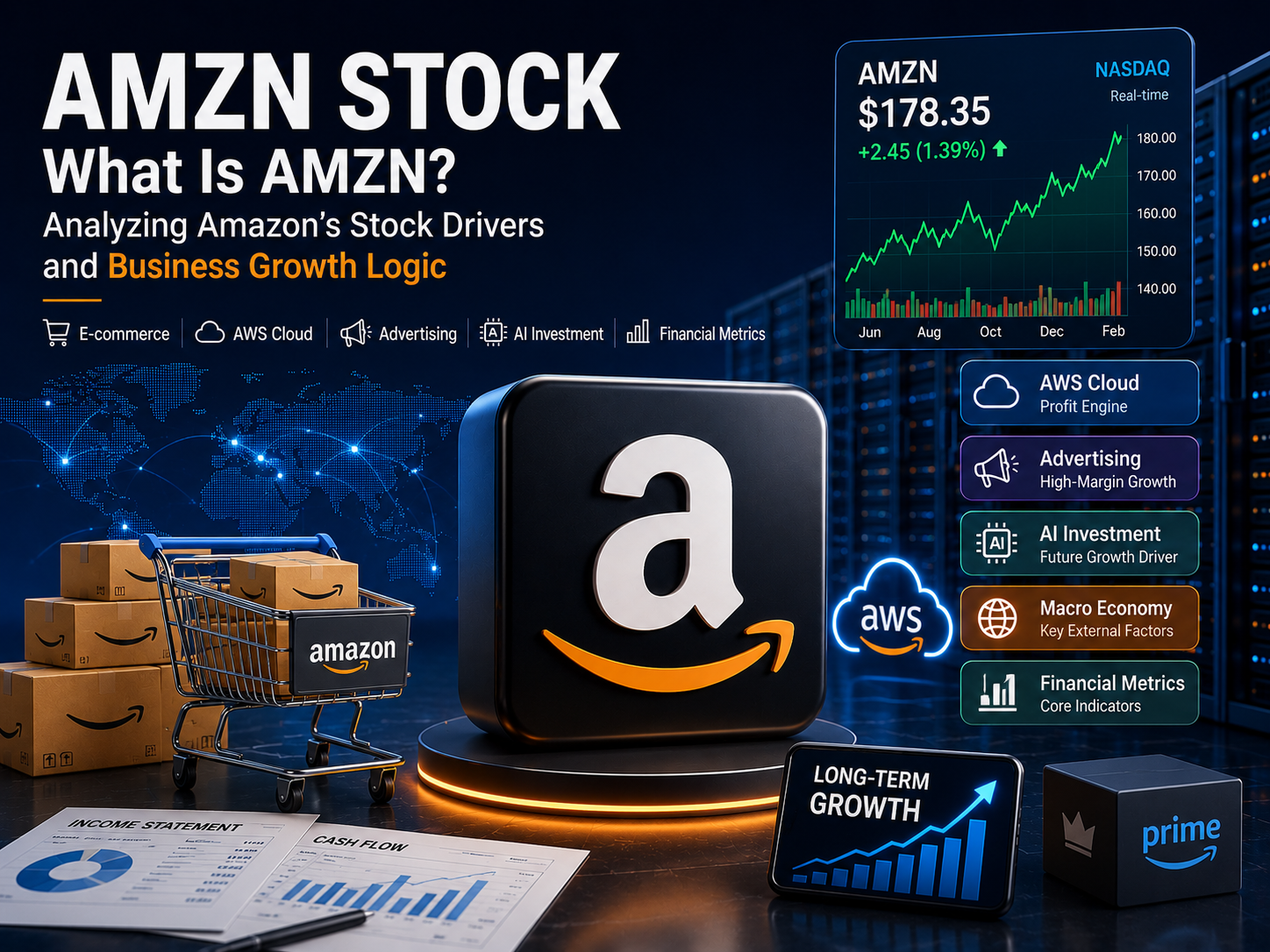
As one of the world’s most valuable technology companies, Amazon has long been one of the most closely watched technology stocks in the U.S. capital market. The company listed on Nasdaq in 1997 and, after years of development, has expanded into e-commerce, cloud computing, digital advertising, artificial intelligence, enterprise services, and other fields.
From a stock profile perspective, AMZN combines exposure to consumer internet, cloud computing, and AI infrastructure. As a result, its market performance is influenced not only by the retail business, but also by enterprise IT spending, demand for cloud computing, and capital expenditure cycles across the technology sector.
AMZN is currently an important constituent of several major U.S. technology indexes and one of the technology assets widely held by global institutional investors. Because Amazon has a vast user base, a mature business ecosystem, and a continuously expanding technology platform, AMZN has long been viewed as a key reference point for evaluating the growth capacity of large technology companies.
Unlike many single-business companies, Amazon serves both consumer and enterprise markets. This diversified structure gives AMZN a broader set of growth drivers, and it also means investors need to monitor changes across multiple business segments when analyzing the stock, not just e-commerce sales data.
| Item |
Details |
| Company name |
Amazon.com, Inc. |
| Stock ticker |
AMZN |
| Listing market |
NASDAQ |
| Industry |
Technology and internet |
| Core businesses |
E-commerce, cloud computing, advertising, AI |
| Main revenue sources |
Online retail, AWS, advertising, membership services |
Because Amazon’s business coverage is so broad, AMZN’s valuation logic differs clearly from that of traditional retailers. Capital markets tend to pay more attention to AWS growth, advertising profitability, and progress in the company’s artificial intelligence strategy, all of which have become important variables affecting Amazon’s long-term stock performance.
How Amazon’s Revenue Structure Affects Its Stock Price
Amazon’s revenue sources are highly diversified, but different businesses do not affect the stock price to the same degree. Although e-commerce contributes the largest revenue scale, capital markets often pay closer attention to the growth of higher-profit businesses.
Amazon’s main revenue sources currently include:
| Business Segment |
Main Revenue Source |
| Online retail |
Product sales |
| Third-party seller services |
Commissions and logistics services |
| AWS |
Cloud computing services |
| Advertising |
Platform advertising placements |
| Prime membership |
Subscription revenue |
From a market valuation perspective, revenue scale is not the only metric. Investors care more about revenue quality, meaning which businesses can consistently generate profit and cash flow. For example, while e-commerce is large in scale, its margins are relatively lower; AWS and advertising, by contrast, usually have higher margins and therefore tend to carry more weight in how the market evaluates Amazon’s long-term value.
That is why, when Amazon releases earnings, the market often looks not only at total revenue growth, but also at how quickly its higher-profit businesses are growing.
Why AWS Has Become Central to AMZN’s Valuation
AWS (Amazon Web Services) is Amazon’s cloud computing platform and a major player in the global cloud computing market. For many analysts, AWS has become one of the key factors shaping AMZN’s long-term valuation.
AWS provides computing, storage, database, networking, and artificial intelligence services. Many enterprises, developers, and institutional customers rely on AWS to build digital infrastructure, giving AWS revenue a relatively high degree of stability and continuity.
Compared with traditional retail, cloud computing has clearly higher margins. This means that for the same amount of revenue growth, AWS can generate more profit. As a result, capital markets usually assign higher valuation multiples to cloud computing businesses.
When analyzing Amazon, many institutions even value AWS as a standalone large-scale cloud computing company, then add that value to the retail, advertising, and other business segments to form an overall valuation model. This clearly shows how important AWS is to AMZN.
How AI Investment Affects Market Expectations for Amazon
In recent years, artificial intelligence has become one of the most important development directions in the global technology industry. With the rapid growth of generative AI, large models, and enterprise AI applications, the market has started to reassess the growth potential of major technology companies.
Amazon’s AI strategy is mainly built around AWS, including the generative AI service platform Bedrock, its in-house AI chips Trainium and Inferentia, and its continuously expanding data center infrastructure.
AI affects Amazon in two main ways. First, AI applications require substantial computing resources, and that demand can directly drive growth in AWS cloud services. Second, the market is often willing to pay a higher valuation for companies with AI competitiveness, creating what is often described as an “AI premium.”
Therefore, even when some AI investments have not yet translated into near-term profits, the market may still raise AMZN’s valuation because of future growth expectations. This is also why AI-related news has frequently affected Amazon’s stock price in recent years.
What Are the Core Metrics in Amazon’s Earnings Reports
When analyzing AMZN stock, earnings reports are one of the most important sources of information. The market usually uses several key indicators to assess Amazon’s current operating condition and future growth trend.
The following indicators are usually watched most closely by investors:
| Core Metric |
Why It Matters |
| Revenue growth rate |
Measures business expansion speed |
| AWS revenue growth rate |
Measures cloud computing demand |
| Advertising revenue growth rate |
Measures monetization capacity |
| Operating margin |
Measures profitability |
| Free cash flow |
Measures financial health |
Among these, AWS growth is often the central focus after earnings are released. If AWS grows faster than the market expected, investors usually see it as a sign that enterprise customer demand remains strong, which can improve market confidence.
At the same time, free cash flow is attracting more attention. Compared with accounting profit, free cash flow better reflects a company’s actual ability to generate cash, making it an important reference point for long-term valuation.
Although Amazon has a powerful business ecosystem, AMZN’s performance is still affected by the macroeconomic environment.
First, Federal Reserve interest rate policy can affect technology stock valuations. The value of growth companies depends heavily on future cash flows. In a high-interest-rate environment, the discounted value of future earnings falls, so technology stock valuations are often pressured.
Second, changes in consumer spending can affect Amazon’s e-commerce business. When economic growth slows or consumer confidence weakens, consumer purchasing power may decline, which can weigh on platform sales.
In addition, enterprise IT spending affects AWS revenue growth. If companies reduce their technology investment budgets, cloud computing demand may slow, which can also affect the market’s expectations for Amazon’s future growth.
As a result, AMZN reflects not only Amazon’s own operating performance, but also, to some extent, changes in the global economy and technology industry cycle.
How to Trade AMZN Stock with Crypto Assets
As multi-asset trading markets develop, investors are no longer limited to traditional stock accounts when participating in the AMZN market.
Gate currently supports multiple trading methods, including spot tokens, CFD products, and related derivatives. Users can choose different products according to their own needs to participate in the AMZN market.
| Product Type |
Main Features |
| Spot tokens |
Hold the corresponding asset, no leverage |
| CFD products |
Track AMZN stock price movements |
| Derivatives trading |
Supports two-way trading and leverage mechanisms |
For users who want exposure to Amazon’s price movements, CFD products allow trading without directly holding the stock and support both long and short positions. Compared with traditional stock accounts, a multi-asset trading system can bring digital assets and traditional financial products under unified management, improving capital efficiency.
It is important to note that CFDs and other leveraged derivative products carry higher risks. Their prices usually track the movements of the underlying asset, so their risk and return characteristics differ clearly from spot stocks.
Summary
AMZN is the stock ticker for Amazon and one of the most representative stocks in the global technology industry. Although Amazon still has a massive e-commerce business, AWS cloud computing, digital advertising, and artificial intelligence initiatives have become important growth engines affecting its long-term value.
From a capital markets perspective, AWS growth, progress in AI investment, advertising business expansion, and free cash flow performance often have a greater impact on AMZN’s valuation changes than product sales scale alone. Understanding these core drivers helps provide a fuller view of Amazon’s business value and stock price logic.
FAQs
What Kind of Stock Is AMZN?
AMZN is Amazon’s stock ticker on the Nasdaq market and represents investor ownership of equity in Amazon.
Why Does AWS Affect AMZN’s Stock Price?
AWS is one of Amazon’s highest-margin businesses. Its revenue growth and profitability usually have a direct impact on how the market assesses Amazon’s overall valuation.
Why Does AI Affect Amazon’s Valuation?
AI applications require large amounts of cloud computing resources, which can drive AWS growth. At the same time, the market often assigns higher valuation expectations to companies with AI competitiveness.
What Are Amazon’s Most Important Revenue Sources?
Amazon’s revenue mainly comes from online retail, third-party seller services, AWS cloud computing, advertising, and Prime membership subscription services.
Which Financial Metrics Matter Most?
When analyzing AMZN, the market usually focuses on AWS revenue growth, advertising business growth, operating margin, and free cash flow.
Can AMZN Be Traded on Gate?
Users can participate in the AMZN market through related products provided by Gate, including spot tokens, CFD products, and other related TradFi trading products.