In modern capital markets, an exchange is not only a place where buyers and sellers complete transactions. It is also essential infrastructure for price discovery, risk management and liquidity allocation. Whether in equity markets, derivatives markets or index product markets, mature trading platforms are needed to keep the system running efficiently. CBOE is one of the key institutions that plays this role.
Compared with many securities exchanges that investors are more familiar with, CBOE is best known for its options business and volatility product ecosystem. As institutional investors place greater emphasis on risk management, the importance of options and derivatives markets continues to grow. CBOE has also gradually developed into one of the most influential exchange groups in global financial markets.
What Is CBOE Global Markets?
CBOE Global Markets is a publicly listed exchange group headquartered in Chicago, United States. The company was originally founded in 1973 to create a standardized equity options market and provide investors with a unified, transparent and efficient trading platform.
Unlike commercial banks or asset management firms, CBOE does not engage in lending or investment management. Its core function is to operate financial market infrastructure, providing trading environments and market services for investors, brokers, market makers, institutional clients and listed companies.
Today, CBOE has grown into a diversified exchange group covering equities, options, futures, foreign exchange and market data services. The company operates multiple trading platforms and serves financial institutions and investors across different regions of the world.
From an industry perspective, CBOE is a financial infrastructure provider. Its commercial value is built on the continued trading and risk management activities of market participants.
CBOE’s History and Market Position
CBOE’s history has developed almost in parallel with the rise of the modern options market. In 1973, CBOE officially launched a standardized equity options market, creating unified rules and trading standards for what had previously been a relatively fragmented over the counter options market.
The introduction of standardized contracts greatly improved market transparency and liquidity. It also helped options evolve from a tool mainly used by professional institutions into a widely adopted financial product. As the U.S. capital market continued to grow, the options market expanded steadily, and CBOE gradually became an industry leader.
After entering the 21st century, CBOE continued to expand its business through technology upgrades, product innovation and strategic acquisitions. The company not only strengthened its options business, but also moved gradually into equity trading, futures trading and global market data services.
Today, CBOE has evolved from a single options exchange into a global diversified exchange operator, holding an important position in both U.S. and global capital markets.

How CBOE’s Exchange Business Works
The core task of an exchange is to create a fair, transparent and efficient market environment. Through its electronic trading platforms, CBOE connects buyers and sellers so market participants can trade under a unified set of rules.
When investors submit buy or sell orders, the trading system automatically matches orders based on price and time priority. Once a trade is executed, the relevant price and transaction information is disclosed to the market in real time, forming the mechanism of market price discovery.
Beyond order matching, CBOE is also responsible for market supervision and risk management. The exchange needs to monitor unusual trading activity, maintain market order and work with clearing institutions to safeguard transaction security.
For modern capital markets, exchanges do more than execute trades. They are also an important guarantee of market liquidity and price transparency. As a result, exchange operations have become an indispensable part of the global financial system.
CBOE’s Options Market and Derivatives Ecosystem
The options market is CBOE’s core business area and one of its most important sources of competitive advantage.
Options give investors the right to buy or sell an asset at an agreed price at a specified future time. They are therefore widely used for risk management, income enhancement and portfolio protection. Both institutional and individual investors can use options to manage risks caused by market volatility.
Around the options market, CBOE has gradually built a complete derivatives ecosystem. In addition to equity options, the company also operates index options, volatility products and various innovative derivatives markets. These products reinforce one another, allowing market participants to allocate assets and manage risk according to different needs.
Because the options market has strong network effects, higher liquidity generally leads to more efficient trading. Leading exchanges can therefore continue attracting new market participants, further strengthening their competitive advantages.
Why the VIX Volatility Index Became an Important Market Indicator
The VIX index is one of CBOE’s most globally influential financial products. It is also an important indicator used by investors worldwide to assess market risk sentiment.
The VIX index calculates the market’s expected future volatility based on S&P 500 index option prices, allowing it to reflect investors’ expectations of future market uncertainty. Because it is closely linked to market sentiment, the VIX is often called the “fear index.”
When market risk rises, investors usually increase their demand for hedging, which pushes option prices higher and drives the VIX index upward. Conversely, when market sentiment is stable, the VIX usually remains at a lower level.
As demand for volatility trading has grown, futures, options, ETFs and related investment products built around the VIX have formed a complete ecosystem. This means the VIX is not only a market indicator, but also one of CBOE’s most recognizable brand assets.
CBOE’s Role in Global Capital Markets
CBOE’s role in global capital markets is reflected not only in its operation of trading platforms, but also in its contribution to risk management infrastructure.
Modern financial markets require a wide range of tools to help investors manage risk, and options and derivatives are important ways to achieve that goal. By operating one of the world’s leading options markets, CBOE helps both institutional and individual investors respond more effectively to market volatility.
At the same time, CBOE supports global investment decision making through its market data services and index systems. Many financial institutions rely on its market data for research, quantitative analysis and asset allocation, making CBOE an important information provider in global capital markets.
In a sense, CBOE connects investors, market makers, institutional clients and listed companies, forming an important part of the modern financial market structure.
How CBOE Differs From CME and ICE
Although CBOE, CME and ICE are all among the world’s leading exchange groups, their business focuses differ significantly.
| Exchange |
Core Strength |
Representative Products |
| CBOE |
Equity options and volatility products |
Equity options, VIX |
| CME |
Futures and interest rate products |
Equity index futures, interest rate futures |
| ICE |
Energy and global trading networks |
Crude oil, energy derivatives |
CBOE’s most distinctive strength is its leading position in equity options and volatility markets. CME is more focused on futures markets, especially interest rates, foreign exchange and equity index futures, where it has global influence. ICE has built its competitive advantage through energy markets and global trading networks.
These differences allow the three exchanges to serve different types of clients and establish their own distinct market positions.
Main Use Cases of CBOE
CBOE’s use cases are mainly concentrated in investing, risk management and market analysis.
For institutional investors, CBOE markets provide a wide range of options tools that can be used for portfolio hedging and risk control. For asset management firms, index options and volatility products can help build more complex investment strategies.
In market research, many investors watch the VIX index to assess market risk sentiment. Market data services also provide foundational data support for quantitative funds and financial technology companies.
As the derivatives market continues to develop, the products offered by CBOE have been widely applied across multiple areas of global capital markets.
How to Buy CBOE Global Markets Stock
CBOE is the stock ticker of CBOE Global Markets in the U.S. securities market. Traditionally, investors can buy CBOE stock through brokerage accounts that support U.S. stock trading, allowing them to participate in the development of the global exchange industry.
Because CBOE’s revenue is closely tied to options trading volume, market activity and the level of participation in financial markets, many market participants view it as one of the important companies for observing global capital market activity.
As digital asset markets and traditional financial markets gradually converge, more trading tools linked to U.S. stock price movements have also appeared in the market. For example, some platforms offer CFD products linked to stock prices, allowing users to participate in price movements without directly holding the underlying shares.
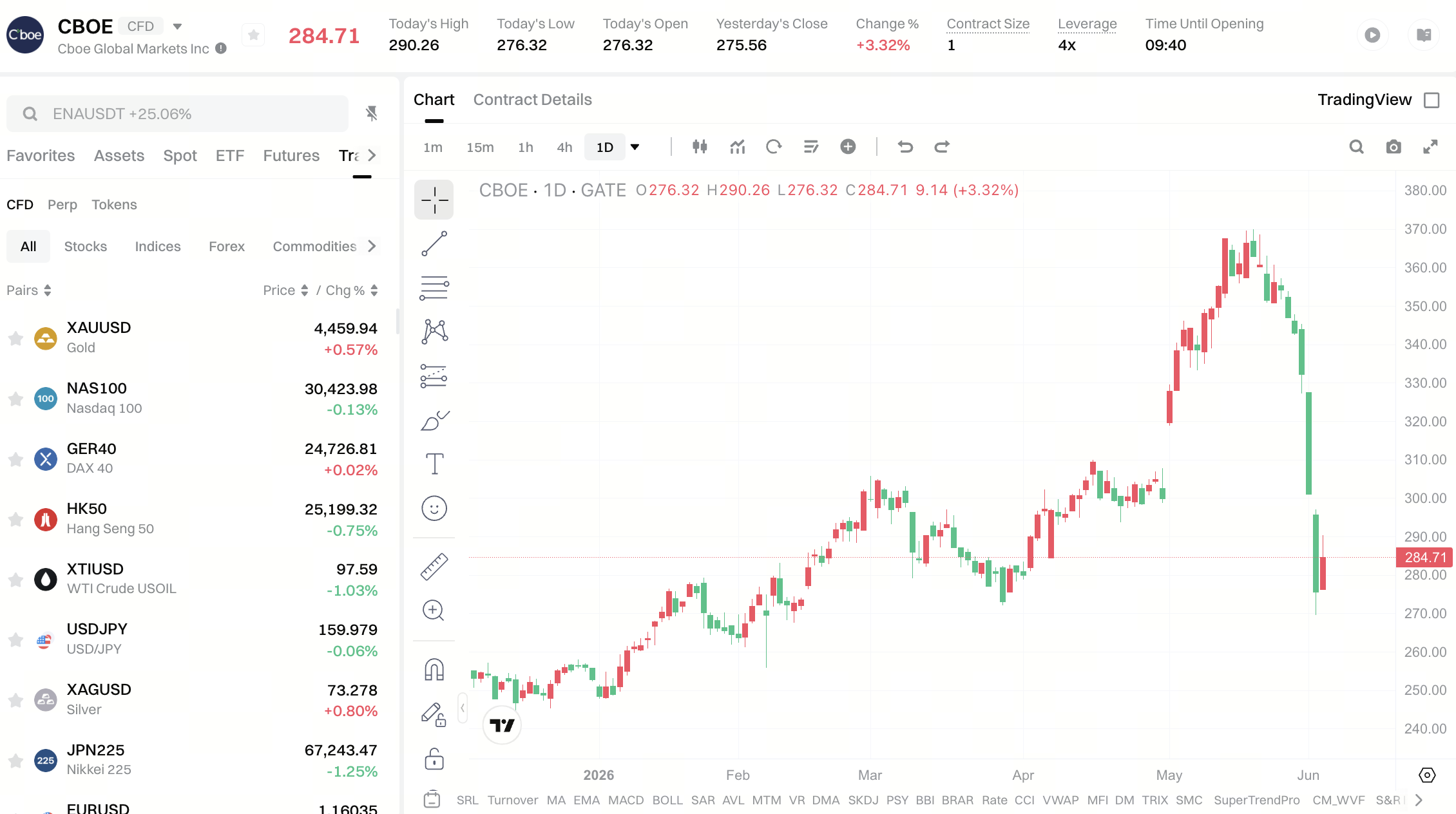
Gate TradFi is continuously expanding its coverage of traditional financial assets. Users can follow digital assets, U.S. stocks, ETFs, indices and commodity markets within a unified account environment. Some markets also offer Gate CFD products, providing more options for cross market asset allocation and price tracking.
Regardless of how investors participate in the market, they should fully understand the product structure, trading rules and regulatory requirements in their region.
CBOE’s Strengths and Limitations
CBOE’s greatest strengths come from its long established leadership in the options market and its volatility product ecosystem. Mature liquidity, a broad customer base and the influence of the VIX brand together form its core competitive advantages.
At the same time, exchange businesses have clear economies of scale. Once an exchange has built market depth and liquidity advantages, new entrants often find them difficult to replicate. This creates relatively high industry barriers for CBOE.
However, the exchange industry also faces competitive pressure. Global exchange groups continue to launch new products and technologies, while changes in market structure may also affect trading volume growth. In addition, changes in the regulatory environment and fluctuations in market cycles can influence exchange operations.
Therefore, CBOE’s development benefits from the expansion of global derivatives markets, but it must also continue innovating its products and upgrading its technology to maintain its competitive edge.
Summary
CBOE Global Markets is one of the world’s leading exchange operators and an important force behind the modern options market and volatility product ecosystem. By operating equities, options and derivatives trading platforms, providing market data services and building the VIX index system, CBOE has become an important financial infrastructure provider in global capital markets. As demand for risk management continues to grow, options and volatility markets are becoming increasingly important, and CBOE’s role in the global financial system is also becoming more significant.
FAQs
What kind of company is CBOE?
CBOE Global Markets is one of the world’s leading exchange operators. Its main businesses include options, equities, futures and market data services.
Why is CBOE well known?
CBOE was an important pioneer in the modern standardized equity options market and is also the creator of the VIX volatility index.
What is the relationship between the VIX index and CBOE?
The VIX index was developed and is operated by CBOE. It is one of the most widely used market volatility indicators in the world.
How does CBOE mainly make money?
CBOE mainly generates revenue through trading fees, market data services, index licensing and related market services.
What is the difference between CBOE and CME?
CBOE focuses more on options markets and volatility products, while CME is stronger in futures and interest rate derivatives markets.
Is CBOE a financial institution or an exchange?
CBOE is an exchange operator and financial market infrastructure provider, not a traditional bank or asset management institution.