Within the global internet industry, Meta has long held an important position. Billions of users use Meta’s platforms every day to access information, build social connections, consume content, and conduct business activities. This vast user base not only forms Meta’s core competitive advantage, but also provides rich data and application scenarios for its advertising business and AI strategy.
In recent years, as generative AI has developed rapidly, Meta has begun investing more resources in large model research and AI infrastructure. Compared with its previous growth model, which was mainly driven by social media and advertising, Meta is gradually shifting toward a dual position as both a social platform and an AI platform.
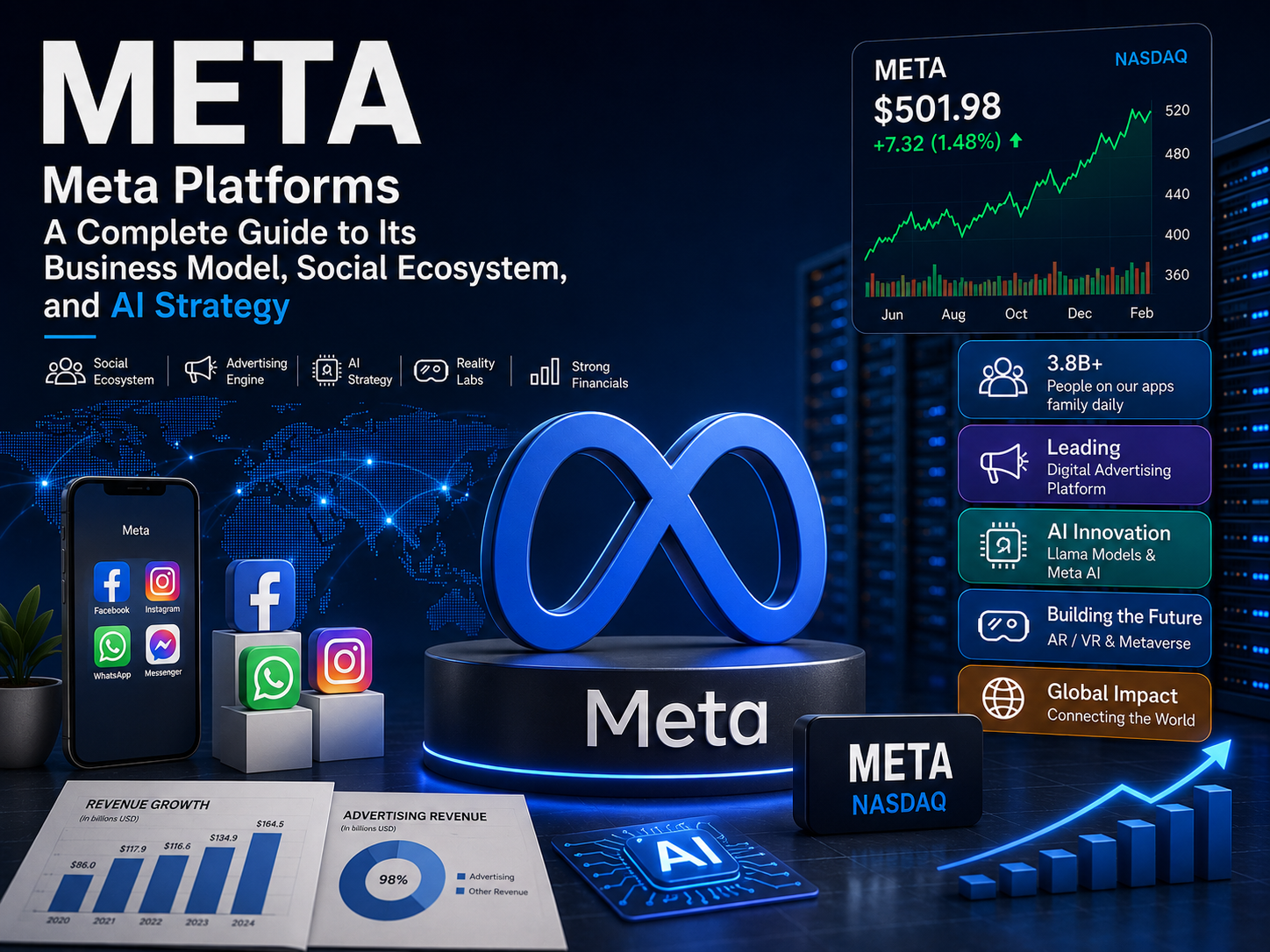
Meta Platforms is one of the world’s largest social media groups. The company first grew around Facebook as its core product, then built an ecosystem spanning social networking, content distribution, instant messaging, and digital advertising through the acquisition of platforms such as Instagram and WhatsApp.
Meta’s business model is built on a combination of free services and advertising monetization. Users can access Facebook or Instagram without paying, while advertisers use the platforms to reach audiences around the world.
Meta’s main businesses currently include:
| Business Segment |
Main Products |
| Social platforms |
Facebook |
| Images and short videos |
Instagram |
| Instant messaging |
WhatsApp, Messenger |
| Advertising business |
Meta Ads |
| AI business |
Meta AI, Llama |
| Virtual reality |
Reality Labs |
What makes Meta distinctive in the global internet industry is its large scale social network, which spans different age groups and regions. This network effect allows Meta to continuously attract users, creators, and advertisers into its ecosystem.
Meta’s Development History and Market Position
Meta was formerly known as Facebook. The company was founded by Mark Zuckerberg in 2004. Facebook was initially positioned as a campus social network before gradually expanding into global markets.
As its user base grew, Facebook began commercializing through advertising. Meta later expanded the scope of its ecosystem through a series of strategic acquisitions, with Instagram and WhatsApp among the most representative examples.
Meta’s development can be broadly divided into several stages:
| Stage |
Core Focus |
| Social networking period |
Facebook expansion |
| Mobile internet period |
Instagram growth |
| Platform ecosystem period |
WhatsApp and advertising business |
| AI and metaverse period |
AI and Reality Labs |
In 2021, the company officially changed its name from Facebook to Meta Platforms. This change was not only a brand upgrade, but also reflected the company’s strategic direction of moving from a single social media business toward a broader technology platform.
Today, Meta has become an important player in the global digital advertising market, as well as a major competitor in generative AI.
Meta’s core competitiveness comes from its vast social platform ecosystem. Facebook, Instagram, WhatsApp, and Messenger together form a network system that covers social networking, content distribution, and instant messaging.
The value of Meta’s platforms mainly comes from network effects. As the number of users increases, platform content becomes richer and advertisers become more willing to spend, creating a positive growth cycle.
Meta’s social ecosystem is mainly made up of three roles:
-
Ordinary users
-
Content creators
-
Advertisers
Users produce content, creators attract traffic, and advertisers purchase exposure opportunities. Together, these three groups drive platform growth.
Meta’s recommendation system distributes content based on user interests and behavior, helping increase the amount of time users spend on the platform and how often they interact. This data driven content recommendation model has become an important foundation of modern social media platforms.
The large social ecosystem also gives Meta’s AI products a wide range of application scenarios, allowing the company to test and promote new features and services quickly.
Advertising is Meta’s most important source of revenue, and it is also an important foundation supporting the company’s valuation.
Meta’s platforms have billions of active users, allowing the company to offer advertisers digital traffic at enormous scale. Advertisers run ads on Facebook and Instagram to reach their target audiences.
The core advantage of Meta’s advertising system comes from its precise targeting capabilities. The advertising system can combine user interests, behavioral characteristics, and interaction history to improve ad matching efficiency.
Meta’s advertising business mainly includes:
| Ad Format |
Use Case |
| Feed ads |
Facebook and Instagram |
| Reels ads |
Short video content |
| Brand ads |
Brand promotion |
| Conversion ads |
E commerce sales |
The importance of the advertising business lies not only in its revenue scale, but also in its profit margins. Compared with operating social platforms themselves, advertising can usually generate higher profits, making it the core driver of Meta’s long term growth.
Artificial intelligence has become an important part of Meta’s strategy. Unlike some technology companies that mainly advance AI through external partnerships, Meta places greater emphasis on open source models and in-house research and development capabilities.
Meta’s AI strategy mainly focuses on the following areas:
-
Llama large language models
-
Meta AI assistant
-
AI recommendation systems
-
AI advertising optimization
-
AI infrastructure development
The Llama series is one of Meta’s most important AI projects. Unlike closed models, Meta has chosen to open parts of its model capabilities, hoping to attract developers and enterprises to build the ecosystem together.
For Meta, the significance of AI is not limited to technology competition. It also lies in improving the efficiency of existing businesses. Recommendation algorithms, ad delivery, content moderation, and other processes all rely heavily on AI technology.
As investment in AI infrastructure increases, the market has also begun to view Meta as an important participant among large AI platforms, not merely as a social media company.
Although Meta, Google, and TikTok are all internet platforms, there are clear differences in their business structures and growth logic.
Google is centered on search and advertising, while TikTok relies mainly on the growth of its short video content ecosystem. Meta’s advantage comes from the combined network effects of multiple social platforms.
| Comparison Dimension |
Meta |
Google |
TikTok |
| Core business |
Social platforms |
Search and advertising |
Short video |
| Main revenue |
Advertising |
Advertising and cloud services |
Advertising |
| User relationship |
Social network |
Search demand |
Content consumption |
| AI strategy |
Llama ecosystem |
Gemini ecosystem |
Content recommendation |
Meta is distinctive because it has both social relationship chains and content recommendation capabilities. Compared with platforms that rely only on search or short video, Meta can build a more complete user ecosystem through multiple products.
This ecosystem advantage has also become an important foundation for Meta’s competition in advertising and AI.
What Are Meta’s Main Use Cases?
Meta’s products are widely used across personal social networking, content creation, corporate marketing, business communication, and other areas.
Ordinary users usually use Facebook and Instagram to access information, share daily life, and participate in community interactions. Businesses use Meta’s platforms more often for brand marketing and customer operations.
Meta’s main use cases include:
-
Social interaction
-
Content distribution
-
Digital marketing
-
Brand promotion
-
Online commerce
-
AI assistant services
WhatsApp is also increasingly being used by businesses for customer service and commercial communication. As AI features are added, Meta’s platform use cases are expanding from traditional social networking into intelligent assistants and enterprise services.
This ability to expand across scenarios helps Meta continue increasing its ecosystem influence.
META is an important stock in the U.S. technology equity market. Through the Gate TradFi product system, users can participate in various global stock related markets, including META.
Users can currently choose spot stocks, CFD products, or other related derivatives tools based on their different needs.
| Product Type |
Features |
| Spot tokens |
Hold the corresponding asset |
| CFD products |
Track stock price movements |
| Derivatives products |
Support two way trading |
For users who follow META stock price movements, CFD products allow participation in market price action without directly holding the stock.
It is important to note that CFDs and other leveraged products are derivatives instruments. Their risk and return characteristics differ from traditional stock holdings, so users should fully understand the product rules and risk management requirements before trading.
Meta’s greatest advantage comes from its massive user base and mature advertising ecosystem. Facebook, Instagram, and WhatsApp together form one of the most influential social networks in the world.
Meta’s main strengths include:
-
Massive global user scale
-
Mature advertising business
-
Clear network effects
-
Strengthening AI research and development capabilities
At the same time, Meta also faces several challenges.
Its main limitations include:
-
High dependence on advertising business
-
Rising global regulatory pressure
-
Intensifying social media competition
-
High AI infrastructure investment costs
As technology industry competition enters the AI era, Meta needs to sustain advertising business growth while continuing to invest in AI and infrastructure in order to maintain long term competitiveness.
Conclusion
META is the stock ticker for Meta Platforms. Meta has developed from a single social media platform into an integrated technology company spanning social networks, digital advertising, instant messaging, and artificial intelligence.
Facebook, Instagram, and WhatsApp form Meta’s core ecosystem, while advertising has long been the company’s most important source of revenue. As generative AI develops rapidly, Meta is also strengthening its competitiveness in artificial intelligence through products such as the Llama models and Meta AI.
Over the long term, Meta’s market position and growth potential will be shaped jointly by its social ecosystem, advertising capabilities, and AI strategy.
FAQs
META is the stock ticker for Meta Platforms, Inc. Meta is one of the world’s largest social media companies, with platforms including Facebook, Instagram, and WhatsApp.
How Does Meta Mainly Make Money?
Meta mainly generates revenue through digital advertising. Advertisers place ads on platforms such as Facebook and Instagram to reach target audiences.
Meta AI is Meta’s artificial intelligence product system, including the Meta AI assistant, Llama large language models, and various AI services and tools.
Meta relies mainly on social networks and its advertising ecosystem, while Google relies mainly on search engines, advertising, and cloud computing services.
What Are the Features of the Llama Model?
Llama is a series of large language models developed by Meta. Its key feature is an open ecosystem strategy, allowing developers and enterprises to innovate and deploy solutions based on the model.
Users can participate in the META market through related TradFi products offered by Gate, including spot stocks, CFD products, and other trading tools linked to stock prices.