Most modern infrastructure depends on construction materials. From highways and airport runways to residential communities and commercial parks, all kinds of engineering projects require large amounts of aggregates, cement and concrete as basic raw materials. As cities expand, transportation networks are upgraded, and public facilities continue to be built, the construction materials industry has become one of the foundational sectors supporting economic development.
Unlike many consumer-facing brands, Martin Marietta operates mainly upstream in the industrial value chain. Ordinary consumers may not buy its products directly, but the roads, bridges, schools, hospitals and residential buildings they use every day are often closely connected to the materials it supplies. For this reason, Martin Marietta is regarded as one of the key participants in the U.S. infrastructure system.
What Is MLM, Martin Marietta Materials?
Martin Marietta is a publicly listed U.S. company focused on construction materials production and supply. It is also one of the largest aggregates producers in North America.
The company’s core business centers on construction materials, including aggregates, crushed stone, sand and gravel, cement, ready-mixed concrete and asphalt. These materials are widely used in road construction, commercial real estate development, residential construction and major public works projects.
Compared with building raw materials such as steel and timber, aggregates may have a relatively low technical threshold, but they are irreplaceable basic resources in engineering construction. Whether building highways or urban housing, large quantities of aggregates are needed as foundational materials, which gives the aggregates market stable long-term demand.
In capital markets, MLM is usually classified under the construction materials sector. Its operating performance is closely tied to the U.S. real estate market, infrastructure investment and the broader construction cycle.
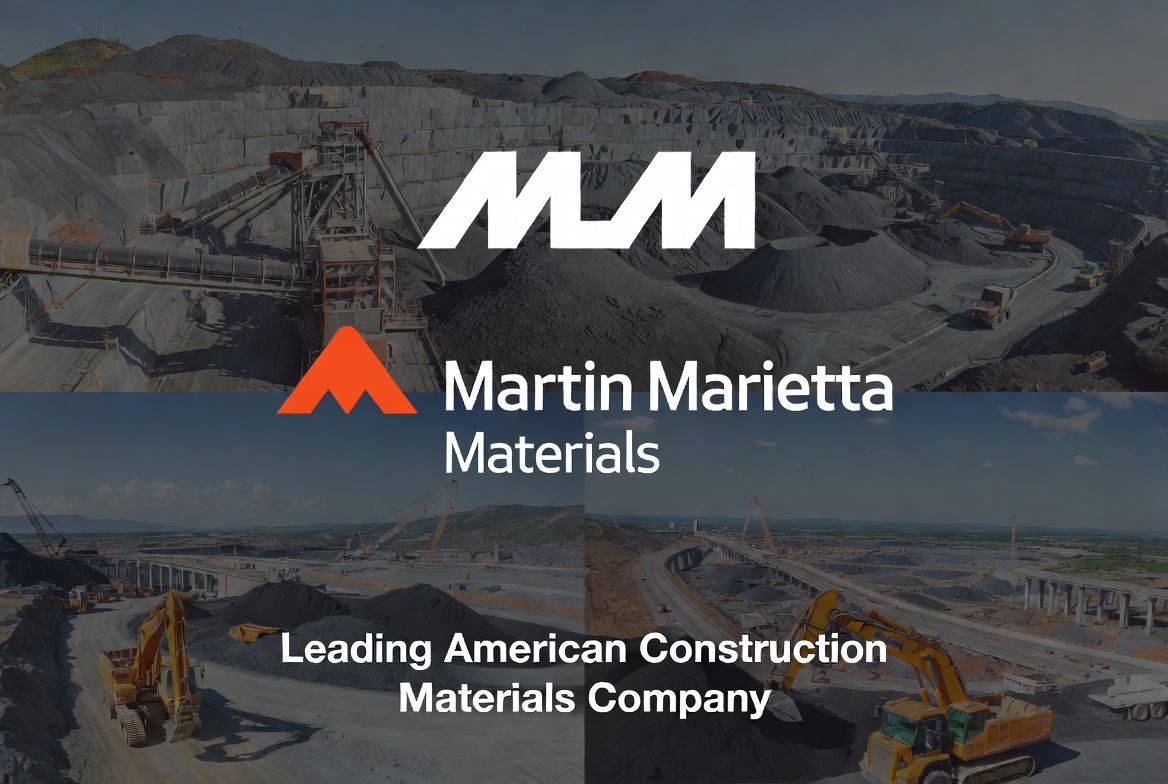
Martin Marietta’s History and Market Position
Martin Marietta’s history can be traced back to the early 20th century. After decades of development and multiple rounds of industry consolidation, the company gradually became one of the major leaders in the U.S. construction materials industry.
Over the past several decades, the U.S. construction materials industry has undergone a clear trend toward consolidation. Large companies have expanded their market coverage by acquiring regional quarries, transportation networks and concrete businesses. Martin Marietta built a large production and supply system spanning multiple states through this process.
In terms of market positioning, the company does not serve end consumers directly. Instead, it serves engineering contractors, real estate developers, government agencies and infrastructure projects. Because construction materials are expensive to transport, regional resource placement is critical to competition in the industry. Companies with high-quality quarry resources and mature transportation networks are often able to build strong competitive advantages.
Today, Martin Marietta has become one of the important representative companies in the U.S. construction materials industry.
How Martin Marietta’s Construction Materials Business Works
Martin Marietta’s business model is built on resource extraction, materials processing and regional supply networks.
The company first extracts natural rock resources through quarries and mining sites, then uses crushing, screening and processing equipment to produce aggregates in different specifications. Once processed, these aggregates can meet the needs of road construction, bridge building, residential development, industrial projects and other fields.
The construction materials industry is highly localized. Because aggregates are costly to transport, most projects prefer to purchase from nearby suppliers. As a result, control over high-quality mining resources and regional supply networks is often more important than brand recognition.
By operating quarries, transportation systems and production facilities across multiple regions of the United States, Martin Marietta has built a broad construction materials supply network. This layout helps the company serve regional markets over the long term and maintain stable customer relationships.
Why Aggregates Are the Company’s Core Revenue Source
Aggregates are Martin Marietta’s most important product category and the foundation of the broader construction materials system.
Aggregates usually include crushed stone, sand and gravel, and other mineral particle materials. Although the price per ton is relatively low, construction projects use them in massive quantities, creating a large market overall.
Highway construction is one of the most typical sources of aggregates demand. Building one kilometer of highway often requires tens of thousands of tons of aggregates, while major airport, port and industrial park projects require even larger volumes of materials.
In addition, the aggregates business has strong resource characteristics. High-quality mining areas take a long time to develop, and new supply is constrained by land, environmental and approval requirements. Companies with abundant resource reserves therefore tend to have strong competitive barriers.
For Martin Marietta, the aggregates business not only provides its largest source of revenue, but also forms an important foundation for the company’s long-term competitive advantage.
Martin Marietta’s Role in U.S. Infrastructure Construction
The U.S. infrastructure construction market is one of Martin Marietta’s most important sources of end demand.
Roads, bridges, railways, airports and public facilities all require large amounts of construction materials. When government infrastructure investment increases, demand for construction materials often rises as well, supporting growth across the industry.
In recent years, the United States has continued to promote transportation network upgrades and public facility modernization plans. Large infrastructure projects usually have long construction cycles and stable material demand, which can provide construction materials companies with a steady source of orders.
Martin Marietta participates in these projects through its supply system spanning multiple states. Whether in state-level highway projects or urban infrastructure upgrade programs, the company may serve as an important materials supplier.
For this reason, the company’s role in the U.S. infrastructure ecosystem is not only that of a materials producer, but also that of a key participant in the construction chain.
How Martin Marietta Serves Residential, Commercial and Public Works Markets
Demand for construction materials mainly comes from three areas: residential construction, commercial real estate development and public works.
The residential market is an important source of long-term demand. As populations grow and cities expand, new homes, community roads and supporting facilities all require large quantities of aggregates and concrete materials.
Commercial real estate projects also rely on construction materials supply. Office buildings, shopping centers, logistics and warehousing facilities, and industrial parks all need stable support from construction materials providers.
Public works usually involve larger scale and longer construction periods. Schools, hospitals, airports and municipal projects not only create sustained demand, but can also provide relatively stable market support during periods of economic volatility.
By serving all three major end markets at the same time, Martin Marietta is able to build a relatively balanced revenue structure.
How Martin Marietta Differs from Vulcan Materials and CRH
Martin Marietta, Vulcan Materials and CRH are all important players in the global construction materials industry, but their business focuses differ.
| Company |
Core Strength |
Main Market |
| Martin Marietta, MLM |
Aggregates resources and infrastructure market |
United States |
| Vulcan Materials, VMC |
Leading scale in aggregates |
United States |
| CRH |
Global construction materials system |
Europe and North America |
Vulcan Materials is also focused on the aggregates market and competes directly with Martin Marietta for U.S. construction materials demand. CRH, by contrast, has a more international business footprint and strong influence in both Europe and North America.
In comparison, Martin Marietta is more focused on the U.S. market and builds its competitive advantage through high-quality resource reserves and regional positioning.
Main Application Scenarios for Martin Marietta
The construction materials produced by Martin Marietta are widely used in all kinds of modern construction activities.
Transportation infrastructure is one of the most important application areas. Highways, railways, airport runways and bridges all require large quantities of aggregates and concrete products.
Real estate development is also an important source of demand. Residential communities, commercial complexes and industrial parks all depend on construction materials supply.
In addition, energy facilities, data centers and major industrial projects also require stable construction materials support. In practical terms, Martin Marietta’s products serve the foundational construction activities of the entire modern economy.
How to Buy MLM, Martin Marietta Materials, Stock
MLM is the stock ticker for Martin Marietta Materials, which trades on the New York Stock Exchange. Traditionally, investors can buy MLM stock through brokerage accounts that support U.S. stock trading, allowing them to participate in the development of the U.S. construction materials industry.
Because Martin Marietta’s operating performance is closely related to U.S. infrastructure investment, real estate construction and engineering project demand, many investors view it as an important representative company for observing the U.S. construction materials market.
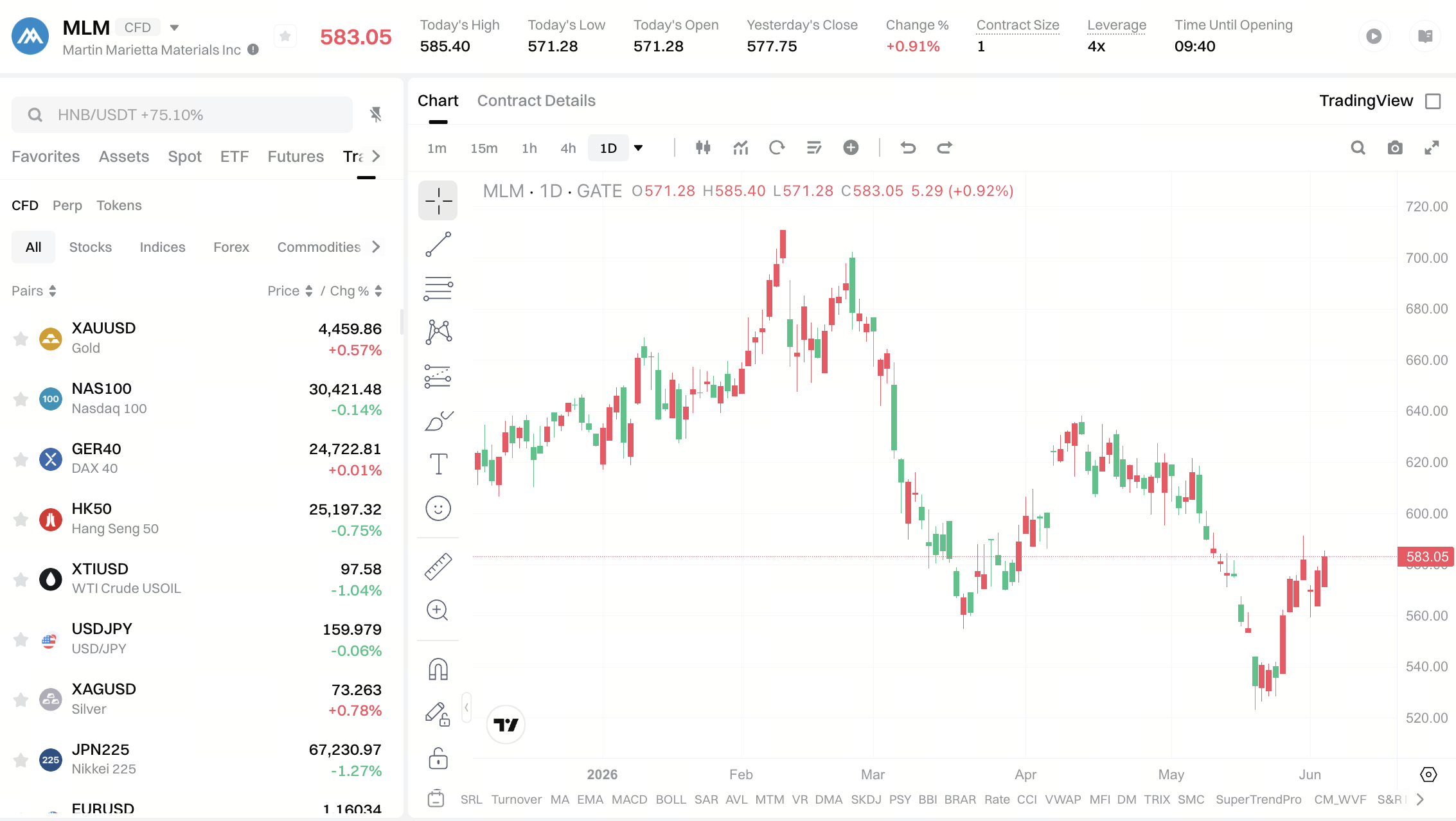
As digital asset markets and traditional financial markets gradually become more integrated, more trading tools linked to the price movements of U.S. stocks have also emerged. For example, some platforms offer CFD products linked to stock prices, allowing users to participate in market price changes without directly holding the underlying shares.
Gate TradFi is continuing to expand its coverage of traditional financial assets. Users can monitor digital assets, U.S. stocks, ETFs, indices and commodities within a unified account environment. Some markets also offer Gate CFD products, providing more options for cross-market asset allocation and market observation.
Regardless of how investors participate in the market, they should fully understand the product structure, trading mechanism and regulatory requirements in their region.
Martin Marietta’s Strengths and Limitations
Martin Marietta’s greatest strengths come from its rich aggregates resource reserves and broad regional supply network. The construction materials industry has clear resource characteristics, and high-quality mining areas are often difficult to replicate, making resource reserves an important competitive barrier in themselves.
At the same time, the company is deeply involved in U.S. infrastructure construction and the real estate market, allowing it to benefit from long-term growth in construction demand. Stable end-market demand also helps support the scale of its business.
However, the construction materials industry is still affected by economic cycles. When the real estate market slows or engineering projects decrease, demand for construction materials may decline. In addition, energy costs, transportation costs and environmental regulatory requirements may also affect the company’s operating performance.
As a result, Martin Marietta’s development benefits from long-term infrastructure construction demand, but it must also face the challenges created by cyclical fluctuations in the construction industry.
Conclusion
Martin Marietta Materials, MLM, is one of the leading construction materials producers in the United States. Its core business focuses on basic construction materials such as aggregates, crushed stone, cement and concrete. With abundant resource reserves, a broad regional footprint and deep ties to the infrastructure construction market, the company holds an important position in the U.S. construction materials industry. From highways to residential communities, and from commercial real estate to public works, Martin Marietta’s products are widely involved in the construction of modern infrastructure and have become an important part of the U.S. engineering and construction ecosystem.
FAQs
What kind of company is MLM?
MLM is the stock ticker for Martin Marietta Materials. The company is a U.S. construction materials producer that mainly operates in aggregates, cement, concrete and related products.
What products does Martin Marietta mainly sell?
Martin Marietta mainly sells aggregates, crushed stone, sand and gravel, cement, ready-mixed concrete and related construction materials.
Why is the aggregates business so important?
Aggregates are essential basic materials for roads, bridges, residential buildings and commercial construction, which gives them stable long-term market demand.
Who are Martin Marietta’s main customers?
The company’s customers mainly include construction contractors, real estate developers, infrastructure builders and government engineering projects.
How is Martin Marietta different from Vulcan Materials?
Both companies are leaders in the U.S. construction materials industry, but they differ in resource layout, regional market coverage and business structure.
Is Martin Marietta in a cyclical industry?
Yes. The construction materials industry is closely related to real estate investment and infrastructure construction activity, so it has certain cyclical characteristics.