Real world asset tokenization is becoming an important trend in the blockchain industry. As more government bonds, real estate, private credit, and commodity assets enter on-chain markets, the industry’s focus has gradually shifted from “how to bring assets on-chain” to “how to generate sustainable yield.”
Early RWA projects mostly focused on asset issuance and ownership mapping. Once on-chain assets were issued, however, they often lacked further financial use cases. How to make the cash flows generated by real world assets circulate on-chain and support new financial activity has become a key question for the development of the RWA ecosystem.
What Is Nest?
As an on-chain protocol built specifically for real world asset yield management, Nest is built on Plume. Through standardized yield product design and smart contract based management mechanisms, it brings cash flows generated by real world assets into blockchain financial markets.
Nest does not directly create yield. Its yield comes from the economic activity of the underlying real world assets themselves, such as interest on government bonds, interest on corporate loans, real estate rental income, or revenue from infrastructure projects.
Nest’s core value lies in turning these traditional yield streams into programmable, tradable, and composable on-chain financial products.
How Does Nest Work?
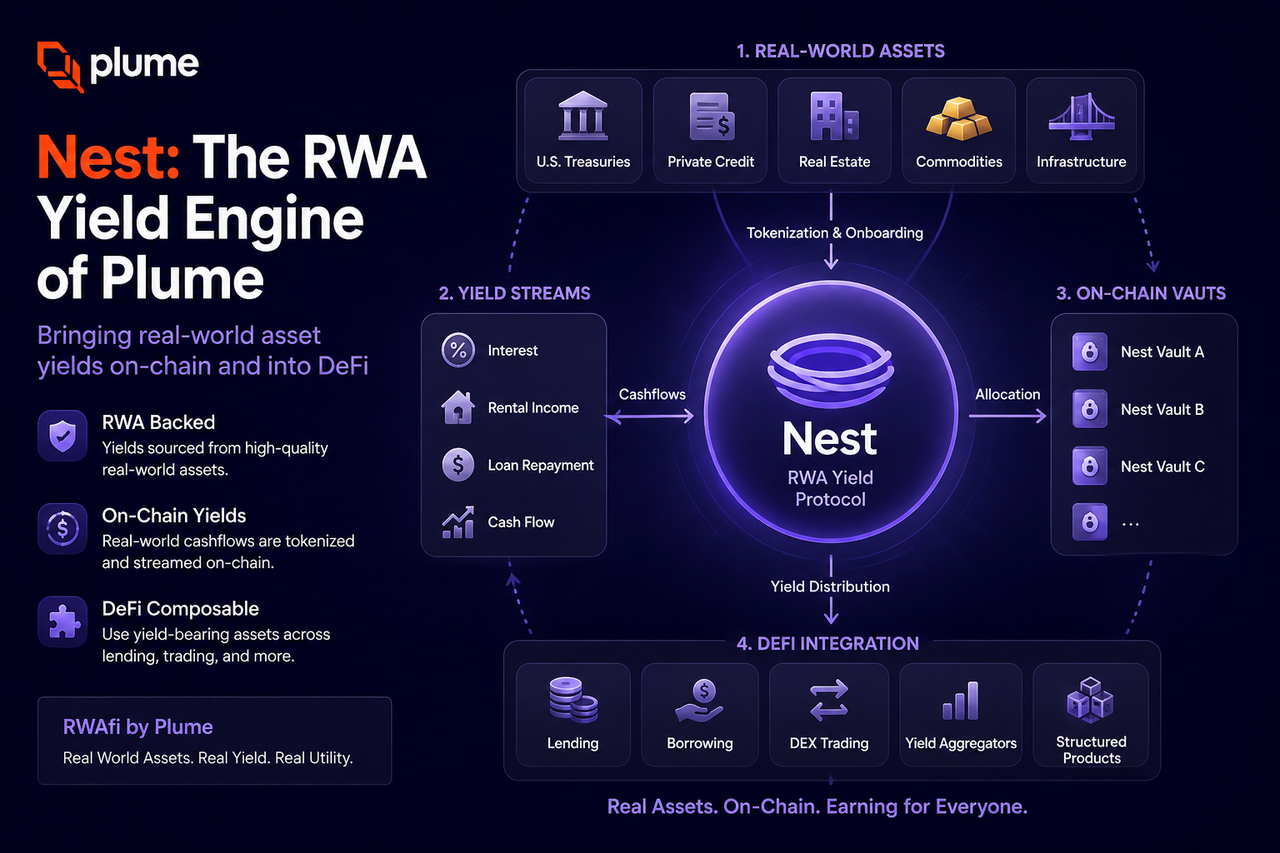
Nest’s operating logic can be divided into several steps:
Real world assets are first tokenized and brought into the Plume network.
Asset issuers then connect those assets to the Nest yield market.
Nest creates corresponding yield pools or yield products based on the asset category.
As the real world assets continue generating cash flow, the related yield data is synchronized on-chain.
Smart contracts automatically calculate and distribute yield according to predefined rules.
Finally, the yield can enter user accounts as on-chain assets and participate further in other DeFi applications.
This process creates a complete closed loop for bringing real world asset yields into on-chain financial markets.
Where Does Nest’s Yield Come From?
Nest’s yield mainly comes from real world assets themselves, rather than incentive tokens issued by the protocol.
Common yield sources include:
Government Bond Yield
Fixed interest income generated by short term government bonds and treasury securities.
Private Credit Yield
Interest returns from corporate financing and lending activities.
Real Estate Yield
Rental income generated by commercial real estate and residential projects.
Infrastructure Yield
Cash flows generated by energy, telecommunications, and public utility projects.
Commodity Finance Yield
Yield activities related to commodity trading and supply chain finance.
Nest uses standardized mechanisms to map these yield streams into the on-chain environment.
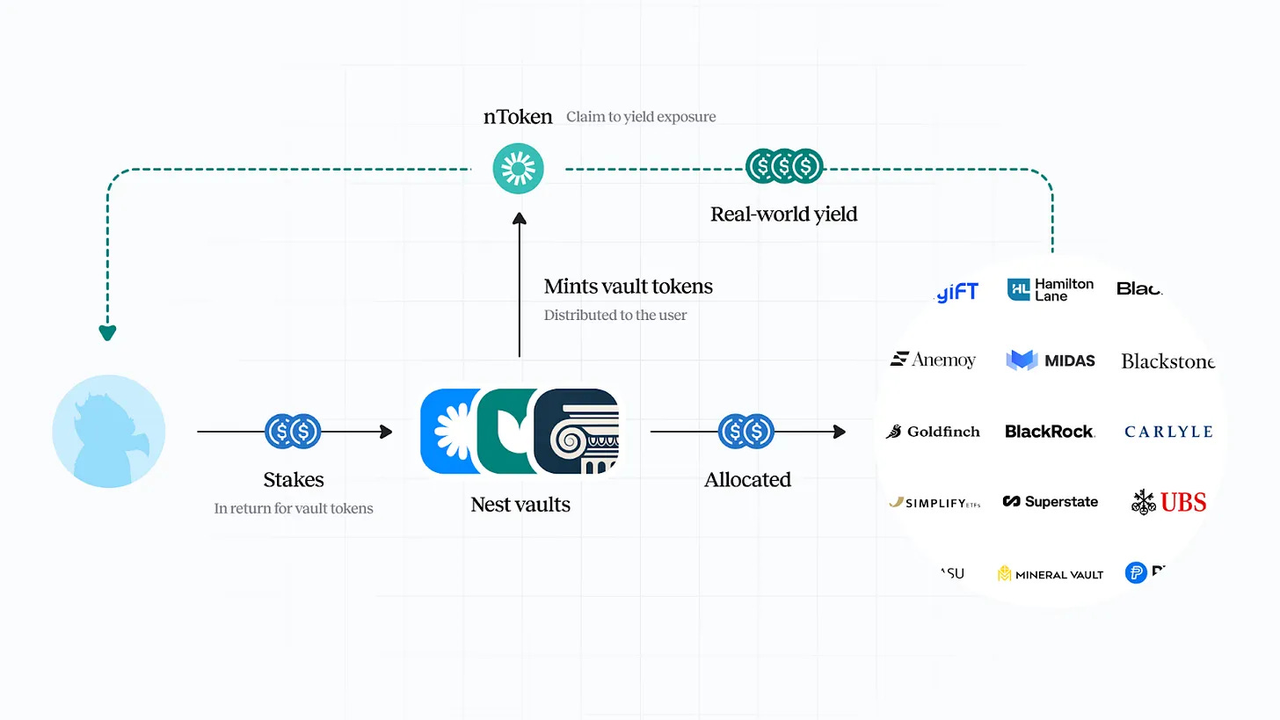
What Is Nest Vault?
Vault is a core component of the Nest yield system.
A Vault can be understood as a pool structure designed specifically to manage real world asset yields.
After assets enter a Vault, their yields are accumulated and distributed according to preset rules.
The main functions of a Vault include:
-
Aggregating real world asset yields
-
Simplifying user participation
-
Automatically completing yield settlement
-
Improving asset utilization efficiency
Through the Vault mechanism, users do not need to directly manage the underlying assets, but can still obtain the corresponding yield rights.
How Does Nest Manage Risk?
Compared with crypto assets, real world assets have a more complex risk structure.
For this reason, Nest introduces multiple layers of risk control in its design.
Asset Screening Mechanism
Only reviewed real world assets are allowed to enter the protocol.
Third Party Custody Mechanism
Real world assets are usually managed by independent custodians.
Continuous Disclosure Mechanism
Asset operation data and yield performance are updated regularly.
Smart Contract Automated Management
This reduces management risks caused by manual operations.
Compliance Review Mechanism
This ensures that assets and participants meet relevant regulatory requirements.
Together, these measures improve the transparency and credibility of real world asset yield products.
How Is Nest Different from Traditional Fixed Income Products?
| Comparison Dimension |
Nest |
Traditional Fixed Income Products |
| Yield Source |
Real world asset cash flows |
Real world asset cash flows |
| Management Method |
Smart contracts |
Financial institutions |
| Settlement Efficiency |
on-chain automatic settlement |
Manual or centralized systems |
| Composability |
Can access DeFi |
Relatively low |
| Liquidity |
Supported by on-chain markets |
Relies on traditional markets |
| Transparency |
on-chain verifiable |
Limited information disclosure |
Nest does not change the source of the yield itself. Instead, it changes how yield circulates and is managed within the financial system.
What Role Does Nest Play in the RWAfi Ecosystem?
The core goal of RWAfi is to make real world assets an important part of on-chain financial activity.
Simply bringing assets on-chain is not enough to achieve this goal.
Real world assets need liquidity, yield markets, and collaborative relationships with other financial protocols.
Nest takes on precisely this role.
By bringing yields generated by real world assets into DeFi, Nest enables real world assets to participate in lending, liquidity management, yield aggregation, asset allocation, and other use cases, helping them become genuinely integrated into the on-chain financial system.
Many RWA projects mainly focus on the asset tokenization stage.
Nest focuses more on the ongoing operation and yield management of assets after they enter the blockchain.
| Dimension |
Nest |
Traditional RWA Platforms |
| Core Goal |
Building a yield market |
Asset issuance |
| Main Focus |
Yield liquidity |
Asset mapping |
| DeFi Integration |
Deep support |
Limited support |
| Financial Composability |
High |
Relatively low |
| RWAfi Attributes |
Strong |
Relatively weak |
This difference makes Nest a key piece of infrastructure in Plume’s RWAfi strategy.
Conclusion
As Plume’s flagship RWA yield protocol, Nest’s core goal is to connect real world assets with on-chain yield markets. Through standardized yield management, Vault structures, and smart contract based automatic distribution mechanisms, Nest brings cash flows generated by real world assets such as government bonds, private credit, and real estate into the blockchain financial ecosystem.
Compared with traditional RWA platforms, which mainly focus on asset issuance, Nest places greater emphasis on yield circulation and financial composability after assets enter the blockchain. As an important part of RWAfi architecture, Nest is helping real world assets evolve from static registered assets into dynamic financial assets, while providing infrastructure for their participation in DeFi.
FAQs
Where Does Nest’s Yield Come From?
Nest’s yield comes from real world assets themselves, including government bond interest, private credit returns, real estate rental income, and infrastructure project cash flows, rather than yield created by the protocol itself.
What Is the Relationship Between Nest and Plume?
Plume provides the infrastructure needed to bring real world assets on-chain, while Nest manages the yields generated by those assets and introduces them into DeFi markets. Together, they form the RWAfi ecosystem.
What Is Nest Vault?
Nest Vault is an on-chain pool structure used to manage real world asset yields. It is responsible for yield aggregation, settlement, and distribution, making it easier for users to participate in real world asset yield markets.
Is Nest a DeFi Protocol?
Nest is a yield protocol that connects real world assets with DeFi markets. Its core function is to standardize real world asset yields and integrate them into the on-chain financial ecosystem.







