Uniswap v4 aggregates liquidity within a Singleton and optimizes gas efficiency through Flash Accounting. Hooks enable custom Solidity integration at critical nodes throughout the pool lifecycle. Drawing on the recent developments of UPEG, SATO (in the Ethereum context), and Slonks, this analysis explores on-chain scarcity—highlighting the specialized roles of AMM callbacks and NFT state machines. This is intended as educational content; begin by examining contract addresses and the blockchain itself, followed by an exploration of the underlying narrative.
In 2026, the Ethereum ecosystem began to undergo a subtle transformation:
More and more projects started turning “trading behavior itself” into assets. Previously, on-chain transactions were basic actions—swap, mint, or adding liquidity were simply steps in the asset transfer process. Now, these actions are being recorded, restructured, and further transformed into new forms of content, quotas, trading fee structures, and even new sources of scarcity. The Uniswap v4 Hook is one of the most critical pieces of infrastructure driving this new wave.
Uniswap v4’s Real Breakthrough: Beyond Just Hooks
For many, the first thing that stands out about Uniswap v4 is: “Developers can finally write Hooks.”
However, from a protocol architecture perspective, the real breakthrough in v4 is that Uniswap is evolving the AMM into something much closer to an “extensible settlement kernel.”
Unlike v3, v4 consolidates the state management of many pools into a Singleton (a single PoolManager) structure. Previously, each pool typically had its own contract; in v4, much more logic is centralized within a unified execution environment.
This brings several key innovations:
Multi-hop routing and complex operations are more gas-efficient;
Internal state updates for liquidity and swaps are more efficient;
Native ETH routes are easier to integrate;
Flash Accounting enables internal net settlement before a transaction ends, reducing unnecessary asset transfers.
These changes may seem low-level, but their true impact is that complex on-chain logic can finally “run at scale.”
In the past, many ideas were not impossible to design, but gas costs and execution complexity made them impractical.
With v4’s architecture, developers can now embed:
Dynamic fee rates
Behavioral state machines
On-chain content generation
Bonding curves
Custom accounting
Automated allocation and buyback logic
directly into the liquidity pathway. The value of Hooks truly comes to the forefront in this context.
What Is a Hook, Exactly?
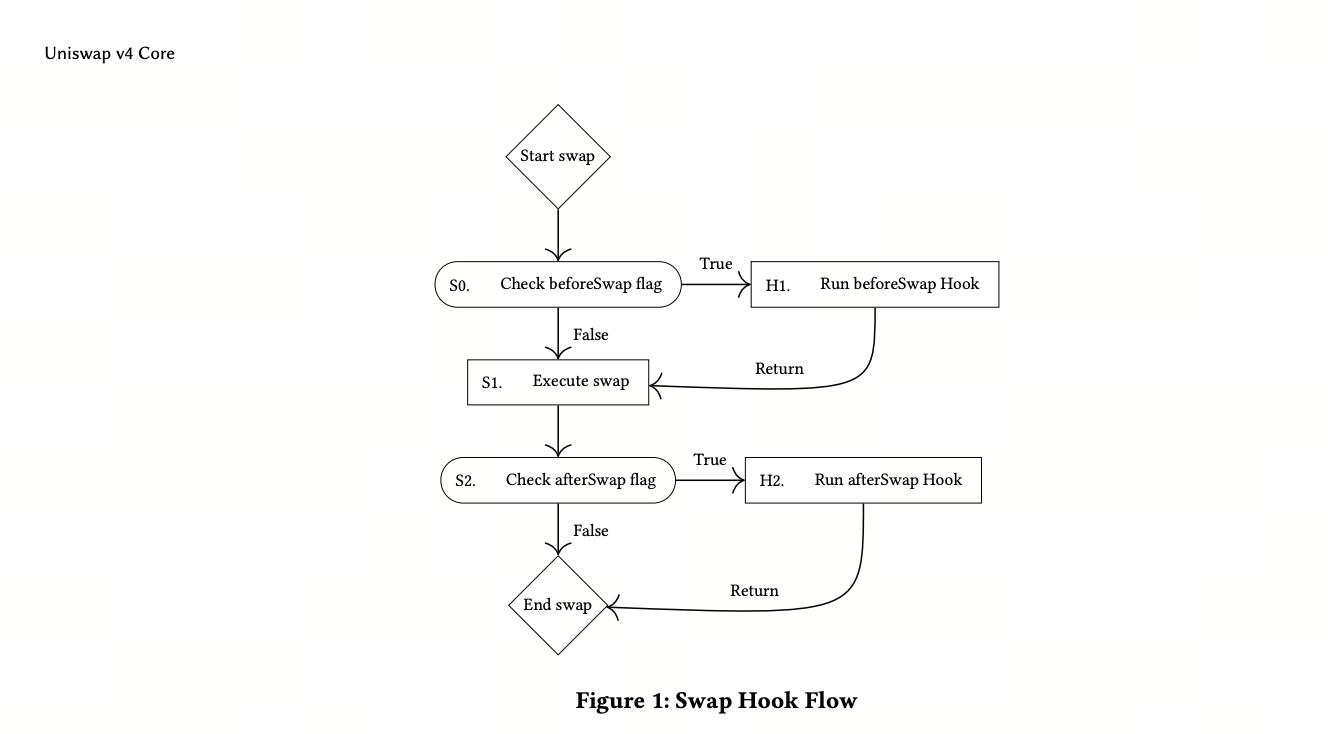
Simply put, a Hook is external contract logic that attaches to the lifecycle of a liquidity pool.
Uniswap v4 triggers Hooks at specific nodes, such as:
Pool initialization
Adding or removing liquidity
Swaps
Donations
Trading fee processing
Developers can execute custom logic at these points.
So fundamentally, a Hook is not a “product,” but an interface layer that lets developers rewrite AMM behavior.
For example:
Dynamically adjusting fee rates based on market volatility;
Recording user actions during swaps;
Automatically directing trading fees to a treasury;
Binding trading paths to NFT states;
Triggering on-chain content generation during trades.
This is why, even when many recent projects appear to be meme or NFT projects, the underlying discussion always returns to: “What rules is its Hook actually changing?”
Of course, it’s important to note:
Hooks bring expressive power, not guaranteed returns.
Market liquidity, token distribution, exit structures, and sentiment cycles still drive most short-term price volatility.
What v4 changes is how the rules can be written. It doesn’t eliminate market competition.
Slonks: Embedding Scarcity in the NFT State Machine
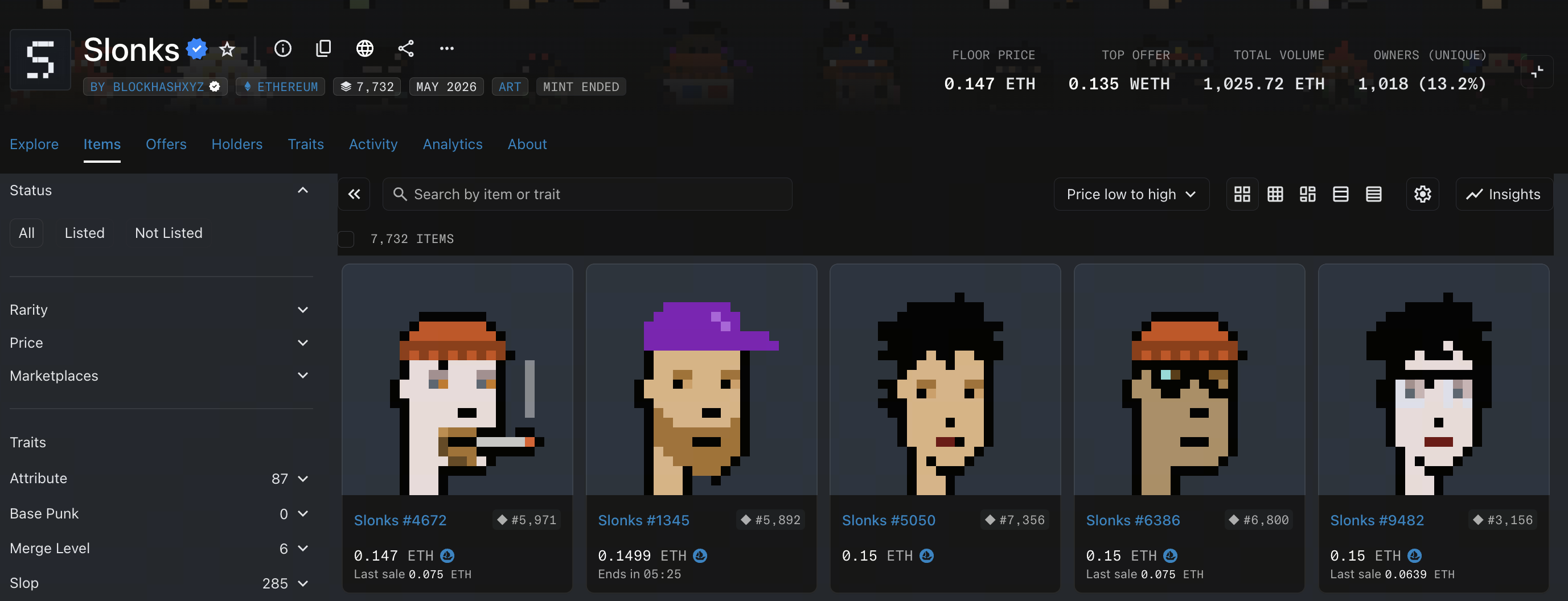
Image source: Opensea
Unlike many abstract Hook narratives, Slonks is a more intuitive example. At its core, it’s an NFT state machine project. The core mechanic is simple: the on-chain model “imitates” a corresponding CryptoPunk, and intentional deviations—called slop—become part of the project’s aesthetic. The key is the merge mechanism: two NFTs of the same level can be merged, burning one and upgrading the other, which changes its visual state.
Scarcity is created through:
Ongoing burning
State evolution
Reduction in NFT supply
Community preference for “higher-level slop”
This logic is more like a game state machine than a traditional PFP collection.
The subsequent launch of $SLOP further financializes this NFT scarcity structure.
According to public information from the project:
The official ETH/$SLOP pool is built on Uniswap v4;
Swap trading fees are distributed via Hook;
Some funds are used for buybacks, NFT operations, or specific pools;
The Hook acts as a “fund allocation and trading fee routing layer,” rather than the core NFT logic itself.
The Hook may not create the story, but it now determines “how funds flow around the narrative.”
UPEG: When Swaps Become Content
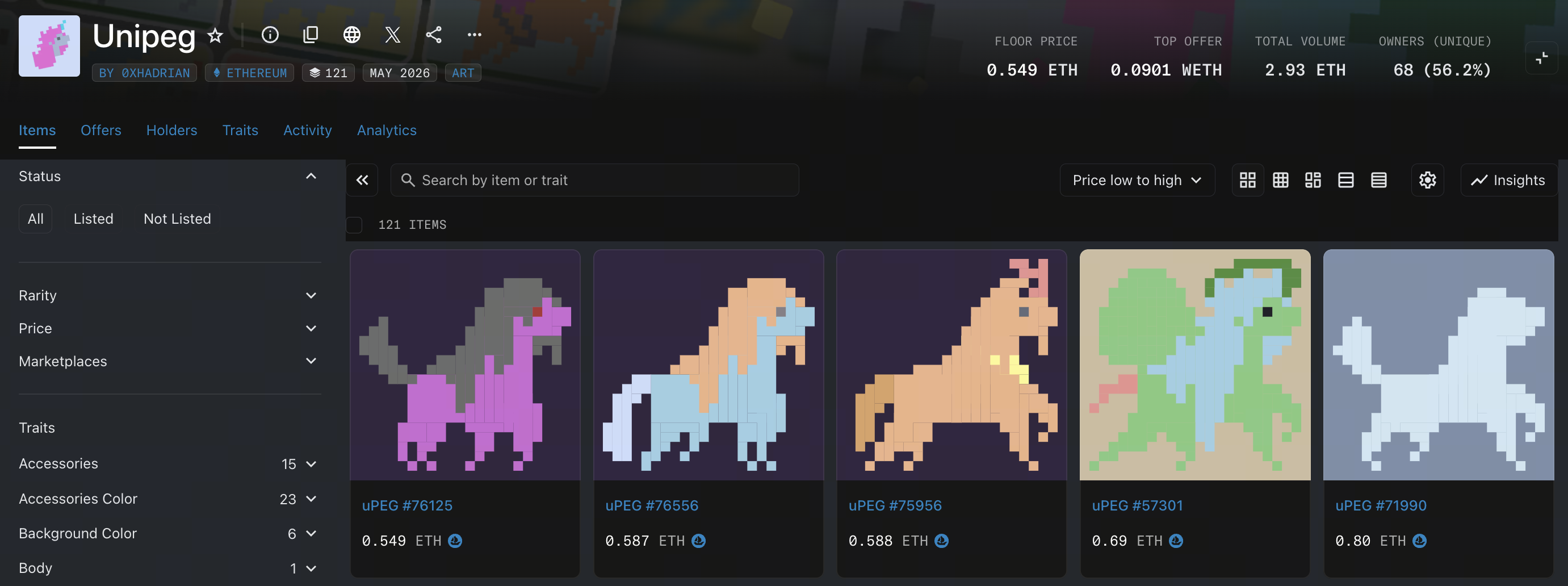
Image source: Opensea
If Slonks is about NFT state changes, UPEG takes it further: it turns trading behavior itself into content. User interactions with the pool become part of the content creation process.
In some experimental designs:
Swaps
Adding or removing liquidity
Specific path interactions
Participation in specific blocks
can all trigger Hook logic, altering on-chain state. On-chain rendering then generates pixel art, serial numbers, quotas, or visual content.
As a result:
Trading is no longer just trading.
It now also encompasses:
Content creation
State recording
Scarcity allocation
Identity marking
The Hook becomes the core hub of the behavioral state machine. Many, upon seeing these projects for the first time, wonder: “Why does a single swap carry so much meaning?” From a product design perspective, this is a new on-chain scarcity logic: scarcity now comes not just from “holding,” but from “participation.”
SATO: Hooks Enter Issuance and Liquidity Structures
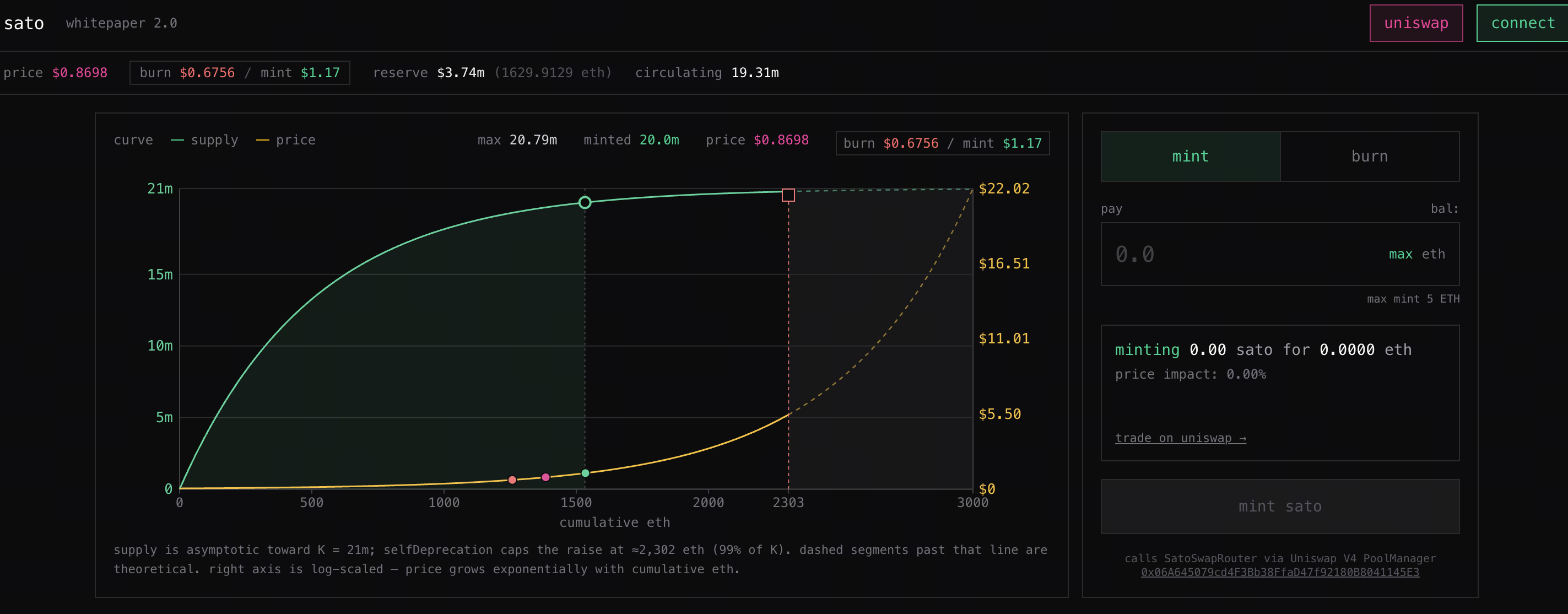
Image source: SATO official website
Compared to UPEG’s focus on content, SATO leans toward financial structure experimentation.
Recently in the Ethereum ecosystem, SATO-related projects have begun directly coupling:
Bonding curves
Liquidity management
Trading fee structures
Reserve logic
with Uniswap v4 Hooks.
The core approach: users first purchase along the bonding curve; after reaching a certain stage, they gradually enter a more open secondary liquidity environment.
The Hook then manages:
Partial trading fee diversion
Fund management under specific conditions
Switching between issuance and liquidity phases
Reserve path control
This type of design has sparked significant discussion because it blurs the lines between issuance and market making.
Previously, most token issuances were one-time events; now, some projects are experimenting with integrating issuance, liquidity, trading fees, and market behavior into a single, continuously operating system. Naturally, these structures are controversial. When projects claim that every trade accumulates value, trading fees continually strengthen the underlying asset, and liquidity is automatically reinforced,
the real questions users should ask are:
How can these assets be withdrawn?
Who has priority in extreme market conditions?
Are there governance privileges?
Are there hidden liquidity exits?
Is buyback and fund usage transparent?
These questions aren’t unique to Hook projects, but are often glossed over in market narratives.
What Does the Hook Narrative Really Change?
The real significance of the current Hook craze isn’t whether a specific project will keep rising.
What matters is that the Ethereum ecosystem is embracing a new design paradigm. Previously, AMMs were merely trading infrastructure.
Now, they’re evolving into:
Behavior recording layers
State update layers
Content generation layers
Fund allocation layers
Scarcity management layers
Trading is no longer just a transaction. It’s becoming a composable, recordable, and priceable on-chain behavior.
UPEG turns actions into content;
SATO connects actions to issuance and liquidity structures;
Slonks embeds scarcity into NFT state changes.
Not all of these will succeed long term. But they demonstrate that Uniswap v4 is pushing AMMs from “trading protocols” toward becoming “on-chain behavior engines.” These experiments are likely just beginning.
Disclaimer: This article is for technical and market analysis only and does not constitute investment advice. Crypto assets are highly volatile, and experimental protocols may carry liquidity, contract, security, and governance risks. Please verify contract addresses, audit information, on-chain data, and project documentation carefully before participating, and thoroughly assess your principal risk.
Disclaimer
* The information is not intended to be and does not constitute financial advice or any other recommendation of any sort offered or endorsed by Gate.
* This article may not be reproduced, transmitted or copied without referencing Gate. Contravention is an infringement of Copyright Act and may be subject to legal action.
Yala inherits the security and decentralization of Bitcoin while using a modular protocol framework with the $YU stablecoin as a medium of exchange and store of value. It seamlessly connects Bitcoin with major ecosystems, allowing Bitcoin holders to earn yield from various DeFi protocols.
Solana faces both opportunities and challenges in its development. Recently, severe network congestion has led to a high transaction failure rate and increased fees. Consequently, some have suggested using Layer 2 and appchain technologies to address this issue. This article explores the feasibility of this strategy.
Sui is a PoS L1 blockchain with a novel architecture whose object-centric model enables parallelization of transactions through verifier level scaling. In this research paper the unique features of the Sui blockchain will be introduced, the economic prospects of SUI tokens will be presented, and it will be explained how investors can learn about which dApps are driving the use of the chain through the Sui application campaign.
This article introduces the technical principles, framework, and applications of Zero-Knowledge (ZK) technology, covering aspects from privacy, identity (ID), decentralized exchanges (DEX), to oracles.
Tronscan is a blockchain explorer that goes beyond the basics, offering wallet management, token tracking, smart contract insights, and governance participation. By 2025, it has evolved with enhanced security features, expanded analytics, cross-chain integration, and improved mobile experience. The platform now includes advanced biometric authentication, real-time transaction monitoring, and a comprehensive DeFi dashboard. Developers benefit from AI-powered smart contract analysis and improved testing environments, while users enjoy a unified multi-chain portfolio view and gesture-based navigation on mobile devices.