Cloud gaming is becoming an important direction for the gaming industry. As AAA games continue to demand higher hardware performance, more platforms are trying to lower the barrier for user devices through remote computing. In this trend, GeForce Now represents the traditional cloud gaming platform model, while YOM represents DePIN-driven decentralized cloud gaming infrastructure. Together, they reflect two different paths for the industry.
What Is YOM?
As a cloud gaming infrastructure network built on DePIN, or decentralized physical infrastructure network, YOM’s core goal is to integrate idle GPU resources around the world into a unified real-time computing network, providing low-latency cloud gaming services for game developers and users through the HyperOrch intelligent scheduling system.
Unlike traditional gaming platforms, YOM focuses more on infrastructure development. Developers can deploy games to the network, while node operators participate in service supply by contributing GPU resources and earning network incentives.
What Is GeForce Now?
GeForce Now is a centralized cloud gaming platform launched by NVIDIA.
GeForce Now allows users to run purchased PC games on remote servers and stream the game visuals in real time to devices such as computers, phones, tablets, and smart TVs.
All computing resources come from data centers built and operated by NVIDIA. Users usually access the service through a subscription and receive different levels of performance support depending on their plan.
GeForce Now’s core positioning is that of a cloud gaming platform, not an open infrastructure network.
How Do YOM and GeForce Now Differ in Infrastructure Architecture?
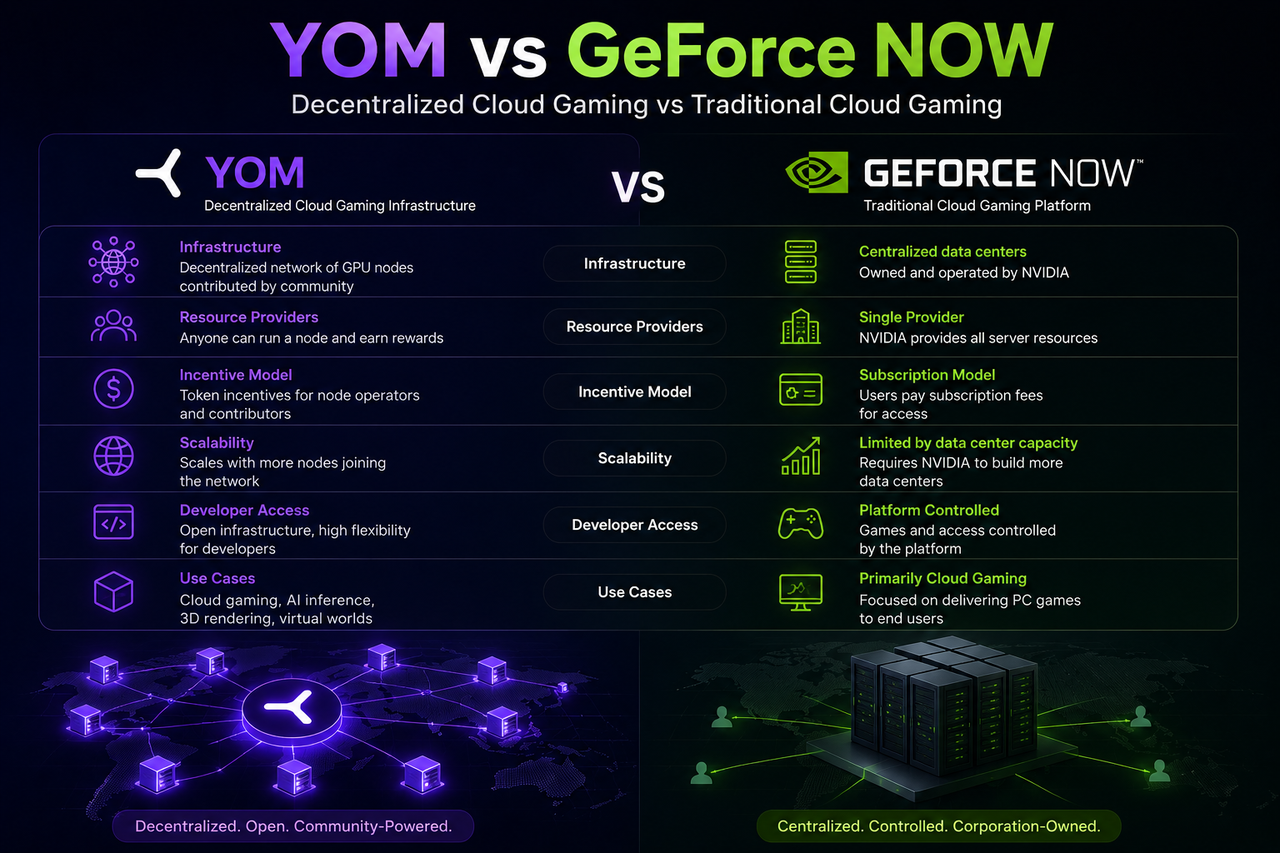
The most fundamental difference between YOM and GeForce Now comes from their infrastructure architecture.
GeForce Now uses a centralized data center model. Server procurement, deployment, maintenance, and upgrades are all managed centrally by NVIDIA.
YOM, by contrast, uses a distributed GPU network model. Node operators around the world can contribute hardware resources to join the network, while an intelligent scheduling system brings them together into a unified computing layer.
At the architectural level, GeForce Now is closer to a traditional internet service, while YOM is closer to an open infrastructure protocol.
How Do YOM and GeForce Now Differ in GPU Resource Sources?
The source of GPU resources directly determines how a network scales.
GeForce Now’s GPU resources come from NVIDIA-owned or partner data centers. When the user base grows, the platform needs to build out new server resources.
YOM’s GPU resources come from community node operators. Any participant that meets the requirements can connect to the network and provide computing power.
This means YOM can make use of large amounts of idle hardware, while GeForce Now depends on enterprise capital investment to expand capacity.
GeForce Now’s Resource Model
GeForce Now delivers standardized service through unified procurement and operations.
This approach helps ensure hardware consistency and service quality.
YOM’s Resource Model
YOM aggregates GPU nodes around the world through an open network.
Resource capacity can expand as network participation grows, creating a distributed computing marketplace.
Are There Differences in the User Experience Between YOM and GeForce Now?
From a player’s perspective, both platforms can run games remotely.
After a user opens a game, visuals are streamed to the end device, while control inputs are sent back to the server in real time.
However, because their resources are deployed differently, the two platforms may show different characteristics in network coverage and edge node distribution.
GeForce Now depends more on regional data center placement, while YOM depends on the coverage of its node network.
How Do YOM and GeForce Now Differ in Their Developer Ecosystems?
GeForce Now is primarily oriented toward players.
Game publishers need to establish partnerships with the platform, while users access supported game content through the platform.
YOM places greater emphasis on the developer ecosystem.
Developers can deploy games or real-time interactive applications directly to the network and use distributed GPU resources to run services.
This makes YOM closer to an infrastructure platform than a simple content distribution channel.
How Do the Incentive Mechanisms Work?
GeForce Now’s business model is built on subscription services.
Users pay a subscription fee to gain access, while the platform operates and maintains the server resources.
YOM introduces a token-based incentive mechanism.
Node operators earn rewards by contributing GPU computing power, while developers call computing resources through the network, creating an incentive loop between supply and demand.
The two models reflect different design approaches, one based on centralized platform economics and the other on decentralized network economics.
GeForce Now mainly serves the consumer gaming market.
Its goal is to let players experience large PC games without buying a high-performance computer.
In addition to cloud gaming, YOM also focuses on scenarios such as real-time 3D rendering, virtual worlds, digital twins, and AI inference.
As a result, YOM is positioned more as real-time computing infrastructure rather than simply an end-user gaming platform.
Core Differences Between YOM and GeForce Now
| Comparison Dimension |
YOM |
GeForce Now |
| Network Type |
Decentralized GPU network |
Centralized cloud gaming platform |
| Infrastructure Source |
Community nodes |
NVIDIA data centers |
| Core Positioning |
Cloud gaming infrastructure |
Cloud gaming service platform |
| Scaling Method |
Node network expansion |
Data center expansion |
| Incentive Mechanism |
Token incentives |
Subscription payments |
| Developer Openness |
Relatively high |
Relatively limited |
| Resource Ownership |
Distributed |
Centrally managed by an enterprise |
| Application Scope |
Gaming, AI, 3D rendering |
Mainly cloud gaming |
Conclusion
YOM and GeForce Now are both built on cloud gaming technology, but their underlying logic is not the same. GeForce Now uses a traditional centralized data center model, providing players with stable cloud gaming services through unified operations. YOM, by contrast, integrates global GPU node resources through the DePIN model to build an open real-time computing network.
From an industry perspective, the two models represent two development paths for cloud gaming. Traditional platforms emphasize service quality and unified operations, while decentralized networks emphasize resource sharing, open participation, and elastic scaling. As edge computing and GPU networks continue to develop, the two models may coexist over the long term and serve different types of application needs.
FAQs
Is GeForce Now a DePIN project?
GeForce Now is not a DePIN project. GeForce Now is a cloud gaming platform built and operated centrally by NVIDIA, with its server resources and service management controlled by the company.
YOM is classified as a decentralized cloud gaming platform because its computing resources come from an open GPU node network rather than data centers operated by a single company.
Do both YOM and GeForce Now support AAA games?
Both can support AAA games. The difference is that GeForce Now mainly provides services as a gaming platform, while YOM focuses more on cloud gaming infrastructure and resource scheduling capabilities.
Who provides YOM’s GPU nodes?
YOM’s GPU nodes are provided by community operators. Node participants contribute computing resources to the network and receive corresponding incentives based on their service contribution.
Can YOM be used for scenarios beyond gaming?
Yes. YOM’s infrastructure is not only suitable for cloud gaming, but can also support real-time 3D rendering, virtual worlds, digital twins, and low-latency AI inference applications.