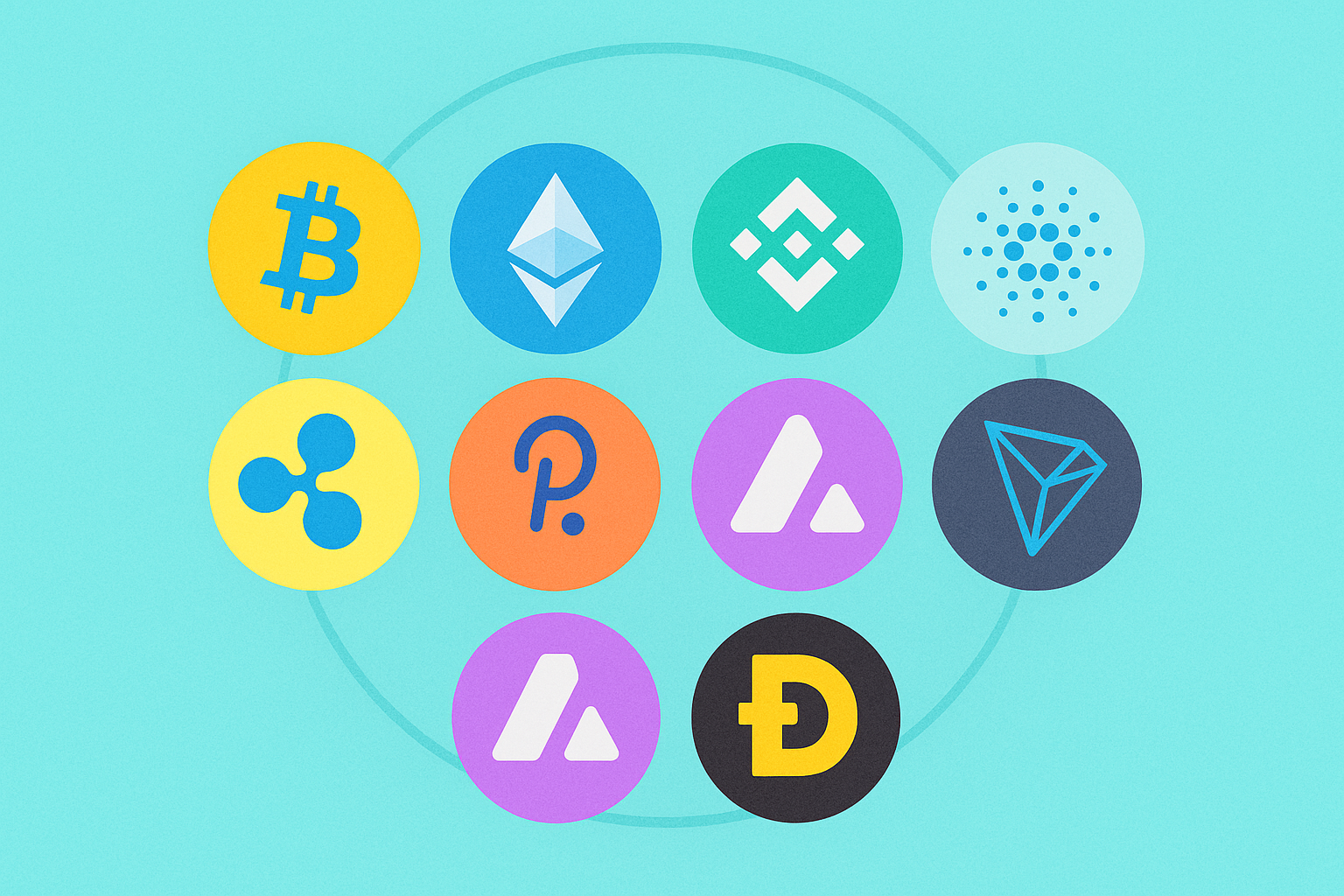
This comprehensive guide explores the top cryptocurrencies for long-term investment in 2024, addressing investor needs across experience levels. The article analyzes market recovery trends and presents ten promising digital assets: Bitcoin (decentralized store of value), Ethereum (smart contract platform), BNB (exchange ecosystem token), Cardano (research-driven blockchain), Solana (high-performance network), Ripple (enterprise payments), Polkadot (cross-chain interoperability), Avalanche (scalable smart contracts), TRON (content distribution), and Dogecoin (community-driven asset). Each cryptocurrency section details core utilities, tokenomics, ecosystem developments, and investment rationale. The guide emphasizes conducting thorough research, diversification strategies, risk management techniques, and proper exchange selection before committing capital. Perfect for investors seeking actionable insights on building diversified cryptocurrency portfolios while navigating market dynamics and regulatory landscap
Market Overview and Recovery Trends
In recent years, the cryptocurrency market has experienced challenging periods with significant volatility and corrections. However, the market has demonstrated remarkable resilience and has begun to recover substantially. This recovery has been primarily led by major cryptocurrencies, with Bitcoin showing consistent upward price momentum and renewed investor confidence. The market's gradual stabilization has created new opportunities for both seasoned investors and newcomers looking to diversify their digital asset portfolios.
The recovery phase has been characterized by increased institutional adoption, regulatory clarity in various jurisdictions, and growing mainstream acceptance of blockchain technology. These factors have contributed to a more mature and stable market environment, making it an opportune time to explore promising cryptocurrency investments.
Bitcoin: The Pioneer of Digital Currency
Bitcoin stands as the world's first decentralized digital currency, originally created in 2009 by the pseudonymous Satoshi Nakamoto. As the flagship cryptocurrency, BTC has maintained its position as one of the most popular and widely recognized digital assets globally. Its popularity stems from several key factors: transparent blockchain technology, clear utility as a store of value and medium of exchange, and widespread acceptance across various platforms and merchants worldwide.
The cryptocurrency's robust security model, based on proof-of-work consensus mechanism, ensures network integrity and resistance to manipulation. Bitcoin's limited supply of 21 million coins creates scarcity, which many investors view as a hedge against inflation. The network's decentralized nature means no single entity controls the currency, providing users with financial sovereignty and protection from centralized monetary policies.
One of the most compelling reasons Bitcoin remains attractive for investment is its historical price appreciation pattern, particularly around halving events. Bitcoin halving occurs approximately every four years, reducing the mining reward by half and effectively decreasing the rate of new Bitcoin entering circulation. Historical data from previous halving cycles shows significant price increases following these events, as reduced supply meets steady or growing demand. This predictable supply schedule, combined with increasing institutional adoption and the development of Bitcoin-related financial products, positions BTC as a foundational asset in any cryptocurrency portfolio.
Ethereum: The Smart Contract Revolution
Ethereum represents a groundbreaking advancement in blockchain technology, functioning as a decentralized network platform that enables the execution of smart contracts. Unlike Bitcoin's primary focus on peer-to-peer transactions, Ethereum provides a comprehensive ecosystem for building and deploying decentralized applications (DApps) across various industries.
Ether (ETH) serves as the native cryptocurrency of the Ethereum network, powering all operations and transactions within the ecosystem. ETH functions as "gas" for the network, with users paying transaction fees in Ether to execute smart contracts and transfer tokens. The utility of ETH extends beyond simple transactions; it serves as collateral in decentralized finance (DeFi) protocols, enables participation in network governance, and facilitates staking in Ethereum's proof-of-stake consensus mechanism.
The Ethereum network hosts thousands of leading DApps spanning DeFi, NFTs, gaming, and enterprise solutions. This extensive ecosystem creates continuous demand for ETH, as every interaction with these applications requires ETH for transaction fees. The network's transition to proof-of-stake has also introduced staking rewards, allowing ETH holders to earn passive income while securing the network. With ongoing developments in scalability solutions and layer-2 technologies, Ethereum continues to strengthen its position as the premier platform for decentralized innovation.
BNB: Native Token of a Leading Exchange Ecosystem
BNB originated as the native cryptocurrency of a major global trading platform that consistently ranks among the highest in daily trading volume worldwide. The token has evolved significantly from its initial utility, expanding into a comprehensive ecosystem that encompasses multiple blockchain networks and services.
The primary utilities of BNB include serving as a medium of exchange for various goods and services within the ecosystem, paying transaction fees on the associated smart chain with reduced rates, and participating in token launch events for new projects. BNB holders benefit from fee discounts when trading on the platform, making it economically advantageous for active traders. The token also powers a robust DeFi ecosystem, with numerous protocols built on the associated smart chain utilizing BNB for liquidity provision, yield farming, and governance.
A notable feature of BNB's tokenomics is the regular token burn mechanism. According to the project's documentation, a portion of BNB is systematically destroyed each quarter until 50% of the total supply is eliminated. This deflationary mechanism reduces circulating supply over time, potentially creating upward pressure on price as demand remains constant or increases. The burns are transparently recorded on-chain, providing verifiable proof of the supply reduction. This combination of extensive utility, ecosystem growth, and deflationary tokenomics makes BNB an interesting consideration for cryptocurrency portfolios.
Cardano: Research-Driven Blockchain Innovation
Cardano represents a third-generation blockchain platform built on peer-reviewed academic research and evidence-based development methodologies. The project was founded by Charles Hoskinson, a co-founder of Ethereum, who sought to create a more sustainable, scalable, and interoperable blockchain ecosystem. Cardano's development follows a rigorous scientific approach, with each protocol upgrade undergoing formal verification and academic scrutiny before implementation.
ADA, the native cryptocurrency of the Cardano network, aims to serve as a global payment medium while supporting a growing ecosystem of decentralized applications. The relatively accessible price per token makes ADA an attractive entry point for investors seeking exposure to a technically sophisticated blockchain platform without requiring substantial capital investment. This accessibility has contributed to Cardano's large and engaged community of holders and developers.
Cardano's proof-of-stake consensus mechanism, called Ouroboros, offers energy efficiency and security while enabling ADA holders to participate in network validation through staking. The platform's layered architecture separates settlement and computation functions, allowing for greater flexibility and scalability. Cardano's focus on sustainability, interoperability with other blockchains, and governance features positions it as a long-term contender in the smart contract platform space. The network continues to expand its capabilities with regular protocol upgrades, enhancing functionality for DeFi, NFTs, and enterprise applications.
Solana has emerged as a leading high-performance blockchain platform, distinguished by its innovative approach to scalability and transaction processing. The network combines a novel Proof-of-History (PoH) algorithm with a Proof-of-Stake consensus mechanism, creating a unique architecture that enables exceptional throughput. This hybrid approach allows Solana to process thousands of transactions per second while maintaining decentralization and security.
SOL, the native cryptocurrency of the Solana network, serves multiple critical functions within the ecosystem. It is used for paying transaction fees, participating in network staking, and accessing various DApps built on the platform. Solana has attracted significant developer interest due to its low transaction costs and fast confirmation times, resulting in a vibrant ecosystem of DeFi protocols, NFT marketplaces, and Web3 applications.
The network's technical capabilities have made it particularly popular for applications requiring high-frequency transactions, such as decentralized exchanges and gaming platforms. Solana's architecture eliminates many of the scalability bottlenecks that affect other blockchains, making it a compelling alternative for developers seeking performance without sacrificing decentralization. The SOL token has demonstrated substantial growth, reflecting increasing adoption and network activity. As the ecosystem continues to mature and attract more projects, Solana's position as a high-performance blockchain platform strengthens, making SOL a noteworthy consideration for cryptocurrency investors.
Ripple: Enterprise-Focused Payment Solutions
Ripple operates as a fintech company established in the early 2000s with a primary mission to revolutionize international money transfers. The company developed a decentralized payment network designed to facilitate fast, low-cost cross-border transactions, addressing inefficiencies in traditional banking systems. Ripple's technology enables financial institutions to settle international payments in seconds rather than days, with significantly reduced fees compared to conventional methods.
XRP serves as the native cryptocurrency of the Ripple network, functioning as a bridge currency for transactions between different fiat currencies. When financial institutions use Ripple's payment network, XRP can be used as an intermediary asset, eliminating the need for pre-funded nostro accounts in various currencies. This utility makes XRP particularly valuable for facilitating liquidity in cross-border payments.
The cryptocurrency has experienced significant developments in recent years, particularly following positive legal outcomes in regulatory proceedings. These developments have renewed confidence in XRP's long-term viability and potential for wider adoption. Ripple continues to expand partnerships with banks and payment providers globally, increasing the practical utility of XRP in real-world financial transactions. The combination of enterprise adoption, regulatory clarity, and technological advantages positions XRP as a unique cryptocurrency with strong fundamentals tied to solving actual problems in the global financial system.
Polkadot: Enabling Blockchain Interoperability
Polkadot represents an ambitious vision for the future of blockchain technology, functioning as a multi-chain, open-source platform designed to enable different blockchains to communicate and work together seamlessly. The project addresses one of the blockchain industry's most significant challenges: the lack of interoperability between different networks. Polkadot's architecture allows specialized blockchains, called parachains, to connect to a central relay chain, sharing security while maintaining their unique features and governance.
DOT, the native utility token of the Polkadot platform, serves several crucial functions within the ecosystem. Token holders can participate in network governance by voting on protocol upgrades, parachain auctions, and other significant decisions affecting the platform's development. DOT is also used for paying transaction fees and bonding tokens to secure parachain slots, creating multiple sources of demand for the token.
The platform's innovative approach to scalability through parallel processing across multiple parachains offers significant advantages over single-chain architectures. This design allows Polkadot to process numerous transactions simultaneously across different chains, dramatically increasing overall network capacity. The ecosystem has attracted diverse projects spanning DeFi, NFTs, gaming, and enterprise solutions, all benefiting from Polkadot's shared security model and cross-chain capabilities. As blockchain interoperability becomes increasingly important for the industry's maturation, Polkadot's role as a hub connecting different ecosystems positions DOT as a strategic long-term investment.
Avalanche has established itself as a prominent blockchain platform specifically engineered to support smart contracts and decentralized applications with exceptional performance characteristics. The platform's architecture incorporates multiple innovative features designed to overcome the traditional blockchain trilemma of achieving scalability, security, and decentralization simultaneously.
AVAX, the native cryptocurrency of the Avalanche network, powers all operations within the ecosystem. The platform utilizes a unique consensus mechanism based on Proof-of-Stake, combined with a directed acyclic graph (DAG) structure that enables parallel processing of transactions. This architectural approach allows Avalanche to achieve sub-second finality and process thousands of transactions per second, making it highly competitive with traditional payment systems in terms of speed and efficiency.
Avalanche's subnet functionality enables developers to create customized blockchains with specific rules and validator sets while maintaining interoperability with the broader Avalanche ecosystem. This flexibility has attracted numerous projects seeking to build scalable DApps without compromising on performance or security. The platform supports full Ethereum Virtual Machine (EVM) compatibility, allowing developers to easily port existing Ethereum applications to Avalanche and benefit from lower fees and faster transaction times. The growing ecosystem of DeFi protocols, NFT projects, and enterprise applications built on Avalanche demonstrates the platform's technical capabilities and developer appeal, making AVAX a compelling consideration for investors seeking exposure to high-performance blockchain infrastructure.
TRON: Decentralized Content Distribution
TRON functions as a decentralized blockchain platform with a specific focus on empowering content creators and facilitating digital content distribution. The platform aims to build a truly decentralized internet where creators can directly connect with their audiences without intermediary platforms taking significant portions of revenue. TRON's architecture supports high throughput and low transaction costs, making it practical for frequent microtransactions common in content consumption and distribution.
TRX serves as the primary native cryptocurrency for the TRON ecosystem, functioning as the medium of exchange for all transactions on the platform. Content creators can receive TRX directly from consumers, while developers can use TRX to deploy and interact with smart contracts. The platform's focus on entertainment and content distribution has led to partnerships with various media companies and the development of decentralized applications for gaming, streaming, and social media.
One of TRON's notable characteristics is its accessibility, with TRX maintaining a relatively low price per token. This affordability makes it easy for users to acquire and utilize TRX for platform interactions without significant financial barriers. The network has achieved substantial transaction volumes, particularly in stablecoin transfers, demonstrating real-world usage and adoption. TRON's delegated proof-of-stake consensus mechanism enables fast block times and high scalability, supporting the platform's vision of becoming a global entertainment content distribution system. As the platform continues to expand its ecosystem and attract more content creators and consumers, TRX presents an interesting opportunity for investors interested in the intersection of blockchain technology and digital content.
Dogecoin: From Meme to Mainstream
Dogecoin emerged in 2013 as a lighthearted parody of the cryptocurrency boom, utilizing the popular "Doge" meme featuring a Shiba Inu dog. Despite its humorous origins, Dogecoin has evolved into a legitimate cryptocurrency with a large, passionate community and significant market presence. The coin was never intended to be taken seriously as an investment, yet it has defied expectations by maintaining relevance and value over many years.
DOGE has gained tremendous popularity among traders and investors, particularly due to its high volatility and sensitivity to social media trends and celebrity endorsements. This characteristic makes Dogecoin particularly attractive for short-term trading strategies, as price movements can be substantial and rapid. The cryptocurrency has benefited from endorsements by high-profile individuals and has been adopted by various merchants as a payment method, adding practical utility beyond speculation.
Dogecoin's technical foundation is based on Litecoin's codebase, featuring fast block times and low transaction fees. Unlike many cryptocurrencies with capped supplies, Dogecoin has an inflationary model with new coins continuously mined, which proponents argue makes it more suitable as an actual currency rather than just a store of value. The strong community support and widespread recognition give Dogecoin a unique position in the cryptocurrency market. While it may not offer the technical sophistication of platforms like Ethereum or Solana, Dogecoin's cultural impact and mainstream awareness make it a notable consideration for portfolios seeking exposure to high-volatility, sentiment-driven assets.
Conducting Thorough Research Before Cryptocurrency Investment
Before committing capital to any cryptocurrency investment, it is absolutely essential to conduct comprehensive research and due diligence. The cryptocurrency market presents unique risks and opportunities that require careful evaluation and understanding. Investors should never rely solely on price predictions or social media hype when making investment decisions.
Thorough research should encompass multiple dimensions of a cryptocurrency project. First, examine the project's whitepaper and technical documentation to understand the underlying technology, consensus mechanism, and unique innovations. Evaluate the team behind the project, their experience, track record, and transparency in communication. Assess the cryptocurrency's actual utility and real-world use cases—tokens with clear, valuable functions tend to have more sustainable long-term value than those based purely on speculation.
Additionally, analyze the project's tokenomics, including supply dynamics, distribution mechanisms, and any inflationary or deflationary features. Review the ecosystem's growth metrics, such as active addresses, transaction volumes, developer activity, and partnerships with established entities. Understanding these fundamental factors helps investors make informed decisions and set realistic expectations about potential returns and risks.
Market conditions, regulatory developments, and technological trends also significantly impact cryptocurrency values. Stay informed about broader market dynamics and how they might affect specific investments. Diversification across different types of cryptocurrencies and blockchain platforms can help manage risk while maintaining exposure to the sector's growth potential.
Always remember the fundamental principle: DYOR (Do Your Own Research). This approach empowers investors to make independent, informed decisions based on thorough analysis rather than following crowd sentiment or unverified claims. The time invested in research significantly reduces the likelihood of losses and increases the probability of identifying genuinely promising investment opportunities in the dynamic cryptocurrency market.
FAQ
What cryptocurrencies are considered 'promising' and what are the main evaluation criteria?
Promising cryptocurrencies typically feature strong technical foundations, active community support, and clear use cases. Key criteria include innovation, market demand, transaction volume, developer activity, tokenomics alignment with protocol revenue, and network effects strength.
Which promising cryptocurrencies deserve attention in 2024, and what are their primary use cases?
Ethereum powers smart contracts and DeFi applications, Solana enables high-speed transactions, Kaspa focuses on mining efficiency, and XRP facilitates cross-border payments. Each addresses distinct blockchain needs.
What are the main risks of investing in cryptocurrencies, and how can you reduce investment risks?
Main risks include extreme price volatility, hacking, exchange failures, and regulatory changes. Reduce risks by diversifying investments, using secure cold wallets, enabling two-factor authentication, withdrawing assets from exchanges regularly, and staying informed about regulatory developments.
What are the core advantages of Bitcoin, Ethereum and other altcoins compared to each other?
Bitcoin excels as a store of value with first-mover advantage and network security. Ethereum offers programmable smart contracts enabling decentralized applications and a thriving ecosystem. Altcoins typically lack the adoption, liquidity, and developer support that Bitcoin and Ethereum command, making them less established alternatives.
How to choose a reliable exchange to purchase cryptocurrency and what security issues should be noted?
Select exchanges with strong security measures, regulatory compliance, and transparent fee structures. Verify their security history, enable two-factor authentication, use cold storage options, and avoid platforms with past security breaches. Always research reputation and trading volume before depositing funds.
How much startup capital is needed for cryptocurrency investment, and how should small investors get started?
Cryptocurrency investment can start with as little as $50-$100. Small investors should adopt dollar-cost averaging by investing fixed amounts regularly over time to build positions gradually and reduce volatility impact.
What are the respective roles of technical and fundamental analysis in cryptocurrency investment?
Technical analysis predicts market trends through historical price and trading volume patterns, while fundamental analysis evaluates the cryptocurrency's actual utility, technology, and financial health. Combined, they provide investors with a comprehensive perspective for making informed investment decisions.
How significant is the impact of policy regulation on cryptocurrency investment, and which countries have more friendly policies?
Regulatory policy significantly impacts crypto investments. Switzerland, Singapore, and Portugal are crypto-friendly nations with clear compliance frameworks. El Salvador and some Caribbean nations also offer supportive environments. Investors should monitor regulatory developments in their jurisdictions.
* The information is not intended to be and does not constitute financial advice or any other recommendation of any sort offered or endorsed by Gate.