This comprehensive analysis compares AIBOT and TRX—two distinct blockchain assets representing different market segments. AIBOT, launched in 2025, operates as an emerging AI-powered trading ecosystem with full-stack capabilities including trading bots and community tools, currently trading at $0.004547 with significant volatility. TRX, established since 2017 as blockchain infrastructure, trades at $0.2838 with national recognition from Dominica and substantially higher liquidity. The article examines historical price performance (AIBOT declined 98.92% from peak; TRX declined 34%), tokenomics structures, institutional adoption patterns, and technical ecosystems. Investment recommendations vary by investor profile—conservative investors favor TRX's stability, while aggressive investors may allocate toward AIBOT's speculative growth potential. Price forecasts through 2031 indicate divergent trajectories, with TRX offering moderate returns and established infrastructure, whereas AIBOT presents higher-risk growth
Introduction: Investment Comparison Between AIBOT and TRX
In the cryptocurrency market, the comparison between Cherry AI (AIBOT) and TRON (TRX) continues to be a topic of interest for investors. The two projects differ significantly in market capitalization ranking, application scenarios, and price performance, representing distinct positioning within the crypto asset landscape.
Cherry AI (AIBOT): Launched in 2025, this project has positioned itself as a full-stack crypto ecosystem combining AI-powered trading bots, web trading platforms, and community growth tools.
TRON (TRX): Since its inception in 2017, TRON has established itself as a blockchain infrastructure platform, gaining recognition particularly after being designated as national blockchain infrastructure by Dominica in 2022.
This article will provide a comprehensive analysis of the investment value comparison between AIBOT and TRX, examining historical price trends, supply mechanisms, institutional adoption, technical ecosystems, and future projections. The analysis aims to address one of the most pressing questions for investors:
"Which is the better buy right now?"
I. Historical Price Comparison and Current Market Status
Historical Price Trends of AIBOT (Coin A) and TRX (Coin B)
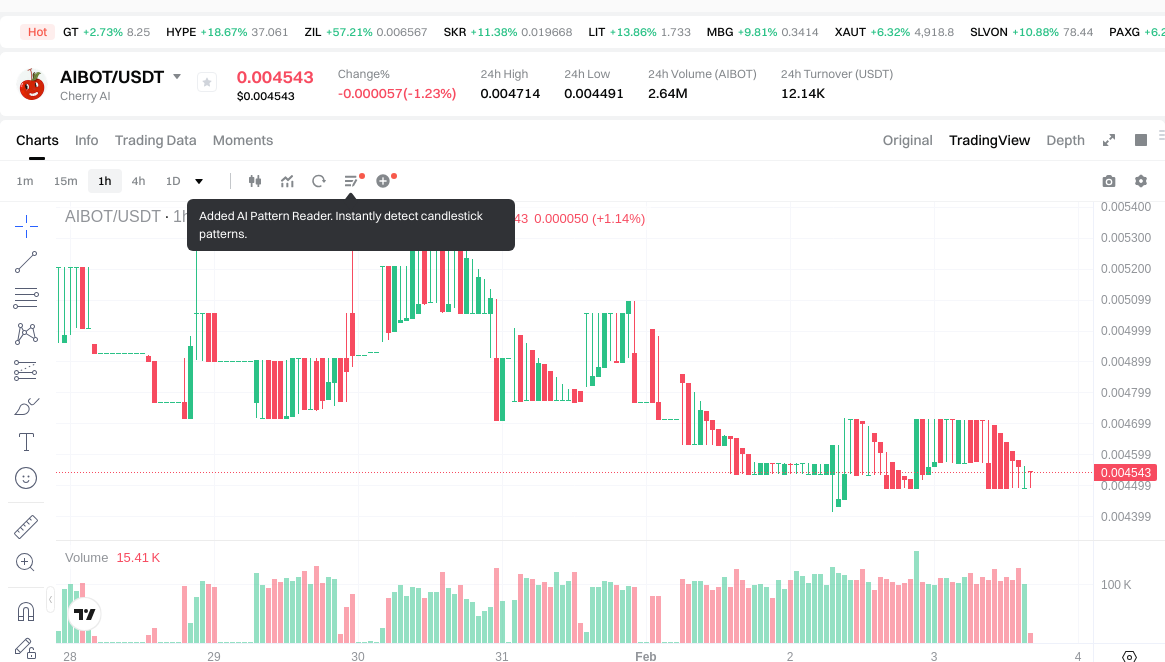
- 2025: AIBOT reached an all-time high of $0.0442 on October 28, 2025, followed by a significant decline to an all-time low of $0.0032 on September 25, 2025, reflecting high volatility in its early trading period.
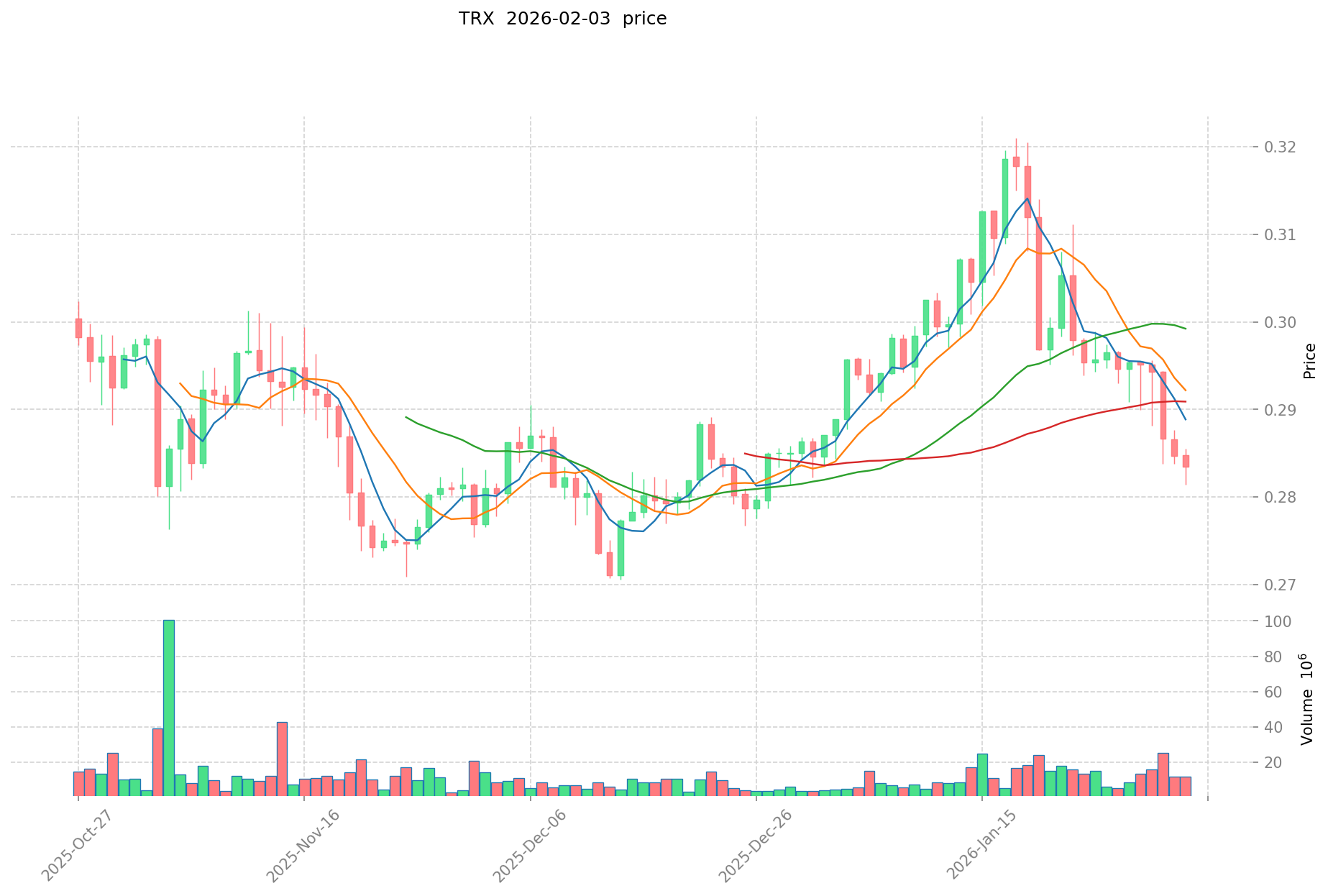
- 2024: TRX achieved its all-time high of $0.431288 on December 4, 2024, demonstrating sustained growth momentum in the broader market cycle.
- Comparative Analysis: During recent market cycles, AIBOT has experienced substantial price fluctuations, with a decline of approximately 98.92% from its historical peak to current levels, while TRX has shown relatively more stable performance with a decline of approximately 34% from its all-time high.
Current Market Status (2026-02-03)
- AIBOT Current Price: $0.004547
- TRX Current Price: $0.2838
- 24-Hour Trading Volume: AIBOT recorded $12,151.96 compared to TRX's $2,424,088.99
- Market Sentiment Index (Fear & Greed Index): 17 (Extreme Fear)
View real-time prices:
II. Core Factors Influencing AIBOT vs TRX Investment Value
Supply Mechanism Comparison (Tokenomics)
- AIBOT: The project has a maximum supply of 1 billion AIBOT tokens. The token structure is designed to ensure economic viability, promote community development, and continuously create scarcity.
- TRX: The materials do not provide specific information about TRX's supply mechanism.
- 📌 Historical Pattern: Supply mechanisms can influence price cycles through controlled token release and scarcity dynamics.
Institutional Adoption and Market Application
- Institutional Holdings: According to the materials, AI, stablecoins, and blockchain infrastructure sectors continue to receive capital attention, though specific institutional preference data between AIBOT and TRX is not provided.
- Enterprise Adoption: Specific comparative data on cross-border payments, settlements, or investment portfolio applications for AIBOT and TRX is not available in the materials.
- National Policies: Regulatory attitudes vary across different jurisdictions, with monetary policy and interest rate adjustments potentially affecting investment behavior in cryptocurrency markets.
Technical Development and Ecosystem Building
- AIBOT Technical Development: AIBOT serves as the pillar of the Cherry ecosystem, with revenue allocation mechanisms designed to support ongoing development.
- TRX Technical Development: The materials do not provide specific information about TRX's technical upgrades or developments.
- Ecosystem Comparison: The materials indicate that investment activity covers areas including quantitative trading, stock selection, and timing strategies, though specific DeFi, NFT, payment, or smart contract implementation comparisons are not detailed.
Macroeconomic Factors and Market Cycles
- Performance in Inflationary Environments: Exchange rates are influenced by global market supply and demand. Key factors include interest rates and inflation, with low inflation potentially helping preserve currency value.
- Macroeconomic Monetary Policy: Central bank decisions on raising or lowering interest rates affect investment behavior. Federal Reserve rate adjustments have shown correlation with cryptocurrency market movements.
- Geopolitical Factors: The materials note that core inflation data and Federal Reserve policy expectations have influenced market sentiment, though specific impacts on cross-border transaction demand are not detailed.
Note: Cryptocurrency investments are speculative in nature and prices can be highly volatile. Investment decisions should be based on individual financial circumstances and risk tolerance.
III. 2026-2031 Price Forecast: AIBOT vs TRX
Short-term Forecast (2026)
- AIBOT: Conservative $0.00336 - $0.00454 | Optimistic $0.00454 - $0.00650
- TRX: Conservative $0.145 - $0.284 | Optimistic $0.284 - $0.338
Mid-term Forecast (2028-2029)
- AIBOT may enter a gradual growth phase, with estimated price range of $0.00387 - $0.00861
- TRX may enter a consolidation phase, with estimated price range of $0.335 - $0.531
- Key drivers: institutional capital inflow, ETF developments, ecosystem expansion
Long-term Forecast (2030-2031)
- AIBOT: Baseline scenario $0.00694 - $0.00897 | Optimistic scenario $0.00897 - $0.0106
- TRX: Baseline scenario $0.328 - $0.528 | Optimistic scenario $0.528 - $0.618
View detailed price predictions for AIBOT and TRX
Disclaimer
AIBOT:
| Year |
Predicted High Price |
Predicted Average Price |
Predicted Low Price |
Price Change |
| 2026 |
0.00649792 |
0.004544 |
0.00336256 |
1 |
| 2027 |
0.007177248 |
0.00552096 |
0.0029261088 |
22 |
| 2028 |
0.00660306816 |
0.006349104 |
0.00387295344 |
41 |
| 2029 |
0.0086131944864 |
0.00647608608 |
0.0060227600544 |
44 |
| 2030 |
0.010411603590816 |
0.0075446402832 |
0.006941069060544 |
67 |
| 2031 |
0.010594183885669 |
0.008978121937008 |
0.007721184865826 |
99 |
TRX:
| Year |
Predicted High Price |
Predicted Average Price |
Predicted Low Price |
Price Change |
| 2026 |
0.3378886 |
0.28394 |
0.1448094 |
0 |
| 2027 |
0.441498306 |
0.3109143 |
0.245622297 |
9 |
| 2028 |
0.44768550057 |
0.376206303 |
0.33482360967 |
32 |
| 2029 |
0.53141021330265 |
0.411945901785 |
0.3789902296422 |
45 |
| 2030 |
0.584880791354343 |
0.471678057543825 |
0.391492787761374 |
66 |
| 2031 |
0.618086926605428 |
0.528279424449084 |
0.327533243158432 |
86 |
IV. Investment Strategy Comparison: AIBOT vs TRX
Long-term vs Short-term Investment Strategies
- AIBOT: May be suitable for investors with higher risk tolerance who are interested in emerging AI-powered trading ecosystem projects and early-stage growth opportunities. The token's historical volatility suggests it may align with speculative trading approaches rather than long-term holding strategies.
- TRX: May be suitable for investors seeking exposure to established blockchain infrastructure platforms with relatively more stable price performance and broader institutional recognition, particularly those interested in cross-border payment and settlement applications.
Risk Management and Asset Allocation
- Conservative Investors: AIBOT 10-20% vs TRX 80-90% - Conservative portfolios may allocate smaller positions to higher-volatility assets like AIBOT while maintaining larger exposure to more established projects like TRX.
- Aggressive Investors: AIBOT 40-50% vs TRX 50-60% - Aggressive portfolios may increase allocation to early-stage projects like AIBOT while maintaining substantial exposure to infrastructure platforms like TRX.
- Hedging Tools: Stablecoin allocation, options strategies, and cross-asset diversification can help manage portfolio volatility across different market conditions.
V. Potential Risk Comparison
Market Risk
- AIBOT: High price volatility with approximately 98.92% decline from historical peak, reflecting significant downside risk during adverse market conditions. Limited trading volume of $12,151.96 may result in liquidity challenges and price slippage.
- TRX: Moderate price volatility with approximately 34% decline from all-time high, demonstrating relatively more stable performance. Higher trading volume of $2,424,088.99 provides better liquidity for position entry and exit.
Technical Risk
- AIBOT: As an emerging project launched in 2025, the platform faces execution risks related to ecosystem development, user adoption, and long-term technical sustainability.
- TRX: The materials do not provide specific information regarding network stability, scalability challenges, or security vulnerabilities for TRX's blockchain infrastructure.
Regulatory Risk
Global regulatory developments may impact both projects differently. Emerging AI-focused crypto projects like AIBOT may face scrutiny regarding automated trading mechanisms and compliance frameworks. Established blockchain infrastructure platforms like TRX may be subject to payment system regulations and cross-border transaction compliance requirements. Monetary policy adjustments and interest rate decisions by central banks, particularly the Federal Reserve, can influence overall cryptocurrency market sentiment and capital flows.
VI. Conclusion: Which Is the Better Buy?
📌 Investment Value Summary:
- AIBOT Advantages: Exposure to emerging AI-powered trading ecosystem with potential for significant growth if the platform achieves successful user adoption and ecosystem expansion. The token's current price represents substantial discount from historical peak.
- TRX Advantages: Established blockchain infrastructure platform with national recognition (designated as national blockchain infrastructure by Dominica in 2022), relatively more stable price performance, and significantly higher trading liquidity compared to AIBOT.
✅ Investment Recommendations:
- Novice Investors: Consider starting with more established projects like TRX to gain exposure to blockchain infrastructure while limiting allocation to highly volatile assets like AIBOT until developing better understanding of market dynamics and risk management.
- Experienced Investors: May consider diversified exposure across both assets based on individual risk tolerance, with higher allocation to TRX for core portfolio stability and selective allocation to AIBOT for speculative growth opportunities.
- Institutional Investors: Focus on established blockchain infrastructure platforms with proven track records and regulatory clarity. Conduct thorough due diligence on emerging projects before allocation decisions.
⚠️ Risk Disclaimer: Cryptocurrency markets exhibit high volatility and investment outcomes are uncertain. This analysis does not constitute investment advice. Investment decisions should be based on individual financial circumstances, risk tolerance, and comprehensive research.
VII. FAQ
Q1: What are the main differences in risk profiles between AIBOT and TRX investments?
AIBOT presents significantly higher volatility risk with a 98.92% decline from its historical peak and limited trading volume of $12,151.96, making it suitable primarily for aggressive investors with high risk tolerance. TRX demonstrates more moderate risk characteristics with only a 34% decline from its all-time high and substantially higher liquidity at $2,424,088.99 in 24-hour trading volume, positioning it as a more suitable option for conservative investors seeking exposure to established blockchain infrastructure. The fundamental difference lies in project maturity—AIBOT launched in 2025 as an emerging AI-powered trading ecosystem facing execution risks, while TRX has operated since 2017 with national recognition as blockchain infrastructure in Dominica since 2022.
Q2: Which asset offers better short-term trading opportunities in 2026?
Based on current market conditions and price forecasts, TRX appears to offer more predictable short-term trading opportunities with an estimated conservative range of $0.145-$0.284 and optimistic scenario of $0.284-$0.338 for 2026. AIBOT's projected conservative range of $0.00336-$0.00454 and optimistic scenario of $0.00454-$0.00650 reflects higher uncertainty. The key distinction is trading volume—TRX's significantly higher liquidity enables better order execution and reduced slippage, while AIBOT's limited volume may result in difficulty entering or exiting positions at desired prices. Current market sentiment showing Extreme Fear (index of 17) suggests cautious positioning is advisable regardless of asset selection.
Q3: How do supply mechanisms affect the long-term investment value of AIBOT versus TRX?
AIBOT implements a maximum supply cap of 1 billion tokens designed to create scarcity dynamics and support economic viability through controlled token release mechanisms. This supply structure aims to drive long-term value appreciation through deliberate scarcity creation as ecosystem adoption grows. However, the materials do not provide specific information about TRX's supply mechanism, making direct tokenomics comparison challenging. Historical patterns suggest that well-designed supply mechanisms with controlled inflation and token burning features can positively influence price cycles, though actual market performance depends heavily on adoption rates, utility generation, and broader market conditions rather than supply mechanics alone.
Q4: What portfolio allocation strategies are recommended for investors interested in both assets?
Conservative investors should consider a 10-20% allocation to AIBOT versus 80-90% to TRX, prioritizing capital preservation through higher exposure to the more established blockchain infrastructure platform while maintaining limited speculative exposure to emerging opportunities. Aggressive investors may adopt a 40-50% AIBOT versus 50-60% TRX allocation, accepting higher volatility in exchange for potential upside from early-stage ecosystem growth. Both strategies should incorporate hedging tools including stablecoin reserves for opportunistic rebalancing, options strategies to manage downside risk, and cross-asset diversification beyond these two projects. Portfolio decisions should align with individual financial circumstances, investment time horizons, and ability to withstand potential capital loss.
Q5: How do macroeconomic factors differently impact AIBOT and TRX investment performance?
Federal Reserve interest rate policies and inflation dynamics affect both assets but with varying intensity—TRX as an established payment and settlement infrastructure may correlate more directly with cross-border transaction demand influenced by currency value fluctuations and monetary policy shifts. AIBOT, as an emerging AI-powered trading ecosystem, may exhibit more sensitivity to broader risk appetite in cryptocurrency markets, with institutional capital flows responding to rate expectations and inflation data. Low inflation environments historically support cryptocurrency valuations by preserving purchasing power, while aggressive rate hikes can trigger capital reallocation away from speculative assets. Current market conditions showing Extreme Fear sentiment suggest macroeconomic uncertainty is weighing on both assets, though TRX's established use cases may provide relative stability compared to AIBOT's speculative positioning.
Q6: What are the primary technical and ecosystem development differences between AIBOT and TRX?
AIBOT positions itself as a comprehensive crypto ecosystem integrating AI-powered trading bots, web trading platforms, and community growth tools, with revenue allocation mechanisms designed to support ongoing development and ecosystem expansion. The project's focus on automated trading and AI integration represents an emerging sector within cryptocurrency applications. TRX operates as blockchain infrastructure platform with established recognition, particularly following its designation as national blockchain infrastructure by Dominica in 2022, suggesting institutional validation and real-world implementation. The materials do not provide detailed information about TRX's specific technical upgrades or smart contract capabilities, but its longer operational history since 2017 implies more mature infrastructure compared to AIBOT's 2025 launch. Investment consideration should weigh proven infrastructure stability against potential innovation disruption.
Q7: What regulatory considerations should investors evaluate when comparing AIBOT and TRX investments?
Emerging AI-focused cryptocurrency projects like AIBOT may face evolving regulatory scrutiny regarding automated trading mechanisms, algorithmic transparency requirements, and compliance frameworks for AI-powered financial services. Established blockchain infrastructure platforms like TRX may encounter payment system regulations, cross-border transaction compliance requirements, and potential classification as payment rails subject to financial services oversight. Both assets remain exposed to broader cryptocurrency regulatory developments including securities classification debates, taxation policies, and jurisdictional restrictions on trading activities. Central bank monetary policy decisions, particularly Federal Reserve rate adjustments, create indirect regulatory impact through market liquidity conditions and institutional capital allocation decisions. Investors should monitor regulatory developments in their jurisdictions and assess compliance risks inherent to each project's business model and operational structure.
Q8: Based on 2026-2031 price forecasts, which asset offers superior long-term return potential?
Long-term forecasts through 2031 suggest TRX may offer more substantial absolute price appreciation, with optimistic scenario projecting $0.618 compared to AIBOT's $0.0106. However, percentage return potential tells a different story—AIBOT's forecast implies potential 99% increase from 2026 to 2031 baseline scenario, while TRX projects 86% growth over the same period. The critical distinction lies in risk-adjusted returns—TRX's more stable trajectory and higher baseline prices suggest lower volatility-adjusted gains, whereas AIBOT's projections assume successful ecosystem adoption and survival through multiple market cycles, presenting higher execution risk. Investors seeking maximum absolute returns with moderate risk may favor TRX, while those pursuing higher percentage gains with acceptance of significant downside risk might consider AIBOT allocation. All forecasts remain speculative and subject to substantial uncertainty requiring ongoing reassessment.
* The information is not intended to be and does not constitute financial advice or any other recommendation of any sort offered or endorsed by Gate.