ANI vs SNX: Which AI-Powered Oracle Network Offers Better Value for 2024?
Introduction: Investment Comparison Between ANI and SNX
In the cryptocurrency market, the comparison between ANI vs SNX has always been a topic that investors cannot avoid. The two not only show significant differences in market cap ranking, application scenarios, and price performance, but also represent different positioning within crypto assets.
ANI (ANI): Since its launch in 2025, this memecoin has positioned itself as an adorable AI companion in the crypto world, combining kawaii charm with cutting-edge technology. With a current market cap of approximately $627,889 and ranking at #2855, ANI represents the emerging intersection of artificial intelligence and meme culture.
SNX (SNX): Since 2018, Synthetix has been designed as a decentralized protocol enabling the creation of synthetic assets. With a market cap of around $110.36 million and ranking at #288, SNX supports various synthetic assets including fiat currencies pegged to the US dollar, precious metals, indices, and other cryptocurrencies.
This article will comprehensively analyze the investment value comparison between ANI vs SNX around historical price trends, supply mechanisms, institutional adoption, technical ecosystems, and future predictions, attempting to answer investors' most pressing question:
"Which is the better buy right now?"
I. Historical Price Comparison and Current Market Status
ANI and SNX Historical Price Trends
-
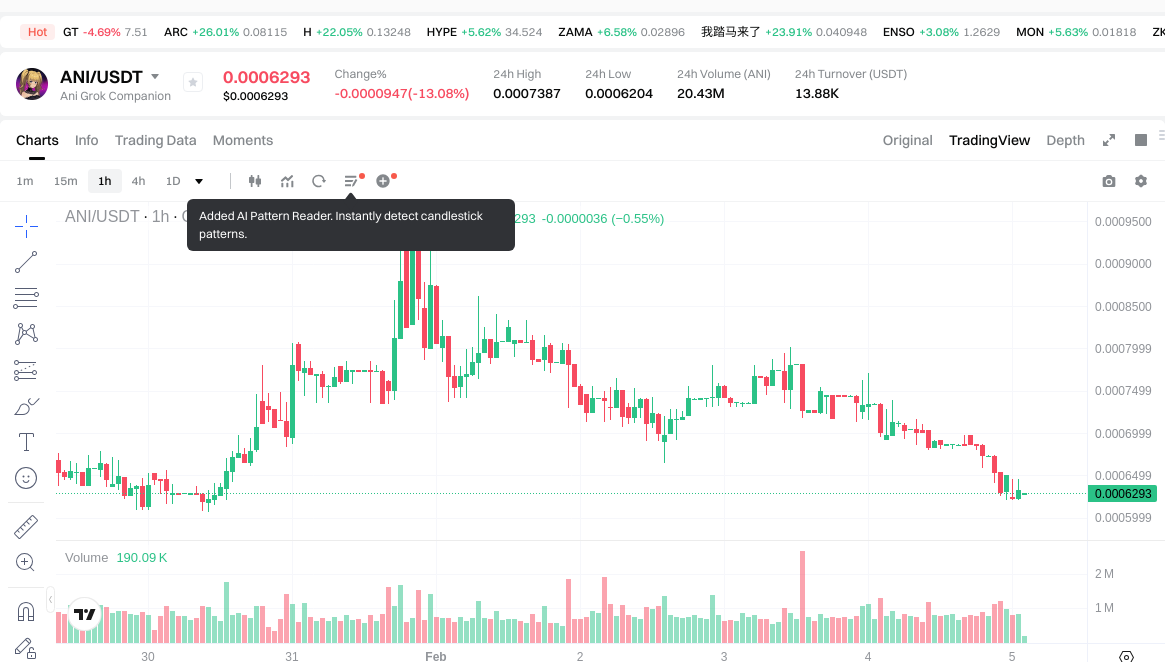
2025: ANI experienced significant price volatility following its launch, reaching an all-time high of $0.0276 on August 17, 2025. The token demonstrated substantial growth during its initial trading period.
-
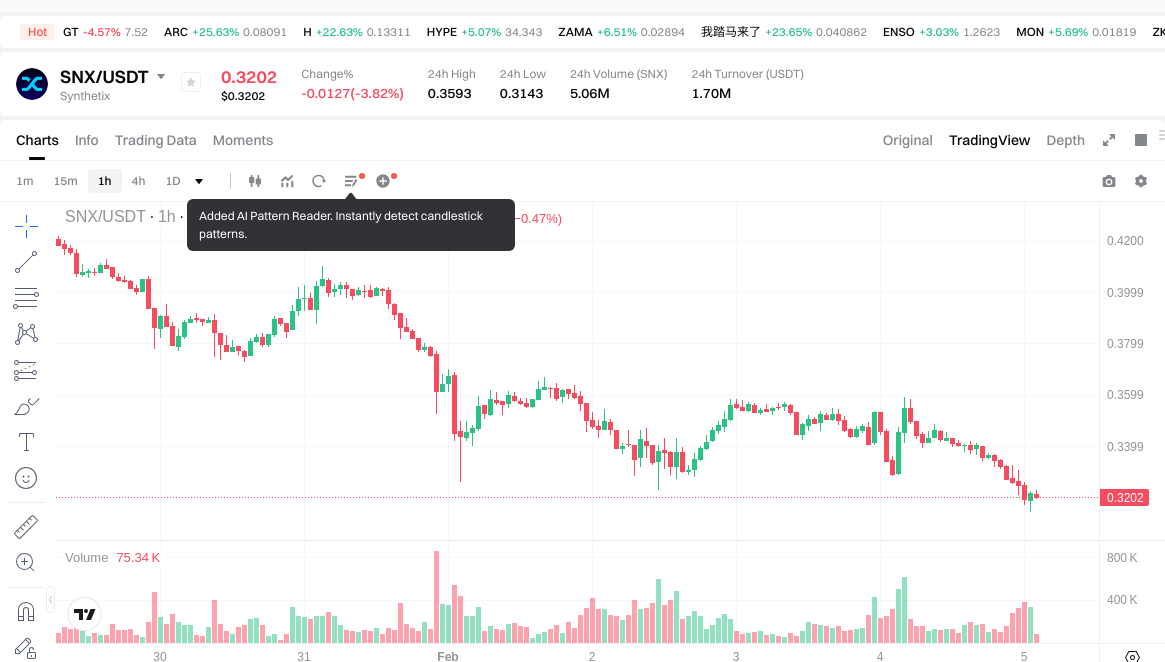
2021: SNX achieved its historical peak of $28.53 on February 14, 2021, driven by the broader DeFi market expansion and increased adoption of synthetic asset protocols.
-
Comparative Analysis: During the recent market cycle, ANI declined from its peak of $0.0276 to a low of $0.0006068 recorded on January 30, 2026, representing a substantial correction. In contrast, SNX has experienced a prolonged downtrend from its 2021 peak of $28.53 to current levels around $0.3213, reflecting broader challenges in the DeFi sector.
Current Market Status (February 5, 2026)
- ANI Current Price: $0.0006279
- SNX Current Price: $0.3213
- 24-Hour Trading Volume: ANI recorded $13,901.45 compared to SNX's significantly higher volume of $1,704,254.94
- Market Sentiment Index (Fear & Greed Index): 14 (Extreme Fear)
View real-time prices:
- Check ANI current price Market Price
- Check SNX current price Market Price
II. Core Factors Influencing ANI vs SNX Investment Value
Supply Mechanism Comparison (Tokenomics)
Based on available reference materials, specific tokenomics details for ANI and SNX supply mechanisms were not provided in the source documents. The materials primarily discuss general investment principles, portfolio management strategies, and risk assessment frameworks rather than detailed token supply structures.
Institutional Adoption and Market Application
-
Institutional Holdings: Reference materials indicate that portfolio values in related investment vehicles have reached significant levels, with one portfolio showing holdings valued over $2 billion. However, specific institutional preference data comparing ANI and SNX was not available in the provided sources.
-
Enterprise Adoption: The materials discuss investment portfolio composition and diversification strategies but do not provide comparative analysis of ANI versus SNX adoption in cross-border payments, settlements, or institutional investment portfolios.
-
National Policy: Regulatory attitudes toward these specific assets across different jurisdictions were not detailed in the reference materials.
Technology Development and Ecosystem Building
The provided materials focus on investment methodology, portfolio tracking through on-chain API data integration, and risk management frameworks. Specific technical upgrades, DeFi integration, NFT ecosystem development, payment solutions, or smart contract implementation details for either ANI or SNX were not covered in the source documents.
Macroeconomic Factors and Market Cycles
-
Performance in Inflationary Environments: The materials emphasize the importance of portfolio diversification and weak correlation management as key factors for maintaining position balance, particularly noting that cryptocurrency investment involves rapid market changes. However, comparative inflation-hedge characteristics between ANI and SNX were not specifically addressed.
-
Macroeconomic Monetary Policy: While the materials discuss the significance of regular position tracking and portfolio rebalancing in volatile markets, specific analysis of interest rate impacts, US dollar index correlations, or their differential effects on ANI versus SNX was not included.
-
Geopolitical Factors: The reference materials highlight investment principles focused on identifying undervalued assets and potential growth opportunities, but did not provide analysis of cross-border transaction demand or international situation impacts on these particular assets.
III. 2026-2031 Price Forecast: ANI vs SNX
Short-term Forecast (2026)
- ANI: Conservative $0.00050344 - $0.0006293 | Optimistic $0.0006293 - $0.000893606
- SNX: Conservative $0.23433 - $0.321 | Optimistic $0.321 - $0.40125
Medium-term Forecast (2028-2029)
- ANI may enter a gradual growth phase, with projected price range of $0.0004504755948 - $0.0011572562694 in 2028, potentially reaching $0.000531833040585 - $0.001024987314582 by 2029
- SNX may enter a volatility adjustment phase, with projected price range of $0.24484275 - $0.579461175 in 2028, potentially reaching $0.469077901875 - $0.557955820125 by 2029
- Key drivers: institutional capital flows, ETF developments, ecosystem expansion
Long-term Forecast (2031)
- ANI: Base scenario $0.000658142420754 - $0.001175254322776 | Optimistic scenario $0.001175254322776 - $0.001633603508659
- SNX: Base scenario $0.421635362879362 - $0.554783372209687 | Optimistic scenario $0.554783372209687 - $0.693479215262109
Disclaimer
ANI:
| Year | Predicted High Price | Predicted Average Price | Predicted Low Price | Price Change |
|---|---|---|---|---|
| 2026 | 0.000893606 | 0.0006293 | 0.00050344 | 0 |
| 2027 | 0.00079191112 | 0.000761453 | 0.00040357009 | 21 |
| 2028 | 0.0011572562694 | 0.00077668206 | 0.0004504755948 | 23 |
| 2029 | 0.001024987314582 | 0.0009669691647 | 0.000531833040585 | 54 |
| 2030 | 0.001354530405911 | 0.000995978239641 | 0.000677265202955 | 58 |
| 2031 | 0.001633603508659 | 0.001175254322776 | 0.000658142420754 | 87 |
SNX:
| Year | Predicted High Price | Predicted Average Price | Predicted Low Price | Price Change |
|---|---|---|---|---|
| 2026 | 0.40125 | 0.321 | 0.23433 | 0 |
| 2027 | 0.4550175 | 0.361125 | 0.23473125 | 12 |
| 2028 | 0.579461175 | 0.40807125 | 0.24484275 | 27 |
| 2029 | 0.557955820125 | 0.4937662125 | 0.469077901875 | 53 |
| 2030 | 0.583705728106875 | 0.5258610163125 | 0.30499938946125 | 63 |
| 2031 | 0.693479215262109 | 0.554783372209687 | 0.421635362879362 | 72 |
IV. Investment Strategy Comparison: ANI vs SNX
Long-term vs Short-term Investment Strategy
-
ANI: May suit investors seeking high-risk, high-reward opportunities in emerging meme-AI hybrid tokens. The asset's extreme volatility and early-stage positioning suggest suitability for speculative short-term traders comfortable with substantial price fluctuations. The token's limited trading volume and market cap indicate higher liquidity risks that favor nimble, short-duration positions.
-
SNX: May appeal to investors interested in DeFi protocol exposure with established market presence. With its longer operational history since 2018 and significantly higher trading volumes, SNX potentially offers more suitable conditions for both medium-term holders seeking synthetic asset protocol growth and long-term investors evaluating DeFi infrastructure development.
Risk Management and Asset Allocation
-
Conservative Investors: ANI 5-10% vs SNX 15-20% allocation within a diversified cryptocurrency portfolio. Conservative positioning reflects ANI's higher volatility profile and SNX's relatively established market position, though both remain speculative assets requiring limited exposure.
-
Aggressive Investors: ANI 15-25% vs SNX 25-35% allocation. Higher risk tolerance may accommodate increased exposure to both assets, with SNX potentially receiving larger weighting due to superior liquidity characteristics and established protocol infrastructure.
-
Hedging Tools: Stablecoin reserves (30-50% of crypto allocation), derivatives instruments where available, and cross-asset diversification across uncorrelated cryptocurrency sectors can help manage position-specific risks inherent in both ANI and SNX holdings.
V. Potential Risk Comparison
Market Risk
-
ANI: Faces substantial market risk stemming from its memecoin classification, limited trading history, and low market capitalization ($627,889). The token experienced significant drawdown from its August 2025 peak of $0.0276 to January 2026 low of $0.0006068, demonstrating extreme price sensitivity. Current extreme fear market sentiment (Fear & Greed Index: 14) may amplify volatility.
-
SNX: Confronts market risks associated with DeFi sector performance and synthetic asset adoption rates. The substantial decline from February 2021 peak of $28.53 to current levels around $0.3213 reflects prolonged sector challenges. Market cap positioning at #288 provides relatively better liquidity compared to ANI, though significant downside risk persists in adverse market conditions.
Technical Risk
-
ANI: Limited information available in reference materials regarding network infrastructure, scalability solutions, or technical architecture. The token's early stage and small ecosystem may present undocumented technical vulnerabilities.
-
SNX: As a DeFi protocol enabling synthetic asset creation, SNX faces technical risks related to smart contract security, oracle reliability for price feeds, and protocol upgrade execution. The complexity of synthetic asset mechanisms may introduce unforeseen technical challenges.
Regulatory Risk
- Global Regulatory Impact: Both assets face evolving cryptocurrency regulatory frameworks across jurisdictions. ANI's memecoin classification may attract scrutiny regarding marketing practices and utility claims. SNX's synthetic asset protocol potentially faces more complex regulatory considerations regarding securities classification, derivatives regulations, and cross-border financial service requirements. Regulatory developments in major markets could differentially impact adoption trajectories and institutional participation for both tokens.
VI. Conclusion: Which Is the Better Buy?
📌 Investment Value Summary:
-
ANI Advantages: Represents emerging intersection of AI and meme culture; early-stage positioning offers potential for substantial returns if adoption accelerates; relatively accessible entry price point for speculative allocation.
-
SNX Advantages: Established protocol with operational history since 2018; higher market cap ranking (#288) and significantly superior trading volume ($1.7M vs $13.9K daily); represents exposure to DeFi synthetic asset sector with developed infrastructure.
✅ Investment Recommendations:
-
Novice Investors: Consider limiting exposure to both assets given high volatility profiles. If participating, SNX may offer relatively more established infrastructure and liquidity, though substantial risk remains. Prioritize education on asset fundamentals and risk management before allocation.
-
Experienced Investors: May allocate small portfolio percentages to both assets as part of diversified cryptocurrency holdings. SNX could serve as DeFi sector exposure, while ANI represents speculative positioning in meme-AI convergence. Maintain strict position sizing discipline and defined exit strategies.
-
Institutional Investors: SNX may warrant consideration as part of DeFi protocol research and limited allocation strategies, given its established market presence and synthetic asset functionality. ANI's limited liquidity and market cap likely fall below institutional allocation thresholds. Comprehensive due diligence on regulatory classification, custody solutions, and risk management frameworks remains essential.
⚠️ Risk Warning: Cryptocurrency markets exhibit extreme volatility. This analysis does not constitute investment advice. Both ANI and SNX carry substantial risk of capital loss. Investors should conduct independent research, assess personal risk tolerance, and consider consulting financial advisors before making investment decisions.
VII. FAQ
Q1: What are the main differences between ANI and SNX in terms of market positioning?
ANI is an emerging memecoin launched in 2025 that combines AI companion themes with meme culture, currently ranked #2855 with a market cap of approximately $627,889. SNX is an established DeFi protocol operating since 2018 that enables synthetic asset creation, ranked #288 with a market cap around $110.36 million. The fundamental difference lies in their use cases: ANI focuses on meme-AI convergence speculation, while SNX provides infrastructure for decentralized synthetic assets including fiat currencies, precious metals, and cryptocurrency derivatives.
Q2: Which token offers better liquidity for trading?
SNX demonstrates significantly superior liquidity compared to ANI. SNX records daily trading volume of approximately $1,704,254.94, while ANI shows only $13,901.45 in 24-hour volume as of February 5, 2026. This substantial difference means SNX traders can execute larger positions with reduced slippage risk and easier entry/exit capabilities. ANI's limited liquidity presents challenges for position management and may result in wider bid-ask spreads, making it more suitable for smaller, speculative allocations rather than substantial portfolio positions.
Q3: What are the price volatility characteristics of ANI versus SNX?
Both tokens exhibit high volatility, though with different patterns. ANI demonstrated extreme price swings from its August 2025 peak of $0.0276 to January 2026 low of $0.0006068—representing approximately 98% drawdown within months. SNX experienced a prolonged decline from its February 2021 peak of $28.53 to current levels around $0.3213, reflecting approximately 99% correction over multiple years. ANI shows acute short-term volatility typical of memecoins, while SNX demonstrates sustained downtrend volatility characteristic of DeFi sector challenges during market cycles.
Q4: How should conservative investors approach allocation between these assets?
Conservative investors should maintain minimal exposure to both assets given their high-risk profiles. Recommended allocation within a diversified cryptocurrency portfolio would be 5-10% for ANI and 15-20% for SNX, with total crypto exposure representing only a small portion of overall investment holdings. SNX receives higher allocation recommendations due to its superior liquidity, established operational history, and developed protocol infrastructure. Conservative investors should prioritize stablecoin reserves (30-50% of crypto allocation) and implement strict stop-loss disciplines to manage downside risk inherent in both volatile assets.
Q5: What regulatory risks should investors consider for ANI and SNX?
Both tokens face evolving regulatory landscapes with distinct considerations. ANI's memecoin classification may attract regulatory scrutiny regarding marketing practices, utility claims, and potential securities characterization depending on jurisdiction. SNX confronts more complex regulatory considerations as a synthetic asset protocol, including possible classification under securities regulations, derivatives frameworks, and cross-border financial service requirements. Major regulatory developments in key markets—particularly regarding DeFi protocols and synthetic assets—could significantly impact SNX's operational model and adoption trajectory, while memecoin regulations may affect ANI's distribution and promotional activities.
Q6: What are the projected price ranges for 2026-2027?
For 2026, ANI shows conservative projections of $0.00050344 - $0.0006293 and optimistic scenarios of $0.0006293 - $0.000893606, while SNX projects conservatively at $0.23433 - $0.321 and optimistically at $0.321 - $0.40125. Looking ahead to 2027, ANI forecasts range from $0.00040357009 to $0.00079191112 with approximately 21% potential change, whereas SNX estimates span $0.23473125 to $0.4550175 with approximately 12% potential change. These projections reflect ANI's early-stage volatility potential and SNX's relatively more established, though still uncertain, growth trajectory within the DeFi sector.
Q7: Which token is more suitable for short-term versus long-term investment strategies?
ANI may better suit short-term speculative traders comfortable with extreme volatility and liquidity constraints, given its memecoin characteristics and early-stage positioning. The token's limited trading history and small market cap favor nimble, short-duration positions rather than extended holding periods. SNX demonstrates characteristics potentially more compatible with both medium-term and long-term strategies, offering exposure to DeFi protocol development with established infrastructure since 2018. SNX's superior trading volume and market positioning provide conditions more conducive to longer holding periods for investors evaluating synthetic asset protocol growth, though substantial risk remains for all timeframes.
Q8: What institutional considerations apply to ANI versus SNX investments?
Institutional investors face significantly different thresholds for each asset. ANI's limited liquidity ($13,901.45 daily volume) and low market cap ($627,889) likely fall below minimum institutional allocation criteria, presenting challenges for position building, custody solutions, and exit strategy execution. SNX may warrant institutional consideration as part of DeFi protocol research allocations, given its higher market cap ranking (#288), superior liquidity ($1.7M daily volume), and established operational framework for synthetic assets. However, both assets require comprehensive due diligence regarding regulatory classification, smart contract audits, custody infrastructure, and risk management frameworks before any institutional capital deployment.
Share
Content
Introduction: Investment Comparison Between ANI and SNX
I. Historical Price Comparison and Current Market Status
II. Core Factors Influencing ANI vs SNX Investment Value
III. 2026-2031 Price Forecast: ANI vs SNX
IV. Investment Strategy Comparison: ANI vs SNX
V. Potential Risk Comparison
VI. Conclusion: Which Is the Better Buy?
VII. FAQ
How to Buy Cryptocurrency


Trending Cryptocurrencies



2025 SUI coin: price, buying guide, and Staking rewards

How to Buy Crypto: A Step-by-Step Guide with Gate.com
HNT Price in 2025: Helium Network Token Value and Market Analysis

What is SwissCheese (SWCH) and How Does It Democratize Investment?

Cardano (ADA) Price Analysis and Outlook for 2025

How to Invest in Metaverse Crypto

Comprehensive Guide to Trading Systems

What Does DYOR Mean in Crypto?

How to Profit from Investing in Esports — A Comprehensive Guide

Comprehensive Guide to Fiat Currency
What is mobile mining, and can you earn money with it?