This comprehensive guide compares DRAC and CHZ, two distinct blockchain tokens with different market positioning and investment characteristics. DRAC, a BRC-20 inscription token launched in 2023, ranks 2989 with a $538,713 market cap, while CHZ, a sports fan engagement token since 2019, ranks 121 with a $438.61 million market cap. The article analyzes historical price trends, current market status, supply mechanisms, institutional adoption, technical ecosystems, and provides detailed price forecasts through 2031. DRAC offers higher volatility and speculative potential with 191% one-year returns but limited liquidity, while CHZ provides established ecosystem stability with partnerships across major sports organizations and superior trading volume on Gate. Investment recommendations vary by investor profile: conservative investors favor CHZ's liquidity and market presence, while experienced traders may use DRAC as a satellite position. Both assets carry substantial risk within current Extreme Fear market sentim
Introduction: DRAC vs CHZ Investment Comparison
In the cryptocurrency market, the comparison between DRAC vs CHZ has been a topic that investors cannot avoid. The two not only show significant differences in market cap ranking, application scenarios, and price performance, but also represent different crypto asset positioning.
DRAC (DRAC): Since its launch in 2023, this BRC-20 based crypto inscription has gained market attention. As of February 5, 2026, DRAC ranks 2989 with a market cap of approximately $538,713 and a circulating supply of 106.82 million tokens.
Chiliz (CHZ): Launched in 2019, Chiliz has been positioned as the exclusive utility token for Socios.com, providing sports and esports fans with governance rights over teams, events, and leagues. As of February 5, 2026, CHZ ranks 121 with a market cap of approximately $438.61 million and a circulating supply of 10.26 billion tokens.
This article will comprehensively analyze the investment value comparison between DRAC vs CHZ around historical price trends, supply mechanisms, institutional adoption, technical ecosystems, and future predictions, and attempt to answer the question that investors care about most:
"Which is the better buy right now?"
I. Historical Price Comparison and Current Market Status
Historical Price Trends of DRAC (Coin A) and CHZ (Coin B)
- 2022: DRAC experienced significant price volatility, reaching its all-time high of $0.091844 on November 1, 2022, during a period of heightened interest in BRC-20 inscriptions.
- 2021: CHZ was influenced by the growing adoption of fan tokens in the sports industry, achieving its all-time high of $0.878633 on March 13, 2021, reflecting strong market enthusiasm for sports-related blockchain applications.
- 2025: DRAC recorded its all-time low of $0.00005608 on February 16, 2025, marking a substantial decline from its peak. In contrast, CHZ maintained relatively higher price levels throughout various market cycles, benefiting from its established partnerships with major sports organizations.
- Comparative Analysis: During market downturns, DRAC declined from $0.091844 to $0.00005608, representing a significant contraction. CHZ, while also experiencing corrections, demonstrated comparatively more resilient price action, declining from $0.878633 to $0.00410887 at its lowest point in September 2019.
Current Market Status (February 5, 2026)
- DRAC Current Price: $0.005043
- CHZ Current Price: $0.04276
- 24-hour Trading Volume: DRAC $15,093.79 vs CHZ $1,424,855.84
- Market Sentiment Index (Fear & Greed Index): 12 (Extreme Fear)
- Market Capitalization: DRAC $538,713.43 vs CHZ $438,614,012.53
- 24-hour Price Change: DRAC -5.4% vs CHZ -5.9%
- 7-day Price Change: DRAC -13.10% vs CHZ -20.41%
- 30-day Price Change: DRAC -18.73% vs CHZ -4.37%
- 1-year Price Change: DRAC +191.17% vs CHZ -27.18%
View Real-time Prices:
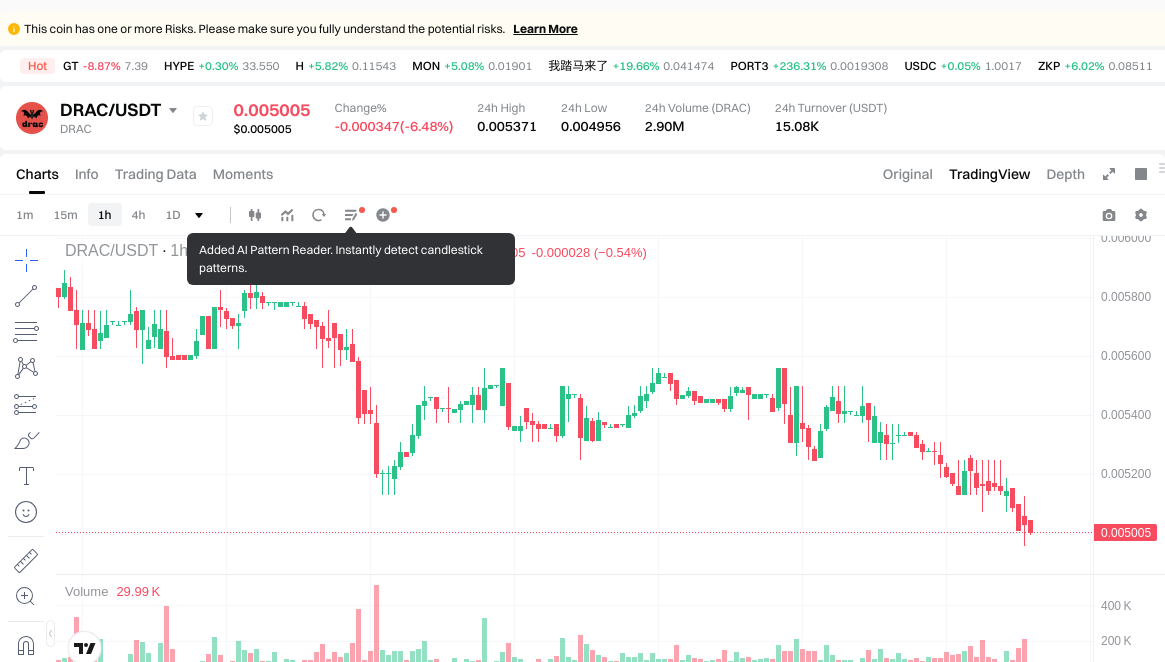
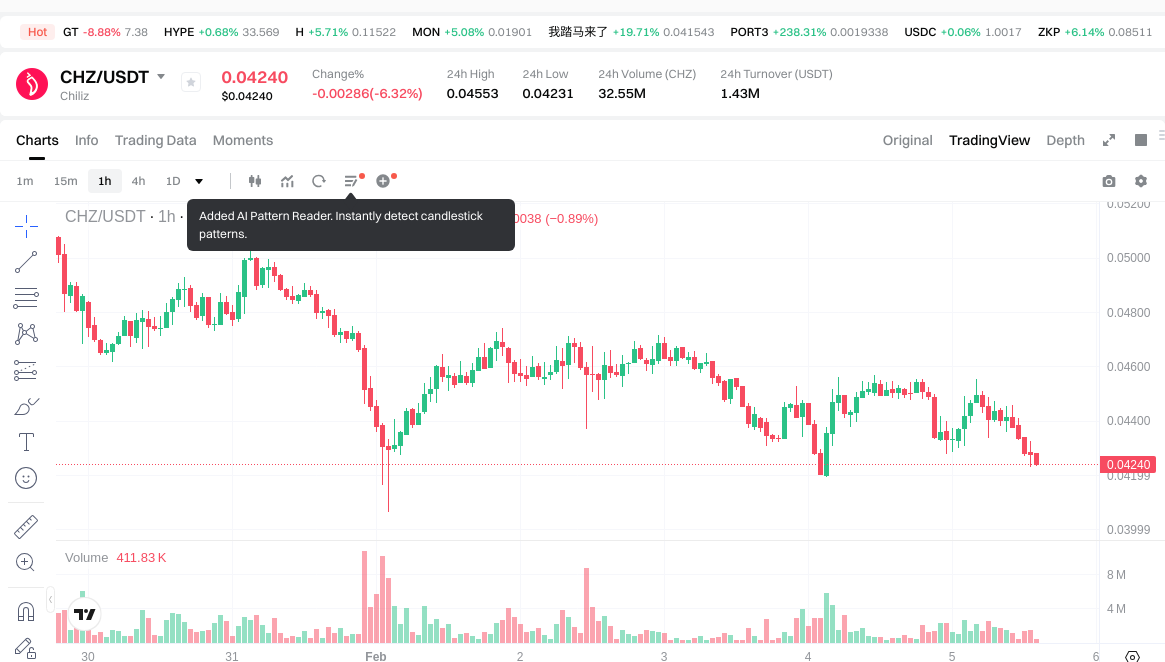
II. Core Factors Influencing DRAC vs CHZ Investment Value
Supply Mechanism Comparison (Tokenomics)
- DRAC: The available materials primarily discuss DRAC's technical routing capabilities in satellite internet systems, focusing on network congestion management with additional routing overhead as a trade-off. Supply mechanism details are not available in the provided sources.
- CHZ: The reference materials do not contain information regarding CHZ's supply mechanism or tokenomics structure.
- 📌 Historical Pattern: Insufficient data available to establish correlations between supply mechanisms and price cycle dynamics for these assets.
Institutional Adoption and Market Application
- Institutional Holdings: The provided materials do not contain comparative data on institutional preference between DRAC and CHZ.
- Enterprise Adoption: Reference sources focus on DRAC's network management efficiency and cost-saving contributions in technical infrastructure contexts, while specific applications in cross-border payments, settlements, or investment portfolios for either asset remain undocumented in the available materials.
- National Policies: Regulatory attitudes toward DRAC and CHZ across different jurisdictions are not addressed in the reference documentation.
Technical Development and Ecosystem Building
- DRAC Technical Upgrades: Materials indicate DRAC provides simplified network management capabilities and addresses unknown network congestion scenarios, though at the cost of additional routing overhead. These characteristics may enhance system reliability and scalability in satellite internet routing applications.
- CHZ Technical Development: The available sources suggest CHZ demonstrates advantages in data center automation, though specific technical specifications and developmental roadmaps are not detailed.
- Ecosystem Comparison: Implementation status across DeFi, NFT, payment systems, and smart contract deployments for both assets is not documented in the provided materials.
Macroeconomic Environment and Market Cycles
- Performance Under Inflationary Conditions: Comparative anti-inflation characteristics between DRAC and CHZ cannot be determined from available reference materials.
- Macroeconomic Monetary Policy: The impact of interest rate fluctuations and U.S. dollar index movements on both assets lacks documentation in the provided sources.
- Geopolitical Factors: Cross-border transaction demand patterns and international situation impacts on DRAC and CHZ remain unaddressed in available materials.
III. 2026-2031 Price Forecast: DRAC vs CHZ
Short-term Forecast (2026)
- DRAC: Conservative $0.00435 - $0.00501 | Optimistic $0.00501 - $0.00551
- CHZ: Conservative $0.0364 - $0.0424 | Optimistic $0.0424 - $0.0564
Mid-term Forecast (2028-2029)
- DRAC may enter a gradual growth phase, with estimated price range of $0.00408 - $0.00901
- CHZ may enter a consolidation and expansion phase, with estimated price range of $0.0359 - $0.0906
- Key drivers: institutional capital inflows, ETF developments, ecosystem expansion
Long-term Forecast (2030-2031)
- DRAC: Baseline scenario $0.00490 - $0.00963 | Optimistic scenario $0.00802 - $0.01124
- CHZ: Baseline scenario $0.0560 - $0.0886 | Optimistic scenario $0.0767 - $0.1005
View detailed price predictions for DRAC and CHZ
Disclaimer
DRAC:
| Year |
Predicted High Price |
Predicted Average Price |
Predicted Low Price |
Price Change |
| 2026 |
0.0055055 |
0.005005 |
0.00435435 |
0 |
| 2027 |
0.006831825 |
0.00525525 |
0.00294294 |
4 |
| 2028 |
0.008037904875 |
0.0060435375 |
0.00423047625 |
19 |
| 2029 |
0.00901212312 |
0.0070407211875 |
0.00408361828875 |
39 |
| 2030 |
0.01123699101525 |
0.00802642215375 |
0.004896117513787 |
59 |
| 2031 |
0.010691194308795 |
0.0096317065845 |
0.00866853592605 |
90 |
CHZ:
| Year |
Predicted High Price |
Predicted Average Price |
Predicted Low Price |
Price Change |
| 2026 |
0.0563521 |
0.04237 |
0.0364382 |
0 |
| 2027 |
0.067131028 |
0.04936105 |
0.043437724 |
15 |
| 2028 |
0.06756540524 |
0.058246039 |
0.04426698964 |
36 |
| 2029 |
0.0905842398528 |
0.06290572212 |
0.0358562616084 |
47 |
| 2030 |
0.100535925092184 |
0.0767449809864 |
0.056023836120072 |
79 |
| 2031 |
0.097504498343221 |
0.088640453039292 |
0.060275508066718 |
107 |
IV. Investment Strategy Comparison: DRAC vs CHZ
Long-term vs Short-term Investment Strategies
-
DRAC: May appeal to investors focused on emerging BRC-20 inscription assets with higher risk tolerance, seeking potential returns from early-stage technical developments in satellite network routing applications. The asset's substantial price volatility and lower market capitalization position it as a speculative opportunity rather than a stable holding.
-
CHZ: May suit investors interested in sports and entertainment sector blockchain applications, particularly those seeking exposure to fan engagement platforms with established partnerships. The asset's higher market capitalization and trading volume suggest relatively improved liquidity compared to DRAC.
Risk Management and Asset Allocation
-
Conservative Investors: DRAC 10-15% vs CHZ 85-90%. This allocation reflects CHZ's comparatively higher market capitalization and established ecosystem presence, though both assets carry substantial volatility characteristics.
-
Aggressive Investors: DRAC 30-40% vs CHZ 60-70%. This approach increases exposure to DRAC's potential growth trajectory while maintaining CHZ as a portfolio anchor within the cryptocurrency allocation.
-
Hedging Instruments: Stablecoin allocation for liquidity management, options strategies for downside protection, and cross-asset diversification across multiple blockchain sectors to mitigate concentration risk.
V. Comparative Risk Analysis
Market Risk
-
DRAC: Demonstrates pronounced price volatility with significant historical drawdowns from peak valuations. Limited trading volume of $15,093.79 may result in reduced liquidity during market stress periods. The asset's low market capitalization ranking at 2989 indicates exposure to delisting risk and reduced market maker support.
-
CHZ: Exhibits sensitivity to sports industry adoption cycles and fan token market sentiment. While maintaining higher trading volume at $1,424,855.84, the asset has shown considerable price corrections during broader cryptocurrency market downturns. The current Extreme Fear sentiment reading of 12 suggests elevated market uncertainty affecting both assets.
Technical Risk
-
DRAC: Materials indicate additional routing overhead as a trade-off for network congestion management capabilities in satellite internet systems. Scalability considerations and network stability during high-load scenarios require ongoing technical assessment. The BRC-20 standard's relative novelty compared to established token standards presents implementation uncertainties.
-
CHZ: Reference sources suggest advantages in data center automation, though specific technical architecture details remain undocumented in available materials. Smart contract security, platform infrastructure resilience, and integration complexity with sports organizations represent ongoing technical considerations.
Regulatory Risk
- Global regulatory frameworks continue evolving around cryptocurrency assets, with potential differential impacts on utility tokens versus inscription-based assets. CHZ's positioning within sports entertainment may attract sector-specific regulatory scrutiny regarding fan engagement and governance mechanisms. DRAC's classification under BRC-20 inscriptions may face evolving regulatory interpretations as authorities assess inscription-based token models. Both assets remain subject to jurisdictional variations in cryptocurrency classification, taxation policies, and trading restrictions.
VI. Conclusion: Which Is the Better Buy?
📌 Investment Value Summary:
-
DRAC Advantages: Demonstrated significant one-year price appreciation of 191.17% despite broader market challenges. Early-stage positioning in BRC-20 inscription space may offer exposure to emerging technical applications in satellite network routing. Lower entry price point enables fractional allocation strategies for experimental portfolio segments.
-
CHZ Advantages: Established market presence since 2019 with partnerships across major sports organizations. Higher market capitalization ranking at 121 and substantially greater trading volume indicate improved liquidity characteristics. Focused utility within sports fan engagement platforms provides clearer value proposition and use case definition.
✅ Investment Recommendations:
-
Beginner Investors: Consider prioritizing foundational cryptocurrency education before allocating to either asset. If proceeding, CHZ's higher liquidity and established ecosystem may present fewer execution challenges, though both assets carry substantial volatility. Position sizing should remain minimal relative to overall portfolio, with particular attention to risk management protocols.
-
Experienced Investors: Evaluate allocation decisions based on portfolio strategy objectives, risk tolerance parameters, and existing cryptocurrency exposure. DRAC may serve as a satellite position for those exploring inscription-based assets, while CHZ could complement sports and entertainment sector theses. Regular rebalancing protocols and stop-loss mechanisms warrant consideration given current market volatility.
-
Institutional Investors: Conduct comprehensive due diligence encompassing custody solutions, regulatory compliance frameworks, and liquidity analysis. CHZ's higher market capitalization and trading volume may better accommodate institutional position sizes, though both assets require careful consideration of execution strategies and counterparty risk management.
⚠️ Risk Disclosure: Cryptocurrency markets exhibit extreme volatility characteristics. This analysis does not constitute investment advice, financial recommendations, or solicitation to purchase securities. Investors should conduct independent research, consult qualified financial advisors, and carefully assess personal risk tolerance before making investment decisions.
VII. FAQ
Q1: What is the primary difference between DRAC and CHZ in terms of their core utility?
DRAC is a BRC-20 inscription token focused on technical applications in satellite network routing and congestion management, while CHZ serves as a sports fan engagement token for the Socios.com platform. DRAC represents an emerging experimental asset class within the Bitcoin ecosystem, leveraging inscription technology for network infrastructure applications. In contrast, CHZ has an established use case centered around providing governance rights and interactive experiences for sports and esports fans across major teams and leagues globally.
Q2: Which asset demonstrates better liquidity characteristics for trading execution?
CHZ exhibits significantly superior liquidity with a 24-hour trading volume of $1,424,855.84 compared to DRAC's $15,093.79 as of February 5, 2026. This 94-fold difference in trading volume translates to tighter bid-ask spreads, reduced slippage during order execution, and enhanced ability to enter or exit positions without substantial market impact. CHZ's higher market capitalization ranking at 121 versus DRAC's 2989 further indicates broader market maker participation and exchange support, making it more suitable for investors requiring reliable execution across various position sizes.
Q3: How have DRAC and CHZ performed during the past year amid market volatility?
DRAC has demonstrated exceptional one-year performance with a 191.17% price increase, while CHZ declined 27.18% over the same period. However, this divergence should be contextualized within each asset's maturity stage and market capitalization. DRAC's gains reflect recovery from extremely depressed levels following its all-time low of $0.00005608 in February 2025, representing speculative interest in emerging BRC-20 inscriptions. CHZ's decline aligns with broader cryptocurrency market corrections and reduced enthusiasm for fan token applications, though its higher absolute price of $0.04276 versus DRAC's $0.005043 reflects sustained market valuation.
Q4: What are the key risk factors investors should consider when comparing these assets?
Both assets carry substantial volatility risk, though with different characteristics. DRAC faces liquidity constraints due to minimal trading volume, delisting risk from its low market cap ranking, and technical uncertainties surrounding BRC-20 inscription standards and satellite routing applications. CHZ confronts market sensitivity to sports industry adoption cycles, dependency on Socios.com platform development, and potential regulatory scrutiny regarding fan governance mechanisms. Additionally, both assets operate within an evolving global regulatory landscape where cryptocurrency classification and compliance requirements remain subject to jurisdictional variations.
Q5: Which asset is more suitable for portfolio diversification purposes?
The suitability depends on existing portfolio composition and diversification objectives. CHZ may provide better diversification for investors seeking exposure to sports entertainment sector blockchain applications, offering relatively lower correlation with traditional cryptocurrency assets focused on DeFi or payments. DRAC could serve diversification purposes for portfolios exploring emerging inscription-based tokens and satellite network infrastructure applications, though its high correlation with broader BRC-20 market sentiment limits diversification benefits. Conservative portfolios may favor CHZ's higher liquidity and established market presence, while aggressive allocations might incorporate DRAC as a satellite position for exposure to nascent asset categories.
Q6: What technical developments could significantly impact the future valuation of these assets?
For DRAC, advancements in satellite internet routing efficiency, reduced overhead costs in network congestion management, and broader adoption of BRC-20 inscription standards could materially affect valuation. Successful implementation in commercial satellite networks or partnerships with telecommunications infrastructure providers would represent positive catalysts. For CHZ, expansion of the Socios.com platform to additional major sports leagues, integration of enhanced fan engagement features, technical upgrades improving scalability and transaction costs, and successful deployment of blockchain-based voting mechanisms for team governance could drive valuation increases. Both assets would benefit from broader cryptocurrency market recovery and improved institutional participation.
Q7: How should investors interpret the current Extreme Fear sentiment reading of 12?
The Fear & Greed Index reading of 12 indicates Extreme Fear conditions across cryptocurrency markets as of February 5, 2026, historically associated with market bottoms and potential accumulation opportunities for long-term investors. However, this sentiment indicator alone should not dictate investment decisions. Both DRAC and CHZ have experienced recent price declines (DRAC -5.4% and CHZ -5.9% over 24 hours), reflecting broader market pressure rather than asset-specific fundamentals. Investors should combine sentiment analysis with technical indicators, fundamental assessments, and personal risk tolerance. Extreme Fear conditions may present entry opportunities for those with conviction in long-term thesis, though timing market bottoms remains inherently uncertain and requires disciplined risk management protocols.
* The information is not intended to be and does not constitute financial advice or any other recommendation of any sort offered or endorsed by Gate.