This comprehensive guide compares EMYC and ADA, two distinct blockchain platforms serving different market segments. EMYC, launched in 2025, operates as a public permissioned blockchain emphasizing regulatory compliance with integrated on-chain KYC and AML features for real-world asset tokenization. ADA, operational since 2017, functions as an established smart contract platform with layered architecture supporting DeFi and NFT ecosystems. The article analyzes historical price trends, market liquidity differences, tokenomics, institutional adoption patterns, and technical development trajectories through 2031 forecasts. Current market conditions reflect EMYC at $0.00701 with limited liquidity versus ADA at $0.30 with substantially higher trading volumes on Gate. Investors will discover tailored strategies addressing conservative, aggressive, and institutional investment profiles, alongside risk assessments covering market volatility, technical execution, and regulatory frameworks affecting both assets.
Introduction: Investment Comparison Between EMYC and ADA
In the cryptocurrency market, the comparison between EMYC vs ADA has become a topic of interest for investors. The two tokens demonstrate notable differences in market cap ranking, application scenarios, and price performance, representing distinct positioning within the crypto asset landscape.
EMYC (E Money): Launched in 2025, EMYC has positioned itself as the world's first public permissioned blockchain network supporting on-chain KYC and AML, focusing on real-world asset tokenization with bank-grade security infrastructure.
ADA (Cardano): Since its introduction in 2017, ADA has been recognized as a technology platform designed to run financial applications for individuals, organizations, and governments worldwide, with a layered architecture supporting smart contracts.
This article will provide a comprehensive analysis of EMYC vs ADA investment value comparison, covering historical price trends, supply mechanisms, institutional adoption, technical ecosystem, and future outlook, attempting to address investors' most pressing question:
"Which is the better buy right now?"
I. Historical Price Comparison and Current Market Status
Historical Price Trends of EMYC (Coin A) and ADA (Coin B)
- 2025: EMYC experienced notable price fluctuation, reaching a recorded high of $0.31049 on January 23, 2025.
- 2021: ADA achieved its all-time high of $3.09 on September 2, 2021, driven by network upgrade developments including the Alonzo smart contract implementation.
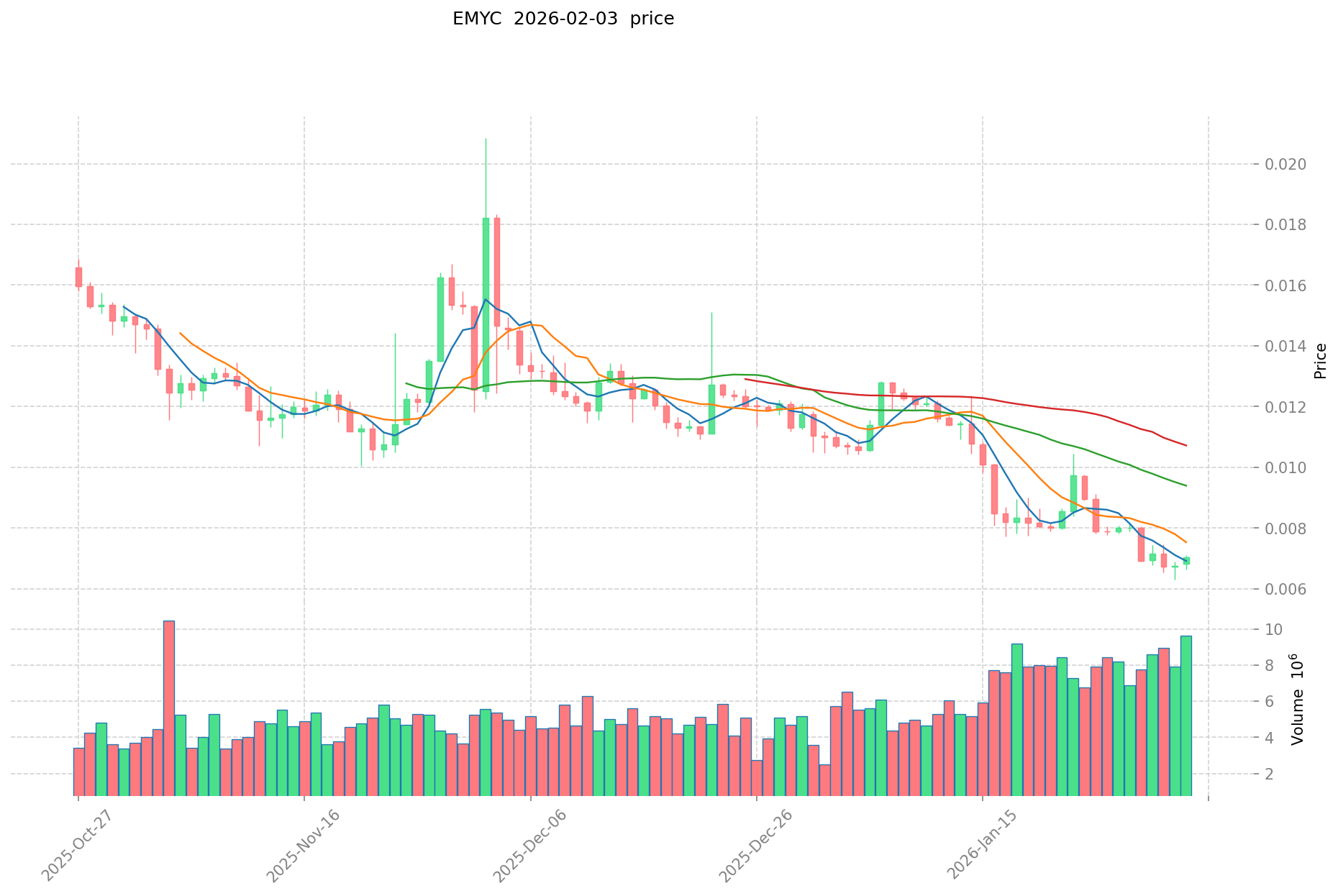
- Comparative Analysis: During recent market cycles, EMYC declined from its high of $0.31049 to a low of $0.006301 recorded on February 1, 2026, while ADA has declined from its peak of $3.09 to current levels around $0.30, representing a significant correction from historical highs.
Current Market Status (February 3, 2026)
- EMYC Current Price: $0.00701
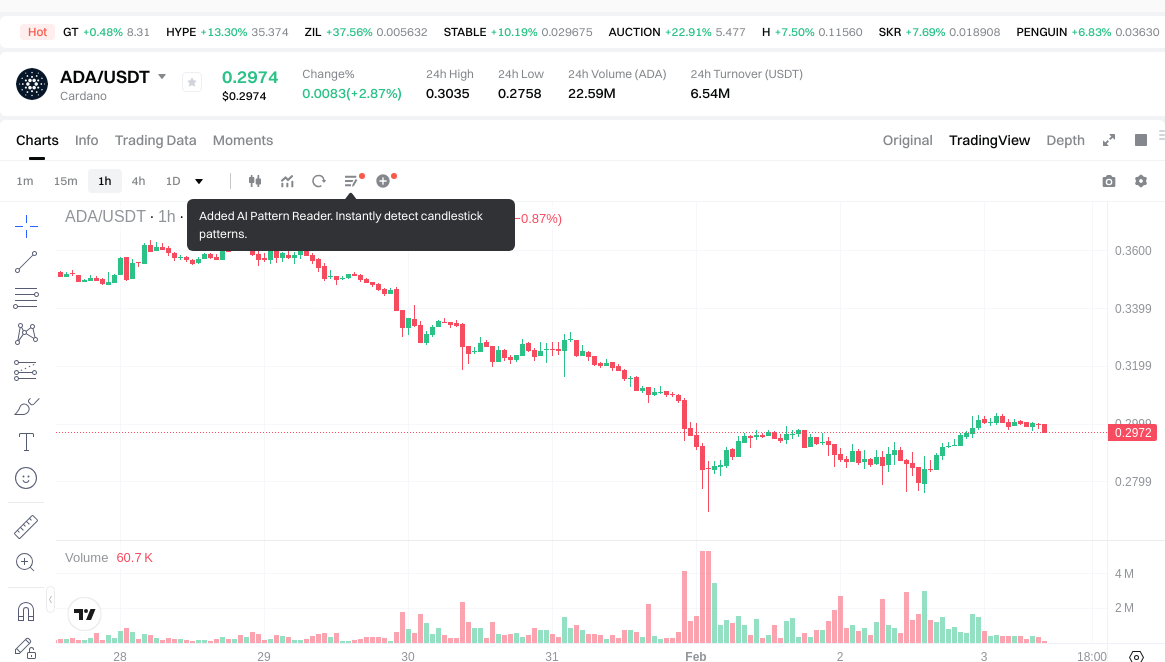
- ADA Current Price: $0.30
- 24-Hour Trading Volume: EMYC $62,026.16 vs ADA $6,550,653.47
- Market Sentiment Index (Fear & Greed Index): 17 (Extreme Fear)
View Real-Time Prices:
II. Core Factors Influencing EMYC vs ADA Investment Value
Supply Mechanism Comparison (Tokenomics)
The supply mechanisms of EMYC and ADA represent fundamental factors in determining their respective investment characteristics. Market demand, technological advancement, and price volatility significantly influence the investment returns of both assets. The innovation level of each project and its market acceptance rate serve as critical determinants of long-term value appreciation potential.
📌 Historical Pattern: Supply mechanisms have historically driven cyclical price movements in cryptocurrency markets, with investor confidence and market trends playing substantial roles in determining asset performance.
Institutional Adoption and Market Application
- Institutional Holdings: Current market trends and investor confidence levels are key factors affecting institutional preference between these assets.
- Enterprise Adoption: The investment value of both EMYC and ADA depends heavily on their acceptance in practical applications, including cross-border payments, settlement systems, and investment portfolios.
- National Policies: Regulatory attitudes vary across jurisdictions, with institutional frameworks and prudent policy approaches serving as important indicators of regional confidence in cryptocurrency adoption.
Technological Development and Ecosystem Construction
The technological innovation and market acceptance of both projects constitute essential elements in their investment value proposition. Development progress in DeFi, NFT, payment systems, and smart contract implementation continues to shape the competitive landscape between these assets.
Macroeconomic Environment and Market Cycles
- Performance Under Inflation: The investment returns of both assets are subject to macroeconomic conditions and market volatility patterns.
- Macroeconomic Monetary Policy: Interest rate fluctuations, currency index movements, and broader monetary policy decisions influence the relative performance of cryptocurrency assets.
- Geopolitical Factors: Cross-border transaction demand and international economic dynamics contribute to market sentiment and adoption patterns for both EMYC and ADA.
III. 2026-2031 Price Forecast: EMYC vs ADA
Short-term Forecast (2026)
- EMYC: Conservative $0.00455 - $0.007 | Optimistic $0.007 - $0.01001
- ADA: Conservative $0.20776 - $0.2968 | Optimistic $0.2968 - $0.394744
Mid-term Forecast (2028-2029)
- EMYC may enter a consolidation phase with projected price range of $0.008680203 - $0.014444271135
- ADA may enter a growth phase with projected price range of $0.225097572 - $0.496602760094
- Key drivers: institutional capital inflows, ETF developments, ecosystem expansion
Long-term Forecast (2031)
- EMYC: Baseline scenario $0.0120367348877 - $0.014860166528025 | Optimistic scenario $0.014860166528025 - $0.018723809825311
- ADA: Baseline scenario $0.313748739210076 - $0.56026560573228 | Optimistic scenario $0.56026560573228 - $0.694729351108027
View detailed price predictions for EMYC and ADA
Disclaimer
EMYC:
| Year |
Predicted High Price |
Predicted Average Price |
Predicted Low Price |
Price Change |
| 2026 |
0.01001 |
0.007 |
0.00455 |
0 |
| 2027 |
0.01216215 |
0.008505 |
0.00552825 |
21 |
| 2028 |
0.01457034075 |
0.010333575 |
0.008680203 |
47 |
| 2029 |
0.014444271135 |
0.012451957875 |
0.010459644615 |
77 |
| 2030 |
0.01627221855105 |
0.013448114505 |
0.01143089732925 |
91 |
| 2031 |
0.018723809825311 |
0.014860166528025 |
0.0120367348877 |
111 |
ADA:
| Year |
Predicted High Price |
Predicted Average Price |
Predicted Low Price |
Price Change |
| 2026 |
0.394744 |
0.2968 |
0.20776 |
0 |
| 2027 |
0.40455324 |
0.345772 |
0.31465252 |
15 |
| 2028 |
0.4389402654 |
0.37516262 |
0.225097572 |
25 |
| 2029 |
0.496602760094 |
0.4070514427 |
0.219807779058 |
36 |
| 2030 |
0.66870411006756 |
0.451827101397 |
0.29368761590805 |
51 |
| 2031 |
0.694729351108027 |
0.56026560573228 |
0.313748739210076 |
87 |
IV. Investment Strategy Comparison: EMYC vs ADA
Long-term vs Short-term Investment Strategies
-
EMYC: May be suitable for investors interested in emerging blockchain infrastructure projects with focus on regulatory compliance and tokenization applications. The asset's characteristics suggest consideration for speculative allocation within diversified portfolios.
-
ADA: May be suitable for investors seeking exposure to established smart contract platforms with multi-year development history and broader ecosystem adoption. The asset's market position suggests potential consideration for medium to long-term holding strategies.
Risk Management and Asset Allocation
-
Conservative Investors: Portfolio allocation approaches may vary based on individual risk tolerance, investment objectives, and time horizons. Conservative strategies typically emphasize capital preservation and lower volatility exposure.
-
Aggressive Investors: Higher-risk portfolios may include increased exposure to emerging assets, though diversification principles remain fundamental to risk management practices.
-
Hedging Tools: Risk management strategies may incorporate stablecoin allocations, derivatives instruments, and cross-asset diversification to mitigate portfolio volatility.
V. Potential Risk Comparison
Market Risk
-
EMYC: Limited trading volume ($62,026.16 as of February 3, 2026) presents liquidity considerations. Price volatility remains elevated, with the asset experiencing fluctuations from $0.31049 (January 23, 2025) to $0.006301 (February 1, 2026). Market depth and order book stability warrant careful evaluation.
-
ADA: Trading volume of $6,550,653.47 indicates relatively higher market liquidity compared to EMYC. Historical price correction from $3.09 (September 2021) to current levels around $0.30 demonstrates significant drawdown risk. Market sentiment index of 17 (Extreme Fear) reflects current risk environment.
Technical Risk
-
EMYC: As a project launched in 2025, network maturity and scalability under increased transaction loads require ongoing assessment. The permissioned blockchain model introduces considerations regarding network governance and operational continuity.
-
ADA: Network upgrade implementation history includes the Alonzo smart contract deployment. Ongoing development progress and protocol modifications present execution risks. Ecosystem stability depends on continued technical advancement and community coordination.
Regulatory Risk
- Global regulatory frameworks continue to evolve, with varying approaches across jurisdictions affecting both assets differently. EMYC's positioning as a public permissioned blockchain with on-chain KYC and AML features may face distinct compliance considerations compared to ADA's decentralized protocol structure. Regulatory developments regarding asset classification, securities laws, and cross-border transaction policies remain ongoing factors influencing both projects.
VI. Conclusion: Which Is the Better Buy?
📌 Investment Value Summary:
-
EMYC Characteristics: Positioned as an emerging blockchain infrastructure project launched in 2025, focusing on regulatory compliance features including on-chain KYC and AML capabilities. Current market positioning includes lower liquidity metrics and significant price volatility patterns.
-
ADA Characteristics: Established smart contract platform with operational history since 2017, featuring layered architecture and broader ecosystem development. Market presence includes higher trading volumes and established institutional awareness, though with notable price correction from historical peaks.
✅ Investment Considerations:
-
New Investors: Comprehensive education regarding cryptocurrency market dynamics, volatility patterns, and risk management principles should precede any allocation decisions. Starting with established assets with higher liquidity may support learning objectives.
-
Experienced Investors: Portfolio construction may incorporate both emerging and established assets based on individual risk tolerance, investment timeframe, and diversification objectives. Technical analysis, fundamental research, and ongoing monitoring remain essential practices.
-
Institutional Investors: Due diligence processes should encompass regulatory compliance frameworks, custody solutions, liquidity assessment, and alignment with institutional investment mandates. Risk management protocols and governance structures require careful consideration.
⚠️ Risk Disclosure: Cryptocurrency markets exhibit extreme volatility characteristics. This content does not constitute investment advice, financial guidance, or recommendations for specific investment actions. Investors should conduct independent research, consult qualified financial advisors, and assess personal risk tolerance before making investment decisions.
VII. FAQ
Q1: What are the main differences between EMYC and ADA in terms of blockchain architecture?
EMYC operates as a public permissioned blockchain with integrated on-chain KYC and AML features focusing on real-world asset tokenization, while ADA functions as a decentralized smart contract platform with layered architecture supporting broader DeFi and NFT applications. EMYC launched in 2025 positions itself as a bank-grade security infrastructure emphasizing regulatory compliance, whereas ADA, operational since 2017, has established a mature ecosystem with protocol upgrades like the Alonzo smart contract implementation completed in 2021.
Q2: How do the current liquidity levels differ between EMYC and ADA?
As of February 3, 2026, ADA demonstrates significantly higher liquidity with 24-hour trading volume of $6,550,653.47 compared to EMYC's $62,026.16, representing approximately 105 times greater market liquidity. This substantial difference in trading volume affects market depth, order execution efficiency, and price stability, with EMYC's limited liquidity presenting considerations for position entry and exit timing, particularly for larger transaction sizes.
Q3: What price volatility patterns have EMYC and ADA exhibited historically?
EMYC has experienced extreme volatility since its 2025 launch, declining from $0.31049 (January 23, 2025) to $0.006301 (February 1, 2026), representing approximately 98% drawdown within one year. ADA demonstrated significant historical volatility with decline from its all-time high of $3.09 (September 2021) to current levels around $0.30, representing approximately 90% correction over a multi-year period. Both assets exhibit high-risk volatility characteristics typical of cryptocurrency markets.
Q4: How do the supply mechanisms of EMYC and ADA affect their investment characteristics?
The tokenomics of both assets serve as fundamental determinants of their investment profiles, with supply mechanisms historically driving cyclical price movements influenced by market demand, technological advancement, and investor confidence levels. While specific circulating supply figures are not detailed in available data, the structured supply mechanisms of both projects contribute to their respective price discovery processes and long-term value propositions within distinct market positioning strategies.
Q5: What regulatory considerations differentiate EMYC from ADA?
EMYC's positioning as a public permissioned blockchain with integrated on-chain KYC and AML capabilities presents distinct regulatory compliance frameworks compared to ADA's decentralized protocol structure. EMYC's bank-grade security infrastructure and regulatory-first approach may face different jurisdictional requirements regarding asset classification and operational compliance, while ADA's decentralized architecture encounters evolving regulatory frameworks affecting smart contract platforms globally. Both assets remain subject to ongoing regulatory developments across multiple jurisdictions.
Q6: What are the projected growth trajectories for EMYC and ADA through 2031?
Conservative forecasts suggest EMYC may range from $0.00455 to $0.018723809825311 between 2026 and 2031, representing potential growth of approximately 311% from current levels under optimistic scenarios. ADA conservative projections range from $0.20776 to $0.694729351108027 for the same period, suggesting potential growth of approximately 231% from current levels. These projections incorporate factors including institutional capital inflows, ecosystem expansion, and macroeconomic conditions, though actual outcomes remain subject to significant uncertainty.
Q7: Which investment strategy is more appropriate for different investor profiles?
Conservative investors may consider higher allocations to established assets like ADA with greater liquidity and operational history, while maintaining limited speculative exposure. Aggressive investors with higher risk tolerance might incorporate emerging projects like EMYC within diversified portfolios, though fundamental diversification principles remain essential. Institutional investors require comprehensive due diligence encompassing regulatory compliance frameworks, custody solutions, and alignment with investment mandates before considering either asset.
Q8: What are the primary risk factors to consider when comparing EMYC and ADA?
Market risk differs substantially, with EMYC's limited trading volume ($62,026.16) presenting liquidity constraints compared to ADA's higher volume ($6,550,653.47). Technical risks include EMYC's network maturity considerations as a 2025-launched project versus ADA's established infrastructure with ongoing protocol development requirements. Regulatory risks affect both assets differently based on their architectural approaches, with EMYC's permissioned model and ADA's decentralized structure facing distinct compliance frameworks across evolving global regulatory landscapes.
* The information is not intended to be and does not constitute financial advice or any other recommendation of any sort offered or endorsed by Gate.