ETHS vs RUNE: A Comprehensive Comparison of Ethereum Staking and Cross-Chain Interoperability Solutions


Introduction: Investment Comparison Between ETHS and RUNE
In the cryptocurrency market, the comparison between ETHS vs RUNE has consistently been a topic that investors cannot overlook. Both exhibit notable differences in market cap ranking, application scenarios, and price performance, while representing distinct positioning within the crypto asset landscape.
ETHS: Since its launch in 2023, it has gained market recognition as the core asset of Facet, a decentralized Ethereum L1 scaling protocol funded by the Ethereum Foundation, positioned as an Unstoppable Rollup empowering secure expansion of the Ethereum mainnet.
RUNE (RUNE): Launched in 2019, it serves as the native token of THORChain, a highly optimized multi-chain protocol utilizing pBFT consensus for sub-second block finality, supporting cross-chain transactions and liquidity provision.
This article will comprehensively analyze the investment value comparison between ETHS vs RUNE through historical price trends, supply mechanisms, institutional adoption, technological ecosystems, and future forecasts, attempting to address the question investors care about most:
"Which is the better buy right now?"
I. Historical Price Comparison and Current Market Status
ETHS (Coin A) and RUNE (Coin B) Historical Price Trends
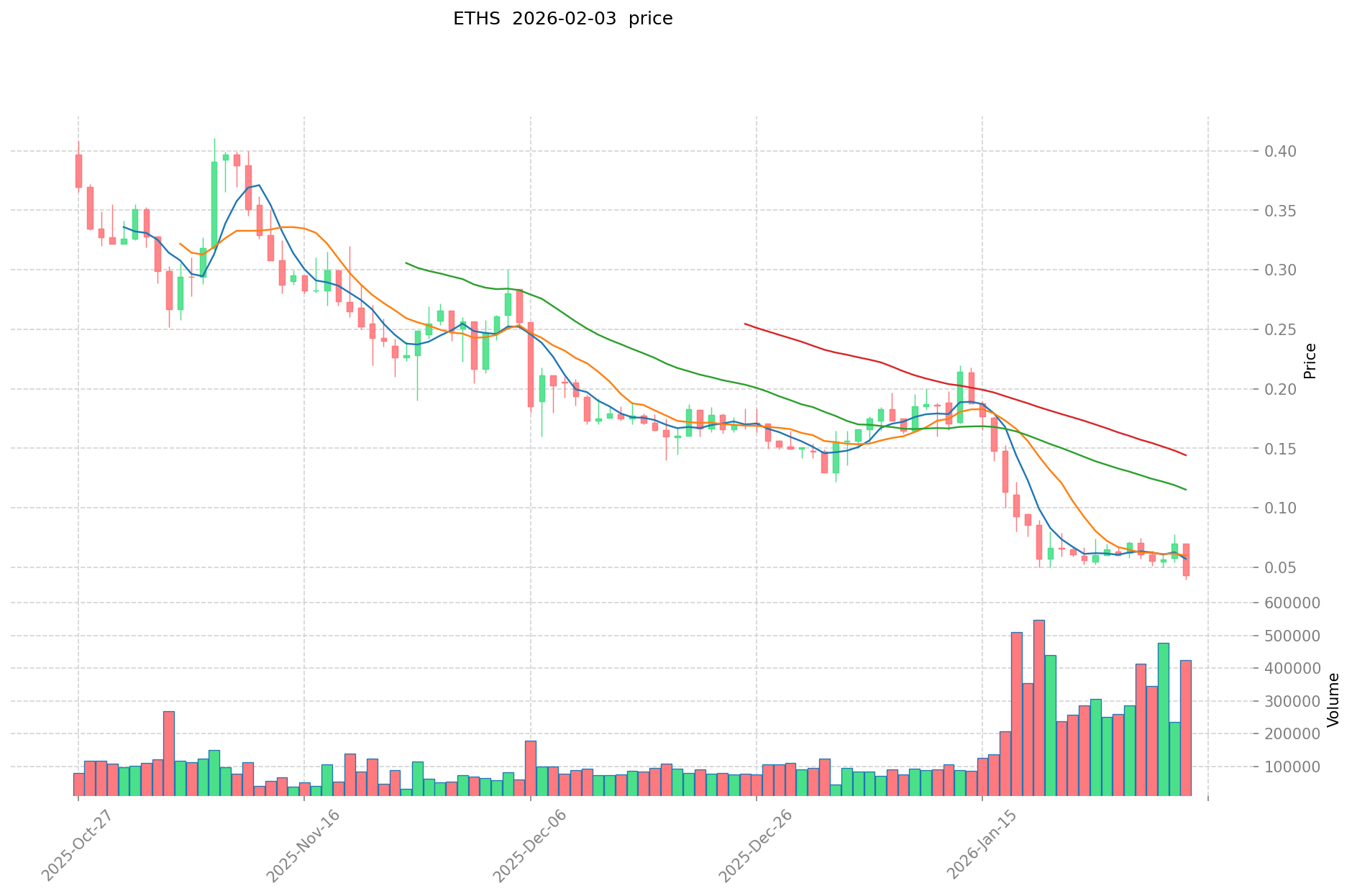
- 2024: ETHS experienced significant price volatility, reaching a historical high of $13.9 in January 2024. Following this peak, the asset entered a prolonged downward trend.
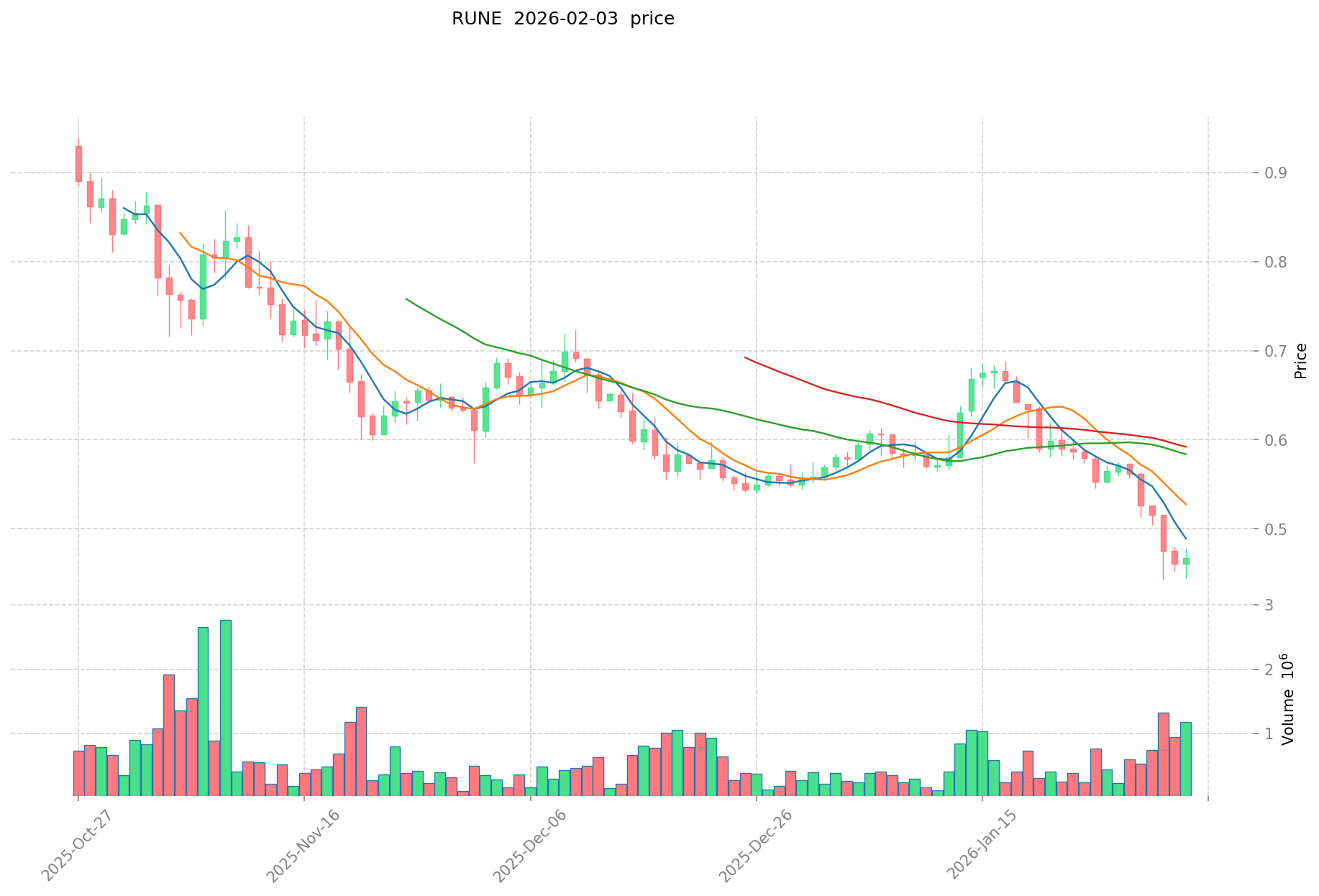
- 2021: RUNE was influenced by broader market momentum during the cryptocurrency bull market, with its price reaching $20.87 in May 2021. Since then, the asset has undergone substantial corrections.
- Comparative Analysis: During the recent market cycle, ETHS declined from its all-time high of $13.9 to a recent low of $0.03377, representing a decline of over 99%. In comparison, RUNE decreased from its peak of $20.87 to $0.00851264, also experiencing a significant drawdown exceeding 99%.
Current Market Conditions (2026-02-04)
- ETHS current price: $0.04098
- RUNE current price: $0.4594
- 24-hour trading volume: ETHS $16,266.15 vs RUNE $463,461.69
- Market Sentiment Index (Fear & Greed Index): 17 (Extreme Fear)
View real-time prices:
- Check current ETHS price Market Price
- Check current RUNE price Market Price
II. Core Factors Influencing ETHS vs RUNE Investment Value
Supply Mechanism Comparison (Tokenomics)
- ETHS: Reference materials indicate ETHS operates within the Ethereum ecosystem framework, though specific supply mechanism details are not provided in available sources.
- RUNE: RUNE protocol was proposed by Ordinals founder Casey Rodarmor, utilizing a UTXO-based model for asset recording. The protocol aims to address limitations in existing Bitcoin network fungible token solutions such as BRC20 and Taproot Assets.
- 📌 Historical Pattern: Reference materials suggest that Bitcoin's halving cycle and Ethereum's upgrade progress represent fundamental factors determining crypto asset trajectories, though specific correlations to supply mechanisms driving price cycles require further data.
Institutional Adoption and Market Application
- Institutional Holdings: Available materials do not provide comparative data on institutional preference between ETHS and RUNE.
- Enterprise Adoption: Reference materials mention BRC-20 and related protocols attracting developer attention and expanding user bases, particularly following the introduction of Bitcoin spot ETF-driven market conditions. However, specific applications of ETHS or RUNE in cross-border payments, settlements, or investment portfolios are not detailed in provided sources.
- National Policies: Materials reference regulatory developments affecting broader crypto markets, including exchange compliance measures, though jurisdiction-specific regulatory stances toward ETHS and RUNE are not explicitly addressed.
Technical Development and Ecosystem Building
- ETHS Technical Development: Reference materials characterize ETHS as part of inscription speculation extending beyond Bitcoin ecosystem to Ethereum Virtual Machine (EVM)-based chains, though technical upgrade specifics are not detailed.
- RUNE Technical Development: RUNE protocol employs a UTXO model with data storage in transaction OP_RETURN fields, enabling direct binding with Bitcoin UTXO sets. This approach offers more streamlined asset data storage and indexing compared to BRC-20's JSON format in witness data. Materials note the protocol had not formally launched as of referenced timeframes, with current "Rune" concept projects appearing as Bitcoin NFTs serving as scoring mechanisms for future token airdrops.
- Ecosystem Comparison: Available materials discuss broader Bitcoin ecosystem developments including Ordinals, BRC-20, and related protocols driving increased transaction activity and community engagement. Reference sources mention DeFi, NFT, and token standards development across Bitcoin and Ethereum ecosystems, though specific deployment metrics for ETHS and RUNE across DeFi, NFT, payment, and smart contract applications are not provided.
Macroeconomic Conditions and Market Cycles
- Performance in Inflationary Environments: Materials reference Bitcoin's halving cycle and Ethereum's upgrade progress as core factors in crypto asset trajectories, though comparative inflation-hedging attributes of ETHS versus RUNE are not specifically analyzed in available sources.
- Macroeconomic Monetary Policy: Reference materials mention Bitcoin spot ETF developments and regulatory interactions with exchanges, suggesting broader market sensitivity to policy developments. Specific impacts of interest rates and dollar index movements on ETHS and RUNE are not detailed in provided materials.
- Geopolitical Factors: Available sources do not provide specific analysis of cross-border transaction demand or international developments affecting ETHS and RUNE comparative positioning.
III. 2026-2031 Price Forecast: ETHS vs RUNE
Short-term Forecast (2026)
- ETHS: Conservative $0.021 - $0.041 | Optimistic $0.041 - $0.060
- RUNE: Conservative $0.415 - $0.456 | Optimistic $0.456 - $0.525
Medium-term Forecast (2028-2029)
- ETHS may enter a consolidation phase with projected price range of $0.039 - $0.084
- RUNE may enter an expansion phase with projected price range of $0.312 - $0.874
- Key drivers: institutional capital inflows, ETF developments, ecosystem growth
Long-term Forecast (2030-2031)
- ETHS: Baseline scenario $0.040 - $0.073 | Optimistic scenario $0.055 - $0.087
- RUNE: Baseline scenario $0.431 - $0.743 | Optimistic scenario $0.630 - $1.225
Disclaimer: Price predictions are based on historical data analysis and market trends. Cryptocurrency markets are highly volatile and subject to various risk factors. These forecasts should not be considered as investment advice. Users should conduct independent research and consult with financial professionals before making any investment decisions.
ETHS:
| Year | Predicted High Price | Predicted Average Price | Predicted Low Price | Price Change |
|---|---|---|---|---|
| 2026 | 0.0598308 | 0.04098 | 0.0213096 | 0 |
| 2027 | 0.061494588 | 0.0504054 | 0.042340536 | 23 |
| 2028 | 0.06825899268 | 0.055949994 | 0.05371199424 | 36 |
| 2029 | 0.0844621109424 | 0.06210449334 | 0.0391258308042 | 51 |
| 2030 | 0.085741463505204 | 0.0732833021412 | 0.039572983156248 | 78 |
| 2031 | 0.087463621105522 | 0.079512382823202 | 0.054863544148009 | 94 |
RUNE:
| Year | Predicted High Price | Predicted Average Price | Predicted Low Price | Price Change |
|---|---|---|---|---|
| 2026 | 0.52486 | 0.4564 | 0.415324 | 0 |
| 2027 | 0.6574442 | 0.49063 | 0.3287221 | 6 |
| 2028 | 0.648661923 | 0.5740371 | 0.499412277 | 24 |
| 2029 | 0.874229801445 | 0.6113495115 | 0.311788250865 | 33 |
| 2030 | 1.032477622496775 | 0.7427896564725 | 0.43081800075405 | 61 |
| 2031 | 1.224934422488799 | 0.887633639484637 | 0.630219884034092 | 93 |
IV. Investment Strategy Comparison: ETHS vs RUNE
Long-term vs Short-term Investment Strategies
- ETHS: May appeal to investors focused on Ethereum ecosystem developments and emerging protocol infrastructure, particularly those with higher risk tolerance given historical price volatility patterns
- RUNE: May suit investors interested in cross-chain liquidity protocols and Bitcoin ecosystem innovations, with consideration for protocol development timelines
Risk Management and Asset Allocation
- Conservative Investors: ETHS 20-30% vs RUNE 70-80%
- Aggressive Investors: ETHS 40-50% vs RUNE 50-60%
- Hedging Tools: Stablecoin allocation, options strategies, cross-asset portfolio diversification
V. Comparative Risk Analysis
Market Risk
- ETHS: Reference materials indicate price declined over 99% from historical peaks, suggesting substantial downside volatility exposure. Trading volume of $16,266.15 reflects limited liquidity conditions
- RUNE: Materials show similar drawdown patterns exceeding 99% from peak levels, though current trading volume of $463,461.69 indicates relatively higher market activity
Technical Risk
- ETHS: Available materials do not detail specific scalability metrics or network stability parameters for evaluation
- RUNE: Protocol utilizes UTXO model with OP_RETURN data storage. Materials note the protocol development status and implementation timeline require consideration
Regulatory Risk
- Global regulatory developments may affect both assets differently based on their respective protocol architectures and use cases. Materials reference broader compliance measures affecting crypto markets, though jurisdiction-specific impacts on ETHS and RUNE require ongoing monitoring
VI. Conclusion: Which Is the Better Buy?
📌 Investment Value Summary:
- ETHS Characteristics: Represents positioning within Ethereum ecosystem infrastructure developments, with reference materials noting significant historical price volatility
- RUNE Characteristics: Associated with cross-chain protocol development and Bitcoin ecosystem innovations, with materials indicating UTXO-based technical architecture
✅ Investment Considerations:
- Beginning Investors: Consider establishing foundational understanding of both protocol architectures and ecosystem developments before allocation decisions. Materials indicate both assets have experienced substantial price movements requiring careful risk assessment
- Experienced Investors: May evaluate comparative technical development trajectories, ecosystem growth metrics, and relative liquidity conditions. Price forecast ranges suggest potential for continued volatility across timeframes
- Institutional Investors: Available materials do not provide specific institutional adoption metrics for comparative evaluation. Further research into protocol maturity, regulatory positioning, and market infrastructure may inform allocation strategies
⚠️ Risk Disclosure: Cryptocurrency markets exhibit high volatility characteristics. This analysis does not constitute investment advice. Market conditions as of 2026-02-04 indicate Extreme Fear sentiment levels. Users should conduct independent research and consult qualified financial professionals before making investment decisions.
VII. FAQ
Q1: What is the fundamental difference between ETHS and RUNE protocols?
ETHS operates within the Ethereum ecosystem as part of Facet's decentralized L1 scaling infrastructure, while RUNE functions as the native token of THORChain's multi-chain liquidity protocol utilizing pBFT consensus. ETHS represents positioning in Ethereum-based inscription and scaling developments launched in 2023, whereas RUNE, launched in 2019, focuses on cross-chain transaction facilitation and liquidity provision across multiple blockchain networks. The technical architectures differ significantly, with ETHS leveraging EVM compatibility and RUNE employing a UTXO-based model with OP_RETURN data storage for direct Bitcoin UTXO set binding.
Q2: Why have both ETHS and RUNE experienced price declines exceeding 99% from their historical peaks?
Both assets declined over 99% from their respective all-time highs due to broader cryptocurrency market cycle corrections and sector-specific factors. ETHS fell from $13.9 (January 2024) to $0.03377, while RUNE decreased from $20.87 (May 2021) to $0.00851264. These substantial drawdowns reflect the typical volatility patterns in emerging crypto protocols during market downturns, compounded by shifts in investor sentiment, reduced speculative interest in inscription-based assets, and broader macroeconomic pressures affecting risk-on assets. The current market sentiment index at 17 (Extreme Fear) as of February 4, 2026, indicates continued bearish market conditions affecting both assets.
Q3: Which asset offers higher liquidity for trading purposes?
RUNE demonstrates significantly higher liquidity with 24-hour trading volume of $463,461.69 compared to ETHS's $16,266.15 as of February 4, 2026. This approximately 28x volume differential suggests RUNE offers more favorable conditions for order execution, tighter bid-ask spreads, and reduced slippage risk for both entry and exit positions. The higher liquidity may reflect RUNE's longer market presence since 2019, broader exchange listings, and established user base within the THORChain ecosystem. Investors prioritizing trade execution efficiency and portfolio liquidity management may find RUNE's current market depth more suitable for position sizing and risk management strategies.
Q4: What are the key price forecast differences between ETHS and RUNE through 2031?
ETHS forecasts show conservative 2026 range of $0.021-$0.041 with long-term 2031 baseline scenario of $0.040-$0.073, representing relatively modest appreciation from current levels. RUNE projections indicate 2026 conservative range of $0.415-$0.456 with 2031 baseline scenario of $0.431-$0.743, suggesting potential for more substantial absolute price growth. The optimistic 2031 scenario for RUNE reaches $0.630-$1.225 compared to ETHS's $0.055-$0.087, reflecting divergent growth trajectories based on historical patterns and ecosystem development expectations. These forecasts incorporate different maturity stages, with RUNE's established protocol potentially benefiting from continued cross-chain adoption while ETHS remains in earlier developmental phases.
Q5: How should conservative versus aggressive investors approach ETHS vs RUNE allocation?
Conservative investors may consider 20-30% ETHS allocation versus 70-80% RUNE positioning, prioritizing the more established protocol with higher liquidity and longer operational history. Aggressive investors might adopt 40-50% ETHS versus 50-60% RUNE allocation, accepting higher volatility exposure in exchange for potential upside from earlier-stage protocol development. Both strategies should incorporate stablecoin reserves for risk management, particularly given current Extreme Fear market conditions. The allocation frameworks reflect risk-adjusted return considerations, with RUNE's relative stability and liquidity favoring conservative approaches while ETHS's higher-risk profile may appeal to investors seeking asymmetric return opportunities despite substantial historical drawdowns.
Q6: What technical development factors distinguish ETHS and RUNE ecosystems?
ETHS technical development centers on Ethereum ecosystem infrastructure and EVM-based inscription innovations, though specific scalability metrics and upgrade timelines remain limited in available documentation. RUNE's technical architecture employs a UTXO model with OP_RETURN field data storage, offering streamlined asset indexing compared to alternative protocols using JSON witness data formats. The cross-chain functionality of THORChain's pBFT consensus mechanism enables sub-second block finality for multi-chain liquidity operations, representing a distinct technical approach from ETHS's Ethereum-focused scaling solutions. Investors evaluating technical risk should consider that RUNE's longer operational history provides more verifiable network stability data compared to ETHS's more recent deployment.
Q7: What regulatory considerations affect ETHS versus RUNE investment decisions?
Both assets face evolving regulatory landscapes affecting cryptocurrency markets broadly, though jurisdiction-specific impacts may differ based on protocol architecture and use cases. RUNE's cross-chain liquidity functionality may encounter regulatory scrutiny related to decentralized exchange operations and multi-chain asset bridging, particularly as compliance frameworks develop around DeFi protocols. ETHS's positioning within Ethereum inscription protocols may face regulatory considerations similar to those affecting NFT and digital collectible markets. Global regulatory developments, including exchange compliance measures and securities classification determinations, represent ongoing risk factors requiring continuous monitoring. Investors should assess regulatory positioning within their specific jurisdictions and consider that both assets operate in developing compliance environments.
Q8: Given current market conditions, what timeline considerations should inform ETHS vs RUNE investment decisions?
Short-term investors (2026 horizon) should note RUNE's higher current liquidity and more established market presence may offer relatively lower execution risk compared to ETHS's limited trading volume. Medium-term investors (2028-2029) may evaluate ETHS's potential consolidation phase ($0.039-$0.084 range) against RUNE's projected expansion phase ($0.312-$0.874 range), suggesting different risk-reward profiles during the mid-cycle period. Long-term investors (2030-2031) should consider that both assets face substantial uncertainty given historical volatility patterns and evolving protocol development trajectories. The current Extreme Fear market sentiment (index: 17) as of February 4, 2026, suggests potential accumulation opportunities for patient investors with appropriate risk tolerance, though timing market bottoms remains inherently uncertain in cryptocurrency markets.
Share
Content
Introduction: Investment Comparison Between ETHS and RUNE
I. Historical Price Comparison and Current Market Status
II. Core Factors Influencing ETHS vs RUNE Investment Value
III. 2026-2031 Price Forecast: ETHS vs RUNE
IV. Investment Strategy Comparison: ETHS vs RUNE
V. Comparative Risk Analysis
VI. Conclusion: Which Is the Better Buy?
VII. FAQ
How to Buy Cryptocurrency


Trending Cryptocurrencies



How to Mine Ethereum in 2025: A Complete Guide for Beginners

Ethereum 2.0 in 2025: Staking, Scalability, and Environmental Impact

What is Ethereum: A 2025 Guide for Crypto Enthusiasts and Investors

How does Ethereum's blockchain technology work?
What are smart contracts and how do they work on Ethereum?

Ethereum Price Analysis: 2025 Market Trends and Web3 Impact

What is MOBI: A Comprehensive Guide to Amazon's E-Book File Format and Its Uses

What is ALMANAK: A Comprehensive Guide to Digital Calendar and Event Management Systems

Proof of Work vs Proof of Stake: Which Is Superior?

What is RWAINC: A Comprehensive Guide to Real-World AI and Networking Capabilities
The Most Promising Cryptocurrencies: Where to Invest