This comprehensive analysis compares FIR and STX as cryptocurrency investment options on Gate exchange. FIR is an AI-powered decentralized music creation platform launched in 2025, while STX is an established Bitcoin layer-2 infrastructure operational since 2019. The article examines historical price trends, tokenomics, institutional adoption, technological ecosystems, and price forecasts through 2031. STX demonstrates superior liquidity and stability with 24-hour volume of $2,427,866 versus FIR's $12,741, though both experienced significant corrections from peaks. Long-term projections suggest STX's price range of $0.279-$0.704 by 2031 and FIR's $0.00384-$0.0102. Investment recommendations vary by experience level: conservative investors favor STX (15-20% allocation), while aggressive investors may diversify across both assets based on risk tolerance and market positioning.
Introduction: Investment Comparison Between FIR and STX
In the cryptocurrency market, the comparison between FIR vs STX has been a topic that investors cannot avoid. Both differ significantly in market cap ranking, application scenarios, and price performance, representing different positioning in the crypto asset landscape.
FIR (Fireverse): Launched in 2025, FIR has gained market recognition through its positioning as an AI-powered decentralized music creation platform. The platform combines artificial intelligence and blockchain technology to provide music generation, copyright protection, and token incentives, aiming to revolutionize music creation and monetization in the Web3 ecosystem.
STX (Stacks): Since its launch in 2019, STX has been positioned as a blockchain infrastructure layer that enables decentralized applications and smart contracts. It provides users with data ownership and privacy-focused solutions, utilizing its Proof of Transfer (PoX) consensus mechanism to build a new type of decentralized internet.
This article will comprehensively analyze the investment value comparison between FIR vs STX, focusing on historical price trends, supply mechanisms, institutional adoption, technological ecosystem, and future predictions, attempting to answer investors' most pressing question:
"Which is the better buy right now?"
I. Historical Price Comparison and Current Market Status
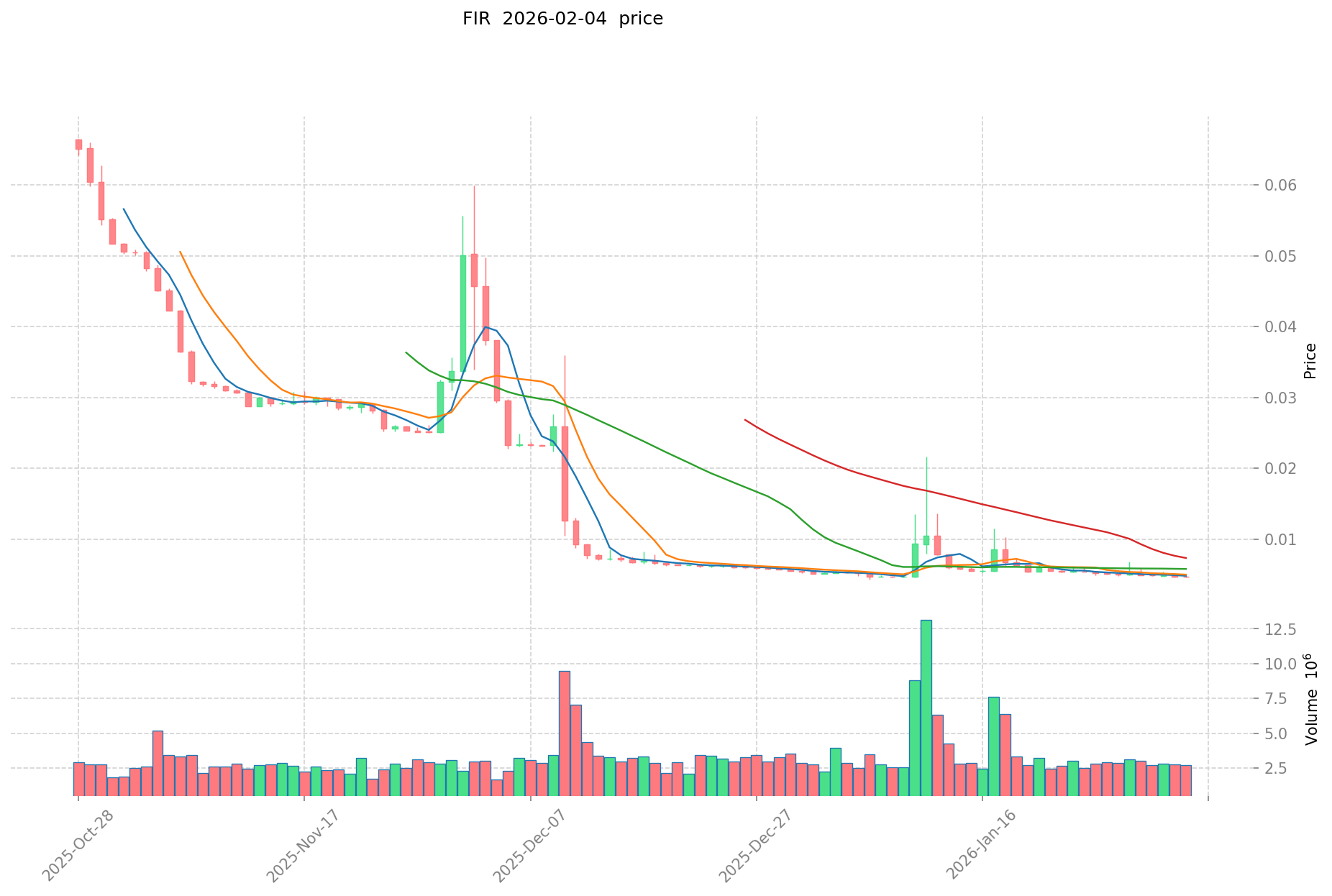
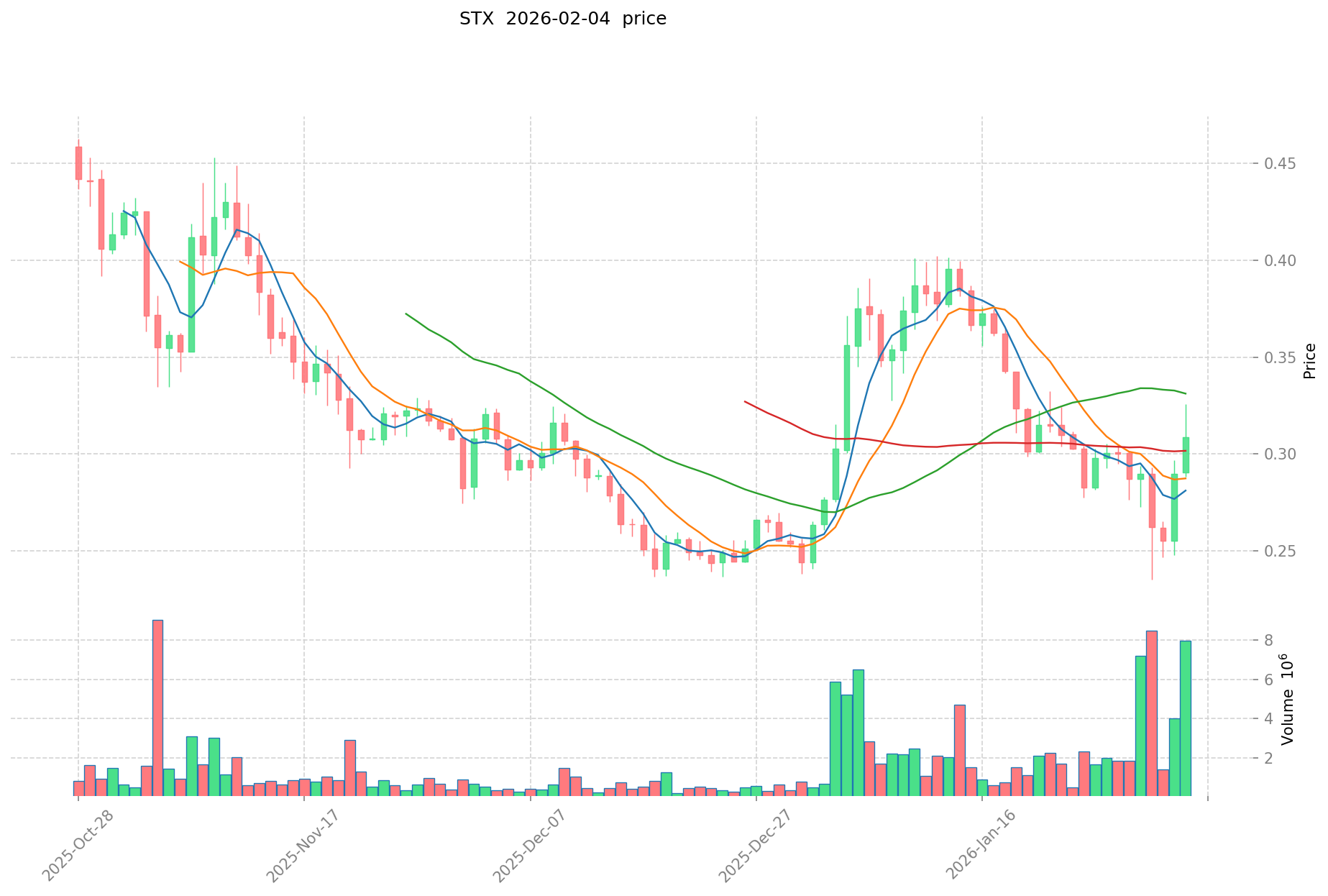
FIR and STX Historical Price Trends
- 2025: FIR reached an all-time high of $0.13662 on August 19, 2025, representing significant early-stage volatility typical of newly launched tokens.
- 2026: FIR experienced notable price decline, dropping to an all-time low of $0.004254 on January 6, 2026, reflecting a period of market correction and reduced trading interest.
- 2024: STX achieved its all-time high of $3.86 on April 1, 2024, driven by increased adoption of Bitcoin Layer-2 solutions and growing DeFi activity on the Stacks network.
- 2020: STX recorded its all-time low of $0.04559639 on March 13, 2020, coinciding with broader cryptocurrency market downturns during the early pandemic period.
- Comparative Analysis: During the 2025-2026 market cycle, FIR declined from its peak of $0.13662 to $0.004254, representing a substantial correction of over 96%. In contrast, STX has experienced a decline from $3.86 to current levels around $0.3086, showing an approximate 92% decrease from its all-time high, though maintaining relatively higher price stability compared to FIR's more recent launch volatility.
Current Market Status (2026-02-04)
- FIR Current Price: $0.00464
- STX Current Price: $0.3086
- 24-Hour Trading Volume: FIR recorded $12,741.69 vs STX recorded $2,427,866.26
- Market Sentiment Index (Fear & Greed Index): 17 (Extreme Fear)
View real-time prices:
II. Core Factors Influencing FIR vs STX Investment Value
Supply Mechanism Comparison (Tokenomics)
- FIR: Current circulation represents approximately 2% of total supply, indicating controlled token release with potential supply expansion dynamics.
- STX: Token distribution mechanism tied to Bitcoin layer-2 infrastructure development, with supply dynamics connected to network staking and protocol participation.
- 📌 Historical Pattern: Low circulating supply combined with institutional backing may create supply-demand imbalances during periods of increased market interest.
Institutional Adoption and Market Application
- Institutional Holdings: FIR demonstrates backing from established institutional investors, positioning it within professional investment portfolios.
- Enterprise Adoption: STX operates within the Bitcoin layer-2 ecosystem, facilitating smart contract functionality and decentralized application development on Bitcoin infrastructure.
- National Policy: Both assets operate within evolving regulatory frameworks, with jurisdictional approaches varying based on classification as utility tokens or infrastructure components.
Technology Development and Ecosystem Construction
- FIR Technology Development: Represents early-stage technological implementation with emphasis on execution capability and competitive positioning within its sector.
- STX Technology Development: Focuses on Bitcoin layer-2 scalability solutions, enabling programmability while maintaining connection to Bitcoin security model.
- Ecosystem Comparison: STX maintains presence in DeFi infrastructure built on Bitcoin, while FIR's ecosystem development remains in formative stages with evaluation dependent on technical execution.
Macroeconomic Environment and Market Cycles
- Performance in Inflationary Environment: Assets with limited circulating supply and institutional support may exhibit different behavior patterns during periods of monetary expansion.
- Macroeconomic Monetary Policy: Interest rate adjustments and dollar index movements influence capital allocation toward crypto assets, affecting both tokens through risk-on/risk-off dynamics.
- Geopolitical Factors: Cross-border transaction requirements and international developments may impact adoption patterns for blockchain infrastructure solutions, particularly those enhancing Bitcoin functionality.
III. 2026-2031 Price Forecast: FIR vs STX
Short-term Forecast (2026)
- FIR: Conservative $0.003234 - $0.00462 | Optimistic $0.00462 - $0.0051744
- STX: Conservative $0.282069 - $0.3033 | Optimistic $0.3033 - $0.33363
Mid-term Forecast (2028-2029)
- FIR may enter a gradual growth phase, with projected price range of $0.00323362116 - $0.007625087316
- STX may enter a moderate expansion phase, with projected price range of $0.1656018 - $0.53978798412
- Key drivers: institutional capital inflows, ETF developments, ecosystem expansion
Long-term Forecast (2030-2031)
- FIR: Base scenario $0.003839528617744 - $0.007244393618385 | Optimistic scenario $0.007244393618385 - $0.010214595001922
- STX: Base scenario $0.279789575898294 - $0.4823958205143 | Optimistic scenario $0.4823958205143 - $0.704297897950878
View detailed price predictions for FIR and STX
Disclaimer
FIR:
| Year |
Predicted High Price |
Predicted Average Price |
Predicted Low Price |
Price Change |
| 2026 |
0.0051744 |
0.00462 |
0.003234 |
0 |
| 2027 |
0.005533836 |
0.0048972 |
0.002791404 |
5 |
| 2028 |
0.0059978457 |
0.005215518 |
0.00323362116 |
12 |
| 2029 |
0.007625087316 |
0.00560668185 |
0.0048778132095 |
20 |
| 2030 |
0.00787290265377 |
0.006615884583 |
0.00516038997474 |
42 |
| 2031 |
0.010214595001922 |
0.007244393618385 |
0.003839528617744 |
56 |
STX:
| Year |
Predicted High Price |
Predicted Average Price |
Predicted Low Price |
Price Change |
| 2026 |
0.33363 |
0.3033 |
0.282069 |
-1 |
| 2027 |
0.3375729 |
0.318465 |
0.1656018 |
3 |
| 2028 |
0.465786909 |
0.32801895 |
0.2525745915 |
6 |
| 2029 |
0.53978798412 |
0.3969029295 |
0.377057783025 |
28 |
| 2030 |
0.4964461842186 |
0.46834545681 |
0.2856907286541 |
51 |
| 2031 |
0.704297897950878 |
0.4823958205143 |
0.279789575898294 |
56 |
IV. Investment Strategy Comparison: FIR vs STX
Long-term vs Short-term Investment Strategies
- FIR: Suitable for high-risk tolerance investors focused on early-stage technology platforms with potential for ecosystem development in the AI-powered music creation sector. The token's current low circulating supply and institutional backing may attract investors seeking asymmetric upside potential despite elevated volatility.
- STX: Suitable for investors seeking exposure to Bitcoin layer-2 infrastructure with established technological framework and DeFi ecosystem presence. The token appeals to those prioritizing infrastructure plays with longer operational history and connection to Bitcoin network security.
Risk Management and Asset Allocation
- Conservative Investors: FIR 5-10% vs STX 15-20%
- Aggressive Investors: FIR 15-25% vs STX 25-35%
- Hedging Tools: Stablecoin allocation for portfolio stability, options strategies for downside protection, cross-asset diversification across multiple blockchain infrastructure tokens
V. Potential Risk Comparison
Market Risk
- FIR: Exposure to extreme volatility characteristic of newly launched tokens, with historical price decline exceeding 96% from peak levels. Limited trading volume of $12,741.69 may result in liquidity constraints and price slippage during position adjustments.
- STX: Subject to correlation with Bitcoin network developments and layer-2 adoption cycles. Trading volume of $2,427,866.26 provides relatively improved liquidity conditions, though market sentiment indicators showing extreme fear suggest continued downside pressure potential.
Technical Risk
- FIR: Early-stage platform execution capability requires validation through ecosystem development and user adoption metrics. Network stability and scalability considerations remain evaluation factors as infrastructure matures.
- STX: Infrastructure dependency on Bitcoin network operations and Proof of Transfer consensus mechanism functionality. Technical developments in layer-2 scalability solutions and smart contract implementation require ongoing monitoring.
Regulatory Risk
- Global regulatory frameworks for AI-powered platforms and blockchain infrastructure continue evolving, with classification determinations affecting compliance requirements. Bitcoin layer-2 solutions may face different regulatory treatment compared to standalone platform tokens, influencing operational parameters and market access across jurisdictions.
VI. Conclusion: Which Is the Better Buy?
📌 Investment Value Summary:
- FIR Advantages: Early-stage positioning in AI-powered music creation sector with institutional backing and low circulating supply potentially creating supply-demand dynamics during market recovery periods. Represents higher risk/reward profile suitable for portfolio diversification in speculative allocation.
- STX Advantages: Established presence in Bitcoin layer-2 infrastructure with operational history since 2019, DeFi ecosystem integration, and technological framework enabling smart contract functionality on Bitcoin network. Provides exposure to Bitcoin infrastructure development with relatively improved liquidity conditions.
✅ Investment Recommendations:
- Beginning Investors: Consider STX for initial exposure to blockchain infrastructure with established operational history and relatively improved liquidity. Limit allocation to 5-10% of portfolio with emphasis on risk management and dollar-cost averaging during extreme fear market conditions.
- Experienced Investors: Evaluate portfolio diversification through strategic allocation between both assets, with STX representing 15-20% for infrastructure exposure and FIR representing 5-10% for early-stage technology platform participation. Implement position sizing based on individual risk tolerance and market cycle assessment.
- Institutional Investors: Conduct comprehensive due diligence on technological frameworks, ecosystem development metrics, and regulatory compliance positioning. Consider strategic allocation emphasizing STX for Bitcoin layer-2 infrastructure exposure while evaluating FIR's platform execution capability against investment mandates and risk parameters.
⚠️ Risk Warning: The cryptocurrency market exhibits extreme volatility characteristics. This analysis does not constitute investment advice. Market participants should conduct independent research and consult qualified financial professionals before making investment decisions.
VII. FAQ
Q1: What is the fundamental difference between FIR and STX?
FIR is an AI-powered decentralized music creation platform launched in 2025, while STX is a Bitcoin layer-2 infrastructure that enables smart contracts and decentralized applications, operational since 2019. The core distinction lies in their positioning: FIR focuses on music generation, copyright protection, and token incentives within the Web3 ecosystem, whereas STX provides blockchain infrastructure solutions utilizing Proof of Transfer (PoX) consensus mechanism to enhance Bitcoin network functionality with programmability and DeFi capabilities.
Q2: Which token shows better liquidity for trading purposes?
STX demonstrates significantly superior liquidity with 24-hour trading volume of $2,427,866.26 compared to FIR's $12,741.69 as of February 4, 2026. This substantial volume difference means STX offers improved execution conditions, reduced price slippage, and easier position entry/exit capabilities. FIR's limited trading volume may result in liquidity constraints, making it challenging for investors to execute larger positions without impacting market price, particularly during periods of reduced market activity.
Q3: How have both tokens performed during market downturns?
Both tokens have experienced substantial corrections from their respective all-time highs, though at different magnitudes. FIR declined approximately 96% from its peak of $0.13662 (August 2025) to $0.004254 (January 2026), reflecting extreme volatility typical of newly launched tokens. STX decreased roughly 92% from its all-time high of $3.86 (April 2024) to current levels around $0.3086, demonstrating relatively higher price stability despite significant drawdown. The current Fear & Greed Index of 17 (Extreme Fear) indicates continued market distress affecting both assets.
Q4: What portfolio allocation is appropriate for risk-averse investors?
Conservative investors should consider limited exposure with recommended allocation of 5-10% for FIR and 15-20% for STX within cryptocurrency portfolio segments. This conservative approach reflects STX's longer operational history and established infrastructure positioning versus FIR's early-stage development and elevated volatility profile. Risk management should include stablecoin allocation for portfolio stability, dollar-cost averaging strategies during market downturns, and diversification across multiple blockchain infrastructure tokens to mitigate concentration risk.
Q5: What are the primary regulatory concerns for both tokens?
Regulatory considerations differ based on token classification and operational framework. FIR faces evolving regulatory frameworks for AI-powered platforms and utility token classifications, with compliance requirements varying across jurisdictions. STX operates within Bitcoin layer-2 infrastructure, potentially subject to different regulatory treatment compared to standalone platform tokens, with considerations around smart contract functionality, DeFi applications, and connection to Bitcoin network security model. Both assets require monitoring of jurisdictional approaches affecting market access and operational parameters.
Q6: Which token offers better long-term growth potential through 2031?
Long-term projections suggest divergent growth trajectories based on market positioning and ecosystem development. STX forecasts indicate potential price range of $0.279 - $0.704 by 2031, representing established infrastructure play with Bitcoin layer-2 adoption drivers. FIR projections show range of $0.00384 - $0.0102 by 2031, reflecting early-stage platform growth potential with higher uncertainty factors. Growth realization depends on technological execution, ecosystem expansion, institutional capital inflows, and broader market cycle developments affecting cryptocurrency infrastructure and application layers.
Q7: How does institutional backing affect investment considerations?
Institutional backing provides credibility signals and potential supply-demand dynamics influencing price behavior. FIR demonstrates backing from established institutional investors, which may create interest during market recovery periods, though limited circulating supply (approximately 2% of total) introduces supply expansion considerations. STX's institutional presence connects to Bitcoin infrastructure development and DeFi ecosystem participation, offering different value proposition through established technological framework and operational history. Institutional adoption patterns require evaluation against execution capability, ecosystem metrics, and competitive positioning within respective sectors.
Q8: What exit strategy should investors implement for these assets?
Exit strategies should align with risk tolerance, investment timeframe, and portfolio objectives. Beginning investors should establish predetermined price targets and stop-loss levels, utilizing dollar-cost averaging for position reduction during strength periods while maintaining core allocation through market cycles. Experienced investors may implement staged exit approaches, reducing positions during technical resistance levels or fundamental deterioration signals, while maintaining exposure to long-term infrastructure development themes. Options strategies and cross-asset hedging tools provide additional mechanisms for downside protection and profit realization during elevated volatility periods characteristic of cryptocurrency markets.
* The information is not intended to be and does not constitute financial advice or any other recommendation of any sort offered or endorsed by Gate.