


IRIS vs ZIL: A Comprehensive Comparison of Two Emerging Blockchain Platforms

Introduction: Investment Comparison Between IRIS and ZIL
In the cryptocurrency market, the comparison between IRIS vs ZIL has consistently been a topic investors cannot overlook. Both exhibit notable differences in market cap ranking, application scenarios, and price performance, representing distinct positioning within the crypto asset landscape.
IRISnet (IRIS): Launched in 2019, it has gained market recognition through its positioning as a self-evolving BPoS cross-chain service hub designed to bridge digital and real economies. Named after Iris, the Greek goddess of the rainbow who served as a messenger between mortals and the divine, IRISnet aims to provide next-generation public chain infrastructure for building complex distributed business applications.
Zilliqa (ZIL): Since its launch in 2018, it has been recognized for its high-throughput blockchain platform positioning, capable of scaling to thousands of transactions per second. It addresses transaction speed and scalability challenges by transforming sharding technology from theory into practice, providing a platform for high-throughput on-chain applications.
This article will comprehensively analyze the investment value comparison of IRIS vs ZIL, focusing on historical price trends, supply mechanisms, institutional adoption, technical ecosystems, and future predictions, attempting to answer investors' most pressing question:
"Which is the better buy right now?"
I. Historical Price Comparison and Market Status
IRIS and ZIL Historical Price Trends
-
2021: IRIS experienced significant price movement during the broader crypto market expansion, with its price reaching a peak of $0.299467 in April 2021. During the same period, ZIL also saw substantial growth, hitting its all-time high of $0.255376 in May 2021.
-
2020-2025: Both assets entered a prolonged correction phase following the 2021 peak. IRIS declined from its historical high to its all-time low of $0.00044927 in December 2025, while ZIL reached its lowest point of $0.00239616 in March 2020.
-
Comparative Analysis: Throughout the recent market cycle, IRIS has experienced a more significant decline from its peak, falling approximately 99.8% from its all-time high, whereas ZIL has shown relatively better price retention despite substantial volatility.
Current Market Situation (2026-02-03)
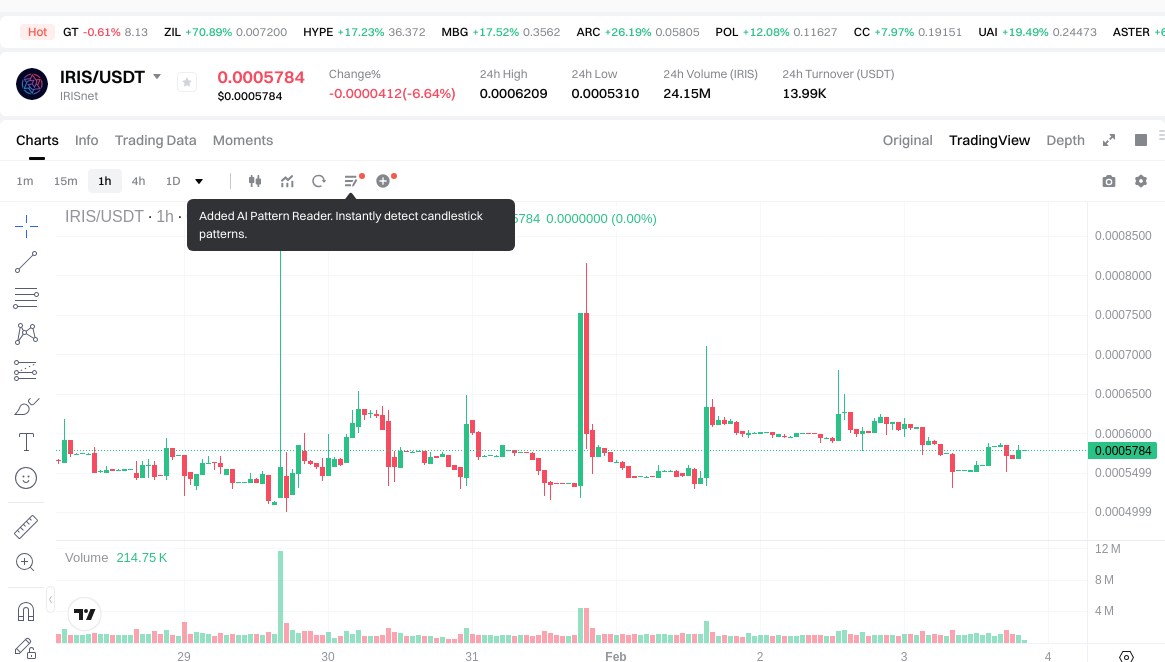
- IRIS Current Price: $0.0005772
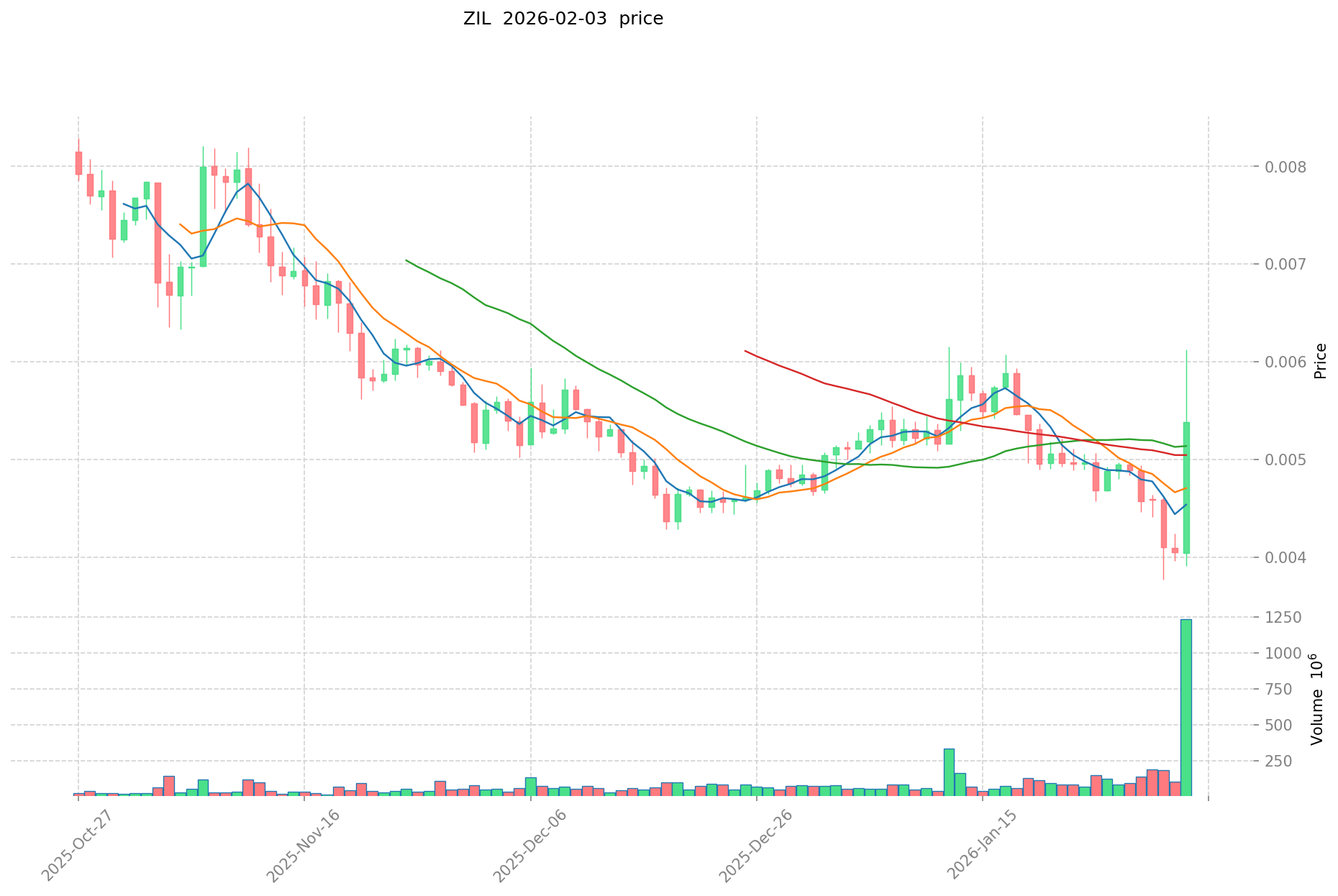
- ZIL Current Price: $0.007103
- 24-Hour Trading Volume: IRIS recorded $14,010.27 compared to ZIL's significantly higher $10,316,596.49
- Fear & Greed Index: 17 (Extreme Fear)
View real-time prices:
- Check IRIS current price Market Price
- Check ZIL current price Market Price
II. Core Factors Influencing IRIS vs ZIL Investment Value
Supply Mechanism Comparison (Tokenomics)
- IRIS: Information regarding IRIS supply mechanism is not available in the provided materials.
- ZIL: Information regarding ZIL supply mechanism is not available in the provided materials.
- 📌 Historical patterns: Supply mechanisms can influence price cycle variations through controlled issuance rates, deflationary pressure, or inflation dynamics, though specific mechanisms for these tokens require further research.
Institutional Adoption and Market Application
- Institutional holdings: Current institutional preference data between IRIS and ZIL is not available in the provided materials.
- Enterprise adoption: Specific information on IRIS or ZIL applications in cross-border payments, settlement systems, or investment portfolios is not available in the provided materials.
- National policies: Regulatory attitudes toward IRIS and ZIL across different jurisdictions require additional research beyond the available materials.
Technological Development and Ecosystem Building
- IRIS technological upgrades: Detailed information on recent or planned technical improvements and their potential impact is not available in the provided materials.
- ZIL technological development: Specific technical advancement details and ecosystem expansion plans are not available in the provided materials.
- Ecosystem comparison: Comprehensive analysis of DeFi integration, NFT platforms, payment solutions, and smart contract implementations for both projects requires further investigation.
Macroeconomic Factors and Market Cycles
- Performance in inflationary environments: Comparative data on inflation-hedging characteristics between IRIS and ZIL is not available in the provided materials.
- Macroeconomic monetary policy: The specific correlation between interest rate fluctuations, US dollar index movements, and the performance of IRIS versus ZIL requires additional analysis.
- Geopolitical factors: The impact of cross-border transaction demand and international developments on these specific tokens needs further examination beyond the available reference materials.
III. 2026-2031 Price Prediction: IRIS vs ZIL
Short-term Prediction (2026)
- IRIS: Conservative $0.000352 - $0.000577 | Optimistic $0.000577 - $0.000825
- ZIL: Conservative $0.00558 - $0.00715 | Optimistic $0.00715 - $0.0102
Mid-term Prediction (2028-2029)
- IRIS may enter a gradual growth phase, with estimated price range of $0.000469 - $0.001260
- ZIL may enter a moderate expansion phase, with estimated price range of $0.00674 - $0.0159
- Key drivers: institutional capital inflows, ETF developments, ecosystem growth
Long-term Prediction (2030-2031)
- IRIS: Baseline scenario $0.000959 - $0.001115 | Optimistic scenario $0.000990 - $0.001635
- ZIL: Baseline scenario $0.0104 - $0.0139 | Optimistic scenario $0.0160 - $0.0216
Disclaimer
IRIS:
| Year | Predicted High Price | Predicted Average Price | Predicted Low Price | Price Change |
|---|---|---|---|---|
| 2026 | 0.000825396 | 0.0005772 | 0.000352092 | 0 |
| 2027 | 0.00086259654 | 0.000701298 | 0.00053999946 | 21 |
| 2028 | 0.0011572819596 | 0.00078194727 | 0.000469168362 | 35 |
| 2029 | 0.00126049899924 | 0.0009696146148 | 0.00077569169184 | 67 |
| 2030 | 0.001271164760002 | 0.00111505680702 | 0.000958948854037 | 93 |
| 2031 | 0.00163456177341 | 0.001193110783511 | 0.000990281950314 | 106 |
ZIL:
| Year | Predicted High Price | Predicted Average Price | Predicted Low Price | Price Change |
|---|---|---|---|---|
| 2026 | 0.01015158 | 0.007149 | 0.00557622 | 0 |
| 2027 | 0.0127159263 | 0.00865029 | 0.0066607233 | 21 |
| 2028 | 0.0129265608615 | 0.01068310815 | 0.0073713446235 | 50 |
| 2029 | 0.015936526582762 | 0.01180483450575 | 0.006728755668277 | 66 |
| 2030 | 0.020112486789171 | 0.013870680544256 | 0.010403010408192 | 95 |
| 2031 | 0.021579311256726 | 0.016991583666714 | 0.015972088646711 | 139 |
IV. Investment Strategy Comparison: IRIS vs ZIL
Long-term vs Short-term Investment Strategies
-
IRIS: May suit investors with higher risk tolerance seeking potential recovery opportunities from deeply discounted price levels, though the significant decline from historical highs indicates substantial uncertainty. The token's positioning as a cross-chain service hub suggests alignment with investors interested in blockchain interoperability infrastructure.
-
ZIL: May appeal to investors focused on established high-throughput blockchain platforms with practical sharding implementation. The relatively stronger price retention compared to IRIS, combined with significantly higher trading volume ($10.3M vs $14K daily), suggests greater market liquidity and potential suitability for both short-term trading and long-term infrastructure investment strategies.
Risk Management and Asset Allocation
-
Conservative Investors: Consider minimal exposure with allocation structures such as IRIS: 20-30% vs ZIL: 70-80% if choosing between these assets, reflecting ZIL's relatively stronger market position and liquidity profile.
-
Aggressive Investors: May explore more balanced allocations such as IRIS: 40-50% vs ZIL: 50-60%, acknowledging the higher risk-reward potential in IRIS's current deeply discounted state, though this carries substantially elevated downside risk.
-
Hedging Tools: Incorporate stablecoin allocations (suggested 30-50% of crypto portfolio), options strategies for downside protection, and cross-asset diversification beyond these two tokens to mitigate concentration risk in the current Extreme Fear market environment (Fear & Greed Index: 17).
V. Potential Risk Comparison
Market Risks
-
IRIS: Faces elevated liquidity risk with extremely low daily trading volume ($14,010), making position entry and exit challenging. The approximately 99.8% decline from all-time high indicates severe market confidence erosion and potential for continued price pressure. Limited market depth may result in significant slippage during transactions.
-
ZIL: While experiencing substantial volatility and correction from historical peaks, maintains considerably stronger market liquidity and trading activity. Price movements remain subject to broader cryptocurrency market cycles and sentiment shifts, though the higher trading volume provides relatively better price discovery mechanisms.
Technical Risks
-
IRIS: Cross-chain service infrastructure faces implementation complexity and competition from numerous interoperability solutions. Network adoption rates and technical execution capabilities require ongoing monitoring, though specific current technical challenges cannot be detailed from available information.
-
ZIL: Sharding technology implementation presents ongoing technical maintenance requirements and potential security considerations inherent to distributed network architectures. Scalability solutions require continuous development to maintain competitive advantages in the high-throughput blockchain sector.
Regulatory Risks
- Both IRIS and ZIL operate within evolving global regulatory frameworks for cryptocurrency assets. Cross-chain infrastructure (IRIS) and high-throughput platforms (ZIL) may face varying regulatory scrutiny across jurisdictions. Investors should monitor regulatory developments in major markets including the United States, European Union, and Asia-Pacific regions, as policy changes could materially impact operational capabilities and market access for both projects.
VI. Conclusion: Which Is the Better Buy?
📌 Investment Value Summary:
-
IRIS Advantages: Represents a deeply discounted entry point from historical levels, potentially offering asymmetric upside for extremely high-risk tolerance investors. Cross-chain service hub positioning addresses blockchain interoperability needs in the evolving multi-chain ecosystem.
-
ZIL Advantages: Demonstrates relatively stronger market position with substantially higher liquidity ($10.3M daily volume vs $14K for IRIS). Established high-throughput blockchain platform with practical sharding implementation provides foundational infrastructure value. Price retention performance suggests relatively better market confidence compared to IRIS.
✅ Investment Recommendations:
-
Beginner Investors: Exercise extreme caution with both assets given current market conditions (Extreme Fear index: 17). If considering exposure, ZIL presents relatively lower execution risk due to superior liquidity. Limit allocation to small portion of overall portfolio (suggested maximum 5-10% of crypto holdings) and prioritize education on blockchain fundamentals before committing capital.
-
Experienced Investors: May consider ZIL for infrastructure exposure within diversified crypto portfolios, acknowledging continued volatility risks. IRIS represents a highly speculative opportunity suitable only for portions of capital allocated to high-risk ventures. Implement strict position sizing (suggested 2-5% maximum per asset) and employ stop-loss mechanisms to manage downside exposure.
-
Institutional Investors: Conduct thorough due diligence on technical roadmaps, team execution capabilities, and competitive positioning before considering either asset. ZIL's higher liquidity profile may accommodate larger position sizes with reduced market impact, though both assets require careful risk assessment within institutional investment frameworks and compliance requirements.
⚠️ Risk Warning: The cryptocurrency market exhibits extreme volatility. This analysis does not constitute investment advice. Both IRIS and ZIL have experienced substantial price declines from historical peaks, and past performance does not indicate future results. Investors should conduct independent research, assess personal risk tolerance, and consider consulting qualified financial advisors before making investment decisions. Never invest more than you can afford to lose.
VII. FAQ
Q1: What are the main differences between IRIS and ZIL in terms of their core technology and use cases?
IRIS (IRISnet) functions as a self-evolving BPoS cross-chain service hub designed to bridge digital and real economies, focusing on blockchain interoperability infrastructure. ZIL (Zilliqa) operates as a high-throughput blockchain platform that implements practical sharding technology to achieve scalability of thousands of transactions per second. While IRIS emphasizes cross-chain connectivity and distributed business applications, ZIL prioritizes transaction speed and on-chain application performance through its sharding architecture.
Q2: Which token has better market liquidity and why does this matter for investors?
ZIL demonstrates significantly superior market liquidity with daily trading volume of $10,316,596.49 compared to IRIS's extremely limited $14,010.27. This liquidity difference critically impacts investment execution: higher liquidity enables easier position entry and exit with minimal slippage, provides better price discovery mechanisms, and reduces the risk of being unable to exit positions during market volatility. For IRIS, the low trading volume creates substantial execution challenges and elevated liquidity risk that investors must carefully consider.
Q3: How have IRIS and ZIL performed since their historical peaks, and what does this indicate?
IRIS has declined approximately 99.8% from its April 2021 all-time high of $0.299467 to current levels around $0.0005772, while ZIL has experienced a less severe correction from its May 2021 peak of $0.255376 to approximately $0.007103. This performance disparity suggests that ZIL has maintained relatively stronger market confidence and price retention despite significant volatility. The extreme decline in IRIS indicates severe market confidence erosion, though it also presents a deeply discounted entry point for extremely high-risk tolerance investors seeking potential recovery opportunities.
Q4: What are the projected price ranges for IRIS and ZIL through 2031?
For IRIS, conservative short-term (2026) projections range from $0.000352 to $0.000825, with long-term (2031) baseline scenarios estimating $0.000959 to $0.001115 and optimistic scenarios reaching $0.001635. For ZIL, short-term projections range from $0.00558 to $0.0102, with long-term baseline scenarios estimating $0.0104 to $0.0139 and optimistic scenarios reaching $0.0216. These predictions suggest potential growth trajectories influenced by institutional capital inflows, ecosystem development, and broader market cycle recovery, though substantial uncertainty remains given current extreme market fear conditions.
Q5: What allocation strategy should different investor types consider when comparing IRIS vs ZIL?
Conservative investors should consider minimal exposure with allocation structures favoring ZIL (70-80%) over IRIS (20-30%) if choosing between these assets, reflecting ZIL's relatively stronger market position and liquidity. Aggressive investors may explore more balanced allocations such as IRIS (40-50%) vs ZIL (50-60%), acknowledging higher risk-reward potential in IRIS's deeply discounted state. All investor types should incorporate substantial stablecoin allocations (30-50% of crypto portfolio) and implement strict position sizing, with suggested maximum allocation of 5-10% of total crypto holdings for beginners and 2-5% per asset for experienced investors, never exceeding amounts they can afford to lose.
Q6: What are the primary risks investors should monitor when holding IRIS or ZIL?
Both assets face significant market risks including extreme volatility and correlation with broader cryptocurrency market cycles. IRIS confronts elevated liquidity risk due to minimal trading volume, making position execution challenging and increasing slippage potential. ZIL maintains better liquidity but remains subject to substantial price fluctuations. Technical risks include IRIS's cross-chain implementation complexity and competition from numerous interoperability solutions, while ZIL's sharding technology requires ongoing maintenance and security considerations. Regulatory risks affect both tokens as they operate within evolving global cryptocurrency frameworks, with potential policy changes in major jurisdictions materially impacting operational capabilities and market access.
Q7: Is now a good time to invest in either IRIS or ZIL given current market conditions?
Current market conditions reflect Extreme Fear (Fear & Greed Index: 17), which historically can present buying opportunities for risk-tolerant investors, though timing market bottoms remains extremely difficult. ZIL's relatively stronger liquidity and market position may offer infrastructure exposure for experienced investors willing to accept continued volatility within diversified portfolios. IRIS represents a highly speculative opportunity suitable only for capital allocated to maximum-risk ventures, given its 99.8% decline from historical peaks and minimal liquidity. Both assets require careful risk assessment, strict position sizing, and implementation of stop-loss mechanisms. Investors should prioritize independent research and never invest more than they can afford to lose, as past extreme declines may or may not indicate future recovery potential.
Q8: How do institutional adoption and ecosystem development compare between IRIS and ZIL?
Comprehensive institutional adoption data and detailed ecosystem development comparisons between IRIS and ZIL require further investigation beyond currently available information. Both projects operate in distinct blockchain infrastructure sectors: IRIS focuses on cross-chain service infrastructure addressing multi-chain interoperability needs, while ZIL provides high-throughput platform capabilities for scalable on-chain applications. Investors interested in ecosystem maturity should conduct thorough due diligence on technical roadmaps, team execution capabilities, partnership developments, DeFi integrations, NFT platform adoptions, and smart contract implementations before making investment decisions. The significantly higher trading volume for ZIL suggests relatively greater market participation and potential ecosystem activity, though specific institutional holdings and enterprise adoption metrics would require additional research.
Share
Content
Introduction: Investment Comparison Between IRIS and ZIL
I. Historical Price Comparison and Market Status
II. Core Factors Influencing IRIS vs ZIL Investment Value
III. 2026-2031 Price Prediction: IRIS vs ZIL
IV. Investment Strategy Comparison: IRIS vs ZIL
V. Potential Risk Comparison
VI. Conclusion: Which Is the Better Buy?
VII. FAQ
How to Buy Cryptocurrency


Trending Cryptocurrencies



2025 SUI coin: price, buying guide, and Staking rewards

How to Buy Crypto: A Step-by-Step Guide with Gate.com

HNT Price in 2025: Helium Network Token Value and Market Analysis

What is SwissCheese (SWCH) and How Does It Democratize Investment?

Cardano (ADA) Price Analysis and Outlook for 2025

How to Invest in Metaverse Crypto

Free Money for App Registration: Crypto Exchange Welcome Bonuses

Is Router Protocol (ROUTE) a good investment?: A Comprehensive Analysis of Features, Market Performance, and Future Prospects

Is EQTY (EQTY) a good investment?: A Comprehensive Analysis of Performance, Risk, and Market Potential

Is My DeFi Pet (DPET) a good investment?: A Comprehensive Analysis of Token Fundamentals, Market Performance, and Risk Factors in 2024

What is a Non-Custodial Wallet vs Custodial Wallet?
