This comprehensive guide evaluates whether Alpaca Finance (ALPACA) represents a viable investment opportunity in the DeFi leveraged yield farming sector. The article examines ALPACA's historical price trajectory from its $8.78 peak in March 2021 to current levels around $0.001677, analyzing market dynamics and volatility patterns. It assesses core investment factors including token supply mechanisms, institutional adoption, macroeconomic influences, and ecosystem development within Binance Smart Chain. The analysis provides detailed price forecasts across conservative, neutral, and optimistic scenarios for 2026-2031, supported by technical and fundamental indicators. Investment strategies tailored for beginners, experienced traders, and institutional investors are presented alongside comprehensive risk management frameworks. The guide evaluates significant risks including extreme volatility (-98.26% annual decline), low liquidity ($27,078.84 daily volume), regulatory uncertainties, and technical vulnerabiliti
Introduction: Alpaca Finance (ALPACA) Investment Position and Market Prospects
ALPACA is a digital asset in the cryptocurrency field. Launched in March 2021, it has developed within the decentralized finance (DeFi) sector as a governance token for a leveraged yield farming protocol on Binance Smart Chain. As of February 2026, ALPACA maintains a market capitalization of approximately $254,348, with a circulating supply of around 151.67 million tokens, and a current price near $0.001677. The token is available on 6 exchanges and has attracted over 83,425 holders. With its positioning in the leveraged yield farming space, ALPACA has become a subject of discussion among investors exploring "Is Alpaca Finance (ALPACA) a good investment?" This article provides a comprehensive analysis of ALPACA's investment characteristics, historical price movements, future price projections, and associated investment risks to serve as a reference for investors.
I. Historical Price Review and Current Investment Value of ALPACA
ALPACA Historical Price Movements and Investment Returns
- 2021: Project launch and initial trading activity → Price reached $8.78 in March, representing early-stage growth for initial investors
- 2022-2024: Broader crypto market correction phase → ALPACA experienced sustained price decline alongside overall market trends
- 2025: Price volatility intensified following exchange delisting announcement → Token exhibited unusual price fluctuations, with 71% surge post-announcement before subsequent decline; approached price levels near historical lows in early 2026
Current ALPACA Investment Market Status (February 2026)
- Current ALPACA price: $0.001677
- 24-hour trading volume: $27,078.84
- Market capitalization: $254,348.31
- Recent price change: -6.05% (24h), -46.96% (7d), -65.02% (30d)
Click to view real-time ALPACA market price
Note: The token experienced significant market volatility during Q2 2025, with price movements characterized by sharp fluctuations. Trading activity showed concentrated volume periods, particularly around the May 2025 exchange delisting event. Current market conditions reflect reduced liquidity and heightened price sensitivity to trading activity.
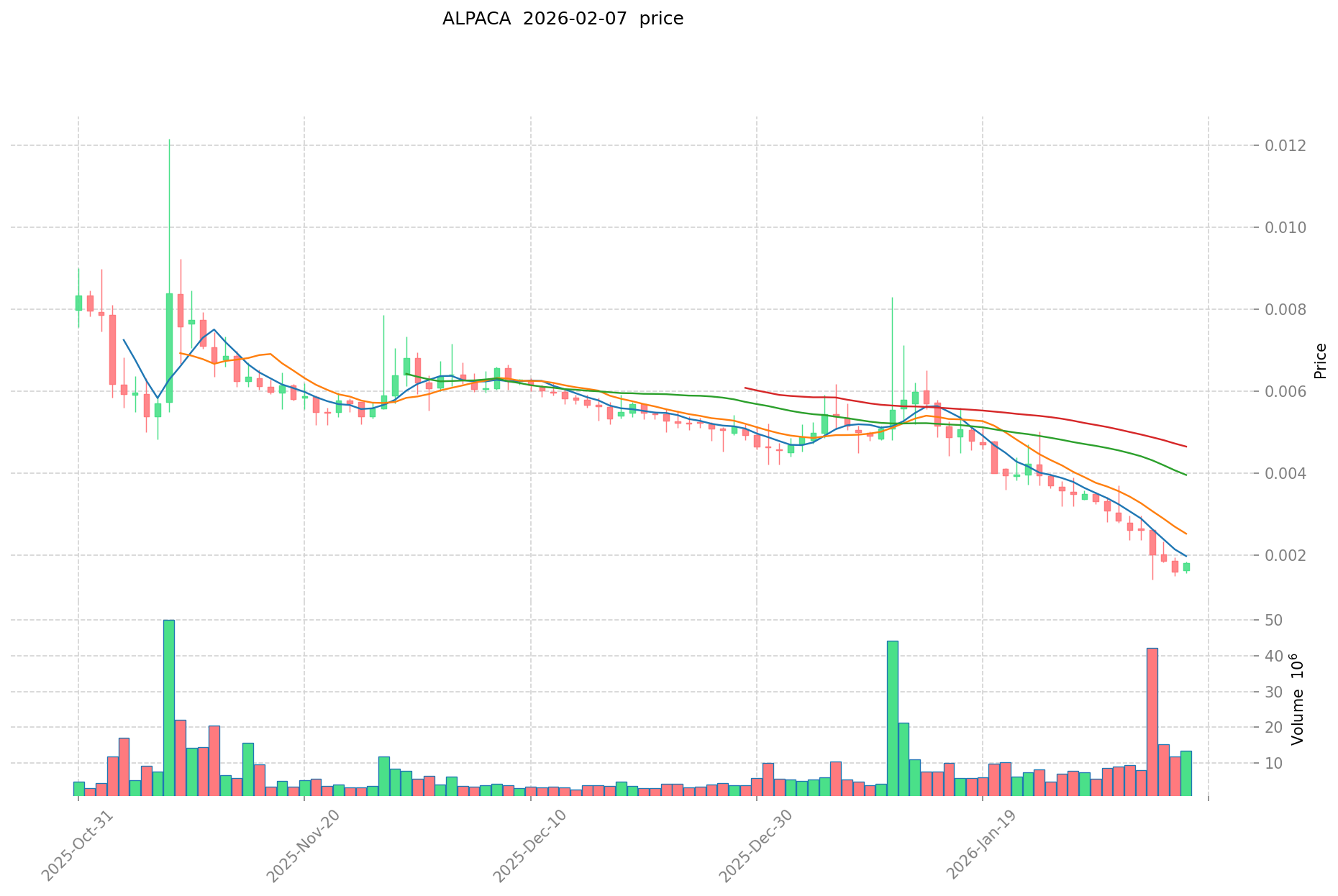
II. Core Factors Influencing Whether ALPACA is a Good Investment
Supply Mechanism and Scarcity (ALPACA Investment Scarcity)
- Supply Mechanism: Alpaca Finance (ALPACA) has a maximum supply of 188,000,000 tokens, with a current circulating supply of approximately 151,668,642 tokens (about 80.67% of the total supply). This relatively high circulation ratio suggests that most tokens are already in the market.
- Historical Pattern: ALPACA's price fluctuations have been notable, with the token experiencing substantial volatility. The price reached a peak of $8.78 in March 2021 and declined to a lower range around $0.00162486 in February 2026. Such price movements reflect market dynamics rather than supply-driven scarcity alone.
- Investment Significance: The near-complete circulation of tokens may reduce future dilution risks, though the token's scarcity effect appears limited given the large existing supply and historical price trajectory.
Institutional Investment and Mainstream Adoption (Institutional Investment in ALPACA)
- Institutional Holding Trends: The available data does not provide specific information on institutional holdings or major corporate investments in ALPACA.
- Mainstream Adoption: There is no documented evidence of prominent enterprises integrating ALPACA into their operations or payment systems within the provided materials.
- Regulatory Influence: No specific national policies or regulatory frameworks directly targeting ALPACA or its investment outlook were mentioned in the reference materials.
Macroeconomic Environment's Impact on ALPACA Investment
- Monetary Policy and Interest Rates: Broader cryptocurrency markets, including ALPACA, may be influenced by central bank policies and interest rate adjustments, though specific correlations for ALPACA were not detailed in the materials.
- Inflation Hedge Role: While some cryptocurrencies are considered as potential inflation hedges, the reference materials do not position ALPACA as a "digital gold" or explicit inflation protection asset.
- Geopolitical Uncertainty: General market uncertainty can affect cryptocurrency demand, but no specific geopolitical events directly linked to ALPACA investment demand were identified in the provided data.
Technology and Ecosystem Development (Technology & Ecosystem for ALPACA Investment)
- Protocol Upgrades: Alpaca Finance has undertaken ongoing protocol improvements, including enhancements to leverage mechanisms, liquidation safety features, and integrations with various yield-generating platforms. These upgrades aim to strengthen the platform's functionality and user security.
- Ecosystem Expansion: As a decentralized finance (DeFi) protocol on Binance Smart Chain (BSC), Alpaca Finance enables leveraged yield farming. The platform's transparency and community-driven approach contribute to its positioning within the BSC ecosystem.
- DeFi Applications: Alpaca Finance's core functionality revolves around yield optimization and leveraged farming, which serve as foundational elements of its investment value proposition. However, specific expansions into NFT or payment applications were not documented in the reference materials.
III. ALPACA Future Investment Outlook and Price Forecast (Is Alpaca Finance (ALPACA) worth investing in 2026-2031)
Short-term Investment Outlook (2026, short-term ALPACA investment outlook)
- Conservative scenario: $0.001032 - $0.001639
- Neutral scenario: $0.001639 - $0.001852
- Optimistic scenario: Above $0.001852
Mid-term Investment Forecast (2027-2029, mid-term Alpaca Finance (ALPACA) investment forecast)
- Market stage expectation: ALPACA may enter a recovery phase following its substantial decline from historical highs, with potential gradual price stabilization as the broader DeFi sector develops.
- Investment return forecast:
- 2027: $0.001675 - $0.002496
- 2028: $0.001802 - $0.002438
- 2029: $0.001231 - $0.003260
- Key catalysts: Platform liquidity growth, expansion of leveraged yield farming features, broader BSC ecosystem developments, and overall DeFi market sentiment.
Long-term Investment Outlook (Is ALPACA a good long-term investment?)
- Base scenario: $0.001412 - $0.002936 (assuming steady platform development and maintained user activity)
- Optimistic scenario: $0.002653 - $0.003537 (assuming significant protocol upgrades and increased adoption)
- Risk scenario: Below $0.001231 (under adverse market conditions or reduced platform activity)
Click to view ALPACA long-term investment and price prediction: Price Prediction
2026-2031 Long-term Forecast
- Base scenario: $0.001412 - $0.002936 (corresponding to steady progress and gradual mainstream application growth)
- Optimistic scenario: $0.002653 - $0.003537 (corresponding to large-scale adoption and favorable market environment)
- Transformative scenario: Above $0.003537 (if the ecosystem achieves breakthrough developments and mainstream adoption)
- 2031-12-31 predicted high: $0.003537 (based on optimistic development assumptions)
Disclaimer: The above predictions are based on historical data and analytical models. Cryptocurrency markets are highly volatile and subject to multiple risk factors. This content does not constitute investment advice. Please conduct thorough research and consult professional advisors before making any investment decisions.
| Year |
Predicted High Price |
Predicted Average Price |
Predicted Low Price |
Price Change |
| 2026 |
0.00185207 |
0.001639 |
0.00103257 |
-2 |
| 2027 |
0.00249611505 |
0.001745535 |
0.0016757136 |
3 |
| 2028 |
0.00243894877875 |
0.002120825025 |
0.00180270127125 |
25 |
| 2029 |
0.003260238269681 |
0.002279886901875 |
0.001231138927012 |
35 |
| 2030 |
0.002936266340924 |
0.002770062585778 |
0.001412731918746 |
64 |
| 2031 |
0.003537923934555 |
0.002853164463351 |
0.002653442950916 |
69 |
IV. ALPACA Investment Strategy and Risk Management (How to invest in Alpaca Finance)
Investment Strategy (ALPACA investment strategy)
Long-term Holding (HODL ALPACA)
For conservative investors seeking stable exposure to DeFi leveraged yield farming protocols, long-term holding may be considered as part of a diversified portfolio. This approach focuses on the fundamental value proposition of Alpaca Finance as a leveraged yield farming platform on Binance Smart Chain.
Active Trading
Active traders may utilize technical analysis and swing trading strategies based on ALPACA's price movements. With 24-hour trading volume of approximately $27,078.84 and recent price fluctuations showing -2.27% (1H), -6.05% (24H), and -46.96% (7D), the token exhibits volatility that may present trading opportunities for experienced participants.
Risk Management (Risk management for ALPACA investment)
Asset Allocation Ratio
- Conservative investors: Consider allocating no more than 1-3% of crypto portfolio to ALPACA
- Aggressive investors: May allocate 5-10% with higher risk tolerance
- Professional investors: Strategic allocation based on comprehensive portfolio analysis and risk assessment
Risk Hedging Solutions
- Maintain diversified portfolio across multiple digital assets
- Consider implementing stop-loss orders to limit potential downside
- Utilize portfolio rebalancing strategies across different market cycles
Secure Storage
- Cold Wallets: Hardware wallets (Ledger, Trezor) recommended for long-term holdings
- Hot Wallets: MetaMask or Trust Wallet for active trading on BSC network
- Contract Address: 0x8f0528ce5ef7b51152a59745befdd91d97091d2f (BSC)
- Always verify contract addresses through official sources before transactions
V. ALPACA Investment Risks and Challenges (Risks of investing in Alpaca Finance)
Market Risks
- High Volatility: ALPACA has experienced substantial price fluctuations, with -98.26% change over the past year and current price at $0.001677, compared to its historical high of $8.78 recorded on March 6, 2021
- Low Liquidity: Daily trading volume of approximately $27,078.84 may present challenges for larger position entries and exits
- Market Cap: With a total market capitalization of approximately $254,348.31 and market dominance of 0.000010%, ALPACA represents a micro-cap asset with associated liquidity constraints
Regulatory Risks
- DeFi protocols face evolving regulatory frameworks across different jurisdictions
- Policy changes regarding leveraged yield farming and decentralized finance may impact project operations
- Compliance requirements for DeFi platforms continue to develop globally
Technical Risks
- Smart contract vulnerabilities may exist despite auditing processes
- BSC network dependencies and potential network congestion issues
- Protocol upgrade implementation risks and governance decision outcomes
- Platform security considerations for leveraged farming positions
Project-Specific Risks
- Limited exchange availability (listed on 6 exchanges)
- High circulating supply ratio of 80.67% (151,668,641.60 ALPACA out of 188,000,000 max supply)
- Fair launch structure without institutional backing may affect long-term development resources
VI. Conclusion: Is Alpaca Finance a Good Investment?
Investment Value Summary
Alpaca Finance presents a niche opportunity within the DeFi leveraged yield farming sector on Binance Smart Chain. While the platform offers unique functionality for yield optimization, recent price performance indicates substantial volatility and market challenges. The token has declined significantly from historical highs, with current valuation reflecting broader market conditions and sector-specific headwinds.
Investor Recommendations
✅ Beginners:
- Start with dollar-cost averaging (DCA) approach with minimal allocation
- Utilize secure hardware wallets for storage
- Thoroughly research DeFi mechanics and leveraged farming risks before participating
- Begin with small test transactions to understand BSC network operations
✅ Experienced Investors:
- Consider swing trading strategies based on technical analysis
- Implement strict risk management with position sizing and stop-losses
- Monitor platform TVL, user activity, and protocol developments
- Maintain diversified DeFi portfolio allocation
✅ Institutional Investors:
- Conduct comprehensive due diligence on protocol security and sustainability
- Evaluate position sizing relative to liquidity constraints
- Consider strategic allocation within broader DeFi exposure framework
- Monitor regulatory developments affecting leveraged DeFi protocols
⚠️ Important Notice: Cryptocurrency investments carry substantial risk. ALPACA's significant price decline (-98.26% over one year) and micro-cap status indicate elevated volatility. This analysis is for informational purposes only and does not constitute investment advice. Always conduct independent research and consider consulting financial professionals before making investment decisions.
VII. FAQ
Q1: Is Alpaca Finance (ALPACA) a good investment for beginners in 2026?
For beginners, ALPACA presents significant risks and is generally not recommended as a primary investment. The token has experienced a 98.26% decline from its historical high of $8.78 to the current price of $0.001677, indicating extreme volatility. With a micro-cap market capitalization of approximately $254,348 and low daily trading volume of $27,078.84, beginners face challenges including limited liquidity, high price sensitivity, and complex DeFi mechanics. If beginners wish to explore ALPACA, they should allocate no more than 1-3% of their crypto portfolio, use dollar-cost averaging (DCA), secure their holdings in hardware wallets, and thoroughly understand leveraged yield farming risks before participating.
Q2: What is the realistic price prediction for ALPACA in 2026-2027?
Based on historical data and analytical models, ALPACA's price forecast for 2026 ranges from $0.001032 (conservative scenario) to $0.001852 (optimistic scenario), with a neutral scenario around $0.001639. For 2027, predictions suggest a potential range of $0.001675 to $0.002496, representing modest recovery potential. However, these projections assume steady platform development and maintained user activity. Given ALPACA's recent 46.96% decline over 7 days and 65.02% decline over 30 days, actual performance may deviate significantly. Investors should note that cryptocurrency markets are highly volatile, and these predictions do not guarantee future returns.
Q3: How does ALPACA's supply mechanism affect its investment potential?
ALPACA has a maximum supply of 188,000,000 tokens, with approximately 151,668,642 tokens already in circulation (80.67% of total supply). This high circulation ratio means most tokens are already on the market, which reduces future dilution risks compared to projects with lower circulation. However, the large existing supply combined with micro-cap market capitalization limits the token's scarcity effect. Unlike Bitcoin's capped 21 million supply, ALPACA's substantial circulating volume and historical price decline from $8.78 to $0.001677 suggest that supply scarcity alone has not been a primary value driver. The investment significance lies more in protocol utility and DeFi sector developments rather than supply-driven appreciation.
Q4: What are the main risks associated with investing in Alpaca Finance?
ALPACA investments carry multiple significant risks: (1) Market Risk: Extreme volatility with 98.26% decline over one year and current micro-cap status with only $254,348 market capitalization; (2) Liquidity Risk: Low daily trading volume of $27,078.84 may create difficulties for position entry and exit; (3) Regulatory Risk: Evolving DeFi regulations globally may impact leveraged yield farming protocols; (4) Technical Risk: Smart contract vulnerabilities, BSC network dependencies, and protocol upgrade uncertainties; (5) Project-Specific Risk: Limited exchange availability (6 exchanges), lack of institutional backing, and concentrated supply distribution. These factors combine to create a high-risk investment profile requiring careful consideration.
Q5: Should investors choose long-term holding (HODL) or active trading for ALPACA?
The choice depends on investor profile and risk tolerance. Long-term holding may suit conservative investors seeking DeFi exposure with 1-3% portfolio allocation, focusing on Alpaca Finance's fundamental value as a BSC leveraged yield farming platform. This approach requires patience through market cycles and strong conviction in protocol development. Active trading may be more appropriate for experienced traders who can capitalize on ALPACA's volatility, with recent fluctuations showing -6.05% (24H) and -46.96% (7D). Active strategies require technical analysis skills, strict risk management with stop-losses, and ability to monitor market movements closely. Given ALPACA's micro-cap status and liquidity constraints, neither strategy eliminates substantial risk, and both require careful position sizing.
Q6: How does Alpaca Finance compare to other DeFi investment opportunities?
Alpaca Finance occupies a specialized niche within DeFi as a leveraged yield farming protocol on Binance Smart Chain, differentiating it from broader DeFi platforms. Compared to larger DeFi protocols, ALPACA has significantly smaller market capitalization ($254,348 vs. billions for established platforms), lower liquidity, and more limited exchange availability (6 exchanges). However, it offers unique leveraged farming functionality that may appeal to sophisticated DeFi users. The platform's fair launch structure without institutional backing contrasts with venture-backed DeFi projects but may limit development resources. When evaluating ALPACA against other DeFi opportunities, investors should consider their risk tolerance, liquidity needs, and specific interest in leveraged yield farming versus other DeFi primitives like lending, DEXs, or liquid staking.
Q7: What storage solutions are recommended for securing ALPACA tokens?
For secure ALPACA storage, investors should implement a multi-layered approach: Cold Storage (recommended for long-term holdings): Hardware wallets such as Ledger or Trezor provide the highest security by keeping private keys offline and protected from online threats. Hot Wallets (suitable for active trading): MetaMask or Trust Wallet enable convenient access for transactions on Binance Smart Chain while maintaining reasonable security for smaller amounts. Before any transaction, always verify the official ALPACA contract address (0x8f0528ce5ef7b51152a59745befdd91d97091d2f on BSC) through multiple trusted sources to avoid scam tokens. Never share private keys or seed phrases, enable two-factor authentication where available, and consider diversifying storage across multiple wallets for larger holdings. Given ALPACA's BSC-based nature, ensure compatibility with BSC network when selecting wallet solutions.
Q8: What key indicators should investors monitor when considering ALPACA investment?
Investors evaluating ALPACA should track several critical metrics: (1) Price Performance: Monitor short-term (1H, 24H, 7D) and long-term price movements relative to predictions; current trends show -6.05% (24H) and -46.96% (7D); (2) Trading Volume: Daily volume of $27,078.84 indicates liquidity levels for position management; (3) Market Capitalization: Current $254,348 with 0.000010% dominance reflects relative market positioning; (4) Protocol Metrics: Total Value Locked (TVL), active users, and leveraged farming positions on Alpaca Finance platform; (5) Technical Developments: Protocol upgrades, security audits, and ecosystem integrations; (6) Broader Market Conditions: BSC ecosystem health, overall DeFi sector trends, and regulatory developments; (7) Community Activity: Holder count (83,425+) and governance participation. Regular monitoring of these indicators helps investors make informed decisions and adjust strategies accordingly.
* The information is not intended to be and does not constitute financial advice or any other recommendation of any sort offered or endorsed by Gate.