This comprehensive analysis evaluates whether Apeiron (APRS) represents a viable investment opportunity within the Web3 gaming sector. The article examines APRS tokenomics, current market metrics showing a $225,395 market cap and 877 holders on the Ronin blockchain, and detailed price performance history revealing a 97.55% decline from May 2024 highs. Core assessment factors include supply mechanisms with 19.77% circulating supply, institutional adoption challenges, and ecosystem development on Ronin's gaming infrastructure. The analysis presents investment scenarios ranging from conservative to optimistic through 2031, alongside risk management strategies for different investor profiles. Key risks encompassing market volatility, regulatory uncertainty, technical dependencies, and limited liquidity are thoroughly addressed. APRS suitability depends on individual risk tolerance, with recommendations spanning from dollar-cost averaging for beginners to active trading for experienced investors, supported by Gate
Introduction: Apeiron (APRS) Investment Position and Market Outlook
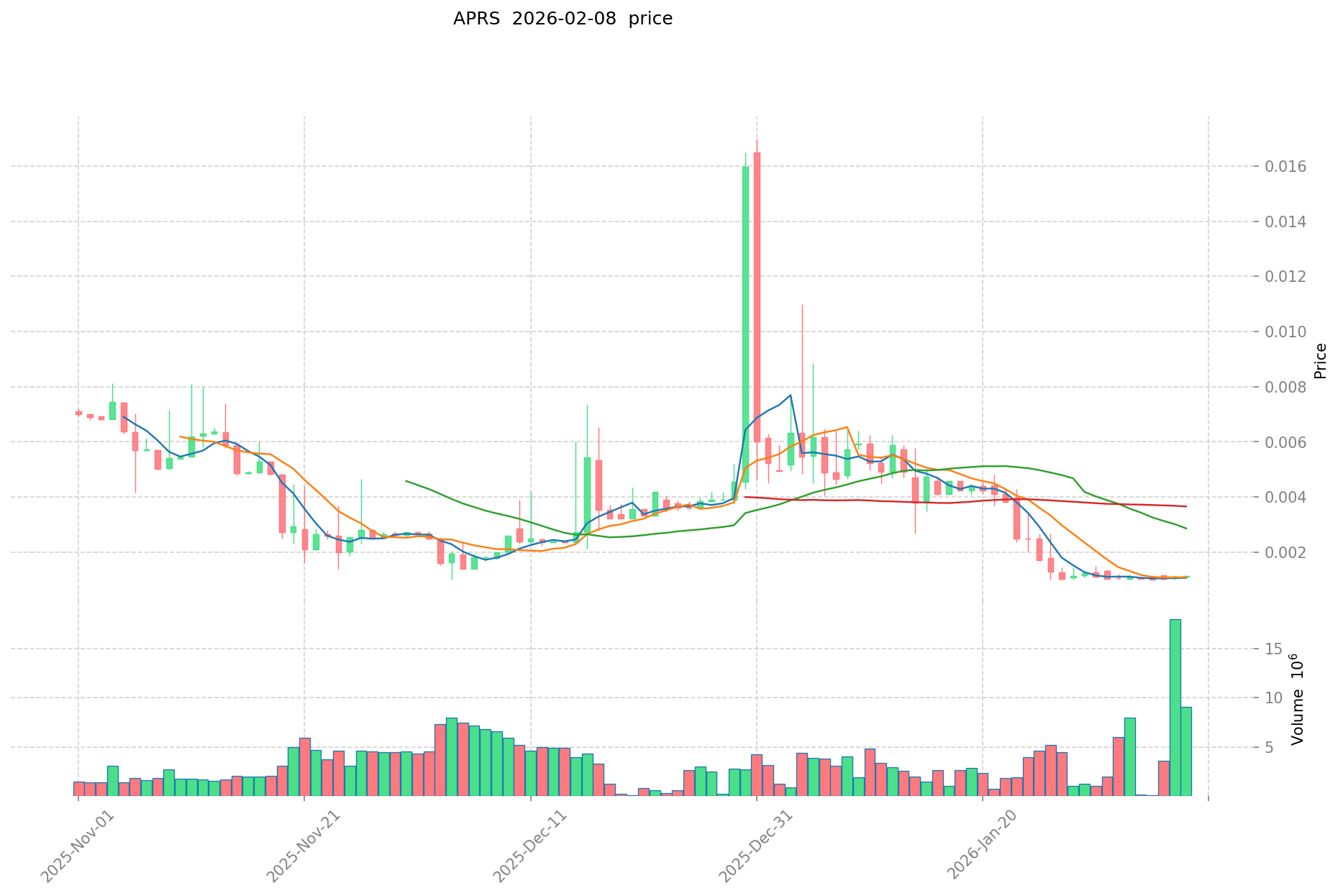
Apeiron (APRS) is a notable asset in the cryptocurrency space, launched in April 2024 as part of a Web3 gaming ecosystem that combines god simulation mechanics with Roguelike adventure elements. As of February 2026, APRS maintains a market capitalization of approximately $225,395, with a circulating supply of around 197.71 million tokens out of a total supply of 1 billion. The current trading price stands at approximately $0.00114. Built on the Ronin blockchain infrastructure, the project features a three-token economic system designed to support in-game economy and NFT marketplace activities. The token has experienced notable price fluctuations since its debut, with recent 30-day performance showing an 82.03% decline and annual performance reflecting a 97.55% decrease from earlier price levels. With approximately 877 token holders and trading activity concentrated on limited exchanges, APRS presents a case study in emerging GameFi tokenomics. This analysis examines the investment characteristics, historical price movements, future price considerations, and associated risks of APRS to provide perspective for those evaluating its position within the digital asset landscape.
I. Apeiron (APRS) Price History Review and Current Investment Value
APRS Historical Price Trends and Investment Returns
-
2024: Apeiron (APRS) experienced notable price movements during this period. In May 2024, the token traded at approximately $0.7901. Following this period, the asset entered a decline phase, with prices dropping over the subsequent months as market conditions shifted.
-
2025: The token continued its downward trajectory throughout 2025. By December 2025, APRS reached a trading level around $0.001001, representing a substantial decrease from the previous year's levels. This movement reflected broader market adjustments and evolving investor sentiment within the gaming token sector.
-
Early 2026: As of February 2026, APRS traded at approximately $0.00114, showing some recovery from the December 2025 levels. The token's circulating supply stood at approximately 197.71 million APRS, representing roughly 19.77% of the total supply of 1 billion tokens.
Current APRS Investment Market Status (February 2026)
- Current APRS Price: $0.00114 (as of February 8, 2026)
- 24-Hour Price Change: -4.58% (with a decline of approximately $0.000055)
- 24-Hour Trading Volume: $9,840.87
- Market Capitalization: Approximately $225,395
- Circulating Supply: 197,714,888 APRS
- Total Supply: 1,000,000,000 APRS
- Max Supply: 1,000,000,000 APRS
- Market Cap to Fully Diluted Valuation Ratio: 19.77%
- Number of Holders: 877
Click to view real-time APRS market price
The token's market presence includes listing on at least one exchange platform, with a fully diluted market cap of approximately $1.14 million. The 24-hour price range fluctuated between $0.001062 and $0.00115, indicating moderate volatility within the short-term trading period.
II. Core Factors Affecting Whether APRS is a Good Investment
Supply Mechanism and Scarcity (APRS Investment Scarcity)
- Total Supply and Circulation: Apeiron has a maximum supply of 1,000,000,000 APRS tokens, with approximately 197,714,888 tokens currently in circulation, representing around 19.77% of the total supply. The remaining tokens may be released gradually, which could influence future supply dynamics.
- Circulating Supply Impact: The relatively low circulation ratio suggests that a significant portion of tokens remains locked or unreleased. This controlled supply mechanism may contribute to scarcity if demand increases over time.
- Investment Significance: The circulating supply ratio is a factor that investors consider when evaluating scarcity. However, future token releases and market absorption capacity should be monitored as part of long-term investment considerations.
Institutional Investment and Mainstream Adoption (Institutional Investment in Apeiron)
- Holder Distribution: As of the latest data, Apeiron has approximately 877 token holders. This relatively limited holder base may indicate that the token has not yet achieved widespread adoption among retail or institutional investors.
- Exchange Listings: Apeiron is listed on a limited number of exchanges, which may affect liquidity and accessibility for potential investors.
- Ecosystem and Adoption: Apeiron is a Web3 game built on the Ronin blockchain, combining god simulation and Roguelike adventure elements with a play-to-earn model. The project features strategic card-based combat and a three-token economic system designed to support in-game economy and NFT marketplace activities. The extent of mainstream adoption and institutional interest remains an area for further observation.
Macroeconomic Environment's Impact on APRS Investment
- Market Volatility: The cryptocurrency market is subject to significant volatility influenced by broader macroeconomic factors, including monetary policy changes and interest rate adjustments. These factors can affect investor sentiment and capital flows into digital assets.
- Economic Uncertainty: During periods of economic uncertainty or inflationary pressures, some investors may seek alternative assets. However, the correlation between macroeconomic conditions and specific gaming tokens like APRS requires careful analysis.
- Risk Considerations: Investors should consider how macroeconomic trends, including regulatory developments and global financial conditions, may impact the gaming and blockchain sectors specifically.
Technology and Ecosystem Development (Technology & Ecosystem for APRS Investment)
- Blockchain Infrastructure: Apeiron is developed on the Ronin blockchain, which is designed to support gaming applications with enhanced security and performance characteristics. The choice of blockchain infrastructure is relevant to the project's technical scalability and user experience.
- Gaming Features and Tokenomics: The project incorporates a three-token system intended to support a sustainable in-game economy and facilitate NFT marketplace transactions. The game offers diverse gameplay including universe exploration, mythical galaxy conquest, and guild versus guild battles.
- Ecosystem Applications: Apeiron's ecosystem includes elements such as strategic gameplay, NFT integration, and play-to-earn mechanics. The development and expansion of these features may influence the token's utility and long-term value proposition within the gaming sector.
III. APRS Future Investment Prediction and Price Outlook (Is Apeiron(APRS) worth investing in 2026-2031)
Short-term Investment Prediction (2026, short-term APRS investment outlook)
- Conservative Forecast: $0.00093456 - $0.001062
- Neutral Forecast: $0.001062 - $0.00136998
- Optimistic Forecast: $0.00136998 and above
Mid-term Investment Outlook (2027-2028, mid-term Apeiron(APRS) investment forecast)
- Market Phase Expectation: Following a period of price correction in 2026, APRS may enter a recovery phase, with market sentiment gradually stabilizing as the broader Web3 gaming sector continues its development trajectory.
- Investment Return Prediction:
- 2027: $0.0008025534 - $0.0017875053
- 2028: $0.0013065204555 - $0.0017870797035
- Key Catalysts: Potential expansion of the Ronin blockchain ecosystem, growth in play-to-earn gaming adoption, and evolution of the three-token economic model.
Long-term Investment Outlook (Is APRS a good long-term investment?)
- Base Scenario: $0.000940604623101 - $0.002253346638905 (assuming steady development of the gaming ecosystem and maintained market interest in blockchain gaming)
- Optimistic Scenario: $0.0024626739223 - $0.002253346638905 (assuming accelerated adoption of Web3 gaming, successful implementation of Guild vs. Guild features, and expanded NFT marketplace activity)
- Risk Scenario: Below $0.000940604623101 (under conditions of reduced player engagement, competitive pressure from alternative gaming platforms, or adverse market conditions)
Click to view APRS long-term investment and price prediction: Price Prediction
2026-02-08 - 2031 Long-term Outlook
- Base Scenario: $0.000940604623101 - $0.00171019022382 (corresponding to stable progress and steady improvement in mainstream applications)
- Optimistic Scenario: $0.0024626739223 - $0.002253346638905 (corresponding to large-scale adoption and favorable market environment)
- Transformative Scenario: Above $0.002253346638905 (if the ecosystem achieves breakthrough development and mainstream adoption)
- 2031-12-31 Predicted High: $0.002253346638905 (based on optimistic development assumptions)
Disclaimer: The above predictions are based on historical data analysis and market modeling. Cryptocurrency markets are characterized by significant volatility and uncertainty. These forecasts should not be construed as financial advice or guaranteed outcomes. Investors should conduct comprehensive research and consider their risk tolerance before making investment decisions.
| Year |
Predicted High Price |
Predicted Average Price |
Predicted Low Price |
Price Change |
| 2026 |
0.00136998 |
0.001062 |
0.00093456 |
-6 |
| 2027 |
0.0017875053 |
0.00121599 |
0.0008025534 |
6 |
| 2028 |
0.0017870797035 |
0.00150174765 |
0.0013065204555 |
31 |
| 2029 |
0.00177596677089 |
0.00164441367675 |
0.001496416445842 |
44 |
| 2030 |
0.0024626739223 |
0.00171019022382 |
0.000940604623101 |
50 |
| 2031 |
0.002253346638905 |
0.00208643207306 |
0.001126673319452 |
83 |
IV. Apeiron Investment Strategy and Risk Management (How to invest in Apeiron)
Investment Methodology (Apeiron investment strategy)
Long-term Holding (HODL Apeiron): This approach may suit investors with a stable risk tolerance who believe in the project's long-term potential. Given Apeiron's integration of Web3 gaming mechanics and its play-to-earn model built on the Ronin blockchain, holders may consider the platform's ecosystem development and user adoption as factors in their decision-making process.
Active Trading: Traders who prefer short-term operations might utilize technical analysis and market timing strategies. Apeiron has shown considerable price fluctuations, with a 24-hour change of -4.58% and a 30-day decline of -82.03%. These volatility patterns may present opportunities for swing trading, though they also introduce higher risk levels.
Risk Management (Risk management for Apeiron investment)
Asset Allocation Ratio:
- Conservative investors: May consider limiting exposure to 1-3% of their total portfolio, given the high volatility and relatively small market capitalization of $225,394.97.
- Aggressive investors: Could allocate 5-10% while maintaining awareness of the project's development stage and market position.
- Professional investors: Might approach with portfolio diversification strategies that account for gaming sector trends and blockchain platform performance.
Risk Hedging Approach: A diversified portfolio combining multiple asset classes and risk mitigation tools could help manage exposure. Given Apeiron's correlation with broader gaming token trends and Ronin blockchain ecosystem performance, investors might consider balancing positions across different sectors.
Secure Storage:
- Cold wallets for long-term holdings to minimize online exposure risks
- Hot wallets for active trading with appropriate security measures
- Hardware wallet solutions for enhanced security of larger holdings
V. Apeiron Investment Risks and Challenges (Risks of investing in Apeiron)
Market Risks: Apeiron exhibits high volatility characteristics. The token experienced a 1-year decline of -97.55%, falling from an all-time high of $0.7901 on May 24, 2024, to $0.00114 as of February 8, 2026. The 24-hour trading volume of $9,840.87 suggests relatively limited liquidity, which may contribute to price fluctuations. The circulating supply represents approximately 19.77% of the maximum supply of 1 billion tokens, indicating potential future dilution considerations.
Regulatory Risks: Web3 gaming projects and play-to-earn mechanisms face evolving regulatory frameworks across different jurisdictions. Policy developments regarding cryptocurrency gaming, NFT marketplaces, and blockchain-based reward systems may impact project operations and token utility.
Technical Risks: As a blockchain-based gaming platform, Apeiron faces potential challenges including smart contract vulnerabilities, network security considerations, and the technical complexities of maintaining a three-token economic system. The project's reliance on the Ronin blockchain means its performance is partially dependent on the underlying infrastructure's stability and security measures.
VI. Conclusion: Is Apeiron a Good Investment?
Investment Value Summary: Apeiron presents characteristics of an early-stage Web3 gaming project with established infrastructure on the Ronin blockchain. The project's focus on combining god simulation gameplay with roguelike mechanics and a play-to-earn model represents participation in the evolving gaming sector. However, the token has experienced significant price declines over the past year, with considerable volatility across multiple timeframes.
Investor Recommendations:
✅ Beginners: Consider a dollar-cost averaging approach with secure wallet storage solutions. Prioritize understanding the project's gaming mechanics and tokenomics before committing capital. Limit initial exposure given the high volatility patterns.
✅ Experienced Investors: May explore swing trading opportunities while maintaining position sizing discipline. Consider monitoring ecosystem developments, user adoption metrics, and broader gaming sector trends as part of a diversified cryptocurrency portfolio.
✅ Institutional Investors: Could evaluate Apeiron as part of a broader Web3 gaming sector allocation strategy, considering the project's tokenomics structure, development roadmap, and competitive positioning within the play-to-earn landscape.
⚠️ Disclaimer: Cryptocurrency investments involve substantial risks, including potential loss of principal. Market conditions can change rapidly, and past performance does not indicate future results. This content is for informational purposes only and does not constitute financial, investment, or trading advice. Conduct thorough research and consider consulting with financial professionals before making investment decisions.
VII. FAQ
Q1: What is Apeiron (APRS) and how does its token economy work?
Apeiron (APRS) is a Web3 gaming token launched in April 2024 on the Ronin blockchain, combining god simulation mechanics with Roguelike adventure elements. The project features a three-token economic system designed to support its in-game economy and NFT marketplace. With a maximum supply of 1 billion tokens and approximately 197.71 million in circulation (19.77%), APRS serves as part of the ecosystem's play-to-earn model. The token enables various gameplay activities including universe exploration, mythical galaxy conquest, and guild versus guild battles, while facilitating NFT transactions within the platform's marketplace infrastructure.
Q2: What has been the price performance of APRS since its launch?
APRS has experienced significant price decline since its debut. The token reached an all-time high of $0.7901 in May 2024, but subsequently declined to approximately $0.00114 as of February 8, 2026—representing a 97.55% decrease from peak levels. The token showed a 30-day decline of 82.03% and a 24-hour change of -4.58%. This volatility reflects broader market adjustments and evolving investor sentiment within the gaming token sector, though recent weeks have shown some modest recovery from December 2025 lows of $0.001001.
Q3: What are the main factors that could influence APRS's future value?
Several factors may affect APRS's investment outlook: (1) Ecosystem Development—expansion of the three-token economic system and increased user adoption of play-to-earn mechanics; (2) Ronin Blockchain Performance—the underlying infrastructure's stability and growth; (3) Gaming Sector Trends—broader Web3 gaming adoption and competition from alternative platforms; (4) Token Supply Dynamics—future releases from the remaining 80% of tokens not yet in circulation; (5) Macroeconomic Conditions—regulatory developments affecting cryptocurrency gaming and market liquidity flows. The limited holder base of 877 and restricted exchange listings also impact accessibility and liquidity considerations.
Q4: What investment strategies are appropriate for APRS?
Investment approaches vary by risk tolerance: Conservative investors may consider limiting exposure to 1-3% of portfolio allocation with a long-term holding strategy, focusing on the project's ecosystem development potential. Aggressive traders might allocate 5-10% while utilizing swing trading strategies to capitalize on the token's volatility patterns. Dollar-cost averaging may suit beginners seeking gradual position building. Given the 24-hour trading volume of $9,840.87 and limited liquidity, investors should implement proper risk management including secure storage (cold wallets for holdings, hot wallets for active trading) and portfolio diversification across different blockchain gaming projects and asset classes.
Q5: What are the primary risks associated with investing in APRS?
Major risk factors include: (1) Market Risk—extreme volatility with 97.55% decline from all-time highs, limited liquidity with daily trading volume under $10,000, and potential dilution from the 80% token supply not yet circulated; (2) Regulatory Risk—evolving frameworks for Web3 gaming, play-to-earn mechanisms, and NFT marketplaces across jurisdictions; (3) Technical Risk—smart contract vulnerabilities, dependency on Ronin blockchain infrastructure security, and complexities of maintaining a three-token economic system; (4) Competition Risk—pressure from alternative gaming platforms in the growing Web3 space; (5) Adoption Risk—uncertainty regarding player engagement and mainstream gaming community acceptance.
Q6: How does APRS compare to other gaming tokens in terms of market position?
APRS maintains a relatively modest market position with a market capitalization of approximately $225,395 and 877 token holders, indicating limited current adoption compared to established gaming tokens. The token's listing on a restricted number of exchanges affects accessibility and liquidity. While built on the Ronin blockchain—known for gaming applications—APRS faces competition from more established play-to-earn projects. The 19.77% circulating supply ratio suggests controlled token distribution, though this also means significant future supply could enter the market. The project's three-token economic system and combination of god simulation with Roguelike mechanics represent differentiation attempts within the competitive GameFi landscape.
Q7: What price predictions exist for APRS through 2031?
Short-term 2026 forecasts range from $0.00093456 (conservative) to $0.00136998 (optimistic). Mid-term projections suggest 2027 prices between $0.0008025534-$0.0017875053, and 2028 between $0.0013065204555-$0.0017870797035. Long-term 2031 predictions estimate a high of $0.002253346638905 under optimistic scenarios with successful ecosystem adoption. Base scenarios anticipate $0.000940604623101-$0.00171019022382 through 2031, assuming steady development. However, these predictions carry significant uncertainty given the project's early stage, market volatility, and dependency on multiple adoption factors. Historical performance showing 97.55% decline underscores that price forecasts should not be construed as guaranteed outcomes or investment advice.
Q8: Is APRS suitable for long-term investment holding?
APRS presents high-risk characteristics for long-term holding. Positive factors include participation in the growing Web3 gaming sector, infrastructure on the established Ronin blockchain, and a structured three-token economic model. However, significant concerns include the 97.55% price decline since launch, limited liquidity with under 900 holders, restricted exchange availability, and 80% of token supply not yet circulated. Long-term viability depends on successful ecosystem development, increased player adoption, competitive positioning against alternative gaming platforms, and favorable regulatory environments. This profile may suit experienced investors with high risk tolerance and diversified portfolios, but requires careful position sizing and ongoing monitoring of project milestones rather than passive holding strategies.
* The information is not intended to be and does not constitute financial advice or any other recommendation of any sort offered or endorsed by Gate.