This comprehensive analysis examines whether Astra Protocol (ASTRA) represents a viable investment opportunity in 2024-2026. The article evaluates ASTRA's current market position—trading at $0.0004118 with a $300,614 market cap on Gate exchange—alongside its historical price trajectory from a $0.500054 peak in February 2023 to recent 75% annual decline. The analysis covers critical investment factors including token supply mechanics (730M circulating of 1B total), AstraSwap exchange functionality on BNB network, and diverse price forecasts through 2031. Investment strategies range from conservative dollar-cost averaging for beginners to active trading for experienced investors, with emphasis on risk management through proper asset allocation and secure storage solutions. The assessment acknowledges substantial market volatility, regulatory uncertainties, and technical risks while presenting multiple scenarios for potential returns, making it essential reading for investors evaluating ASTRA's risk-reward profi
Introduction: Astra Protocol (ASTRA) Investment Position and Market Prospects
Astra Protocol (ASTRA) operates within the cryptocurrency ecosystem through its AstraSwap exchange platform, which facilitates trading on the BNB network. As of February 7, 2026, ASTRA maintains a market capitalization of approximately $300,614, with a circulating supply of 730,000,000 tokens out of a maximum supply of 1,000,000,000 tokens. The current trading price stands at $0.0004118, reflecting a 73% circulation ratio. The project implements a 10% dynamic transaction fee structure allocated toward development initiatives, marketing operations, and charitable contributions supporting various nonprofit organizations. ASTRA holders have the opportunity to participate in team activities to maintain community transparency. This analysis examines ASTRA's investment characteristics, historical price movements, future price considerations, and associated investment risks to provide reference information for market participants evaluating "Is Astra Protocol (ASTRA) a good investment?"
I. Astra Protocol (ASTRA) Price History Review and Current Investment Value
- 2023: ASTRA experienced notable price movement in early 2023, with the token reaching a peak value of $0.500054 on February 24, 2023. During this period, early investors who acquired tokens at lower price points may have seen returns before subsequent market corrections.
- 2024: The token underwent significant price adjustments throughout 2024, with the price declining to $0.00035647 on August 27, 2024. This period reflected broader market volatility affecting smaller-cap digital assets.
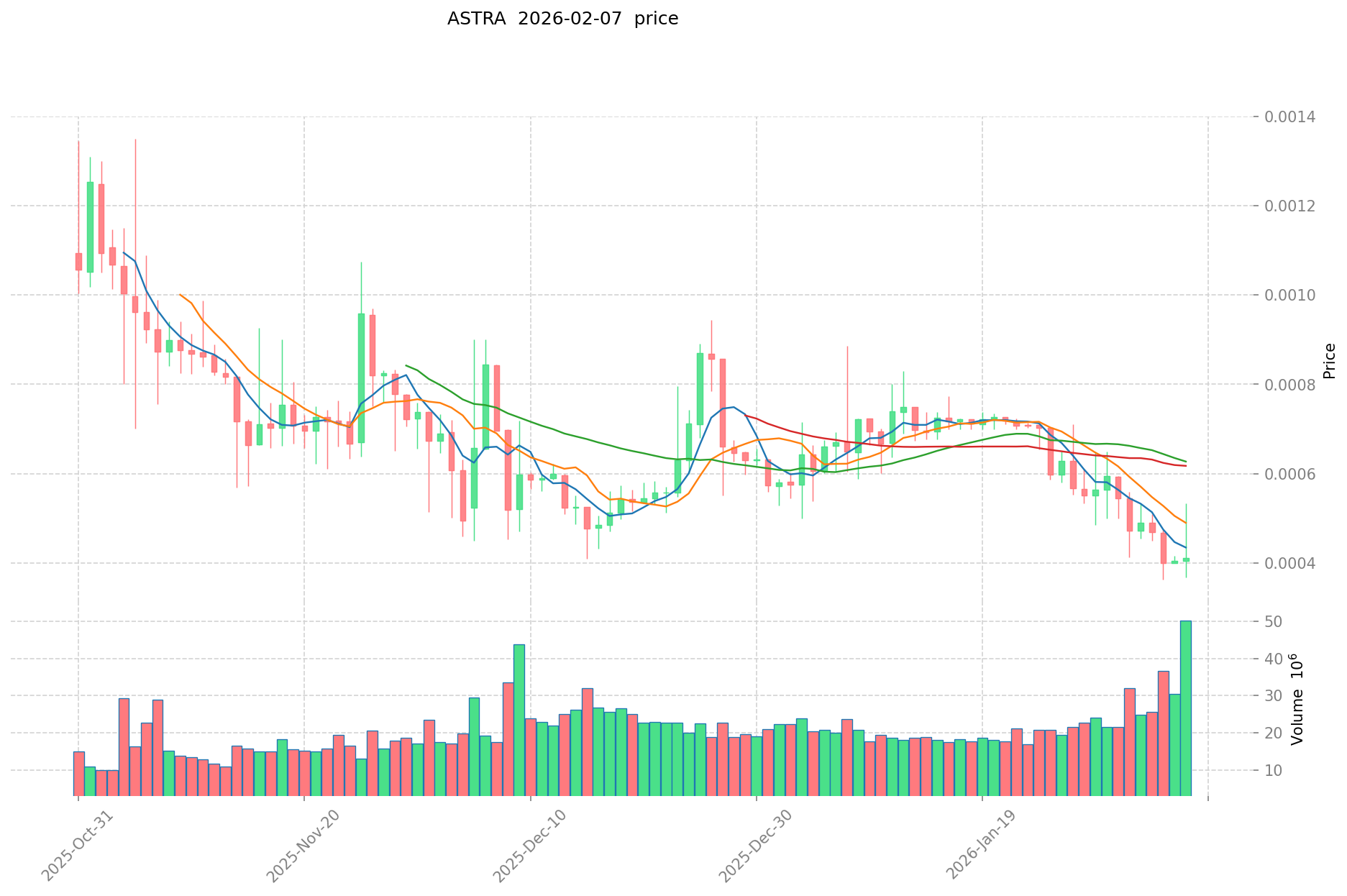
- Recent Performance (2025-2026): From early 2025 through February 2026, ASTRA showed mixed price action with a one-year decline of approximately 75.14%, while short-term movements included a 24-hour increase of 2.02% and a one-hour gain of 1.85%.
Current ASTRA Investment Market Status (February 2026)
- ASTRA Current Price: $0.0004118 (as of February 7, 2026)
- 24-hour Trading Range: High of $0.0005339, Low of $0.0003663
- 24-hour Trading Volume: $22,312.86
- Market Capitalization: $300,614.00
- Circulating Supply: 730,000,000 ASTRA (73% of total supply)
- Fully Diluted Market Cap: $411,800.00
- Token Holders: 2,512 addresses
- Exchange Availability: Listed on 1 exchange platform
Click to view real-time ASTRA market price
II. Core Factors Affecting Whether ASTRA is a Good Investment (Is Astra Protocol(ASTRA) a Good Investment)
Supply Mechanism and Scarcity (ASTRA investment scarcity)
- Total supply capped at 1,000,000,000 ASTRA → influences price dynamics and investment value
- Current circulating supply of 730,000,000 ASTRA (73% of total supply) → relatively high circulation rate may impact scarcity perception
- Investment significance: understanding the token's supply structure is essential for evaluating long-term investment potential
Macroeconomic Environment's Impact on ASTRA Investment
- Broader cryptocurrency market conditions → directly affect altcoin investment attractiveness
- Market volatility and risk appetite → influence investor willingness to engage with lower-cap tokens
- Trading volume patterns provide insights into market participation and liquidity considerations
III. ASTRA Future Investment Forecast and Price Outlook (Is Astra Protocol(ASTRA) worth investing in 2026-2031)
Short-term Investment Forecast (2026, short-term ASTRA investment outlook)
- Conservative forecast: $0.000383 - $0.0004118
- Neutral forecast: $0.0004118 - $0.000486
- Optimistic forecast: $0.000486 - $0.000560
Mid-term Investment Outlook (2027-2029, mid-term Astra Protocol(ASTRA) investment forecast)
-
Market stage expectation: The token may experience gradual growth phases as the project develops its AstraSwap exchange infrastructure on the BNB network. The dynamic transaction fee structure and community-driven governance model could influence adoption rates during this period.
-
Investment return forecast:
- 2027: $0.000423 - $0.000661
- 2028: $0.000327 - $0.000820
- 2029: $0.000585 - $0.000982
-
Key catalysts: AstraSwap platform development, BNB network ecosystem expansion, community governance participation, charitable initiative implementations, and broader DeFi market trends.
Long-term Investment Outlook (Is ASTRA a good long-term investment?)
- Base scenario: $0.000571 - $0.000840 (assuming steady platform adoption and maintained BNB network position)
- Optimistic scenario: $0.000698 - $0.001184 (assuming enhanced exchange functionality and increased user engagement)
- Risk scenario: Below $0.000327 (under adverse market conditions or competitive pressure)
Click to view ASTRA long-term investment and price forecast: Price Prediction
2026-02-07 - 2031 Long-term Outlook
- Base scenario: $0.000571 - $0.000840 USD (corresponding to stable progress and steady mainstream application growth)
- Optimistic scenario: $0.000698 - $0.001184 USD (corresponding to large-scale adoption and favorable market environment)
- Transformative scenario: Above $0.001345 USD (such as ecosystem breakthrough progress and mainstream popularization)
- 2031-12-31 forecast high: $0.001345 USD (based on optimistic development assumptions)
Disclaimer: Price predictions are based on historical data analysis and market trends. Cryptocurrency markets are highly volatile and unpredictable. These forecasts should not be considered as investment advice. Past performance does not guarantee future results. Investors should conduct their own research and consider their risk tolerance before making investment decisions.
| Year |
Predicted High Price |
Predicted Average Price |
Predicted Low Price |
Price Change |
| 2026 |
0.000560048 |
0.0004118 |
0.000382974 |
0 |
| 2027 |
0.00066085664 |
0.000485924 |
0.00042275388 |
18 |
| 2028 |
0.0008199481576 |
0.00057339032 |
0.0003268324824 |
39 |
| 2029 |
0.000982303626708 |
0.0006966692388 |
0.000585202160592 |
69 |
| 2030 |
0.001183675870183 |
0.000839486432754 |
0.000570850774272 |
103 |
| 2031 |
0.001345402931453 |
0.001011581151468 |
0.000697990994513 |
145 |
IV. ASTRA Investment Strategy and Risk Management (How to invest in Astra Protocol)
Investment Strategy (ASTRA investment strategy)
Long-term Holding (HODL ASTRA)
Long-term holding may appeal to conservative investors seeking to participate in the project's development over time. This approach involves accumulating ASTRA tokens and maintaining positions through market cycles, potentially benefiting from the project's evolution and ecosystem growth on the BNB network.
Active Trading
Active trading strategies rely on technical analysis and swing trading techniques. Traders may monitor ASTRA's price movements, which have shown notable volatility, with 24-hour changes of approximately 2.02% and 7-day fluctuations of around -29.79%. Technical indicators, chart patterns, and volume analysis can inform entry and exit decisions for short to medium-term positions.
Risk Management (Risk management for ASTRA investment)
Asset Allocation Ratios
- Conservative investors: May limit ASTRA exposure to a small percentage (1-3%) of their overall crypto portfolio, given the token's relatively low market capitalization and trading volume
- Aggressive investors: Might allocate a moderate portion (5-10%) while maintaining diversification across multiple assets
- Professional investors: Could employ dynamic allocation strategies based on market conditions, technical signals, and fundamental developments
Risk Hedging Solutions
Implementing a multi-asset portfolio approach can help mitigate concentration risk. Investors may consider pairing ASTRA holdings with more established cryptocurrencies, stablecoins, or traditional assets. Position sizing based on volatility metrics and maintaining stop-loss orders can provide additional downside protection.
Secure Storage
- Hot wallets: Suitable for active trading amounts, offering quick access for transactions on exchanges
- Cold wallets: Recommended for long-term holdings, providing enhanced security through offline storage
- Hardware wallets: Devices such as Ledger or Trezor offer robust protection for ERC-20 tokens like ASTRA (contract address: 0x201332Bd45c8628D814F870bFb584B385A7C351e)
V. ASTRA Investment Risks and Challenges (Risks of investing in Astra Protocol)
Market Risks
ASTRA exhibits considerable price volatility, with 24-hour fluctuations ranging from $0.0003663 to $0.0005339. The token's 30-day performance shows approximately -40.25% change, while the 1-year trend indicates around -75.14% variation. The relatively modest 24-hour trading volume of approximately $22,312 may contribute to price sensitivity and liquidity concerns during larger transactions.
Regulatory Risks
As a cryptocurrency project, ASTRA faces evolving regulatory frameworks across different jurisdictions. Policy changes regarding digital assets, decentralized exchanges, and token transactions could impact the project's operations and token utility. Investors should monitor regulatory developments in their respective countries and internationally.
Technical Risks
Potential technical vulnerabilities include smart contract security on the Ethereum network, dependency on BNB network infrastructure for the AstraSwap exchange, and risks associated with protocol upgrades or modifications. The project's dynamic transaction fee structure (10% allocation) requires ongoing technical maintenance and governance decisions that could affect token economics.
VI. Conclusion: Is Astra Protocol a Good Investment?
Investment Value Summary
ASTRA presents characteristics typical of smaller market cap cryptocurrencies, with both potential opportunities and notable challenges. The project's focus on the BNB network ecosystem and its exchange platform provides specific utility, though the token has experienced substantial price fluctuations. The circulating supply represents 73% of the maximum supply (730 million out of 1 billion tokens), with approximately 2,512 holders as of the latest data.
Investor Recommendations
✅ Beginners: Consider a measured approach through dollar-cost averaging in small amounts, paired with secure storage solutions such as hardware wallets. Thorough research into the project's fundamentals and the broader crypto market is essential before any investment.
✅ Experienced investors: May explore swing trading opportunities based on technical analysis while maintaining diversified portfolio allocation. Position sizing should reflect ASTRA's volatility profile and liquidity characteristics.
✅ Institutional investors: Should conduct comprehensive due diligence on the project's technology, team, market position, and competitive landscape before considering any strategic allocation.
⚠️ Disclaimer: Cryptocurrency investments carry substantial risk, including the potential loss of principal. Market volatility, regulatory uncertainty, and technical challenges can significantly impact token values. This content is for informational purposes only and does not constitute financial, investment, or legal advice. Investors should conduct independent research and consult with qualified professionals before making any investment decisions.
VII. FAQ
Q1: What is the current price and market capitalization of Astra Protocol (ASTRA)?
As of February 7, 2026, ASTRA trades at $0.0004118 with a market capitalization of approximately $300,614. The token's 24-hour trading range spans from $0.0003663 to $0.0005339, with a daily trading volume of $22,312.86. The circulating supply stands at 730,000,000 ASTRA tokens (73% of the maximum supply of 1,000,000,000), resulting in a fully diluted market cap of $411,800. These metrics indicate ASTRA operates as a small-cap cryptocurrency with modest trading activity across its single exchange listing.
Q2: How has ASTRA's price performed historically since its peak?
ASTRA experienced significant price volatility since its peak of $0.500054 on February 24, 2023. The token underwent substantial corrections throughout 2024, declining to $0.00035647 by August 27, 2024. Recent performance data shows a one-year decline of approximately 75.14%, a 30-day decrease of around 40.25%, and a 7-day drop of approximately 29.79%. However, short-term movements have shown mixed signals, with a 24-hour increase of 2.02% and a one-hour gain of 1.85% as of the latest data, reflecting the token's characteristic high volatility.
Q3: What are the key factors that could influence ASTRA's investment value?
Several factors affect ASTRA's investment potential, including its supply mechanism with a capped total of 1 billion tokens and current 73% circulation rate, the development progress of its AstraSwap exchange platform on the BNB network, and the broader cryptocurrency market conditions. The project's 10% dynamic transaction fee structure allocated to development, marketing, and charitable initiatives impacts token economics. Additionally, community governance participation, BNB network ecosystem expansion, competitive pressure from other DEX platforms, regulatory developments affecting cryptocurrency exchanges, and overall DeFi market trends serve as important catalysts for price movements.
Q4: What is the long-term price forecast for ASTRA through 2031?
Long-term projections for ASTRA present multiple scenarios based on different adoption and market conditions. The base scenario estimates a range of $0.000571 to $0.000840 by 2031, assuming steady platform adoption and maintained BNB network positioning. An optimistic scenario projects $0.000698 to $0.001184, contingent on enhanced exchange functionality and increased user engagement. The transformative scenario suggests potential above $0.001345 if ecosystem breakthrough developments occur. However, these forecasts carry significant uncertainty due to cryptocurrency market volatility, and investors should recognize that historical data cannot guarantee future performance.
Q5: What are the primary risks associated with investing in ASTRA?
ASTRA investment presents several notable risk categories. Market risks include substantial price volatility with 24-hour fluctuations ranging from $0.0003663 to $0.0005339, modest trading volume of approximately $22,312 that may impact liquidity, and significant historical drawdowns including a 75.14% decline over one year. Regulatory risks involve evolving frameworks for digital assets and decentralized exchanges across jurisdictions. Technical risks encompass smart contract vulnerabilities on the Ethereum network, dependency on BNB network infrastructure, and potential impacts from protocol modifications. The relatively low market cap and limited exchange availability (one platform) also contribute to concentration risk.
Q6: What investment strategies are recommended for different types of ASTRA investors?
Investment approaches vary based on investor profiles and risk tolerance. Beginners should consider dollar-cost averaging with small amounts (1-3% of crypto portfolio), prioritize secure storage through hardware wallets, and conduct thorough research before participation. Experienced investors may explore swing trading opportunities using technical analysis while maintaining diversified allocation (5-10% for aggressive investors), implementing stop-loss orders, and monitoring key technical indicators given the token's volatility patterns. Institutional investors should perform comprehensive due diligence on technology, team, market positioning, and competitive landscape before considering strategic allocation, employing dynamic position sizing based on volatility metrics and market conditions.
Q7: How secure is ASTRA, and what are the recommended storage solutions?
ASTRA operates as an ERC-20 token (contract address: 0x201332Bd45c8628D814F870bFb584B385A7C351e) on the Ethereum network, subject to the security standards of that blockchain infrastructure. For storage, the project recommends different solutions based on holding strategies: hot wallets are suitable for active trading amounts requiring quick access on exchanges; cold wallets are recommended for long-term holdings, providing enhanced security through offline storage; and hardware wallets such as Ledger or Trezor offer robust protection with physical device security features. Investors should implement multi-signature solutions when applicable and maintain secure backup procedures for recovery phrases to prevent loss of access to their holdings.
Q8: What makes AstraSwap and the BNB network integration relevant for ASTRA's investment thesis?
AstraSwap serves as ASTRA's primary utility platform, facilitating decentralized trading on the BNB network, which provides specific ecosystem advantages. The BNB network integration offers benefits including lower transaction costs compared to Ethereum mainnet, faster processing times for trades, and access to the broader Binance Smart Chain DeFi ecosystem. The 10% dynamic transaction fee structure supports ongoing development and marketing initiatives while contributing to charitable organizations, potentially building community goodwill. However, the investment thesis also depends on AstraSwap's ability to compete with established DEX platforms, attract sufficient liquidity providers and traders, and demonstrate technological differentiation within the increasingly competitive decentralized exchange landscape.
* The information is not intended to be and does not constitute financial advice or any other recommendation of any sort offered or endorsed by Gate.