This comprehensive analysis examines Aura Network (AURA) as a Layer 1 blockchain investment opportunity focused on NFT adoption. The article evaluates AURA's current market position at $0.001517 with a $630,683 market cap, reviews historical price movements from $0.06798 in January 2024 to current levels, and assesses core investment factors including supply mechanisms, institutional adoption, and ecosystem development. It provides short-term, mid-term, and long-term price predictions through 2031, outlines investment strategies for different investor profiles, and details critical risk management approaches. The analysis also addresses regulatory risks, technical vulnerabilities, and market volatility concerns. Designed for investors evaluating AURA's viability, this guide combines technical analysis with practical investment recommendations on asset allocation, secure storage solutions, and portfolio diversification strategies for emerging cryptocurrency assets.
Introduction: Aura Network (AURA)'s Investment Position and Market Outlook
AURA is a noteworthy asset in the cryptocurrency space. As of February 2026, Aura Network maintains a market capitalization of approximately $630,683, with a circulating supply of around 415.74 million tokens, and the current price stands at approximately $0.001517. Positioned as a layer 1 blockchain focused on NFT adoption, AURA has gradually become a subject of discussion among investors considering "Is Aura Network (AURA) a good investment?" This article comprehensively analyzes AURA's investment value, historical trends, future price predictions, and investment risks to provide reference for investors.
I. Aura Network (AURA) Price Historical Review and Current Investment Value Status
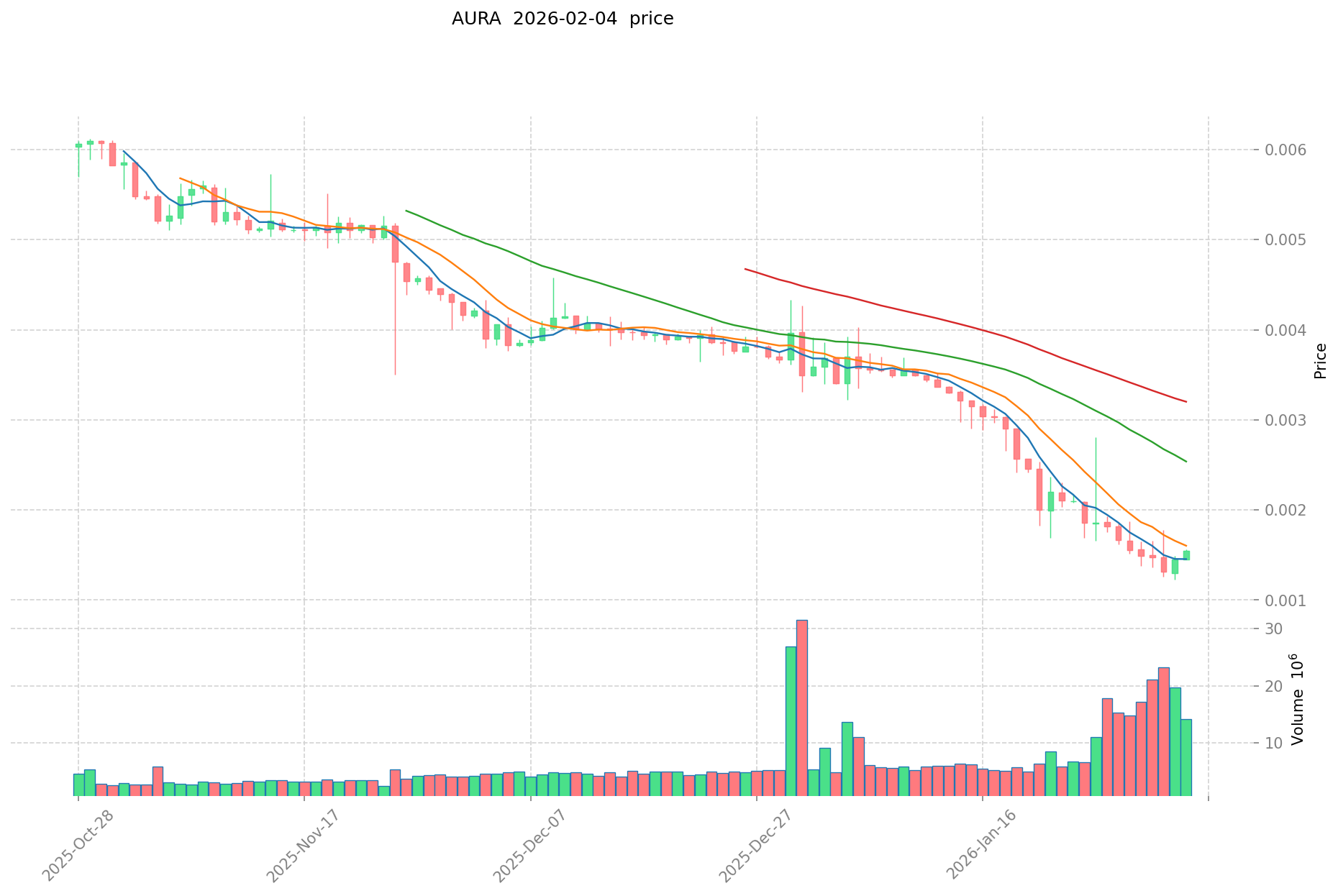
- 2024: AURA recorded a price level of $0.06798 on January 6, 2024 → subsequent market adjustments led to notable price corrections
- 2026: Market volatility intensified → AURA declined to $0.001225 on February 2, 2026
- Recent period: Price fluctuations continue → AURA trades at approximately $0.001517 as of February 5, 2026
Current AURA Investment Market Status (February 2026)
- AURA current price: $0.001517
- 24-hour trading volume: $41,109.38
- Market capitalization: $630,683.69
- Circulating supply: 415,744,026.89 AURA (approximately 41.57% of total supply)
Click to view real-time AURA market price
II. Core Factors Influencing Whether AURA is a Good Investment
Supply Mechanism and Scarcity (AURA Investment Scarcity)
- AURA has a maximum supply of 1,000,000,000 tokens with a current circulating supply of approximately 415,744,027 tokens, representing a circulating ratio of about 41.57%
- The token's price reached $0.06798 in January 2024 and subsequently declined to $0.001225 in February 2026, demonstrating significant volatility during periods of supply distribution
- Investment significance: The controlled supply structure with approximately 58% of tokens yet to enter circulation may influence long-term price dynamics as additional tokens are released into the market
Institutional Investment and Mainstream Adoption (Institutional Investment in AURA)
- AURA currently has 2,847 token holders, indicating a relatively limited holder base
- The project is listed on one exchange platform, suggesting early-stage adoption in the broader cryptocurrency market
- Market capitalization stands at approximately $630,684, representing 0.000058% of the total crypto market share, reflecting its current position as an emerging asset
Macroeconomic Environment's Impact on AURA Investment
- Monetary policy and interest rate changes influence the attractiveness of risk assets, including smaller-cap cryptocurrencies like AURA
- During periods of economic uncertainty, investors may adjust their portfolio allocations, potentially affecting demand for emerging blockchain projects
- Geopolitical factors and regulatory developments in the blockchain sector continue to shape the investment landscape for NFT-focused infrastructure projects
Technology and Ecosystem Development (Technology & Ecosystem for AURA Investment)
- Aura Network operates as a Layer 1 blockchain designed to accelerate NFT adoption globally, positioning itself within the expanding digital asset ecosystem
- The project's focus on scalability and NFT infrastructure development aims to address market needs in the digital collectibles and asset tokenization space
- Long-term investment value may be influenced by the project's ability to expand its ecosystem, increase developer activity, and demonstrate practical use cases for its NFT-focused infrastructure
III. AURA Future Investment Predictions and Price Outlook (Is Aura Network(AURA) worth investing in 2026-2031)
Short-term Investment Prediction (2026, short-term AURA investment outlook)
- Conservative prediction: $0.001296 - $0.001525
- Neutral prediction: $0.001525 - $0.001739
- Optimistic prediction: $0.001739 - $0.001952
Mid-term Investment Outlook (2027-2028, mid-term Aura Network(AURA) investment forecast)
- Market stage expectation: AURA may experience gradual growth as the NFT ecosystem evolves and adoption patterns stabilize across Layer 1 blockchain platforms.
- Investment return prediction:
- 2027: $0.001165 - $0.002173
- 2028: $0.001878 - $0.002601
- Key catalysts: NFT market dynamics, Layer 1 blockchain competitive landscape, ecosystem development progress, and overall cryptocurrency market sentiment.
Long-term Investment Outlook (Is AURA a good long-term investment?)
- Base scenario: $0.001529 - $0.002683 (assuming steady ecosystem development and maintained market position)
- Optimistic scenario: $0.002244 - $0.003702 (assuming enhanced NFT adoption and favorable market conditions)
- Risk scenario: Below $0.001296 (under adverse market conditions or declining ecosystem activity)
View AURA long-term investment and price predictions: Price Prediction
2026-02-05 - 2031 Long-term Outlook
- Base scenario: $0.001529 - $0.002683 (corresponding to steady progress and gradual mainstream application improvement)
- Optimistic scenario: $0.002244 - $0.003702 (corresponding to large-scale adoption and favorable market environment)
- Transformative scenario: Above $0.003702 (such as breakthrough progress in ecosystem and mainstream popularization)
- 2031-12-31 predicted high: $0.003702 (based on optimistic development assumptions)
Disclaimer: The above predictions are based on historical data analysis and market modeling. Cryptocurrency investments involve substantial risk, and past performance does not guarantee future results. Investors should conduct independent research and consider their risk tolerance before making investment decisions.
| Year |
Predicted High Price |
Predicted Average Price |
Predicted Low Price |
Price Change |
| 2026 |
0.001952 |
0.001525 |
0.00129625 |
0 |
| 2027 |
0.002173125 |
0.0017385 |
0.001164795 |
14 |
| 2028 |
0.002601230625 |
0.0019558125 |
0.00187758 |
28 |
| 2029 |
0.002346877209375 |
0.0022785215625 |
0.001663320740625 |
50 |
| 2030 |
0.003052763189437 |
0.002312699385937 |
0.002243318404359 |
52 |
| 2031 |
0.003702169177008 |
0.002682731287687 |
0.001529156833981 |
76 |
IV. AURA Investment Strategy and Risk Management (How to invest in Aura Network)
Investment Strategy (AURA investment strategy)
Long-term Holding (HODL AURA)
This approach is suitable for conservative investors who believe in the long-term potential of Aura Network's NFT ecosystem. Given the token's significant price decline of 81.28% over the past year and current trading near its historical low, long-term holders should carefully assess the project's fundamentals and development roadmap before committing capital.
Active Trading
Active traders may consider technical analysis and swing trading strategies, particularly given AURA's high volatility. The token has shown short-term price movements with a 24-hour range between $0.001488 and $0.001601. However, traders should note the limited exchange availability (only 1 exchange) which may impact liquidity and execution.
Risk Management (Risk management for AURA investment)
Asset Allocation Ratios
- Conservative investors: Consider allocating no more than 1-2% of crypto portfolio to AURA due to its high-risk profile and market cap ranking of 2854
- Aggressive investors: May allocate 3-5% while maintaining strict stop-loss disciplines
- Professional investors: Should conduct thorough due diligence on the project's NFT adoption metrics and ecosystem growth before determining allocation
Risk Hedging Solutions
- Diversify across multiple blockchain projects and asset classes
- Consider implementing position sizing strategies that account for AURA's high volatility
- Monitor market dominance (currently at 0.000058%) and trading volume trends
Secure Storage
- Cold wallets: Hardware wallets (Ledger, Trezor) for long-term holdings
- Hot wallets: Use reputable wallets with multi-signature features for active trading amounts only
- Always verify contract addresses before transactions and enable all available security features
V. AURA Investment Risks and Challenges (Risks of investing in Aura Network)
Market Risk
- High volatility: AURA has experienced substantial price fluctuations, with a 59.39% decline over 30 days and trading 97.77% below its all-time high of $0.06798
- Low liquidity: With only one exchange listing and a 24-hour trading volume of approximately $41,109, liquidity constraints may result in significant slippage during larger transactions
- Market manipulation potential: Lower market cap tokens are generally more susceptible to price manipulation
Regulatory Risk
- NFT-focused projects face evolving regulatory frameworks across different jurisdictions
- Policy uncertainty regarding digital asset classification may impact project operations and token utility
- Cross-border NFT trading regulations continue to develop, potentially affecting Aura Network's global adoption goals
Technical Risk
- Layer 1 blockchain infrastructure requires ongoing maintenance and security audits
- Network upgrade failures or protocol vulnerabilities could impact token value and ecosystem functionality
- Smart contract risks associated with NFT operations and tokenomics implementation
- Limited circulating supply (41.57% of total supply) may create concerns about future token unlocks
VI. Conclusion: Is Aura Network a Good Investment?
Investment Value Summary
Aura Network presents a specialized opportunity in the NFT infrastructure space with its Layer 1 blockchain approach. However, the significant price decline, limited exchange availability, and low market dominance indicate substantial challenges. The project's long-term potential depends heavily on its ability to drive NFT adoption and expand its ecosystem.
Investor Recommendations
✅ Beginners: If considering AURA, implement dollar-cost averaging with minimal allocation (under 2% of crypto portfolio) and utilize secure hardware wallet storage. Thoroughly research the project's NFT ecosystem development before investing.
✅ Experienced Investors: May explore swing trading opportunities while maintaining strict risk management protocols. Consider portfolio diversification across multiple blockchain projects and monitor trading volume patterns closely.
✅ Institutional Investors: Conduct comprehensive due diligence on the project's technical infrastructure, team credentials, and NFT market positioning before any strategic allocation. Assess liquidity requirements carefully given limited exchange availability.
⚠️ Disclaimer: Cryptocurrency investments carry substantial risk. This analysis is for informational purposes only and does not constitute investment advice. Always conduct your own research and consider your financial situation before investing.
VII. FAQ
Q1: Is Aura Network (AURA) a good investment for beginners in 2026?
AURA carries substantial risk and is generally not recommended as a primary investment for beginners due to its high volatility and limited market presence. The token has experienced an 81.28% price decline over the past year and currently trades 97.77% below its all-time high of $0.06798. With a market capitalization of only $630,684 and listing on just one exchange, liquidity constraints pose significant challenges. Beginners considering AURA should limit exposure to under 2% of their crypto portfolio, implement dollar-cost averaging strategies, and thoroughly research the project's NFT ecosystem development before investing.
Q2: What is the predicted price range for AURA in 2027-2028?
Based on market analysis and historical patterns, AURA's mid-term price outlook presents the following ranges: for 2027, conservative estimates suggest $0.001165 to $0.002173, representing a potential 14% increase from 2026 levels; for 2028, projections range from $0.001878 to $0.002601, indicating a possible 28% cumulative growth. These predictions assume steady ecosystem development, favorable NFT market dynamics, and maintained competitive positioning among Layer 1 blockchain platforms. However, investors should note that cryptocurrency price predictions involve significant uncertainty, and actual performance may vary substantially based on market conditions and project execution.
Q3: What are the main risks associated with investing in AURA?
AURA presents three primary risk categories: First, market risk includes extreme volatility (59.39% decline over 30 days), severely limited liquidity with only one exchange listing and $41,109 in 24-hour trading volume, and heightened susceptibility to price manipulation due to its low market cap. Second, regulatory risk encompasses evolving NFT classification frameworks, policy uncertainty regarding digital asset operations, and developing cross-border trading regulations that may impact global adoption. Third, technical risk involves Layer 1 infrastructure maintenance requirements, potential smart contract vulnerabilities in NFT operations, and concerns about future token unlocks given that only 41.57% of total supply currently circulates.
Q4: How should investors allocate portfolio percentage to AURA?
Portfolio allocation for AURA should be carefully calibrated based on investor risk profiles: Conservative investors should limit exposure to 1-2% of their total crypto portfolio due to AURA's high-risk characteristics and ranking of 2854 by market capitalization. Aggressive investors with higher risk tolerance may consider 3-5% allocation while implementing strict stop-loss disciplines and monitoring trading volume trends closely. Professional investors should conduct comprehensive due diligence on NFT adoption metrics and ecosystem growth indicators before determining appropriate position sizing. All investor categories should diversify across multiple blockchain projects and asset classes rather than concentrating holdings in a single low-cap token.
Q5: What factors could drive AURA's price growth in the long term?
Several key catalysts may influence AURA's long-term price trajectory: NFT market expansion and increased adoption of digital collectibles could drive demand for Layer 1 infrastructure like Aura Network. Ecosystem development progress, including developer activity, partnership announcements, and practical use case demonstrations, may enhance token utility and investor confidence. Increased exchange listings would improve liquidity and accessibility, potentially attracting larger investor participation. Additionally, favorable cryptocurrency market sentiment and technological breakthroughs in scalability or NFT infrastructure could create upward price momentum. The optimistic 2031 scenario projects prices reaching $0.003702, though this depends heavily on successful execution across these dimensions.
Q6: How does AURA's circulating supply structure affect investment considerations?
AURA's supply dynamics present important considerations for investors: Currently, only 415,744,027 tokens (approximately 41.57% of the 1 billion maximum supply) are in circulation, with 58.43% yet to be released. This controlled supply structure creates potential price implications as additional tokens enter the market through future unlocks or distribution events. Historically, significant token releases can create downward price pressure if demand does not keep pace with increased supply. Investors should monitor the project's tokenomics roadmap and vesting schedules to understand when and how remaining tokens will enter circulation. This information is critical for long-term position planning and understanding potential dilution effects on investment value.
Q7: What security measures should AURA investors implement?
Protecting AURA investments requires a multi-layered security approach: For long-term holdings, hardware wallets such as Ledger or Trezor provide cold storage solutions that keep private keys offline and protected from online threats. Active traders should use reputable hot wallets with multi-signature features for trading amounts only, minimizing exposure to potential security breaches. All investors must verify contract addresses before executing transactions to avoid phishing attempts or fraudulent tokens. Enable all available security features including two-factor authentication, biometric verification, and transaction whitelisting where supported. Given AURA's limited exchange availability, exercise additional caution when selecting trading platforms and consider reputation, security track record, and regulatory compliance status.
Q8: How does AURA compare to other NFT-focused blockchain investments?
AURA occupies a specialized niche in the NFT infrastructure landscape as a Layer 1 blockchain dedicated to accelerating NFT adoption. Compared to established competitors, AURA's market capitalization of $630,684 and single exchange listing indicate early-stage positioning with corresponding higher risk and potential reward dynamics. While larger NFT platforms benefit from established ecosystems, developer communities, and multiple liquidity sources, AURA's focused approach may offer differentiation if the project successfully executes its roadmap. Investors comparing NFT blockchain investments should evaluate factors including total value locked, transaction volumes, active addresses, developer activity, and partnership quality rather than focusing solely on token price movements. AURA's current metrics suggest it remains in early development phases relative to more established alternatives in the sector.
* The information is not intended to be and does not constitute financial advice or any other recommendation of any sort offered or endorsed by Gate.