The article "Is Aurora (AURORA) a Good Investment?" offers a thorough analysis of Aurora's price trends, technical fundamentals, and market outlook. It explores Aurora's potential as a bridging solution facilitating Ethereum compatibility on the NEAR Protocol. This comprehensive report targets investors interested in assessing Aurora's investment viability, understanding historical price performance, evaluating technical and market risks, and reviewing future predictions. The article structures include sections on project overview, market position, price analysis, technical architecture, investment strategies, and risk assessment, while emphasizing actionable insights for various investor profiles.
Introduction: Aurora (AURORA) Investment Position and Market Prospects
AURORA is an important asset in the cryptocurrency field. As of December 2025, Aurora's market cap stands at approximately $31.48 million, with a fully diluted valuation of $47.36 million and a circulating supply of approximately 664.50 million tokens. The current price is maintained around $0.04737. Built on the NEAR Protocol as an EVM, Aurora delivers a turn-key solution for developers to operate their applications on an Ethereum-compatible, high-throughput, scalable platform with low transaction costs for users. Aurora serves as a bridge product that helps Ethereum users and dApps easily transition to the NEAR blockchain, enabling users to upload and interact with Solidity smart contracts on the NEAR blockchain and transfer assets between Ethereum and NEAR, including ERC-20 tokens.
Currently ranked 676th in market capitalization with a market dominance of 0.0014%, Aurora has attracted attention from investors exploring the question "Is Aurora (AURORA) a good investment?" This article will provide a comprehensive analysis of Aurora's investment value, historical price trends, future price forecasts, and investment risks to serve as a reference for potential investors.
Aurora (AURORA) Cryptocurrency Asset Research Report
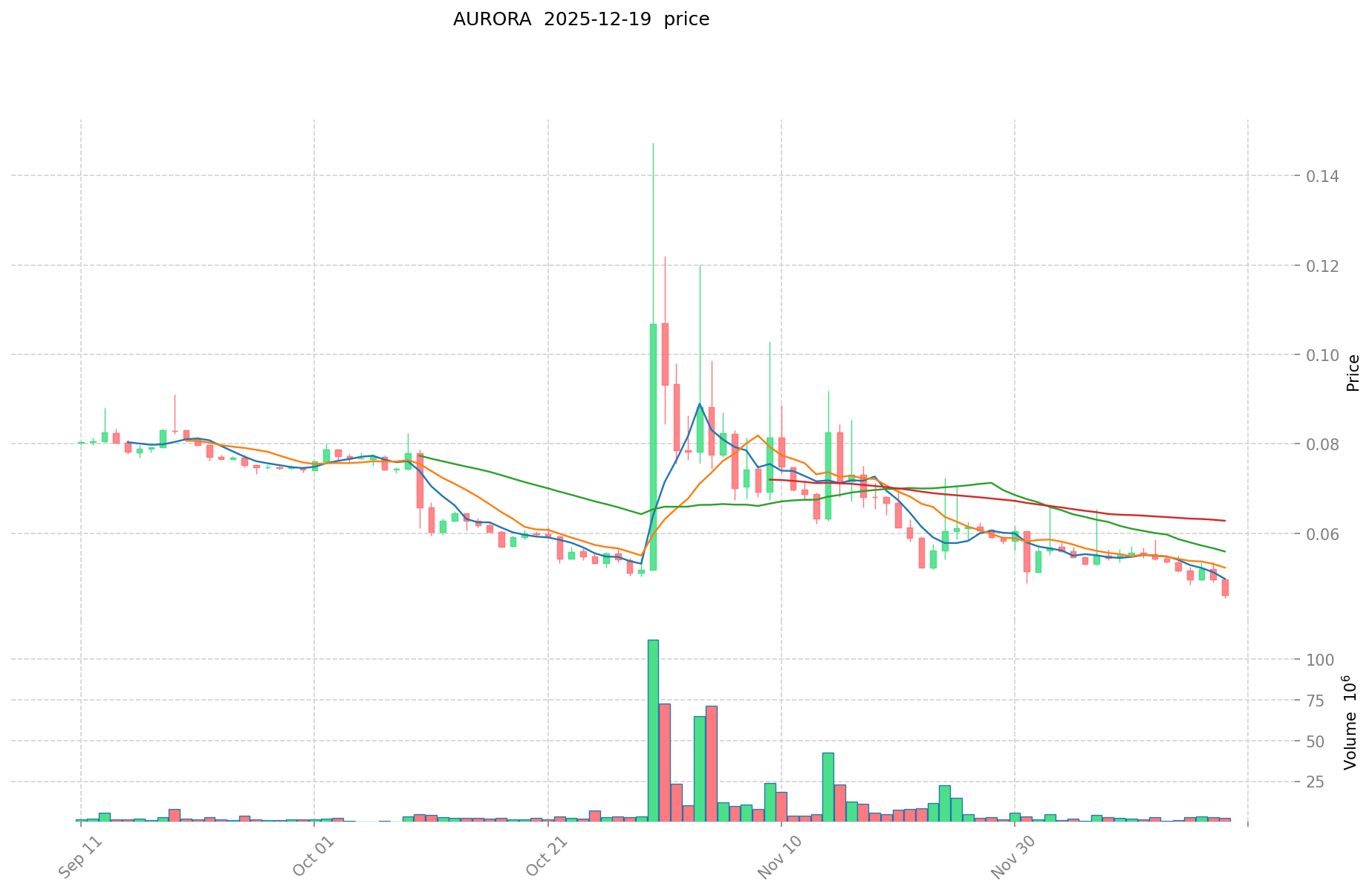
I. Aurora Price History Review and Current Investment Status
Aurora was launched with a maximum supply of 1,000,000,000 tokens. The asset has experienced significant price volatility since its inception:
- All-Time High (ATH): USD 35.40 on January 17, 2022
- All-Time Low (ATL): USD 0.04593082 on December 19, 2025
- One-Year Performance: -81.00% decline
- 30-Day Performance: -28.54% decline
- 7-Day Performance: -15.80% decline
The token has depreciated dramatically from its peak, with cumulative losses exceeding 81% over the past year, indicating a significant bearish trend in the market.
Current Aurora Market Status (December 19, 2025)
| Metric |
Value |
| Current Price |
USD 0.04737 |
| 24-Hour Change |
+0.63% |
| 1-Hour Change |
+0.53% |
| 24-Hour High |
USD 0.04878 |
| 24-Hour Low |
USD 0.04548 |
| Market Capitalization |
USD 31,477,189.07 |
| Fully Diluted Valuation |
USD 47,362,557.89 |
| Circulating Supply |
664,496,286 AURORA |
| Total Supply |
999,842,894 AURORA |
| Circulating Supply Ratio |
66.45% |
| 24-Hour Trading Volume |
USD 69,794.07 |
| Global Market Ranking |
#676 |
| Market Dominance |
0.0014% |
| Token Holders |
7,640 |
Market Sentiment Analysis
Market emotion indicator registers at a neutral to slightly positive level, as evidenced by the modest 24-hour price recovery of +0.63%.
For real-time Aurora market price data, visit Gate Aurora Markets
II. Project Overview and Technical Architecture
Aurora Project Definition
Aurora is an Ethereum Virtual Machine (EVM) constructed on the NEAR Protocol. It provides a turn-key solution for developers to operate applications on an Ethereum-compatible, high-throughput, scalable, and future-safe platform while minimizing transaction costs for end users.
Aurora functions as a migration bridge for Ethereum users and decentralized applications (dApps) to transition to the NEAR blockchain ecosystem. The platform enables two primary functionalities:
I. Upload and execution of Solidity smart contracts on the NEAR blockchain
II. Cross-chain asset transfer between Ethereum and NEAR, including ERC-20 token bridges
Smart Contract Addresses
| Blockchain |
Contract Address |
Explorer |
| Ethereum |
0xAaAAAA20D9E0e2461697782ef11675f668207961 |
Etherscan |
| Aurora EVM |
0x8bec47865ade3b172a928df8f990bc7f2a3b9f79 |
AuroraScan |
III. Market Data Summary
| Metric |
Value |
| Market Cap (Circulating) |
USD 31,477,189.07 |
| Market Cap / FDV Ratio |
66.45% |
| Token Distribution |
11 exchanges listed |
| Last Updated |
December 19, 2025, 16:16:26 UTC |
IV. Official Resources
Disclaimer
This report is prepared for informational purposes only and does not constitute investment advice, financial recommendation, or solicitation to buy or sell any digital asset. Cryptocurrency markets are highly volatile and speculative. Past performance does not guarantee future results. Investors should conduct their own due diligence and consult with qualified financial advisors before making investment decisions.
Aurora (AURORA) Research Report
Report Date: December 19, 2025
I. Project Overview
Aurora is an Ethereum Virtual Machine (EVM) built on the NEAR Protocol, designed to provide developers with a turnkey solution for operating applications on an Ethereum-compatible, high-throughput, scalable, and future-safe platform with low transaction costs. The project serves as a bridge enabling Ethereum users and decentralized applications (dApps) to migrate to the NEAR blockchain while maintaining Solidity smart contract compatibility and facilitating asset transfers between Ethereum and NEAR, including ERC-20 tokens.
Market Position
| Metric |
Value |
| Current Price |
$0.04737 |
| Market Capitalization |
$31,477,189.07 |
| Fully Diluted Valuation |
$47,362,557.89 |
| Circulating Supply |
664,496,286 AURORA |
| Total Supply |
999,842,894 AURORA |
| Maximum Supply |
1,000,000,000 AURORA |
| Market Ranking |
676 |
| Market Share |
0.0014% |
| Number of Token Holders |
7,640 |
| Listed Exchanges |
11 |
II. Core Factors Influencing AURORA as an Investment
Supply Mechanism and Scarcity
Aurora's tokenomics show a maximum supply capped at 1 billion tokens, with circulating supply representing approximately 66.45% of the maximum supply. The relatively high circulating-to-maximum supply ratio of 66.45% indicates a substantial portion of tokens already in circulation, which may limit upside potential from supply-side scarcity compared to assets with lower circulation ratios.
Short-term Price Movement:
- 1-hour change: +0.53%
- 24-hour change: +0.63%
- 7-day change: -15.8%
- 30-day change: -28.54%
- 1-year change: -81%
Historical Price Performance:
- All-time high: $35.40 (January 17, 2022)
- All-time low: $0.04593082 (December 19, 2025)
- Current price represents a decline of approximately 86.6% from all-time high levels
The substantial year-over-year decline of 81% indicates significant downward pressure on the asset, with the token recently establishing new all-time lows during the reporting period.
Trading Activity
- 24-hour trading volume: $69,794.07
- Market emotion indicator: 1 (neutral sentiment)
The relatively modest trading volume in relation to market capitalization suggests limited liquidity, which may amplify price volatility and impact execution efficiency for significant transactions.
Technology and Ecosystem
Aurora functions as a bridge infrastructure solution by:
- Providing EVM compatibility on the NEAR Protocol
- Enabling Solidity smart contract deployment on NEAR
- Facilitating cross-chain asset migration from Ethereum
- Reducing transaction costs compared to Ethereum mainnet
The project's technical foundation depends on NEAR Protocol's performance, scalability improvements, and ecosystem adoption of cross-chain functionality.
III. Market Data and Network Activity
Blockchain Distribution:
- Ethereum (ETH) contract address: 0xAaAAAA20D9E0e2461697782ef11675f668207961
- Aurora EVM contract address: 0x8bec47865ade3b172a928df8f990bc7f2a3b9f79
The dual-chain presence indicates the token operates across multiple blockchain environments, with active contract deployment on both Ethereum and Aurora EVM networks.
IV. Community and Development Resources
V. Summary
Aurora represents an infrastructure-layer solution within the NEAR ecosystem focused on Ethereum interoperability. The project exhibits characteristics of a specialized bridge protocol rather than a standalone blockchain platform. The significant decline from historical price levels, combined with modest current trading activity and relatively high token circulating ratio, suggests the asset is in a challenging phase of market acceptance. Investment decisions should be based on assessment of NEAR Protocol adoption trends, cross-chain infrastructure demand, and broader cryptocurrency market conditions.
III. AURORA Future Investment Predictions and Price Outlook (Is Aurora(AURORA) worth investing in 2025-2030)
Short-term Investment Predictions (2025, Short-term AURORA investment outlook)
- Conservative Forecast: $0.0313 - $0.0408
- Neutral Forecast: $0.0408 - $0.0512
- Optimistic Forecast: $0.0512 - $0.0627
Mid-term Investment Outlook (2027-2028, Mid-term Aurora(AURORA) investment forecast)
- Market Stage Expectation: Aurora is positioned to benefit from increased adoption of EVM-compatible solutions on NEAR Protocol, with growing developer interest in low-cost, scalable Layer-2 infrastructure.
- Investment Return Projections:
- 2027: $0.0340 - $0.0775
- 2028: $0.0517 - $0.0830
- Key Catalysts: Expansion of cross-chain interoperability, increased enterprise adoption of NEAR Protocol, enhancement of Aurora's bridge functionality for ERC-20 token migration, and developer ecosystem growth.
Long-term Investment Outlook (Is AURORA a good long-term investment?)
- Base Case Scenario: $0.0497 - $0.1386 (Assumes steady ecosystem development and moderate market adoption of Ethereum-compatible solutions on NEAR)
- Optimistic Scenario: $0.0775 - $0.1968 (Assumes significant acceleration in dApp migration, institutional interest in low-cost Layer-2 solutions, and successful mainstream integration)
- Risk Scenario: $0.0250 - $0.0400 (Assumes competing Layer-2 solutions gain dominance, reduced developer migration to NEAR, or adverse regulatory environment)
View AURORA long-term investment and price forecasts: Price Prediction
2025-12-31 to 2030-12-31 Long-term Outlook
- Base Case: $0.0497 - $0.1386 USD (Corresponding to steady ecosystem development and mainstream application advancement)
- Optimistic Case: $0.1175 - $0.1968 USD (Corresponding to large-scale adoption and favorable market conditions)
- Transformative Case: $0.2000 USD and above (If breakthrough ecosystem progress is achieved and mainstream adoption accelerates)
- 2030-12-31 Forecast Peak: $0.1386 USD (Based on optimistic development assumptions)
Disclaimer: This analysis is based on historical data and market trends. Cryptocurrency markets are highly volatile. Past performance does not guarantee future results. This content is for informational purposes only and should not be construed as investment advice. Always conduct thorough research and consult with qualified financial advisors before making investment decisions.
| 年份 |
预测最高价 |
预测平均价格 |
预测最低价 |
涨跌幅 |
| 2025 |
0.0512028 |
0.04741 |
0.0312906 |
0 |
| 2026 |
0.068042832 |
0.0493064 |
0.028104648 |
4 |
| 2027 |
0.07745049312 |
0.058674616 |
0.03403127728 |
23 |
| 2028 |
0.0830363165632 |
0.06806255456 |
0.0517275414656 |
43 |
| 2029 |
0.111813164631168 |
0.0755494355616 |
0.071016469427904 |
59 |
| 2030 |
0.138648324142648 |
0.093681300096384 |
0.049651089051083 |
97 |
Aurora (AURORA) Investment Analysis Report
Date: December 19, 2025
I. Project Overview
Aurora is an EVM (Ethereum Virtual Machine) built on the NEAR Protocol, delivering a turn-key solution for developers to operate their applications on an Ethereum-compatible, high-throughput, scalable and future-safe platform with low transaction costs for users. Aurora serves as a bridge product that helps Ethereum users and dApps to easily migrate to the NEAR blockchain. It allows users to upload and interact with Solidity smart contracts on the NEAR blockchain and move assets between Ethereum to NEAR, including ERC-20 tokens.
Market Position
| Metric |
Value |
| Current Price |
$0.04737 |
| Market Cap |
$31,477,189.07 |
| Fully Diluted Valuation |
$47,362,557.89 |
| Circulating Supply |
664,496,286 AURORA |
| Total Supply |
999,842,894 AURORA |
| Market Ranking |
#676 |
| Market Dominance |
0.0014% |
| Active Holders |
7,640 |
| Trading Exchanges |
11 |
Current Market Status
- 24H Change: +0.63%
- 1H Change: +0.53%
- 7D Change: -15.8%
- 30D Change: -28.54%
- 1Y Change: -81%
Historical Price Range
| Metric |
Value |
Date |
| All-Time High |
$35.4 |
January 17, 2022 |
| All-Time Low |
$0.04593082 |
December 19, 2025 |
| 24H High |
$0.04878 |
— |
| 24H Low |
$0.04548 |
— |
| 24H Trading Volume |
$69,794.07 |
— |
Market Analysis
Aurora has experienced significant downward pressure over the past year, declining 81% from its previous levels. The token recently reached its all-time low price coinciding with the current report date, indicating sustained weakness in market sentiment. While short-term indicators show marginal recovery (+0.63% in 24 hours), the broader trend reveals substantial losses across multiple timeframes, particularly over the 7-day, 30-day, and annual periods.
Smart Contract Addresses
| Chain |
Contract Address |
Explorer |
| Ethereum (ETH) |
0xAaAAAA20D9E0e2461697782ef11675f668207961 |
Etherscan |
| Aurora EVM |
0x8bec47865ade3b172a928df8f990bc7f2a3b9f79 |
AuroraScan |
Official Resources
IV. Investment Strategy and Risk Management
Investment Methodology
Long-term Holdings (HODL Strategy)
Suitable for conservative investors who believe in Aurora's long-term value proposition as an Ethereum-to-NEAR bridge solution. This approach requires patience during volatile periods and conviction in the project's technological and adoption roadmap.
Active Trading Strategy
For experienced traders, the extreme price volatility and technical breakdown patterns may create short-term trading opportunities through technical analysis and swing trading approaches. However, the limited 24-hour trading volume ($69,794.07) presents liquidity constraints for larger positions.
Risk Management Framework
Asset Allocation Recommendations
- Conservative Investors: 1-2% portfolio allocation maximum, with Aurora as a speculative satellite position
- Active Investors: 3-5% allocation combined with strict stop-loss discipline
- Institutional Investors: Not recommended as a primary allocation given current market metrics and liquidity constraints
Hedging Strategies
- Multi-asset Portfolio Diversification: Balance Aurora exposure with larger-cap, more established layer-2 and cross-chain solutions
- Risk Hedging Tools: Consider inverse positions or options strategies to protect against further downside
- Position Sizing: Implement strict percentage-based position limits to prevent catastrophic losses
Secure Storage Solutions
- Hot Wallets: MetaMask, Trust wallet for active trading and frequent transactions
- Cold Storage: Hardware wallets (Ledger, Trezor) for long-term holdings
- Multi-signature Wallets: For larger amounts to enhance security against unauthorized access
V. Investment Risks and Challenges
Market Risk
Aurora exhibits extreme price volatility with an 81% annual decline and recent all-time low prices. The token has lost approximately 99.87% of its value from its January 2022 peak, indicating severe market depreciation and potential for continued downside. Low trading volume ($69,794.07 in 24 hours) increases the risk of price manipulation and slippage for significant transactions.
Regulatory Risk
As an EVM bridge solution operating across multiple blockchain ecosystems, Aurora faces uncertain regulatory treatment regarding cross-chain asset transfers and compliance with DeFi regulations in different jurisdictions. Changes in NEAR Protocol governance or Ethereum layer-2 regulatory approaches could materially impact Aurora's operational viability.
Technology Risk
As a Layer-1 scaling solution built on NEAR Protocol, Aurora depends on NEAR's network security and performance. Potential smart contract vulnerabilities, consensus mechanism failures, or integration issues with Ethereum could undermine the platform's reliability. Upgrading challenges or unforeseen technical limitations in cross-chain functionality could hinder adoption.
VI. Conclusion: Is Aurora a Good Investment?
Investment Value Assessment
Aurora's investment thesis rests on its role as a critical infrastructure bridge between Ethereum and NEAR ecosystems. The platform offers genuine utility for developers seeking Ethereum compatibility with NEAR's scalability benefits. However, the 81% one-year decline and recent all-time low price signal severe market skepticism regarding either the project's execution, market adoption, or broader sector headwinds.
The token's current market position at #676 with only 0.0014% market dominance and limited exchange availability (11 exchanges) suggests nascent adoption metrics and liquidity concerns that complicate investment thesis validation.
Investor Guidance
✅ Beginners: If interested in Aurora's technology, implement a dollar-cost averaging (DCA) strategy with small, regular purchases combined with secure cold storage. This approach minimizes timing risk in a volatile environment.
✅ Experienced Traders: Consider tactical positions based on technical analysis around support and resistance levels. Utilize stop-loss orders rigorously given the extreme downtrend. Position sizing should reflect the high-risk profile.
✅ Institutional Investors: Currently not recommended for significant institutional allocation given limited liquidity, small market cap, and execution risks. Monitor for improved market fundamentals before substantial deployment.
⚠️ Disclaimer: Cryptocurrency investments carry substantial risk including potential total loss of capital. Prices are highly volatile, and past performance does not guarantee future results. This report is intended for informational purposes only and does not constitute investment advice. Conduct independent research and consult qualified financial advisors before making investment decisions.
Aurora (AURORA) Cryptocurrency Investment Research Report
Report Date: December 19, 2025
I. Project Overview
Aurora is an Ethereum Virtual Machine (EVM) built on the NEAR Protocol, designed to provide developers with a turnkey solution for operating applications on an Ethereum-compatible, high-throughput, scalable platform with low transaction costs. Aurora serves as a bridge enabling Ethereum users and decentralized applications (dApps) to migrate to the NEAR blockchain while maintaining Solidity smart contract compatibility and facilitating asset transfers between Ethereum and NEAR, including ERC-20 tokens.
Current Market Position
| Metric |
Value |
| Current Price |
$0.04737 |
| Market Capitalization |
$31,477,189.07 |
| Fully Diluted Valuation |
$47,362,557.89 |
| Circulating Supply |
664,496,286 AURORA |
| Total Supply |
999,842,894 AURORA |
| Market Ranking |
#676 |
| Market Dominance |
0.0014% |
| Active Token Holders |
7,640 |
| Listed Exchanges |
11 |
Historical Price Trends
| Metric |
Value |
| All-Time High |
$35.40 (January 17, 2022) |
| All-Time Low |
$0.04593082 (December 19, 2025) |
| 1-Year Change |
-81.00% |
| 30-Day Change |
-28.54% |
| 7-Day Change |
-15.80% |
| 24-Hour Change |
+0.63% |
| 24-Hour Trading Volume |
$69,794.07 |
Aurora has experienced significant downward pressure, declining approximately 99.87% from its all-time high. The token recently established new all-time lows, indicating sustained bearish market sentiment.
Smart Contract Addresses
| Blockchain |
Contract Address |
Explorer |
| Ethereum |
0xAaAAAA20D9E0e2461697782ef11675f668207961 |
Etherscan |
| Aurora EVM |
0x8bec47865ade3b172a928df8f990bc7f2a3b9f79 |
AuroraScan |
Official Resources
IV. Price Forecast and Investment Outlook (2025-2030)
Short-term Forecast (2025)
- Conservative Scenario: $0.0313 - $0.0408
- Neutral Scenario: $0.0408 - $0.0512
- Optimistic Scenario: $0.0512 - $0.0627
Mid-term Forecast (2027-2028)
| Year |
High |
Average |
Low |
Change |
| 2027 |
$0.0775 |
$0.0587 |
$0.0340 |
+23% |
| 2028 |
$0.0830 |
$0.0681 |
$0.0517 |
+43% |
Long-term Forecast (2025-2030)
| Year |
High |
Average |
Low |
Change |
| 2025 |
$0.0512 |
$0.0474 |
$0.0313 |
0% |
| 2026 |
$0.0680 |
$0.0493 |
$0.0281 |
+4% |
| 2027 |
$0.0775 |
$0.0587 |
$0.0340 |
+23% |
| 2028 |
$0.0830 |
$0.0681 |
$0.0517 |
+43% |
| 2029 |
$0.1118 |
$0.0755 |
$0.0710 |
+59% |
| 2030 |
$0.1386 |
$0.0937 |
$0.0497 |
+97% |
V. Investment Risk Assessment
Primary Risk Factors
Market Risk: Aurora exhibits extreme volatility with an 81% annual decline and limited trading volume ($69,794.07 in 24 hours). The low liquidity increases susceptibility to price manipulation and slippage for significant transactions.
Technology Risk: Aurora's functionality depends on NEAR Protocol's network security and performance. Smart contract vulnerabilities, consensus mechanism failures, or integration issues with Ethereum could undermine platform reliability.
Regulatory Risk: Cross-chain asset transfer mechanisms face uncertain regulatory treatment across jurisdictions. Changes in DeFi regulations or NEAR Protocol governance could materially impact operational viability.
Adoption Risk: Low market dominance (0.0014%) and limited exchange availability (11 exchanges) indicate nascent adoption metrics that complicate validation of the investment thesis.
VI. FAQ
Q1: What is Aurora (AURORA) and how does it function within the crypto ecosystem?
A: Aurora is an Ethereum Virtual Machine (EVM) built on the NEAR Protocol that provides developers with a turnkey solution for deploying Ethereum-compatible applications on NEAR's scalable infrastructure. Aurora functions as a bridge enabling users to deploy Solidity smart contracts on NEAR and transfer ERC-20 tokens between Ethereum and NEAR blockchains. The platform reduces transaction costs compared to Ethereum mainnet while maintaining compatibility with Ethereum-based development tools and frameworks.
Q2: What has been Aurora's historical price performance and current market status?
A: Aurora launched at a peak of $35.40 in January 2022 and has experienced severe depreciation, declining 81% over the past year and reaching an all-time low of $0.04593082 on December 19, 2025. The current price stands at approximately $0.04737. The token has lost approximately 99.87% of its value from its peak. While 24-hour price movement shows marginal recovery (+0.63%), broader timeframes reveal sustained bearish trends with limited trading volume of $69,794.07 in 24-hour period.
Q3: Is Aurora (AURORA) a good long-term investment?
A: Aurora's long-term investment viability depends on specific risk tolerance and investment thesis. The project offers genuine utility as an Ethereum-to-NEAR bridge solution, with forecasted price appreciation to $0.1386 by 2030 in optimistic scenarios. However, the extreme historical price decline, low market dominance (0.0014%), and limited adoption metrics present substantial risks. Conservative investors should limit allocation to 1-2% maximum portfolio exposure with dollar-cost averaging strategy. Experienced traders may explore tactical positions using technical analysis with strict stop-loss discipline. Institutional investors should await improved market fundamentals before significant deployment.
Q4: What are the primary risks associated with investing in Aurora?
A: Major investment risks include extreme price volatility and bearish market sentiment reflected in the 81% annual decline; limited trading liquidity that increases susceptibility to manipulation and execution slippage; dependence on NEAR Protocol's network security and performance; uncertain regulatory treatment of cross-chain asset transfers across jurisdictions; and nascent adoption metrics with minimal market dominance. Additionally, competition from alternative Layer-2 solutions and scaling platforms presents sustainability challenges for Aurora's market positioning.
Q5: What is the recommended investment strategy for Aurora based on current market conditions?
A: For conservative investors, implement a dollar-cost averaging (DCA) strategy with small regular purchases and secure cold storage holdings in hardware wallets. For experienced traders, consider tactical positions based on technical analysis around identified support and resistance levels, utilizing rigorous stop-loss orders given the high-risk profile. Institutional investors should currently avoid significant allocation given liquidity constraints and execution risks, monitoring for improved market fundamentals. All investor types should maintain strict position sizing reflecting the extreme volatility and maintain diversified multi-asset portfolios to hedge concentration risk.
Q6: How does Aurora's tokenomics and supply structure affect its investment potential?
A: Aurora has a maximum supply cap of 1 billion tokens with approximately 664.5 million tokens currently in circulation (66.45% circulation ratio). The relatively high circulating-to-maximum supply ratio indicates substantial token availability already distributed, which may limit upside potential from supply-side scarcity compared to assets with lower circulation ratios. This diluted supply structure, combined with current market capitalization of $31.5 million, contributes to the token's modest market dominance of 0.0014%, suggesting limited price discovery catalysts from supply dynamics alone.
Q7: What blockchain networks does Aurora operate on, and where can investors access the token?
A: Aurora operates on both Ethereum and NEAR networks. The Ethereum contract address is 0xAaAAAA20D9E0e2461697782ef11675f668207961 (verified on Etherscan), while the Aurora EVM contract address is 0x8bec47865ade3b172a928df8f990bc7f2a3b9f79 (verified on AuroraScan). The token is currently listed on 11 trading exchanges globally. Investors can access the project through its official website at https://aurora.dev/ and monitor network activity via blockchain explorers. However, limited exchange availability compared to major assets may create barriers to entry or exit for certain geographic markets.
Q8: What market indicators should investors monitor when evaluating Aurora's investment potential?
A: Key monitoring indicators include NEAR Protocol's ecosystem development metrics and cross-chain transaction volume; Aurora's developer adoption rates and dApp deployment growth; 24-hour trading volume trends relative to market capitalization (currently $69,794 volume against $31.5M market cap indicates weak liquidity); regulatory announcements affecting cross-chain asset transfers and NEAR Protocol governance; competitive pressure from alternative Layer-2 solutions (Arbitrum, Optimism, Polygon); and cryptocurrency market sentiment indices. Monitor Aurora's holder base expansion (currently 7,640 active holders) and exchange listing additions as adoption signals, while tracking price action relative to technical support levels established at recent lows.
VII. Disclaimer
This report is prepared for informational purposes only and does not constitute investment advice, financial recommendation, or solicitation to buy or sell any digital asset. Cryptocurrency markets are highly volatile and speculative. Past performance does not guarantee future results. Aurora investment carries substantial risk of partial or total loss of capital. Investors should conduct their own due diligence, review smart contract audits, and consult with qualified financial advisors before making investment decisions. All cryptocurrency transactions involve risk, and investors assume full responsibility for their investment decisions based on independent analysis and professional guidance.
* The information is not intended to be and does not constitute financial advice or any other recommendation of any sort offered or endorsed by Gate.











