This comprehensive analysis evaluates whether Azuro (AZUR) represents a viable investment opportunity within the prediction market ecosystem. AZUR functions as infrastructure providing tooling, oracle solutions, and liquidity for prediction applications, currently trading at $0.002224 with approximately $490,266 market capitalization. The article examines AZUR's operational metrics including 20+ live applications, $370M+ trading volume, and $400K average monthly revenue, alongside significant price volatility—declining 89.96% from its $0.24052 peak. The analysis covers historical performance, supply mechanics, institutional adoption trends, and forecasts ranging from conservative $0.0018768 to optimistic $0.00581987010137 through 2031. Key investment considerations include market risk from limited liquidity, regulatory uncertainty around prediction markets, and technical vulnerabilities. Tailored recommendations address beginner through institutional investors, emphasizing risk management, diversification str
Introduction: Azuro (AZUR) Investment Position and Market Outlook
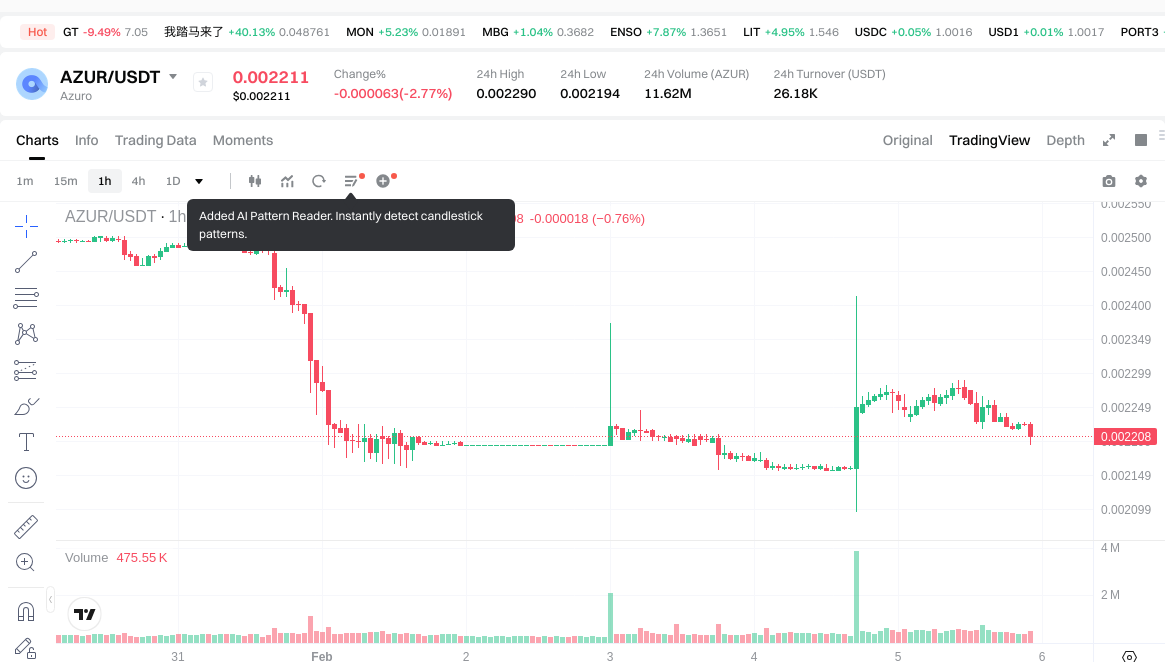
AZUR is a notable asset in the cryptocurrency space, serving as a tooling, oracle and liquidity solution for prediction application ecosystems. As of February 05, 2026, Azuro maintains a market capitalization of approximately $490,266.09, with a circulating supply of around 220,443,390 tokens, and the current price hovering around $0.002224. The project has demonstrated operational traction with over 20 live applications, more than $370 million in trading volume, and 4,500+ liquidity providers. With its positioning as a revenue-generating protocol on Polygon, AZUR has gradually become a focal point for investors discussing "Is Azuro (AZUR) a good investment?" This article will comprehensively analyze Azuro's investment value, historical trends, future price projections and investment risks to provide reference for investors.
I. Azuro (AZUR) Price History Review and Current Investment Value Status
- 2024: Azuro launched on exchanges in June 2024 with an initial offering price of $0.075, experiencing rapid growth in the following weeks
- July 2024: AZUR reached a notable price level of $0.24052 on July 20, 2024, representing a significant appreciation from its launch price, attracting attention from early adopters and liquidity providers
- 2024-2026: The market witnessed substantial volatility, with prices experiencing fluctuations from the mid-2024 peak to a lower range in early 2026, reflecting broader market dynamics and sector-specific trends
Current AZUR Investment Market Status (February 2026)
- AZUR current price: $0.002224
- Market capitalization: approximately $490,266
- 24-hour trading volume: $25,499.15
- Circulating supply: 220,443,390 AZUR (22.04% of total supply)
- Total supply: 1,000,000,000 AZUR
- Number of exchanges listing AZUR: 3
- Token holders: 4,734
Click to view real-time AZUR market price
II. Core Factors Affecting Whether AZUR is a Good Investment (Is Azuro(AZUR) a Good Investment)
Supply Mechanism and Scarcity (AZUR investment scarcity)
- Total Supply and Circulation → Influences Price and Investment Value
- AZUR has a maximum supply of 1,000,000,000 tokens with a current circulating supply of 220,443,390 tokens, representing approximately 22.04% circulation. The limited circulating supply relative to total supply may contribute to price dynamics as market demand fluctuates.
- Investment Significance: The token's supply structure and gradual circulation model are among the factors that market participants consider when evaluating long-term investment potential.
Institutional Investment and Mainstream Adoption (Institutional investment in AZUR)
- Market Participation Trends: As of February 2026, AZUR is held by approximately 4,734 holders and is traded on 3 exchanges, indicating a developing holder base.
- Ecosystem Adoption: Azuro Protocol supports over 20 live prediction applications with a cumulative transaction volume exceeding $370 million and more than 4,500 liquidity providers (LPs). The protocol has been noted as a revenue-generating protocol on Polygon, contributing to its ecosystem presence.
- Adoption Impact: The integration of Azuro's infrastructure by prediction market applications and the active participation of liquidity providers reflect ongoing ecosystem development, which market participants may view as a factor in assessing investment potential.
Macroeconomic Environment's Impact on AZUR Investment
- Market Conditions and Risk Appetite → Changes in broader market sentiment and risk tolerance can influence investor interest in crypto assets including AZUR.
- Economic Uncertainty: During periods of economic uncertainty or shifting monetary policy, participants in the crypto market may adjust their positions, affecting the investment landscape for tokens across various categories.
Technology and Ecosystem Development (Technology & Ecosystem for AZUR investment)
- Infrastructure and Tooling: Azuro provides tooling, oracle solutions, and liquidity infrastructure for prediction applications across multiple chains. This plug-and-play model enables developers to integrate prediction market functionality, supporting ecosystem expansion.
- Revenue and Growth Metrics: The protocol has reported an average monthly revenue of approximately $400,000 over the six months preceding the reference period, with ongoing transaction activity and liquidity provisioning.
- DeFi and Prediction Market Applications: The protocol's focus on prediction markets, liquidity pools, and integration with emerging applications through initiatives like Azuro Launch contributes to its ecosystem utility. The expansion of applications within the ecosystem and the buyback mechanism tied to revenue are among the factors that participants consider when evaluating long-term value.
- Community and Developer Engagement: Azuro has cultivated a community of over 35,000 prediction market users and maintains active engagement across social channels, providing a foundation for ongoing application development and user participation.
III. AZUR Future Investment Forecast and Price Outlook (Is Azuro(AZUR) worth investing in 2026-2030)
Short-term Investment Forecast (2026, short-term AZUR investment outlook)
- Conservative forecast: $0.0018768 - $0.002208
- Neutral forecast: $0.002208 - $0.00229
- Optimistic forecast: $0.00229 - $0.00269376
Mid-term Investment Outlook (2027-2028, mid-term Azuro(AZUR) investment forecast)
- Market stage expectation: Potential entry into growth phase with ecosystem expansion
- Investment return forecast:
- 2027: $0.0014215104 - $0.0036027936
- 2028: $0.00272415312 - $0.003359788848
- Key catalysts: Protocol adoption growth, expansion of prediction application ecosystem, and liquidity pool development
Long-term Investment Outlook (Is AZUR a good long-term investment?)
- Base scenario: $0.00197985395088 - $0.003193312824 (assuming steady protocol development and moderate market conditions)
- Optimistic scenario: $0.003458357788392 - $0.00581987010137 (assuming accelerated adoption and favorable market environment)
- Risk scenario: Below $0.002096 (under extreme market volatility or ecosystem setbacks)
Click to view AZUR long-term investment and price forecast: Price Prediction
2026-02-05 - 2031 Long-term Outlook
- Base scenario: $0.00245088 - $0.00364037661936 (corresponding to steady progress and mainstream application gradual improvement)
- Optimistic scenario: $0.003986212398199 - $0.00581987010137 (corresponding to large-scale adoption and favorable market environment)
- Transformative scenario: Above $0.00581987010137 (if ecosystem achieves breakthrough progress and mainstream adoption)
- 2031-12-31 predicted high: $0.00581987010137 (based on optimistic development assumptions)
Disclaimer: Price forecasts are based on historical data and market analysis models, and actual results may vary significantly due to market volatility, regulatory changes, and other unpredictable factors. This information is for reference only and does not constitute investment advice.
| Year |
Predicted High Price |
Predicted Average Price |
Predicted Low Price |
Price Change |
| 2026 |
0.00269376 |
0.002208 |
0.0018768 |
0 |
| 2027 |
0.0036027936 |
0.00245088 |
0.0014215104 |
10 |
| 2028 |
0.003359788848 |
0.0030268368 |
0.00272415312 |
36 |
| 2029 |
0.00408744041472 |
0.003193312824 |
0.00197985395088 |
43 |
| 2030 |
0.004332048177038 |
0.00364037661936 |
0.003458357788392 |
63 |
| 2031 |
0.00581987010137 |
0.003986212398199 |
0.003188969918559 |
79 |
IV. AZUR Investment Strategy and Risk Management (How to invest in AZUR)
Investment Methodology (AZUR investment strategy)
Long-term Holding (HODL AZUR)
For conservative investors seeking steady exposure, long-term holding may be considered as part of a diversified portfolio. Given AZUR's positioning as infrastructure for prediction markets across multiple chains, investors with extended time horizons might evaluate the protocol's development trajectory, integration with over 20 live applications, and its revenue generation track record on Polygon. However, the token's significant decline of approximately 89.96% over the past year (as of February 5, 2026) underscores the importance of thorough due diligence and awareness of historical volatility patterns.
Active Trading
Active traders may employ technical analysis and swing trading strategies when approaching AZUR. With 24-hour price fluctuations showing movements between $0.002217 and $0.00229, and recent period changes including -1.72% (24H), -10.45% (7D), and -27.1% (30D), volatility characteristics suggest potential opportunities for tactical positioning. Traders should monitor on-chain metrics, protocol revenue trends, and broader prediction market sector developments while maintaining strict risk parameters.
Risk Management (Risk management for AZUR investment)
Asset Allocation Proportion
- Conservative Investors: Limit exposure to 1-3% of total portfolio, prioritizing established assets with proven track records
- Aggressive Investors: May allocate 5-10% to AZUR within a broader DeFi or prediction market thesis, maintaining awareness of concentration risk
- Professional Investors: Institutional participants might consider strategic positioning of 3-7% within specialized prediction market or Polygon ecosystem allocations, with regular rebalancing protocols
Risk Hedging Approach
Implement multi-asset portfolio construction combining correlated and uncorrelated assets. Consider diversification across different blockchain ecosystems, market cap ranges, and crypto categories. Investors may explore derivative instruments where available, though liquidity for AZUR-specific hedging tools may be limited given its market positioning.
Secure Storage
- Cold Storage Solutions: Hardware wallets supporting ERC-20 tokens (contract address: 0x9e6be44cc1236eef7e1f197418592d363bedcd5a on Ethereum) provide enhanced security for long-term holdings
- Hot Wallet Considerations: For active traders, reputable software wallets with multi-signature capabilities offer balance between accessibility and security
- Hardware Wallet Recommendations: Established providers supporting Ethereum-based tokens, with regular firmware updates and backup protocols
V. AZUR Investment Risks and Challenges (Risks of investing in AZUR)
Market Risk
AZUR exhibits substantial price volatility, with historical data showing a decline from an all-time high of $0.24052 (July 20, 2024) to an all-time low of $0.002096 (February 4, 2026). The current market capitalization of approximately $490,266 and relatively limited exchange availability (3 exchanges) suggest lower liquidity compared to established cryptocurrencies, potentially amplifying price swings during periods of market stress. The circulating supply represents 22.04% of maximum supply, indicating potential future dilution considerations.
Regulatory Risk
Prediction market protocols face evolving regulatory frameworks across jurisdictions. Different national authorities maintain varying positions on prediction platforms, with potential classification uncertainties between gaming, betting, and financial instruments. Regulatory developments in key markets where Azuro operates could materially impact protocol adoption, token utility, and market access. Investors should monitor regulatory announcements in regions relevant to Azuro's ecosystem.
Technical Risk
As blockchain infrastructure dependent on smart contract functionality, AZUR faces inherent technical vulnerabilities. Oracle mechanisms critical to prediction market operations introduce potential attack vectors or data reliability concerns. Network security considerations for both Ethereum (primary deployment) and Polygon (where the protocol generates notable revenue) require ongoing monitoring. Protocol upgrades, governance decisions, or integration failures with the 20+ applications in the ecosystem could affect token value and utility.
VI. Conclusion: Is AZUR a Good Investment?
Investment Value Summary
AZUR presents characteristics of an infrastructure play within the prediction market sector, with reported monthly revenue averaging $400,000 over recent months and positioning as a top revenue-generating protocol on Polygon. However, the token has experienced significant price depreciation, declining approximately 89.96% over the past year. The discrepancy between protocol metrics (transaction volume exceeding $370 million, 4,500+ liquidity providers) and token price performance highlights the complex relationship between protocol adoption and token value accrual.
Investor Recommendations
✅ Beginners: Consider dollar-cost averaging with minimal allocations (1-2% of portfolio), prioritizing secure storage solutions. Conduct extensive research on prediction market fundamentals and Azuro's specific value proposition before allocation.
✅ Experienced Investors: May explore swing trading strategies while maintaining strict position sizing and stop-loss protocols. Evaluate protocol revenue metrics, ecosystem growth indicators, and competitive positioning within the prediction market landscape for tactical opportunities.
✅ Institutional Investors: Strategic positioning could be considered within specialized DeFi or prediction market theses, with comprehensive risk assessment frameworks, governance participation evaluation, and regular performance reviews against predefined benchmarks.
⚠️ Disclaimer: Cryptocurrency investments carry substantial risk, including potential complete loss of capital. This content is provided for informational purposes only and does not constitute investment advice, financial counsel, or trading recommendations. Conduct independent research and consult qualified financial advisors before making investment decisions.
VII. FAQ
Q1: Is Azuro (AZUR) a good investment in 2026?
AZUR presents a high-risk investment opportunity with potential returns balanced against significant volatility. The token has demonstrated substantial price decline of approximately 89.96% from its all-time high, dropping from $0.24052 (July 2024) to current levels around $0.002224. However, the protocol shows operational traction with over $370 million in trading volume, 4,500+ liquidity providers, and average monthly revenue of $400,000. Investment suitability depends on individual risk tolerance, portfolio diversification strategy, and investment time horizon. Conservative investors should limit exposure to 1-3% of total portfolio, while more aggressive participants might consider 5-10% allocations within a broader DeFi or prediction market thesis.
Q2: What is the price forecast for AZUR from 2026 to 2031?
Short-term forecasts for 2026 range from $0.0018768 (conservative) to $0.00269376 (optimistic). Mid-term projections suggest 2027 prices between $0.0014215104 and $0.0036027936, with 2028 estimates ranging from $0.00272415312 to $0.003359788848. Long-term outlook through 2031 presents a base scenario of $0.00245088 to $0.00364037661936, an optimistic scenario of $0.003986212398199 to $0.00581987010137, and a potential high of $0.00581987010137 under breakthrough adoption conditions. These forecasts assume continued protocol development, ecosystem expansion, and varying market conditions. However, actual results may differ significantly due to market volatility, regulatory changes, and unpredictable factors inherent to cryptocurrency markets.
Q3: How does AZUR generate value for investors?
AZUR derives its value proposition from serving as infrastructure for the prediction market ecosystem. The protocol provides tooling, oracle solutions, and liquidity infrastructure across multiple chains, supporting over 20 live applications. Revenue generation occurs through protocol fees, with Azuro positioned as a top revenue-generating protocol on Polygon, averaging $400,000 monthly over recent periods. The token's value accrual mechanism includes buyback programs tied to protocol revenue. However, the significant disconnect between strong protocol metrics (4,500+ liquidity providers, $370M+ transaction volume) and declining token price highlights that protocol adoption does not automatically translate to token value appreciation, requiring careful evaluation of tokenomics and value capture mechanisms.
Q4: What are the main risks associated with investing in AZUR?
AZUR investment carries multiple risk dimensions. Market risk includes high volatility, limited liquidity (trading on only 3 exchanges), and relatively small market capitalization of approximately $490,266, which amplifies price swings. Regulatory risk stems from evolving frameworks around prediction markets, with varying jurisdictional approaches that could impact protocol operations and token utility. Technical risk involves smart contract vulnerabilities, oracle mechanism reliability critical to prediction market operations, and potential integration failures with ecosystem applications. Additionally, the circulating supply represents only 22.04% of maximum supply, indicating potential future dilution concerns. Investors face the possibility of complete capital loss and should implement comprehensive risk management strategies.
Q5: How should different investor types approach AZUR investment?
Beginners should adopt an extremely cautious approach, limiting allocations to 1-2% of portfolio value through dollar-cost averaging strategies while prioritizing secure storage solutions such as hardware wallets supporting ERC-20 tokens. Experienced investors may explore active trading strategies utilizing technical analysis, with strict position sizing (3-5% allocation) and stop-loss protocols, while monitoring protocol revenue trends and ecosystem developments. Institutional investors can consider strategic positioning of 3-7% within specialized prediction market or Polygon ecosystem allocations, implementing comprehensive governance participation frameworks and regular performance reviews. All investor categories should maintain diversification across uncorrelated assets, conduct thorough due diligence, and consult qualified financial advisors before investment decisions.
Q6: What factors could drive AZUR price appreciation in the future?
Several catalysts could potentially support AZUR value appreciation. Protocol adoption growth through expansion of the 20+ live applications ecosystem and increased integration by prediction market platforms represents a primary driver. Revenue growth beyond the current $400,000 monthly average, particularly if accompanied by effective token buyback mechanisms, could influence price dynamics. Ecosystem expansion through Azuro Launch initiative supporting new applications and increased liquidity provider participation may enhance utility. Broader prediction market sector growth, favorable regulatory developments in key jurisdictions, and successful technical upgrades improving oracle reliability and smart contract security could provide positive momentum. Additionally, increased exchange listings beyond the current 3 platforms could improve liquidity and accessibility, though historical performance indicates that protocol metrics alone do not guarantee token price appreciation.
Q7: How does AZUR compare to other prediction market protocols?
AZUR positions itself as infrastructure-focused within the prediction market space, emphasizing tooling and liquidity provision rather than direct market operation. With support for over 20 applications, $370M+ trading volume, and positioning as a top revenue-generating protocol on Polygon, Azuro demonstrates operational scale. However, comparative analysis requires evaluation of token value accrual mechanisms, protocol revenue distribution, and ecosystem moat sustainability. The plug-and-play model enabling developers to integrate prediction functionality differentiates Azuro from application-layer competitors. Investors should assess competitive positioning through metrics including protocol fees, liquidity efficiency, developer adoption rates, and token holder value capture relative to alternatives. The 4,734 token holders and limited exchange availability suggest a developing competitive position relative to more established DeFi protocols.
Q8: What storage and security measures should AZUR investors implement?
Security implementation varies by investment approach and holding period. Long-term holders should prioritize cold storage solutions using reputable hardware wallets supporting ERC-20 tokens (contract address: 0x9e6be44cc1236eef7e1f197418592d363bedcd5a on Ethereum). Hardware wallets from established providers with regular firmware updates and backup protocols offer optimal security for significant holdings. Active traders may utilize hot wallet solutions with multi-signature capabilities from reputable providers, balancing accessibility with security. All investors should implement multi-factor authentication, avoid storage of private keys in digital formats, maintain secure backup procedures for recovery phrases, and verify contract addresses before transactions. Given AZUR's relatively small market capitalization and limited liquidity, investors should exercise particular caution regarding exchange security, considering withdrawal to personal wallets for holdings exceeding short-term trading requirements.
* The information is not intended to be and does not constitute financial advice or any other recommendation of any sort offered or endorsed by Gate.