This comprehensive guide evaluates whether Bware (INFRA), the native token of Blast Protocol's decentralized blockchain API infrastructure, represents a sound investment opportunity. The article analyzes INFRA's current market position (trading at $0.06501 with $325,535 market cap as of February 2026), examines historical price performance showing 62.64% annual decline, and explores price predictions ranging from $0.0566-$0.0720 conservatively to $0.0993-$0.1544 optimistically through 2030. The analysis covers core investment factors including token scarcity (5.01% circulating supply), ecosystem development, and technology fundamentals of Blast Protocol's node operator incentive system. Additionally, the guide presents investment strategies for different investor profiles—from dollar-cost averaging for beginners to active trading for experienced investors—alongside comprehensive risk management addressing market volatility, regulatory uncertainty, and technical vulnerabilities. Check real-time INFRA pricing o
Introduction: Bware (INFRA) Investment Position and Market Outlook
INFRA is a significant asset in the cryptocurrency field. As of February 2026, Bware demonstrates a market capitalization of approximately $325,535.17, with a circulating supply of about 5,007,463 tokens, and the current price maintains around $0.06501. With its positioning as a high-end infrastructure and development tools provider in the Web3 ecosystem, as well as the creator of the decentralized blockchain API platform Blast Protocol, INFRA has gradually become a focal point for investors discussing "Is Bware (INFRA) a good investment?" The project's mainnet has been operational since February 2023, allowing participation as node providers and protocol delegators. This article will comprehensively analyze INFRA's investment value, historical trends, future price predictions, and investment risks to provide reference for investors.
I. Bware (INFRA) Price History Review and Current Investment Value
- 2024: On January 24, INFRA reached a notable price level of $2.5433, representing a significant valuation period for early participants in the project.
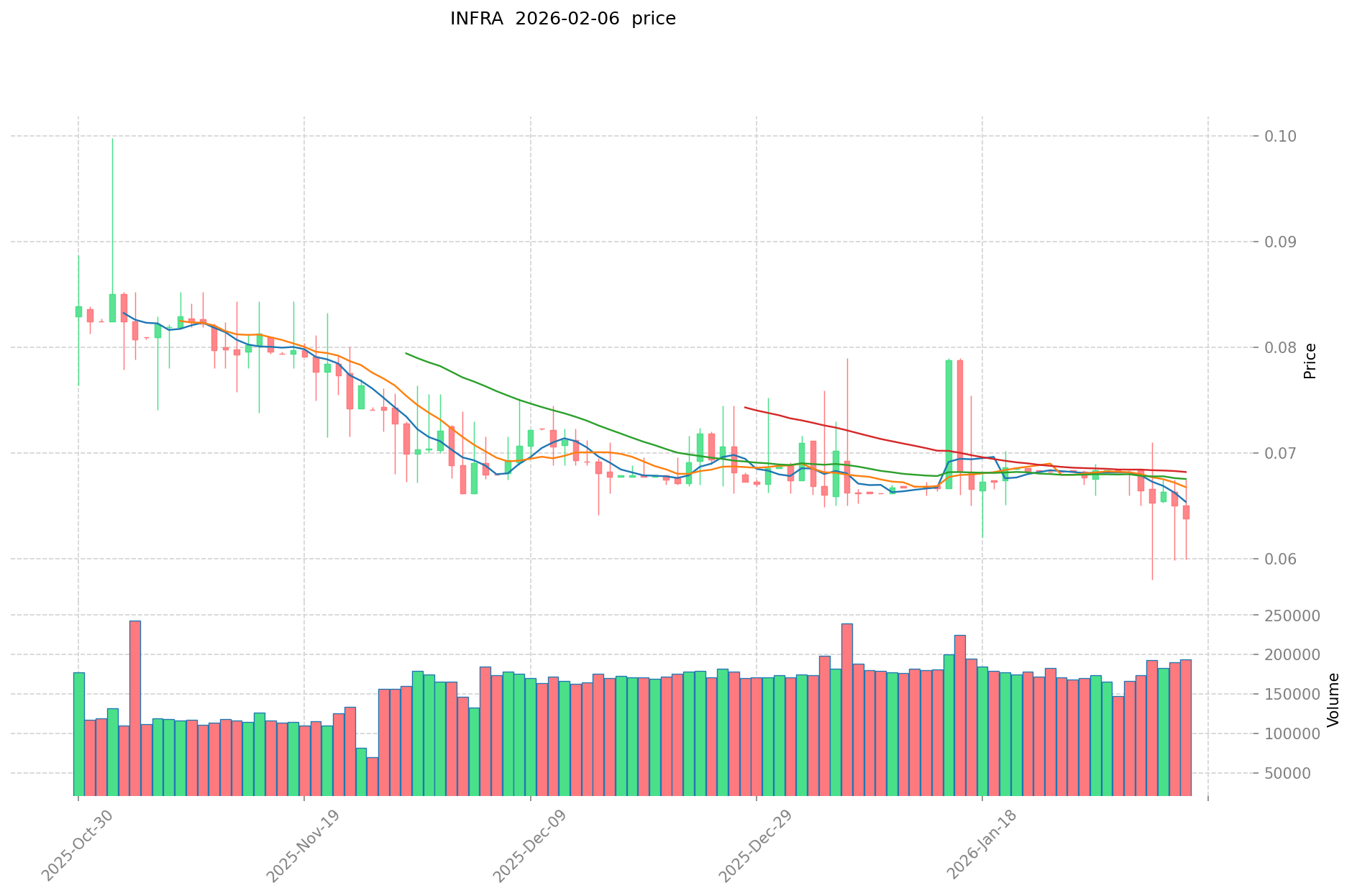
- 2025-2026: Following the broader crypto market cycles, INFRA experienced price adjustments, with the token trading around $0.07428 by the end of 2025 and approximately $0.08381 in February 2026.
- February 2026: The token recorded a new price reference point at $0.057 on February 6, 2026, reflecting ongoing market volatility and adjustment phases in the Web3 infrastructure sector.
Current INFRA Investment Market Status (February 2026)
- Current INFRA Price: $0.06501 (as of February 7, 2026)
- Market Performance (24H): The token has shown a 1.69% increase over the past 24 hours, though it remains down 4.87% over the past 7 days
- 24-Hour Trading Volume: $18,835.29
- Market Capitalization: $325,535.17 with a circulating supply of 5,007,463 INFRA tokens
- Fully Diluted Market Cap: $6,501,000 based on the maximum supply of 100,000,000 tokens
- Market Share: 0.00025% of the total crypto market
- Holder Base: 473 addresses currently hold INFRA tokens
Click to view real-time INFRA market price
II. Core Factors Influencing Whether INFRA is a Good Investment
Supply Mechanism and Scarcity (INFRA Investment Scarcity)
- Total supply capped at 100,000,000 INFRA tokens, with current circulating supply at 5,007,463 tokens (approximately 5.01% of total supply)
- The low circulating supply relative to total supply may contribute to price dynamics as more tokens enter circulation over time
- Investment consideration: The current market cap of approximately $325,535 USD reflects limited market adoption, which presents both risks and potential opportunities for investors
Institutional Investment and Mainstream Adoption (Institutional Investment in INFRA)
- Bware Labs serves as the creator of Blast Protocol, a decentralized blockchain API platform utilized by Web3 companies
- The platform's 2026 roadmap includes plans to enhance node operator incentives and onboard enterprise clients, which may influence adoption rates
- The INFRA token functions in governance and network participant incentivization within the Blast Protocol ecosystem
Macroeconomic Environment Impact on INFRA Investment
- As a Web3 infrastructure token, INFRA's investment attractiveness may be influenced by broader cryptocurrency market conditions and regulatory developments
- Market volatility considerations: INFRA experienced significant price fluctuations, with a 24-hour change of 1.69% and a one-year change of -62.64%
- The token's performance may be affected by investor sentiment toward decentralized infrastructure projects and Web3 adoption trends
Technology and Ecosystem Development (Technology & Ecosystem for INFRA Investment)
- Blast Protocol provides decentralized blockchain API services with a focus on response time performance for Web3 infrastructure
- Planned developments for 2026-2031 include enhanced node operator incentives, new developer tools, expanded API offerings, and improved network uptime targets
- The platform's mainnet has been operational since February 2023, with node providers and protocol delegators able to participate in the network
- The reward mechanism is designed to correlate operator numbers with platform request volume, aiming to provide returns for operators and delegators
III. INFRA Future Investment Forecast and Price Outlook (Is Bware(INFRA) worth investing in 2026-2030)
Short-term Investment Forecast (2026, short-term INFRA investment outlook)
- Conservative forecast: $0.0566 - $0.0720
- Neutral forecast: $0.0650 - $0.0758
- Optimistic forecast: $0.0720 - $0.0865
Mid-term Investment Outlook (2027-2028, mid-term Bware(INFRA) investment forecast)
-
Market phase expectation: INFRA may enter a gradual recovery phase during the mid-term period, with potential growth driven by continued development of the Blast Protocol ecosystem and expansion of node operator participation.
-
Investment return forecast:
- 2027: $0.0719 - $0.0894
- 2028: $0.0520 - $0.1065
-
Key catalysts: Performance-based reward mechanism optimization, increase in platform request volume, and expansion of Web3 infrastructure adoption among major projects.
Long-term Investment Outlook (Is INFRA a good long-term investment?)
- Base scenario: $0.0814 - $0.1154 (assuming steady ecosystem growth and stable node operator network)
- Optimistic scenario: $0.0993 - $0.1544 (assuming significant expansion in Web3 infrastructure demand and enhanced platform adoption)
- Risk scenario: Below $0.0814 (in case of intensified market competition or reduced demand for decentralized API services)
Click to view INFRA long-term investment and price prediction: Price Prediction
2026-02-07 - 2030 Long-term Outlook
- Base scenario: $0.0814 - $0.1153 (corresponding to steady progress and gradual mainstream application growth)
- Optimistic scenario: $0.0992 - $0.1545 (corresponding to large-scale adoption and favorable market conditions)
- Transformative scenario: Above $0.1545 (if ecosystem achieves breakthrough developments and mainstream penetration)
- 2030-12-31 forecast high: $0.1337 (based on optimistic development assumptions)
Disclaimer: Price forecasts are based on historical data analysis and market modeling. Actual market performance may vary significantly due to multiple factors including regulatory changes, technological developments, market sentiment, and macroeconomic conditions. This analysis does not constitute investment advice, and investors should conduct their own due diligence and consider their risk tolerance before making investment decisions.
| Year |
Predicted High Price |
Predicted Average Price |
Predicted Low Price |
Price Change |
| 2026 |
0.0864633 |
0.06501 |
0.0565587 |
0 |
| 2027 |
0.089369247 |
0.07573665 |
0.0719498175 |
16 |
| 2028 |
0.106493303565 |
0.0825529485 |
0.052008357555 |
26 |
| 2029 |
0.099249282334125 |
0.0945231260325 |
0.055768644359175 |
45 |
| 2030 |
0.133702961772971 |
0.096886204183312 |
0.081384411513982 |
49 |
| 2031 |
0.15449474119071 |
0.115294582978141 |
0.084165045574043 |
77 |
IV. INFRA Investment Strategy and Risk Management (How to invest in blockchain infrastructure tokens)
Investment Methodology (INFRA investment strategy)
-
Long-term Holding (HODL INFRA): Suitable for conservative investors
Long-term holding strategies focus on the fundamental value proposition of Bware Labs' decentralized API infrastructure. The Blast Protocol's mainnet has been operational since February 2023, allowing participation as node providers and protocol delegators. This approach benefits from the platform's performance-based reward mechanism and its positioning in the Web3 infrastructure sector.
-
Active Trading: Relying on technical analysis and swing operations
Active traders may consider INFRA's price volatility characteristics. Recent data shows 24-hour price fluctuations with a high of 0.0659 and a low of 0.057. The token has demonstrated various percentage changes across different timeframes: 1.69% over 24 hours, -4.87% over 7 days, and -1.93% over 30 days. Technical traders should monitor these patterns alongside trading volume of approximately 18,835 USDT.
Risk Management (Risk management for INFRA investment)
-
Asset Allocation Ratio: Conservative / Aggressive / Professional investors
Given INFRA's market capitalization of approximately 325,535 USDT and a circulating supply representing 5.01% of total supply (5,007,463 tokens out of 100,000,000 max supply), investors should consider position sizing carefully. The token's market share stands at 0.00025%, indicating its status as a smaller-cap asset within the broader crypto ecosystem.
-
Risk Hedging Solutions: Multi-asset portfolio + hedging instruments
Diversification across different blockchain infrastructure projects and mainstream cryptocurrencies can help mitigate concentration risk. Consider including assets from various sectors to balance exposure to the Web3 infrastructure segment.
-
Secure Storage: Hot and cold wallets + hardware wallet recommendations
INFRA tokens are deployed on multiple chains, with contract addresses on Ethereum (ETH) and Avalanche C-Chain (AVAX_C). Investors should utilize hardware wallets compatible with these networks for long-term storage. For active trading positions, reputable exchange wallets with strong security measures may be appropriate, while larger holdings should be transferred to cold storage solutions.
V. INFRA Investment Risks and Challenges (Risks of investing in blockchain infrastructure tokens)
-
Market Risk: High volatility, price manipulation
INFRA has experienced significant price movement, with a historical high of 2.5433 (recorded on January 24, 2024) and a historical low of 0.057 (recorded on February 6, 2026). The one-year performance shows a decline of 62.64%, demonstrating substantial volatility. With a relatively low 24-hour trading volume and a holder count of 473, the token may be susceptible to lower liquidity conditions.
-
Regulatory Risk: Policy uncertainty across different jurisdictions
As blockchain infrastructure services operate globally, regulatory developments affecting API services, node operations, or decentralized networks could impact Bware Labs' operations and INFRA token utility. Different jurisdictions maintain varying approaches to crypto infrastructure regulation, creating potential compliance challenges.
-
Technical Risk: Network security vulnerabilities, upgrade failures
As a provider of blockchain API infrastructure, the project's success depends on maintaining high-performance, secure services. Technical challenges could include network downtime, security breaches affecting node providers, or difficulties in protocol upgrades. The platform's multi-chain presence (Ethereum and Avalanche) also introduces cross-chain operational complexities.
VI. Conclusion: Is blockchain infrastructure token a Good Investment?
-
Investment Value Summary: INFRA represents exposure to the Web3 infrastructure sector through Bware Labs' Blast Protocol platform, which has been operational since February 2023. The project focuses on providing decentralized blockchain API services with performance-based incentives for node operators. However, the token has experienced notable price fluctuations and currently trades significantly below its historical peak.
-
Investor Recommendations:
✅ Beginners: Dollar-cost averaging (DCA) strategy + secure wallet storage using hardware wallets compatible with Ethereum or Avalanche networks
✅ Experienced Investors: Swing trading strategies considering the token's volatility patterns + portfolio allocation as part of a broader Web3 infrastructure basket
✅ Institutional Investors: Strategic long-term allocation based on thorough due diligence of Bware Labs' technology, partnerships, and adoption metrics
⚠️ Disclaimer: Cryptocurrency investments carry high risk. This content is for informational purposes only and does not constitute investment advice. Investors should conduct their own research and consider their risk tolerance before making investment decisions.
VII. FAQ
Q1: What is INFRA and how does it function as a blockchain infrastructure investment?
INFRA is the native token of Blast Protocol, a decentralized blockchain API platform created by Bware Labs that provides Web3 infrastructure services. The token serves dual purposes: governance participation within the protocol and incentivization for network participants including node providers and delegators. Operating since February 2023, the platform utilizes a performance-based reward mechanism that correlates operator compensation with platform request volume. With a maximum supply of 100 million tokens and only 5.01% currently in circulation (approximately 5,007,463 tokens), INFRA represents investment exposure to the decentralized API services sector within the broader Web3 infrastructure landscape.
Q2: How has INFRA performed historically and what is its current market position?
INFRA reached its peak price of $2.5433 on January 24, 2024, but has since experienced significant decline, currently trading around $0.06501 as of February 7, 2026—representing a one-year decrease of 62.64%. The token maintains a relatively modest market capitalization of approximately $325,535 with 24-hour trading volume around $18,835. With 473 token holders and a market share of 0.00025%, INFRA remains a smaller-cap asset within the cryptocurrency ecosystem. Recent short-term performance shows mixed results: +1.69% over 24 hours but -4.87% over the past week, reflecting ongoing volatility characteristic of infrastructure tokens in the current market environment.
Q3: What are the price predictions for INFRA from 2026 to 2030?
Short-term forecasts for 2026 suggest a conservative range of $0.0566-$0.0720 and an optimistic range of $0.0720-$0.0865. Mid-term projections indicate potential recovery phases, with 2027 estimates ranging from $0.0719-$0.0894 and 2028 forecasts spanning $0.0520-$0.1065. For the long-term outlook through 2030, base scenario predictions range from $0.0814-$0.1154, while optimistic scenarios suggest $0.0993-$0.1544, contingent upon significant expansion in Web3 infrastructure demand. The 2030 year-end forecast high stands at $0.1337 under favorable development assumptions. However, these predictions are subject to substantial uncertainty based on market conditions, adoption rates, and competitive dynamics in the decentralized infrastructure sector.
Q4: What are the primary risks associated with investing in INFRA?
INFRA investment carries several significant risks: (I) Market risk—substantial volatility evidenced by the 62.64% annual decline and the large gap between historical high ($2.5433) and current low ($0.057), combined with relatively thin liquidity and a limited holder base of 473 addresses; (II) Regulatory risk—uncertainty surrounding policies affecting decentralized API services, node operations, and cross-jurisdictional compliance requirements; (III) Technical risk—potential network security vulnerabilities, operational challenges maintaining high-performance infrastructure services, and complexities arising from multi-chain deployment on Ethereum and Avalanche networks. Additionally, the low circulating supply (5.01% of total) creates potential dilution risk as more tokens enter circulation over time.
Q5: What investment strategies are recommended for different types of INFRA investors?
For beginners, a dollar-cost averaging (DCA) strategy is recommended to mitigate timing risk, combined with secure storage using hardware wallets compatible with Ethereum or Avalanche networks for long-term holdings. Experienced investors may consider active trading strategies leveraging INFRA's volatility patterns—24-hour fluctuations between $0.057-$0.0659—while maintaining diversified portfolio allocation within a broader Web3 infrastructure basket. Institutional investors should pursue strategic long-term allocation following comprehensive due diligence of Bware Labs' technology roadmap, partnership developments, and adoption metrics among enterprise clients. Regardless of experience level, position sizing should account for INFRA's small market capitalization ($325,535) and the project's relatively early stage, allocating only capital that investors can afford to lose.
Q6: How does the Blast Protocol ecosystem influence INFRA's investment value?
The Blast Protocol ecosystem directly impacts INFRA's utility and investment proposition through several mechanisms: (I) Node operator participation—the platform's performance-based reward system creates economic incentives that correlate with platform request volume, potentially driving demand for token staking; (II) Governance functionality—INFRA holders participate in protocol decision-making, providing utility beyond speculative trading; (III) Development roadmap—planned enhancements for 2026-2031 including improved node operator incentives, expanded API offerings, new developer tools, and enhanced network uptime targets may strengthen the platform's competitive position. The ecosystem's maturity since its February 2023 mainnet launch provides operational track record, though actual adoption and request volume growth remain critical factors determining whether these developments translate into sustained token value appreciation.
Q7: What factors should investors monitor when evaluating INFRA's future investment potential?
Investors should track several key indicators: (I) Adoption metrics—growth in Web3 companies utilizing Blast Protocol services, expansion in platform request volume, and increase in active node operators; (II) Market dynamics—trading volume trends, changes in holder distribution beyond the current 473 addresses, and improvements in liquidity conditions; (III) Competitive landscape—developments among rival decentralized API infrastructure projects and market share evolution within the Web3 infrastructure sector; (IV) Token economics—circulation schedule for the remaining 94.99% of tokens, staking participation rates, and implementation of the performance-based reward mechanism; (V) Partnership developments—successful onboarding of enterprise clients as outlined in the 2026 roadmap. Additionally, broader macroeconomic conditions affecting cryptocurrency markets and regulatory clarity around decentralized infrastructure services will significantly influence INFRA's investment trajectory through 2030.
* The information is not intended to be and does not constitute financial advice or any other recommendation of any sort offered or endorsed by Gate.