Is DarwiniaRing (RING) a good investment?: A Comprehensive Analysis of Price Potential, Market Fundamentals, and Risk Factors for 2024


Introduction: DarwiniaRing (RING) Investment Position and Market Outlook
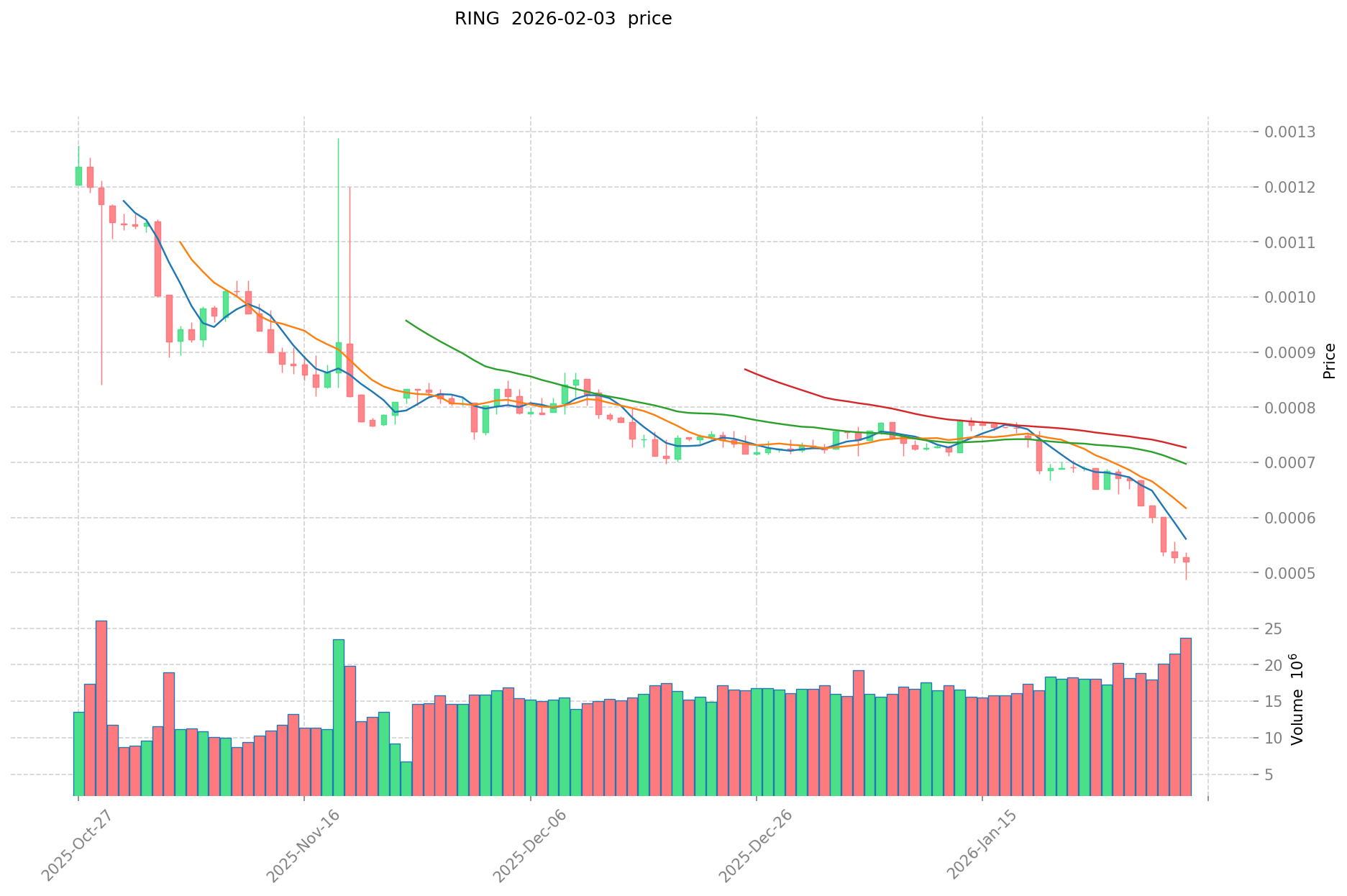
RING is the native asset of Darwinia Network, serving as the gas for transactions including on-chain transaction fees, contract execution fees, and cross-chain service fees. As of February 4, 2026, RING is trading at approximately $0.0004984 with a market capitalization of $850,200.86 and a circulating supply of 1,705,860,464 tokens. The asset ranks 2632 in the cryptocurrency market with a market dominance of 0.000039%. Developed on Substrate, Darwinia Network functions as a cross-chain bridge network connecting Polkadot parachain ecosystem with external heterogeneous chains, featuring full EVM compatibility and focusing on areas including NFT auction markets, stablecoin cross-chain operations, and asset exchange. RING holders can participate in staking to gain influence for governance participation and revenue generation. With its positioning in cross-chain infrastructure, RING has become a subject of interest among investors exploring opportunities in blockchain interoperability. This article provides an analysis of RING's investment characteristics, historical price performance, future price considerations, and associated risks for investor reference.
I. Price History Review and Current Investment Value of RING
Historical Price Trends and Investment Returns of RING (DarwiniaRing (RING) Investment Performance)
- 2021: On March 14, RING reached a notable price level of $0.30361 → Early investors experienced significant returns during this period
- 2023-2025: The token underwent price fluctuations → Market performance reflected broader cross-chain protocol sector trends
- 2026: Price declined from early 2021 levels to $0.00049197 recorded on February 2
Current RING Investment Market Status (February 2026)
- Current RING price: $0.0004984
- 24-hour trading volume: $12,756.74
- Market capitalization: $850,200.86
- Circulating supply: 1,705,860,464 RING (81.24% of total supply)
Click to view real-time RING market price
II. Core Factors Affecting Whether RING is a Good Investment
Supply Mechanism and Scarcity (RING Investment Scarcity)
- Total Supply Cap: RING has a maximum supply of approximately 2.1 billion tokens, with a circulating supply of 1.71 billion tokens (81.24% circulation ratio), creating a defined scarcity model that influences long-term investment considerations.
- Supply Distribution Impact: With 18.96% of tokens yet to enter circulation, potential future supply dilution represents a factor investors should monitor when evaluating scarcity-based value propositions.
- Investment Implications: The defined maximum supply provides a framework for understanding potential scarcity dynamics, though current high circulation ratios suggest limited immediate scarcity pressure compared to assets with lower circulation percentages.
Institutional Investment and Mainstream Adoption (Institutional Investment in RING)
- Adoption Uncertainty: As a cross-chain bridging infrastructure connecting Polkadot parachain ecosystems with external heterogeneous blockchains, RING faces competition from established cross-chain solutions, creating uncertainty around mainstream adoption rates.
- Network Utilization: The asset serves as gas for on-chain transactions, contract execution fees, and cross-chain service fees within the Darwinia Network, with adoption dependent on the network's ability to attract developers and applications.
- Market Position: With a market capitalization of approximately $850,200 and market dominance of 0.000039%, RING remains a relatively small-cap asset with limited institutional visibility as of February 2026.
Macroeconomic Environment's Impact on RING Investment
- Cryptocurrency Market Conditions: RING's performance correlates with broader digital asset market trends, with recent price declines of 71.61% over one year reflecting challenging market conditions for smaller-cap tokens.
- Risk Asset Sentiment: As a specialized cross-chain infrastructure token, RING's investment appeal varies with investor appetite for higher-risk, utility-focused digital assets versus established cryptocurrencies.
- Liquidity Considerations: Limited 24-hour trading volume of $12,756.74 creates execution challenges for larger positions, making RING more sensitive to market microstructure changes than more liquid assets.
Technology and Ecosystem Development (Technology & Ecosystem for RING Investment)
- Substrate-Based Architecture: Built on Substrate framework with full EVM compatibility, Darwinia Network provides technical infrastructure for cross-chain applications, though adoption remains a key determinant of investment value.
- Focus Areas: The network emphasizes non-standard asset NFT auction markets, stablecoin cross-chain solutions, and asset exchange services, targeting specific use cases within the broader blockchain ecosystem.
- Staking Mechanism: RING holders can participate in staking to gain influence in governance decisions and earn rewards, providing utility beyond simple price speculation for long-term holders.
- Cross-Chain Infrastructure Risks: As a bridging protocol, RING faces technical risks inherent to cross-chain solutions, including smart contract vulnerabilities and the challenges of maintaining security across multiple blockchain networks.
III. RING Future Investment Forecast and Price Outlook (Is DarwiniaRing(RING) worth investing in 2026-2031)
Short-term Investment Forecast (2026, short-term RING investment outlook)
- Conservative Forecast: $0.000402813 - $0.0004973
- Neutral Forecast: $0.0004973 - $0.000598
- Optimistic Forecast: $0.000598 - $0.000711139
Mid-term Investment Outlook (2027-2029, mid-term DarwiniaRing(RING) investment forecast)
-
Market Stage Expectation: RING may experience gradual recovery patterns with moderate volatility as the cross-chain infrastructure sector continues development. The token's utility in gas fees and staking mechanisms could influence its mid-term trajectory.
-
Investment Return Forecast:
- 2027: $0.000453164625 - $0.00067672584
- 2028: $0.0003714741486 - $0.0007237341171
- 2029: $0.00048429340942 - $0.000709387529292
-
Key Catalysts: Cross-chain bridge adoption, Substrate ecosystem development, NFT marketplace activity, staking participation rates, and EVM compatibility enhancements.
Long-term Investment Outlook (Is RING a good long-term investment?)
- Base Scenario: $0.000487021822994 - $0.000695745461421 (assuming steady development of Darwinia Network infrastructure and moderate cross-chain activity)
- Optimistic Scenario: $0.000714982823429 - $0.000841852008319 (assuming increased adoption of cross-chain solutions and expansion of Polkadot parachain ecosystem)
- Risk Scenario: Below $0.0004 (under conditions of reduced cross-chain demand or intensified market competition)
Click to view RING long-term investment and price forecast: Price Prediction
2026-02-04 - 2031 Long-term Outlook
- Base Scenario: $0.000487021822994 - $0.000695745461421 (corresponding to steady progress and gradual mainstream application improvement)
- Optimistic Scenario: $0.000714982823429 - $0.000841852008319 (corresponding to large-scale adoption and favorable market conditions)
- Transformative Scenario: Above $0.000841852008319 (if ecosystem achieves breakthrough progress and mainstream penetration)
- 2031-12-31 Predicted High: $0.000822614646311 (based on optimistic development assumptions)
Disclaimer: The above predictions are based on historical data analysis and market modeling. Cryptocurrency markets are highly volatile and unpredictable. These forecasts should not be construed as investment advice. Past performance does not guarantee future results. Investors should conduct their own research and consider their risk tolerance before making any investment decisions.
| Year | Predicted High Price | Predicted Average Price | Predicted Low Price | Price Change |
|---|---|---|---|---|
| 2026 | 0.000711139 | 0.0004973 | 0.000402813 | 0 |
| 2027 | 0.00067672584 | 0.0006042195 | 0.000453164625 | 21 |
| 2028 | 0.0007237341171 | 0.00064047267 | 0.0003714741486 | 28 |
| 2029 | 0.000709387529292 | 0.00068210339355 | 0.00048429340942 | 36 |
| 2030 | 0.000841852008319 | 0.000695745461421 | 0.000487021822994 | 39 |
| 2031 | 0.000822614646311 | 0.00076879873487 | 0.000714982823429 | 54 |
IV. RING Investment Strategy and Risk Management (How to invest in cryptocurrency)
Investment Methodology (RING investment strategy)
Long-term Holding (HODL RING)
For conservative investors seeking exposure to cross-chain infrastructure, RING may represent a long-term strategic position. The token's utility within the Darwinia Network ecosystem—including governance participation, staking rewards, and gas fee payments—provides fundamental value drivers beyond pure speculation. Investors adopting this approach typically focus on the project's development milestones, ecosystem expansion, and adoption metrics rather than short-term price movements.
Key considerations for long-term holders include monitoring the growth of Darwinia Network's cross-chain bridging activities, integration progress with Polkadot parachain ecosystem, and expansion of NFT marketplace and DeFi applications built on the network. The circulating supply ratio of approximately 81.24% suggests relatively limited future dilution compared to projects with lower circulation rates.
Active Trading
Active traders may approach RING through technical analysis and swing trading strategies, capitalizing on the asset's price volatility. With 24-hour trading volume of $12,756.74 and price fluctuations ranging from $0.0004925 to $0.0005203 within the past day, the token presents opportunities for short-term position management.
Technical traders should note the recent price trends: +0.30% over 1 hour, -4.42% over 24 hours, -24.56% over 7 days, -32.64% over 30 days, and -71.61% over 1 year. These metrics indicate significant downward pressure across multiple timeframes, requiring careful risk assessment and stop-loss implementation.
Risk Management (Risk management for RING investment)
Asset Allocation Ratios
Conservative Investors: Given RING's market capitalization of approximately $850,200 and ranking around #2632, conservative portfolios might allocate 0.5-2% to speculative cross-chain infrastructure tokens like RING, maintaining the majority of holdings in established digital assets.
Aggressive Investors: Those with higher risk tolerance and conviction in cross-chain technology adoption might allocate 5-10% to mid-cap infrastructure projects, while maintaining diversification across multiple blockchain ecosystems.
Professional Investors: Institutional or professional investors may take strategic positions based on technical due diligence of Darwinia Network's technology stack, partnership developments, and competitive positioning within the Substrate/Polkadot ecosystem.
Risk Hedging Solutions
Diversification remains the primary risk management tool for RING investors. A balanced portfolio approach might include:
- Core holdings in established cryptocurrencies (40-60%)
- Exposure to multiple cross-chain and interoperability projects (15-25%)
- DeFi protocol tokens (10-20%)
- NFT infrastructure and specialized blockchain projects (5-15%)
Investors should consider the correlation between RING and broader market movements, particularly given its connection to the Polkadot ecosystem. Market downturns affecting major cryptocurrencies typically cascade to smaller-cap assets with amplified volatility.
Secure Storage
Cold and Hot Wallet Solutions: For RING token storage, investors should utilize a combination of hot wallets for active trading and cold storage for long-term holdings. Given the token's ERC-20 contract address (0x9469d013805bffb7d3debe5e7839237e535ec483 on Ethereum), RING is compatible with standard Ethereum wallets.
Hardware Wallet Recommendations: Hardware wallets supporting ERC-20 tokens provide enhanced security for RING storage. Investors should verify contract address authenticity through official channels before any transaction to prevent phishing attacks or fraudulent token interactions.
V. RING Investment Risks and Challenges (Risks of investing in cryptocurrency)
Market Risk
RING exhibits substantial price volatility characteristic of mid-to-lower market cap digital assets. The token's 24-hour price fluctuation range and multi-week downward trends demonstrate the heightened market risk profile. Price discovery in assets with relatively limited liquidity (approximately $12,756 in 24-hour volume) can result in significant slippage during larger transactions.
The token's all-time high of $0.30361 on March 14, 2021, compared to its current price of approximately $0.0004984, represents a decline exceeding 99%, illustrating the extreme volatility potential in cryptocurrency markets. While the all-time low of $0.00049197 was recently recorded on February 2, 2026, suggesting current prices near historical lows, past performance does not guarantee future recovery.
Regulatory Risk
Cross-chain bridge networks and interoperability protocols face evolving regulatory scrutiny across jurisdictions. Regulatory approaches to blockchain infrastructure, especially projects facilitating asset transfers across networks, vary significantly:
- Jurisdictions may classify cross-chain tokens differently regarding securities regulations
- Tax treatment of staking rewards and governance participation remains inconsistent globally
- Compliance requirements for cross-chain bridges continue to develop as authorities assess systemic risks
Investors should monitor regulatory developments in their jurisdiction and consider the potential impact of policy changes on cross-chain infrastructure projects.
Technical Risk
As a Substrate-based network focused on cross-chain bridging, Darwinia Network faces several technical risk categories:
Network Security Vulnerabilities: Cross-chain bridges represent complex technical infrastructure with multiple potential attack vectors. Historical incidents in the broader DeFi ecosystem have demonstrated vulnerabilities in bridge protocols, resulting in significant asset losses.
Upgrade and Development Risks: The project's technical roadmap, including EVM compatibility maintenance, Polkadot parachain integration, and cross-chain functionality expansion, involves execution risks. Development delays, technical challenges, or failed upgrades could impact network adoption and token utility.
Interoperability Challenges: Darwinia Network's value proposition depends on effective bridging between Polkadot parachain ecosystem and external heterogeneous chains. Technical difficulties in maintaining secure, efficient cross-chain connections could limit ecosystem growth.
VI. Conclusion: Is Cryptocurrency a Good Investment?
Investment Value Summary
RING represents a specialized position within the cross-chain infrastructure sector, offering exposure to the Substrate/Polkadot ecosystem and interoperability technology development. The token's utility within Darwinia Network—including governance rights, staking mechanisms, and gas fee functionality—provides fundamental use cases beyond pure speculation.
However, several factors warrant careful consideration: the token's current price remains near historical lows with significant distance from all-time highs, trading volume is relatively modest at approximately $12,757 daily, and market capitalization of around $850,200 positions it as a smaller-cap asset with corresponding liquidity constraints.
The project's focus on NFT marketplace infrastructure, stablecoin cross-chain capabilities, and asset exchange functionality aligns with developing trends in blockchain interoperability, though execution risk and competitive dynamics remain significant factors.
Investor Recommendations
✅ Beginners: New investors interested in RING should approach with caution given the asset's volatility and specialized nature. Consider dollar-cost averaging strategies with small position sizes (0.5-2% of total portfolio) rather than lump-sum investments. Prioritize secure storage using verified wallet solutions and thoroughly research the Darwinia Network ecosystem before committing capital.
✅ Experienced Investors: Those with established cryptocurrency portfolios and understanding of cross-chain technology might consider RING as a tactical allocation within a broader interoperability thesis. Swing trading strategies based on technical analysis could be appropriate given recent price trends, though position sizing should reflect the asset's liquidity profile and volatility characteristics.
✅ Institutional Investors: Professional investors conducting technical due diligence on Substrate-based infrastructure projects may evaluate RING as part of a strategic Polkadot ecosystem allocation. Institutional positions would benefit from direct engagement with the development team, comprehensive smart contract audits review, and assessment of competitive positioning relative to alternative cross-chain solutions.
⚠️ Disclaimer: Cryptocurrency investments carry substantial risk, including potential total loss of capital. This analysis is provided for informational purposes only and does not constitute financial, investment, or trading advice. Investors should conduct independent research, consider their risk tolerance and investment objectives, and consult qualified financial advisors before making investment decisions.
VII. FAQ
Q1: What is RING and what purpose does it serve in the Darwinia Network ecosystem?
RING is the native utility token of Darwinia Network, a Substrate-based cross-chain bridge protocol connecting Polkadot parachain ecosystem with external heterogeneous blockchains. The token serves multiple core functions: it operates as the gas currency for all on-chain transactions including transaction fees, smart contract execution costs, and cross-chain service fees. Additionally, RING holders can participate in network governance through staking mechanisms, earning rewards while influencing protocol decisions. The network focuses on specialized applications including NFT auction markets, stablecoin cross-chain operations, and asset exchange services, with full EVM compatibility enabling developers to deploy Ethereum-compatible applications on the Darwinia infrastructure.
Q2: How has RING's price performed historically and what is its current market position?
RING reached its all-time high of $0.30361 on March 14, 2021, representing the peak of early investor returns during the 2021 cryptocurrency bull market. Since then, the token has experienced significant price decline, with its all-time low of $0.00049197 recorded on February 2, 2026. As of February 4, 2026, RING trades at approximately $0.0004984 with a market capitalization of $850,200.86 and 24-hour trading volume of $12,756.74. The token ranks #2632 in the cryptocurrency market with 0.000039% market dominance, positioning it as a smaller-cap asset with limited liquidity compared to established cryptocurrencies. The circulating supply stands at 1,705,860,464 tokens, representing 81.24% of the maximum supply of approximately 2.1 billion tokens.
Q3: What are the primary risk factors investors should consider when evaluating RING?
RING presents multiple risk categories that investors must carefully assess. Market risk is substantial, evidenced by the token's 99%+ decline from all-time highs and limited liquidity with approximately $12,757 in daily trading volume, which can result in significant price slippage. Technical risks include vulnerabilities inherent to cross-chain bridge protocols, as historical incidents in the DeFi ecosystem have demonstrated security challenges in bridge infrastructure. Regulatory uncertainty affects cross-chain protocols differently across jurisdictions, with evolving frameworks for blockchain interoperability and potential securities classification issues. Competitive dynamics pose adoption risks, as Darwinia Network competes with established cross-chain solutions for developer attention and network utilization. Additionally, execution risk exists regarding the project's technical roadmap, including maintaining EVM compatibility and expanding cross-chain functionality.
Q4: What investment strategies are appropriate for different investor profiles interested in RING?
For conservative investors, RING represents a speculative allocation requiring limited position sizing (0.5-2% of total portfolio) focused on long-term ecosystem development rather than short-term gains. Dollar-cost averaging strategies may mitigate volatility risk while building exposure gradually. Experienced traders might employ swing trading approaches based on technical analysis, capitalizing on the token's price volatility while implementing strict stop-loss protocols given recent downward trends (-71.61% over one year). Institutional investors should conduct comprehensive technical due diligence, including smart contract security audits, competitive positioning analysis within the Substrate/Polkadot ecosystem, and direct engagement with the development team. All investor categories should prioritize secure storage using hardware wallets supporting ERC-20 tokens (RING's contract address: 0x9469d013805bffb7d3debe5e7839237e535ec483) and maintain diversification across multiple blockchain infrastructure projects.
Q5: What are the price forecasts for RING through 2031 and what factors could influence these projections?
Price forecasts for RING through 2031 span a wide range reflecting significant uncertainty. Short-term (2026) predictions range from $0.000402813 (conservative) to $0.000711139 (optimistic). Mid-term projections show potential gradual recovery: 2027 ($0.000453164625-$0.00067672584), 2028 ($0.0003714741486-$0.0007237341171), and 2029 ($0.00048429340942-$0.000709387529292). By 2031, the predicted high reaches $0.000822614646311 under optimistic development assumptions. Key catalysts influencing these projections include cross-chain bridge adoption rates, Substrate ecosystem expansion, NFT marketplace activity, staking participation levels, and broader cryptocurrency market conditions. However, investors should recognize these forecasts are speculative models based on historical data analysis and do not account for unforeseen market disruptions, regulatory changes, or technical challenges. Past performance does not guarantee future results, and cryptocurrency markets exhibit high volatility and unpredictability.
Q6: How does RING's tokenomics structure affect its investment potential?
RING's tokenomics features a maximum supply cap of approximately 2.1 billion tokens, with 1.71 billion currently in circulation (81.24%), creating a defined scarcity model. The relatively high circulation ratio (compared to projects with lower percentages) suggests limited immediate scarcity pressure, though the remaining 18.96% of uncirculated tokens represents potential future supply dilution that investors should monitor. The token's utility extends beyond speculative trading through its governance mechanisms—RING holders can stake tokens to gain influence in protocol decisions and earn rewards, providing long-term value capture mechanisms. This staking functionality creates potential demand pressure as participants lock tokens for governance participation, though adoption rates remain dependent on network utilization growth. The token's role as mandatory gas for all on-chain transactions, contract executions, and cross-chain services theoretically creates organic demand proportional to network activity, making Darwinia Network's ability to attract developers and applications critical to RING's fundamental value proposition.
Q7: What makes Darwinia Network's technology distinctive and how does this affect RING's competitive position?
Darwinia Network distinguishes itself through its Substrate-based architecture combined with full EVM compatibility, enabling seamless deployment of Ethereum-compatible applications while benefiting from Substrate framework's modularity and upgradeability. This technical approach positions the network as a bridge between Polkadot's parachain ecosystem and external heterogeneous blockchains, targeting specific use cases including non-standard asset NFT auction markets, stablecoin cross-chain solutions, and decentralized asset exchange services. However, competitive pressures from established cross-chain protocols create adoption challenges—investors must assess whether Darwinia Network's technical capabilities and specialized focus provide sufficient differentiation to capture market share. The project's success depends on attracting developers to build applications utilizing its cross-chain infrastructure, growing transaction volume to generate sustainable gas fee revenue, and establishing security reputation critical for users trusting the protocol with cross-chain asset transfers. As of February 2026, limited market capitalization and trading volume suggest the network remains in early adoption phases, with investment outcomes heavily dependent on execution of technical roadmap and broader acceptance of Substrate-based interoperability solutions.
Q8: Is RING suitable as a long-term investment and what time horizon should investors consider?
RING's suitability as a long-term investment depends heavily on investor risk tolerance, portfolio diversification strategy, and conviction regarding cross-chain infrastructure adoption. The token's current price near all-time lows (approximately $0.0004984 versus $0.30361 peak) might appear attractive to value-oriented investors, though price declines of this magnitude reflect fundamental questions about demand for the network's services. Long-term holders (3-5+ year horizons) should focus on development milestones including growth in cross-chain bridging activities, integration progress within the Polkadot ecosystem, expansion of NFT marketplace and DeFi applications, and increases in staking participation rates. The relatively high circulating supply ratio (81.24%) limits future dilution concerns compared to projects with lower circulation percentages. However, investors must recognize that long-term success requires Darwinia Network to overcome significant competitive challenges, maintain technical security across complex cross-chain operations, and achieve meaningful adoption amid alternative interoperability solutions. Conservative long-term allocations should remain limited (0.5-2% of total portfolio) with regular reassessment based on ecosystem development progress and market position evolution.
Share
Content
Introduction: DarwiniaRing (RING) Investment Position and Market Outlook
I. Price History Review and Current Investment Value of RING
II. Core Factors Affecting Whether RING is a Good Investment
III. RING Future Investment Forecast and Price Outlook (Is DarwiniaRing(RING) worth investing in 2026-2031)
IV. RING Investment Strategy and Risk Management (How to invest in cryptocurrency)
V. RING Investment Risks and Challenges (Risks of investing in cryptocurrency)
VI. Conclusion: Is Cryptocurrency a Good Investment?
VII. FAQ
How to Buy Cryptocurrency


Trending Cryptocurrencies



What will be the market capitalization of USDC in 2025? Analysis of the stablecoin market landscape.

How is DeFi different from Bitcoin?
What is DeFi: Understanding Decentralized Finance in 2025
USDC stablecoin 2025 Latest Analysis: Principles, Advantages, and Web3 Eco-Applications

Development of Decentralized Finance Ecosystem in 2025: Integration of Decentralized Finance Applications with Web3

2025 USDT USD Complete Guide: A Must-Read for Newbie Investors
Who Is Vitalik Buterin? An In-Depth Look at the Co-Founder of Ethereum

What is Demand Supply Zone and How to Use It in Trading

Trading Indicators: What They Are and How They Work
How to Get Started with DeFi Investing and Key Strategies for Maximizing Returns
NFT Minting: What Is It and How Much Does It Cost to Mint Tokens