This comprehensive analysis evaluates whether DRAC, a BRC-20 meme token, represents a sound investment opportunity. The article examines DRAC's current market position with a $522,369 market cap and $0.00489 price point, reviewing its price history from launch in 2023 through February 2026. Key sections address core investment factors including supply mechanisms, institutional adoption, macroeconomic impacts, and ecosystem development. The analysis provides detailed price forecasts ranging from conservative to optimistic scenarios through 2031, alongside practical investment strategies for different investor profiles. Critical risk assessment covers market volatility, regulatory uncertainty, liquidity constraints (single exchange listing, 2,541 holders), and technical vulnerabilities. Investor recommendations emphasize strict portfolio allocation limits (1-2% for beginners, maximum 10% for aggressive investors) and robust risk management. The conclusion positions DRAC as a high-risk speculative asset suitable
Introduction: DRAC's Investment Position and Market Outlook
DRAC is a BRC-20 based crypto inscription token that has established its presence in the digital asset market since its launch in 2023. As of February 2026, DRAC holds a market capitalization of approximately $522,369.36 with a circulating supply of around 106.82 million tokens, and the current price maintains at approximately $0.00489. With its positioning as a BRC-20 meme token, DRAC has gradually become a focal point for investors discussing "Is DRAC a good investment?" This article will comprehensively analyze DRAC's investment value, historical trends, future price predictions, and investment risks to provide reference for investors.
I. DRAC Price History Review and Current Investment Value Status
- 2023: Launched on May 10 → Price range from $0.000046 to $0.04844
- 2024-2025: Market cycle fluctuations → Price experienced notable variations from prior peaks
- 2025: As of February → Trading at $0.00489, reflecting market adjustments
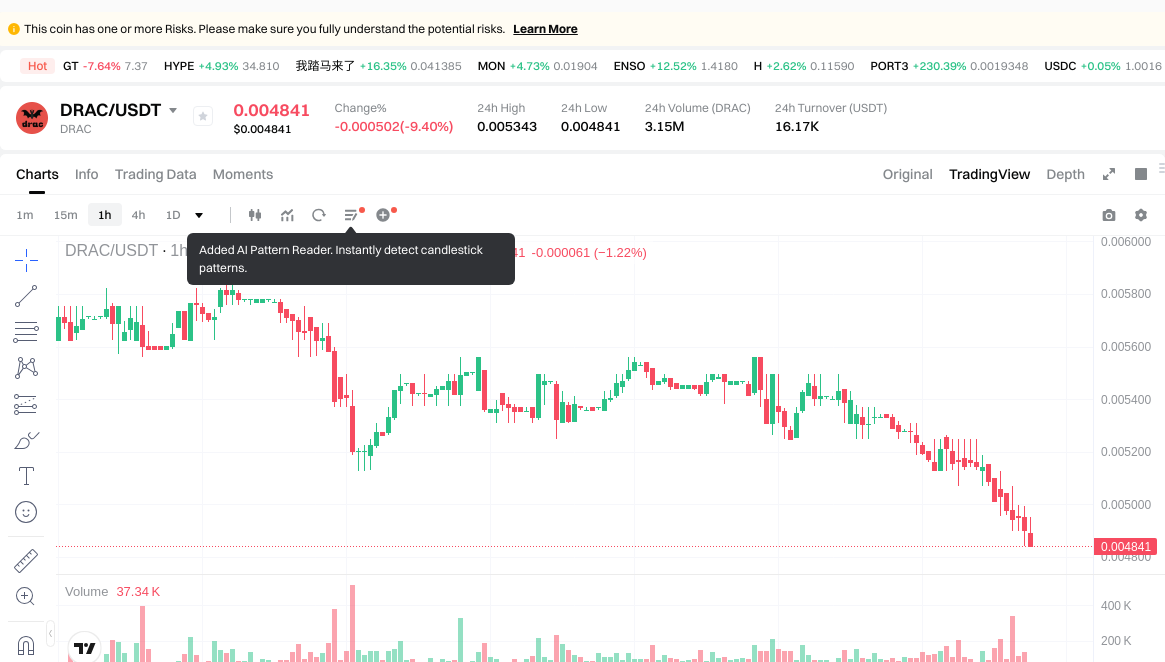
Current DRAC Investment Market Status (February 2026)
- DRAC current price: $0.00489
- Market sentiment (Fear & Greed Index): Data not available in provided materials
- 24-hour trading volume: $16,203.60
- Institutional investor holdings: Information not available in provided materials
Click to view real-time DRAC market price
II. Core Factors Influencing Whether DRAC is a Good Investment
Supply Mechanism and Scarcity (DRAC Investment Scarcity)
- Supply structure: DRAC operates with a maximum supply of 100,000,000 tokens and a circulating supply of 106,824,000 tokens. The circulating supply exceeds the current total supply of 72,001,378.83 tokens, indicating active token distribution.
- Historical price movements: DRAC reached a notable price level of $0.091844 on November 1, 2022, while recording a lower price point of $0.00005608 on February 16, 2025. These fluctuations reflect significant volatility in token valuation over time.
- Investment consideration: The token's supply dynamics, with a circulating ratio of approximately 106.82%, suggest limited scarcity constraints at present, which may influence long-term value assessment.
Institutional Investment and Mainstream Adoption (Institutional Investment in DRAC)
- Holder distribution: As of the latest data, DRAC has approximately 2,541 token holders, indicating a relatively modest holder base for a cryptocurrency asset.
- Exchange availability: DRAC is currently listed on 1 exchange platform, which may impact liquidity and accessibility for potential investors.
- Adoption metrics: Limited information is available regarding institutional holdings or enterprise-level adoption of DRAC, suggesting early-stage market positioning.
Macroeconomic Environment Impact on DRAC Investment
- Market positioning: DRAC is classified as a BRC-20 based meme token, positioning it within a specific market segment that may be influenced by broader cryptocurrency market sentiment and risk appetite.
- Market capitalization: With a market cap of $522,369.36 and a market dominance of 0.000013%, DRAC represents a micro-cap cryptocurrency asset, which typically carries higher volatility characteristics.
- Economic sensitivity: As a smaller market cap asset, DRAC's investment appeal may be more significantly affected by changes in overall cryptocurrency market conditions and investor risk tolerance compared to larger established cryptocurrencies.
Technology and Ecosystem Development (Technology & Ecosystem for DRAC Investment)
- Technical foundation: DRAC is built as a BRC-20 inscription token, utilizing the Bitcoin blockchain infrastructure through the BRC-20 token standard.
- Network presence: The project maintains an active presence through various channels including a website (drac.io), GitHub repository, Twitter, and Instagram accounts, suggesting ongoing community engagement efforts.
- Ecosystem applications: Information regarding specific DeFi integrations, NFT implementations, or payment applications within the DRAC ecosystem is not available in the provided materials, indicating potential areas for future development or limited current utility beyond speculative trading.
III. DRAC Future Investment Forecast and Price Outlook (Is DRAC(DRAC) Worth Investing in 2026-2031)
Short-term Investment Forecast (2026, Short-term DRAC Investment Outlook)
- Conservative forecast: $0.00340 - $0.00493
- Neutral forecast: $0.00493 - $0.00616
- Optimistic forecast: $0.00616 - $0.00700
Mid-term Investment Outlook (2027-2028, Mid-term DRAC(DRAC) Investment Forecast)
- Market phase expectation: The token may experience gradual growth as market conditions evolve, with potential fluctuations influenced by broader crypto market trends and trading activity patterns.
- Investment return forecast:
- 2027: $0.00410 - $0.00792
- 2028: $0.00619 - $0.00700
- Key catalysts: Market sentiment shifts, trading volume changes, and potential developments in the BRC-20 inscription ecosystem.
Long-term Investment Outlook (Is DRAC a Good Long-term Investment?)
- Base scenario: $0.00632 - $0.00807 (assuming stable market conditions and maintained circulation)
- Optimistic scenario: $0.00920 - $0.01033 (assuming favorable market environment and increased adoption)
- Risk scenario: Below $0.00340 (under adverse market conditions or significant volatility)
For more information on DRAC long-term investment and price predictions: Price Prediction
2026-2031 Long-term Outlook
- Base scenario: $0.00493 - $0.00807 USD (corresponding to steady progress and gradual mainstream application improvement)
- Optimistic scenario: $0.00920 - $0.01033 USD (corresponding to large-scale adoption and favorable market environment)
- Transformative scenario: Above $0.01288 USD (if ecosystem achieves breakthrough progress and mainstream adoption)
- 2031-12-31 forecast high: $0.01288 USD (based on optimistic development assumptions)
Disclaimer: Price forecasts are based on historical data analysis and market projections. Actual results may vary significantly due to market volatility, regulatory changes, technological developments, and other unpredictable factors. This information does not constitute investment advice, and investors should conduct their own research and risk assessment before making any investment decisions.
| Year |
Predicted High Price |
Predicted Average Price |
Predicted Low Price |
Price Change |
| 2026 |
0.00615625 |
0.004925 |
0.00339825 |
1 |
| 2027 |
0.00792309375 |
0.005540625 |
0.0041000625 |
14 |
| 2028 |
0.00700113375 |
0.006731859375 |
0.006193310625 |
39 |
| 2029 |
0.009269770359375 |
0.0068664965625 |
0.0063171768375 |
41 |
| 2030 |
0.01032721083 |
0.008068133460937 |
0.007503364118671 |
66 |
| 2031 |
0.012876741003656 |
0.009197672145468 |
0.008277904930921 |
89 |
IV. DRAC Investment Strategy and Risk Management (How to invest in BRC-20 meme tokens)
Investment Methodology (DRAC investment strategy)
-
Long-term Holding (HODL DRAC): Suitable for conservative investors
Long-term holding strategies focus on accumulating DRAC tokens during price dips and maintaining positions through market cycles. This approach minimizes trading costs and emotional decision-making, though investors should be aware of the extended volatility periods common in meme tokens.
-
Active Trading: Relies on technical analysis and swing trading
Active traders may leverage DRAC's historical price fluctuations, with the token showing a 24-hour volatility range between $0.004841 and $0.005343. Technical indicators and volume patterns (current 24h volume: $16,203.60) can inform entry and exit points, though meme tokens typically exhibit unpredictable price movements.
Risk Management (Risk management for DRAC investment)
-
Asset Allocation Ratio: Conservative / Aggressive / Professional investors
- Conservative: Allocate no more than 1-2% of total portfolio to high-risk meme tokens like DRAC
- Aggressive: May allocate 5-10% while maintaining diversification across multiple crypto assets
- Professional: Employ dynamic allocation strategies with strict stop-loss mechanisms
-
Risk Hedging Solutions: Multi-asset portfolio + hedging instruments
Investors should balance DRAC holdings with established cryptocurrencies and traditional assets. Consider using stablecoin positions as safe havens during high volatility periods. Due to DRAC's limited exchange availability (currently listed on 1 exchange), liquidity constraints should be factored into position sizing.
-
Secure Storage: Hot/cold wallets + hardware wallet recommendations
Given DRAC's BRC-20 standard, investors should use Bitcoin-compatible wallets that support BRC-20 tokens. Hardware wallets provide enhanced security for long-term holdings, while hot wallets may be suitable for active trading positions. Always verify wallet compatibility before transferring assets.
V. DRAC Investment Risks and Challenges (Risks of investing in BRC-20 meme tokens)
-
Market Risk: High volatility and price manipulation concerns
DRAC has demonstrated significant price volatility, with a 24-hour decline of 9.39% and a 7-day decrease of 15.65%. The token's historical price range from an all-time low of $0.00005608 (February 16, 2025) to an all-time high of $0.091844 (November 1, 2022) illustrates extreme price swings. The relatively small market cap of approximately $522,369 increases susceptibility to large order impacts and potential manipulation.
-
Regulatory Risk: Policy uncertainty across different jurisdictions
BRC-20 tokens operate within an evolving regulatory landscape. Different countries maintain varying stances on Bitcoin-based tokens and meme cryptocurrencies, which could impact DRAC's accessibility and trading status. Investors should monitor regulatory developments in their jurisdictions and assess compliance requirements.
-
Technical Risk: Network security vulnerabilities and upgrade failures
As a BRC-20 token, DRAC inherits technical dependencies from the Bitcoin network infrastructure. While Bitcoin's security is well-established, the BRC-20 standard itself represents a relatively newer implementation that may face technical challenges or compatibility issues with wallet providers and exchanges. The token's limited exchange availability (1 exchange) may indicate potential technical or liquidity constraints.
-
Liquidity Risk: Limited trading venues and holder concentration
With only 2,541 holders and availability on a single exchange, DRAC faces significant liquidity constraints. This may result in wider bid-ask spreads, difficulty executing large orders, and increased price slippage during trading.
VI. Conclusion: Is BRC-20 meme token a Good Investment?
-
Investment Value Summary: DRAC presents characteristics typical of high-risk meme tokens, with substantial historical volatility and limited market infrastructure. The token has shown a 1-year price increase of 182.32%, though recent trends indicate downward pressure with declines across multiple timeframes (1H: -1.21%, 24H: -9.39%, 7D: -15.65%, 30D: -20.96%).
-
Investor Recommendations:
✅ Beginners: Consider dollar-cost averaging with minimal position sizes (≤1% of portfolio) + secure wallet storage compatible with BRC-20 standard
✅ Experienced Investors: Employ swing trading strategies with strict risk controls + diversified portfolio allocation across multiple crypto assets
✅ Institutional Investors: Exercise caution given limited liquidity and exchange availability; any strategic allocation should account for exit constraints
⚠️ Disclaimer: Cryptocurrency investments carry substantial risk, particularly meme tokens with limited market infrastructure. This content is for informational purposes only and does not constitute investment advice. Investors should conduct thorough due diligence and only invest amounts they can afford to lose entirely.
VII. FAQ
Q1: What is the current market position of DRAC and is it suitable for beginners?
DRAC is a micro-cap BRC-20 meme token with a market capitalization of approximately $522,369 and current price around $0.00489. For beginners, DRAC represents a high-risk investment opportunity that should only constitute 1-2% of a total portfolio. The token demonstrates significant volatility with a 24-hour decline of 9.39% and limited liquidity (available on only 1 exchange with 2,541 holders). Beginners considering DRAC should employ dollar-cost averaging strategies, utilize secure BRC-20-compatible wallets, and thoroughly understand the risks associated with meme token investments before allocating any capital.
Q2: How has DRAC performed historically and what drove its price movements?
DRAC reached its all-time high of $0.091844 on November 1, 2022, and recorded an all-time low of $0.00005608 on February 16, 2025, demonstrating extreme price volatility. Over the past year, the token has achieved a 182.32% increase, though recent trends show downward pressure across multiple timeframes (7-day: -15.65%, 30-day: -20.96%). These price movements are primarily driven by market sentiment toward meme tokens, overall cryptocurrency market conditions, and limited liquidity factors. The significant price range reflects typical meme token characteristics where speculative trading and social media sentiment play dominant roles in valuation.
Q3: What are the main risks investors should consider before investing in DRAC?
DRAC carries multiple significant risk factors: Market Risk - extreme volatility with price swings from $0.00005608 to $0.091844, making it susceptible to sharp corrections; Liquidity Risk - limited to 1 exchange with only 2,541 holders, potentially causing wide bid-ask spreads and difficulty executing large orders; Regulatory Risk - uncertain legal status of BRC-20 tokens across different jurisdictions; Technical Risk - dependencies on Bitcoin network and relatively newer BRC-20 standard implementation. The small market cap ($522,369) increases vulnerability to price manipulation and large order impacts, making DRAC unsuitable for risk-averse investors.
Q4: What is the long-term price forecast for DRAC through 2031?
Price projections for DRAC vary significantly based on market scenarios. Short-term (2026): Conservative forecast ranges from $0.00340 to $0.00700, with neutral estimates around $0.00493-$0.00616. Long-term projections show: Base scenario (2031) at $0.00807, reflecting steady market conditions; Optimistic scenario at $0.01033 assuming favorable adoption; Transformative scenario exceeding $0.01288 with breakthrough ecosystem development. The 2031 predicted high reaches $0.01288 based on optimistic assumptions. However, these forecasts should be viewed cautiously as meme token prices are highly unpredictable and influenced by factors beyond fundamental analysis, including social media trends and speculative trading patterns.
Q5: How does DRAC's supply mechanism affect its investment value?
DRAC operates with a maximum supply of 100,000,000 tokens against a circulating supply of 106,824,000 tokens, resulting in a circulation ratio exceeding 100%. This supply structure indicates that the circulating supply surpasses the current total supply of 72,001,378.83 tokens, suggesting active token distribution and minimal scarcity constraints. Unlike cryptocurrencies with deflationary mechanisms or limited supply creating upward price pressure, DRAC's supply dynamics do not currently support strong scarcity-driven value appreciation. Investors should note that the relatively high circulation ratio may limit long-term value accumulation compared to assets with more restrictive supply models.
Q6: What investment strategies are recommended for different investor types?
Investment approaches vary by experience level: Conservative investors should allocate no more than 1-2% of their portfolio to DRAC, employing dollar-cost averaging and secure hardware wallet storage. Aggressive investors may allocate 5-10% while maintaining diversification and implementing strict stop-loss mechanisms to manage the token's volatility (24h range: $0.004841-$0.005343). Professional traders can employ active swing trading strategies leveraging technical analysis and volume patterns, though they must account for liquidity constraints given the single exchange listing. All investor types should balance DRAC holdings with established cryptocurrencies and maintain stablecoin positions as safe havens during high volatility periods.
Q7: What technical and ecosystem factors should investors evaluate?
DRAC is built on the BRC-20 token standard utilizing Bitcoin blockchain infrastructure, which provides security benefits but also introduces technical dependencies. The project maintains active community channels including a website (drac.io), GitHub repository, and social media presence (Twitter, Instagram). However, available information indicates limited ecosystem applications beyond speculative trading, with no documented DeFi integrations, NFT implementations, or payment utilities. The single exchange listing and relatively small holder base (2,541) suggest early-stage ecosystem development. Investors should assess whether the current technical foundation and limited utility support their investment thesis, particularly for long-term holding strategies.
Q8: How does DRAC compare to other investment opportunities in the current market?
DRAC occupies a niche position as a BRC-20 meme token with a market dominance of 0.000013% and 24-hour trading volume of $16,203.60. Compared to established cryptocurrencies, DRAC offers higher risk-reward potential but with significantly greater downside exposure. The token's micro-cap status and limited infrastructure (1 exchange, 2,541 holders) contrast sharply with mainstream assets that provide deeper liquidity and broader adoption. While DRAC demonstrated a 182.32% one-year return, this performance came with extreme volatility and recent downward trends. Investors comparing DRAC to other opportunities should weigh the potential for outsized gains against substantial risks of complete capital loss, market manipulation vulnerability, and exit liquidity constraints.
* The information is not intended to be and does not constitute financial advice or any other recommendation of any sort offered or endorsed by Gate.