This comprehensive analysis examines whether Echo (ECHO), a Bitcoin staking and liquidity infrastructure protocol on Aptos, represents a viable investment opportunity. Operating at a $1.29 million market cap with 208 million circulating tokens, ECHO handles approximately 65% of Aptos' bridged BTC. The article evaluates ECHO's price history, revealing volatility from $0.07526 (July 2025) to $0.006214 (February 2026), alongside investment fundamentals including token supply mechanics, ecosystem positioning, and technological infrastructure. Price forecasts range from conservative estimates of $0.0053-$0.0063 (2026) to long-term projections of $0.0077-$0.0150 (2031). The analysis addresses critical considerations including market volatility, regulatory uncertainty, and technical risks, while providing investment strategies suited for different investor profiles and risk management approaches. Ideal for investors evaluating exposure to Bitcoin DeFi infrastructure on Gate and other supported exchanges.
Introduction: Echo (ECHO)'s Investment Position and Market Outlook
ECHO is a digital asset in the cryptocurrency sector, operating as a Bitcoin staking and liquidity infrastructure built with Move technology. As of February 2026, Echo holds a market capitalization of approximately $1.29 million, with a circulating supply of 208 million tokens and a current price around $0.006214. The protocol positions itself as a restaking solution targeting both institutional partners and individual holders of BTC ecosystem assets seeking yield opportunities and enhanced liquidity. With 35,364 holders and trading availability across 4 exchanges, ECHO has attracted attention in discussions about "Is Echo (ECHO) a good investment?" This article provides a comprehensive analysis of ECHO's investment value, historical price trends, future price projections, and associated investment risks to serve as a reference for investors.
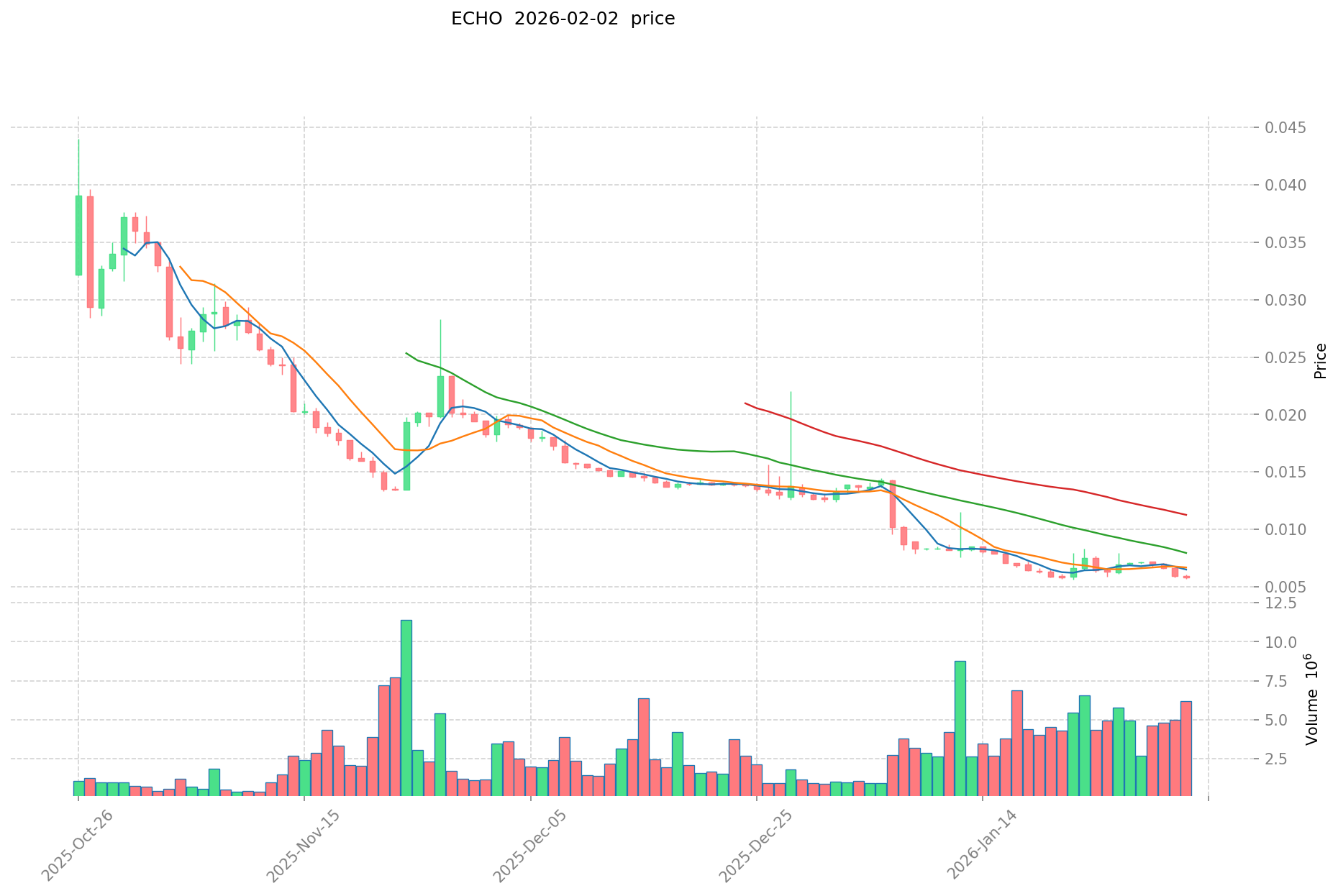
I. Echo (ECHO) Price History Review and Investment Value Status
- July 2025: Reached a peak price level of $0.07526 → Significant investor returns observed during this period
- February 2026: Price declined to $0.005544 → ECHO experienced considerable price volatility
- Recent market cycle: Price movement from $0.07526 to current levels around $0.006214 demonstrates substantial fluctuation
Current ECHO Investment Market Status (February 2026)
- ECHO Current Price: $0.006214
- 24-hour Trading Volume: $54,511.37
- Market Capitalization: $1,292,512
- Circulating Supply: 208,000,000 ECHO
- Total Supply: 1,000,000,000 ECHO
- Circulation Ratio: 20.8%
- Total Holders: 35,364
Click to view real-time ECHO market price
II. Core Factors Influencing Whether ECHO is a Good Investment
Supply Mechanism and Scarcity (ECHO Investment Scarcity)
- Supply Structure: ECHO has a maximum supply of 1,000,000,000 tokens, with a current circulating supply of 208,000,000 tokens, representing a circulating ratio of 20.8%. This capped supply creates a defined scarcity model that may influence investment value.
- Supply Dynamics: The current market cap to fully diluted valuation ratio stands at 20.8%, indicating significant unreleased supply that could impact future price dynamics as additional tokens enter circulation.
- Investment Implications: The fixed maximum supply provides a framework for understanding potential scarcity effects, though the low circulating ratio suggests considerable future supply releases that investors should consider when evaluating long-term holding strategies.
Institutional Investment and Mainstream Adoption (Institutional Investment in ECHO)
- Holder Distribution: The protocol currently has 35,364 token holders, reflecting a developing user base within the Aptos ecosystem.
- Ecosystem Position: Echo Protocol handles approximately 65% of Aptos' bridged BTC, indicating a notable role within the Bitcoin liquidity infrastructure on Aptos, though it operates alongside competitors including Aries Markets and Amnis Finance.
- Market Presence: ECHO is listed on 4 exchanges with a 24-hour trading volume of $54,511.37, suggesting modest liquidity conditions that may affect investment accessibility and execution.
Macroeconomic Environment's Impact on ECHO Investment
- Market Volatility: ECHO has experienced price fluctuations with a 24-hour change of 5.64%, a 7-day decline of 14.24%, and a 30-day decrease of 54.27%, reflecting sensitivity to broader market conditions.
- Crypto Market Dynamics: As a protocol operating within the Bitcoin restaking and liquidity space, ECHO's investment profile may be influenced by shifts in Bitcoin market sentiment, institutional adoption of BTC derivatives, and regulatory developments affecting digital asset liquidity solutions.
- Risk Considerations: The cryptocurrency market's inherent volatility requires investors to assess their risk tolerance and investment horizon when considering exposure to emerging protocols like ECHO.
Technology and Ecosystem Development (Technology & Ecosystem for ECHO Investment)
- Core Infrastructure: Echo Protocol is built using Move programming language and operates as Bitcoin staking and liquidity infrastructure on the Aptos blockchain, targeting both institutional partners and individual BTC asset holders seeking yield opportunities.
- Functional Positioning: The protocol focuses on providing innovative restaking solutions designed to enhance liquidity for Bitcoin L2/LRT assets, addressing a specific niche within the broader DeFi ecosystem.
- Ecosystem Integration: With its smart contract deployed on Aptos (contract address: 0xb2c7780f0a255a6137e5b39733f5a4c85fe093c549de5c359c1232deef57d1b7), ECHO operates within an environment that has shown 17.93% growth over a 30-day period, though individual protocol performance may vary from broader network metrics.
III. ECHO Future Investment Predictions and Price Outlook (Is Echo(ECHO) worth investing in 2026-2031)
Short-term Investment Prediction (2026, short-term ECHO investment outlook)
- Conservative Forecast: $0.0053 - $0.0063
- Neutral Forecast: $0.0063 - $0.0074
- Optimistic Forecast: $0.0074 - $0.0082
Mid-term Investment Outlook (2027-2028, mid-term Echo(ECHO) investment forecast)
- Market Phase Expectation: The token may experience moderate volatility with potential growth driven by ecosystem development and broader Bitcoin staking infrastructure adoption.
- Investment Return Prediction:
- 2027: $0.0059 - $0.0082
- 2028: $0.0069 - $0.0113
- Key Catalysts: Bitcoin Layer 2 ecosystem expansion, institutional adoption of BTC restaking solutions, and enhanced liquidity mechanisms for BTC-related assets.
Long-term Investment Outlook (Is ECHO a good long-term investment?)
- Base Scenario: $0.0077 - $0.0151 (assuming steady protocol development and moderate market conditions through 2030)
- Optimistic Scenario: $0.0093 - $0.0150 (assuming accelerated institutional partnerships and significant expansion of Bitcoin staking infrastructure)
- Risk Scenario: $0.0059 - $0.0077 (under adverse market conditions or limited protocol adoption)
Click to view ECHO long-term investment and price prediction: Price Prediction
2026-02-02 - 2031 Long-term Outlook
- Base Scenario: $0.0077 - $0.0108 USD (corresponding to steady progress and gradual mainstream application growth)
- Optimistic Scenario: $0.0093 - $0.0150 USD (corresponding to large-scale adoption and favorable market environment)
- Transformative Scenario: Above $0.0150 USD (if ecosystem achieves breakthrough progress and mainstream adoption)
- 2031-12-31 Predicted High: $0.0150 USD (based on optimistic development assumptions)
Disclaimer: Price predictions are based on historical data and market analysis models. Cryptocurrency investments carry substantial risk. Past performance does not guarantee future results. Investors should conduct independent research and consider their risk tolerance before making investment decisions.
| Year |
Predicted High Price |
Predicted Average Price |
Predicted Low Price |
Price Change |
| 2026 |
0.00820715 |
0.006265 |
0.0052626 |
0 |
| 2027 |
0.00817676475 |
0.007236075 |
0.0059335815 |
16 |
| 2028 |
0.01132843721625 |
0.007706419875 |
0.00685871368875 |
24 |
| 2029 |
0.011991959967487 |
0.009517428545625 |
0.006662199981937 |
53 |
| 2030 |
0.015056571959178 |
0.010754694256556 |
0.00774337986472 |
73 |
| 2031 |
0.014970534405126 |
0.012905633107867 |
0.009292055837664 |
107 |
IV. ECHO Investment Strategy and Risk Management (How to invest in ECHO)
Investment Methodology (ECHO investment strategy)
Long-term Holding (HODL ECHO): Suitable for Conservative Investors
For investors seeking stable exposure to Bitcoin staking infrastructure, a long-term holding strategy may align with ECHO's positioning as a liquidity solution for BTC ecosystem assets. This approach involves acquiring ECHO tokens and holding them through market cycles, potentially benefiting from the protocol's development as a Move-based Bitcoin staking platform. Given the project's focus on institutional partnerships and BTC asset holders seeking yield opportunities, conservative investors might consider accumulating positions during market corrections while maintaining patience through volatility periods.
Active Trading: Technical Analysis and Swing Operations
Traders employing active strategies should monitor ECHO's price movements across multiple timeframes. Recent data shows notable volatility, with the token experiencing varied percentage changes across different periods. Technical traders might utilize support and resistance levels, volume patterns, and momentum indicators to identify entry and exit points. The token's trading availability on multiple exchanges provides liquidity for swing trading operations, though traders should account for the relatively modest 24-hour trading volume when sizing positions.
Risk Management (Risk management for ECHO investment)
Asset Allocation Ratios: Conservative / Aggressive / Professional Investors
- Conservative Investors: May consider allocating 1-3% of their cryptocurrency portfolio to ECHO, treating it as a speculative position within a broader diversified strategy
- Aggressive Investors: Could allocate 5-10% of their crypto holdings, accepting higher volatility in exchange for potential upside exposure to Bitcoin staking infrastructure
- Professional Investors: Might integrate ECHO as part of a thematic allocation to DeFi infrastructure or Bitcoin L2 ecosystems, with position sizing determined by risk-adjusted return models and correlation analysis
Risk Hedging Solutions: Multi-asset Portfolio + Hedging Tools
Investors can implement several hedging approaches:
- Pair ECHO exposure with stablecoin positions to maintain purchasing power during drawdowns
- Balance holdings with established BTC ecosystem assets or Bitcoin itself to reduce protocol-specific risk
- Consider portfolio diversification across different blockchain infrastructures (Ethereum L2s, Bitcoin L2s, alternative L1s)
- For sophisticated investors, derivatives markets on supported exchanges may offer hedging instruments, though availability should be verified
Secure Storage: Hot/Cold Wallets + Hardware Wallet Recommendations
ECHO operates on the Aptos blockchain, requiring compatible wallet solutions:
- Cold Storage: Hardware wallets supporting Aptos-based tokens provide optimal security for long-term holdings
- Hot Wallets: Aptos-compatible software wallets (such as Petra Wallet, Martian Wallet, or Pontem Wallet) enable active management and DeFi interactions
- Security Best Practices: Store the majority of holdings (70-90%) in cold storage, maintaining only operational amounts in hot wallets; implement multi-signature solutions where possible; regularly verify wallet software authenticity
- Exchange Storage: While ECHO trades on multiple platforms, minimize exchange custody exposure except for active trading positions
V. ECHO Investment Risks and Challenges (Risks of investing in ECHO)
Market Risk: High Volatility and Price Manipulation
ECHO demonstrates significant price volatility characteristic of emerging cryptocurrency projects. The token has experienced substantial percentage fluctuations across various timeframes, reflecting both market sentiment shifts and liquidity constraints. With a market capitalization representing a small fraction of the broader cryptocurrency market and trading volume concentrated across limited exchanges, the token may be susceptible to larger percentage price swings from relatively modest order flows. Investors should anticipate continued volatility as the project develops and market participants reassess its value proposition within the Bitcoin staking infrastructure landscape.
Regulatory Risk: Policy Uncertainty Across Different Jurisdictions
Bitcoin staking protocols operate within an evolving regulatory framework:
- Staking Classification: Regulatory authorities across jurisdictions continue developing frameworks for cryptocurrency staking mechanisms, with potential implications for platforms facilitating BTC yield generation
- Securities Considerations: Depending on token economics and governance structures, regulatory bodies may scrutinize whether certain staking tokens constitute securities offerings
- Cross-border Operations: As a protocol serving both institutional partners (To B) and individual users (To C) globally, ECHO may face varying compliance requirements across different markets
- DeFi Regulatory Evolution: Broader regulatory developments affecting decentralized finance infrastructure could impact liquidity protocols and restaking solutions
Investors should monitor regulatory developments in their jurisdictions and assess compliance implications for their participation.
Technical Risk: Network Security Vulnerabilities and Upgrade Failures
Several technical considerations warrant attention:
- Smart Contract Risk: As a Move-based protocol on Aptos, ECHO's smart contracts govern critical functions including asset custody, staking mechanisms, and liquidity provision. Contract vulnerabilities could result in asset loss or protocol dysfunction
- Aptos Ecosystem Dependency: The protocol's reliance on Aptos blockchain infrastructure means network issues, consensus failures, or upgrade complications on the underlying chain could affect ECHO's operations
- Integration Complexity: Facilitating Bitcoin L2/LRT asset liquidity involves bridging mechanisms and cross-chain interactions that introduce additional technical complexity and potential failure points
- Protocol Upgrades: Future development and upgrades to the Echo Protocol carry implementation risks, including potential bugs, migration issues, or community governance challenges
VI. Conclusion: Is ECHO a Good Investment?
Investment Value Summary
ECHO represents exposure to Bitcoin staking infrastructure built on Move programming language and Aptos blockchain. The protocol addresses demand for liquidity solutions among Bitcoin L2/LRT asset holders and institutional partners, alongside individual BTC holders seeking yield opportunities. However, the project operates in a competitive and rapidly evolving landscape, with substantial price volatility reflecting its early-stage development and market positioning.
Investor Recommendations
✅ Beginners: Consider small, periodic accumulation strategies (dollar-cost averaging) paired with secure wallet storage practices. Prioritize education about Aptos ecosystem and Bitcoin staking mechanisms before committing significant capital.
✅ Experienced Investors: May employ swing trading strategies around technical levels while maintaining core positions. Implement disciplined risk management including position sizing relative to portfolio volatility tolerance and stop-loss protocols.
✅ Institutional Investors: Could evaluate strategic allocation as part of thematic exposure to Bitcoin DeFi infrastructure, conducting thorough due diligence on protocol mechanics, team credentials, and competitive positioning within the BTC staking landscape.
⚠️ Disclaimer: Cryptocurrency investment carries substantial risk including potential total loss of capital. This content provides informational analysis only and does not constitute investment advice, financial counsel, or recommendations to buy, sell, or hold any asset. Investors should conduct independent research, assess personal risk tolerance, and consult qualified financial advisors before making investment decisions.
VII. FAQ
Q1: What is Echo (ECHO) and what makes it different from other Bitcoin staking protocols?
Echo (ECHO) is a Bitcoin staking and liquidity infrastructure protocol built with Move technology on the Aptos blockchain, currently handling approximately 65% of Aptos' bridged BTC. Unlike traditional Bitcoin staking solutions, Echo specifically targets both institutional partners and individual holders of Bitcoin L2/LRT assets seeking yield opportunities. The protocol differentiates itself through its Move-based smart contract architecture (contract address: 0xb2c7780f0a255a6137e5b39733f5a4c85fe093c549de5c359c1232deef57d1b7) and its focus on providing restaking solutions that enhance liquidity for Bitcoin ecosystem assets. With 35,364 holders and a market capitalization of approximately $1.29 million as of February 2026, Echo operates as an emerging player in the competitive Bitcoin DeFi infrastructure space alongside protocols like Aries Markets and Amnis Finance.
Q2: Is ECHO a good short-term or long-term investment?
ECHO presents different risk-return profiles depending on investment horizon. For short-term investors (2026), the token demonstrates significant volatility with recent performance showing a 24-hour change of 5.64%, 7-day decline of 14.24%, and 30-day decrease of 54.27%, creating both opportunities and risks for active traders. Conservative short-term forecasts range from $0.0053 to $0.0063, while optimistic scenarios extend to $0.0082. For long-term investors (2026-2031), ECHO offers exposure to Bitcoin staking infrastructure development with base case projections ranging from $0.0077 to $0.0108 by 2031, and optimistic scenarios reaching $0.0150. Long-term holders should consider the protocol's growth potential within the Bitcoin L2 ecosystem, though they must accept the inherent volatility of early-stage cryptocurrency projects with only 20.8% of tokens currently in circulation.
Q3: What are the main risks associated with investing in ECHO?
ECHO investment carries several key risk categories that investors must evaluate. Market risk includes high volatility evidenced by price movements from $0.07526 (July 2025) to current levels around $0.006214, along with relatively modest 24-hour trading volume of $54,511.37 which may amplify price swings. Technical risks involve smart contract vulnerabilities inherent in Move-based protocols, dependency on Aptos blockchain infrastructure stability, and complexity of bridging Bitcoin L2/LRT assets. Regulatory risk encompasses evolving frameworks for cryptocurrency staking mechanisms, potential securities classification concerns, and varying compliance requirements across jurisdictions for protocols serving both institutional and retail participants. Additionally, with only 208 million tokens circulating from a 1 billion total supply, future token releases could significantly impact price dynamics and investment returns.
Q4: How much should I allocate to ECHO in my investment portfolio?
Portfolio allocation to ECHO should align with investor risk tolerance and experience level. Conservative investors might consider allocating 1-3% of their cryptocurrency portfolio to ECHO, treating it as a speculative position within a broader diversified strategy that includes established cryptocurrencies and stablecoins. Aggressive investors comfortable with higher volatility could allocate 5-10% of their crypto holdings, accepting greater drawdown potential in exchange for exposure to Bitcoin staking infrastructure growth. Professional investors may integrate ECHO as part of thematic allocation to DeFi infrastructure or Bitcoin L2 ecosystems, with position sizing determined through risk-adjusted return models and correlation analysis. Regardless of allocation level, investors should implement proper risk management including cold storage for long-term holdings (70-90% of ECHO positions), hot wallets for active management, and never invest capital they cannot afford to lose entirely.
Q5: Where can I buy ECHO and what wallet should I use for storage?
ECHO tokens are available for purchase on 4 cryptocurrency exchanges, with investors able to view real-time market prices and trading pairs through platforms like Gate.com. For secure storage, ECHO operates on the Aptos blockchain and requires compatible wallet solutions. Long-term holders should prioritize cold storage using hardware wallets that support Aptos-based tokens, storing 70-90% of holdings offline to minimize security risks. For active management and DeFi interactions, hot wallets such as Petra Wallet, Martian Wallet, or Pontem Wallet provide Aptos-compatible interfaces. Investors should implement security best practices including verifying wallet software authenticity, utilizing multi-signature solutions where possible, and minimizing exchange custody exposure except for active trading positions. The combination of cold storage for core holdings and limited hot wallet exposure for operational needs provides optimal security while maintaining accessibility for portfolio management.
Q6: What factors could drive ECHO's price higher in the future?
Several catalysts could potentially influence ECHO's price appreciation over the investment horizon. Ecosystem development factors include expanded adoption of Bitcoin Layer 2 solutions, increased institutional partnerships for BTC restaking services, and enhanced liquidity mechanisms attracting more Bitcoin asset holders seeking yield opportunities. Protocol-specific drivers encompass successful technical implementations, security audit validations, and competitive positioning within the Aptos ecosystem where Echo currently handles 65% of bridged BTC. Macroeconomic factors such as broader Bitcoin market sentiment, institutional adoption of BTC derivatives, and favorable regulatory developments for digital asset liquidity solutions could create tailwinds. However, investors should recognize that these potential catalysts operate alongside downside risks including competitive pressure from alternative protocols, technical vulnerabilities, regulatory challenges, and overall cryptocurrency market volatility.
Q7: How does ECHO's token supply structure affect its investment potential?
ECHO's tokenomics feature a maximum supply of 1,000,000,000 tokens with only 208,000,000 tokens currently in circulation, representing a 20.8% circulating ratio. This supply structure creates both opportunities and considerations for investors. The capped total supply establishes a defined scarcity model similar to other fixed-supply cryptocurrencies, potentially supporting long-term value appreciation if demand grows. However, the low circulating ratio indicates significant unreleased supply that could impact future price dynamics as additional tokens enter the market through vesting schedules, ecosystem incentives, or other distribution mechanisms. The current market cap to fully diluted valuation ratio of 20.8% suggests investors should evaluate potential dilution effects when projecting long-term returns. Understanding the token release schedule and distribution mechanisms is crucial for assessing how supply dynamics might influence investment performance over different time horizons.
Q8: What investment strategy works best for ECHO tokens?
Optimal ECHO investment strategy depends on individual objectives, risk tolerance, and market expertise. Long-term holding (HODL) strategies suit conservative investors seeking stable exposure to Bitcoin staking infrastructure, focusing on accumulating positions during market corrections while maintaining patience through volatility cycles characteristic of emerging protocols. This approach aligns with ECHO's positioning as liquidity solution for BTC ecosystem assets and potential benefits from institutional partnership development. Active trading strategies appeal to experienced investors comfortable with technical analysis, utilizing support/resistance levels, volume patterns, and momentum indicators to identify entry/exit points across multiple timeframes. Given recent volatility metrics (5.64% 24-hour change, -14.24% 7-day, -54.27% 30-day), swing traders should implement disciplined risk management including position sizing relative to portfolio volatility and stop-loss protocols. Dollar-cost averaging provides middle-ground approach for beginners, systematically accumulating ECHO through periodic purchases regardless of short-term price movements.
* The information is not intended to be and does not constitute financial advice or any other recommendation of any sort offered or endorsed by Gate.