This comprehensive analysis examines whether EYWA (EYWA) represents a sound investment opportunity for cryptocurrency investors. As of February 2026, EYWA trades at $0.001031 with a market capitalization of approximately $508,230.85, positioning itself as a unified cross-chain liquidity protocol addressing DeFi fragmentation. The article evaluates EYWA's historical performance, revealing significant price volatility and an approximate 98.38% decline from peak levels in December 2024. Key investment considerations include the token's fixed maximum supply of 1 billion, integration with established DeFi protocols, and technical deployment on Arbitrum network. The analysis provides differentiated investment strategies for conservative, aggressive, and professional investors, alongside comprehensive risk management frameworks encompassing market volatility, regulatory uncertainty, and technical vulnerabilities. Price forecasts through 2031 range from conservative to optimistic scenarios based on protocol adoption
Introduction: EYWA (EYWA) Investment Position and Market Outlook
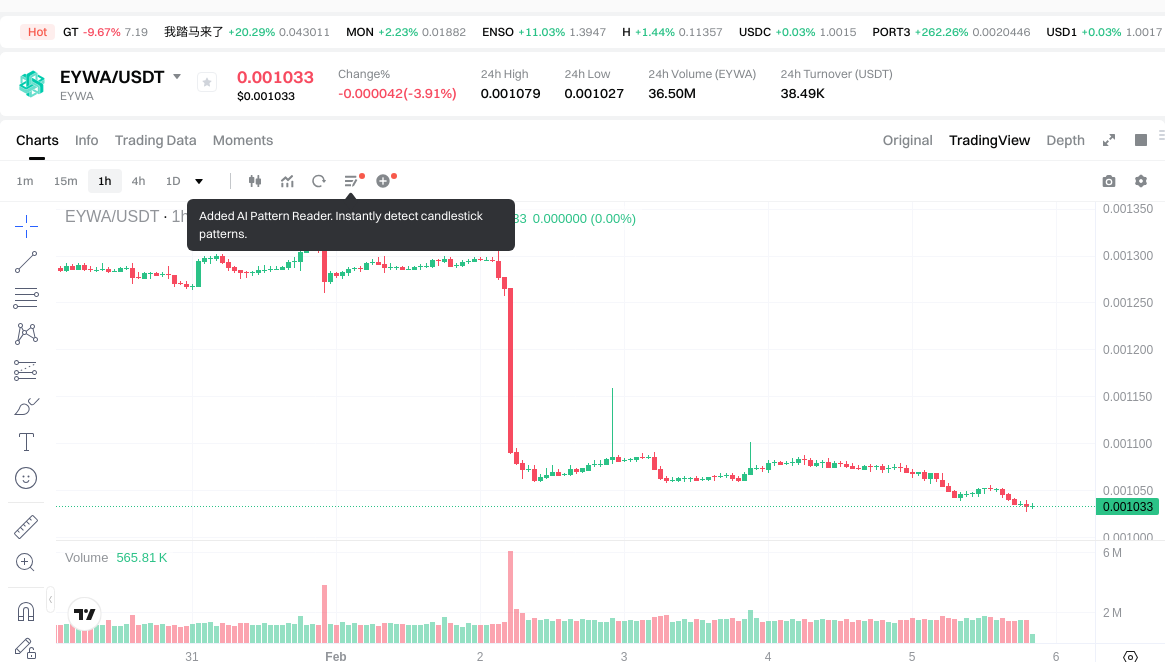
EYWA is a cryptocurrency asset in the digital asset space, having been launched in 2024. As of February 5, 2026, EYWA maintains a market capitalization of approximately $508,230.85, with a circulating supply of around 492,949,414.95 tokens, and a current price hovering around $0.001031. Positioned as a unified cross-chain liquidity market addressing DeFi fragmentation and security challenges, EYWA has become a subject of discussion among investors exploring "Is EYWA (EYWA) a good investment?" This article provides a comprehensive analysis of EYWA's investment characteristics, historical performance, future price considerations, and associated risks to serve as a reference for investors.
I. EYWA (EYWA) Price History Review and Investment Value Status
- 2024: Token listing on major exchanges → Price experienced significant volatility following initial market introduction
- December 2024: Price reached upper range levels → EYWA traded near elevated price points during this period
- Early 2026: Market correction phase → Price declined from previous levels to lower trading ranges
Current EYWA Investment Market Status (February 2026)
- EYWA current price: $0.001031
- 24-hour trading volume: $38,435.29
- Market capitalization: $508,230.85
- Circulating supply: 492,949,414.95 EYWA (49.29% of total supply)
Click to view real-time EYWA market price
II. Core Factors Affecting Whether EYWA is a Good Investment
Supply Mechanism and Scarcity (EYWA investment scarcity)
- Total supply mechanism: EYWA has a maximum supply of 1,000,000,000 tokens, with approximately 492,949,414.95 tokens currently in circulation, representing a circulation rate of about 49.29%
- Price impact: The token experienced significant price volatility, with its price at $0.001031 as of February 5, 2026, showing a notable decline from higher price levels observed in late 2024
- Investment significance: The fixed maximum supply establishes a potential scarcity factor, which may influence long-term valuation dynamics as adoption evolves
Cross-Chain Liquidity and DeFi Integration
- Protocol positioning: EYWA operates as a unified cross-chain liquidity market designed to address liquidity fragmentation and cross-chain communication challenges within the DeFi ecosystem
- CrossCurve protocol: The platform's cross-chain trading and yield protocol leverages Curve's liquidity infrastructure to facilitate low-slippage trading for both institutional and retail users
- Ecosystem relevance: The integration with established DeFi protocols may contribute to the utility and adoption trajectory of the EYWA token within decentralized finance applications
- Trading metrics: EYWA recorded a 24-hour trading volume of approximately $38,435.29 as of February 5, 2026, with trading activity across 4 exchanges
- Price trends: The token showed negative performance across multiple timeframes, including -0.38% (1H), -4% (24H), -21.7% (7D), -29.75% (30D), and -98.38% (1Y)
- Market capitalization: The circulating market capitalization stood at approximately $508,230.85, representing 0.000040% of the overall crypto market
Technical Infrastructure and Network Foundation
- Contract deployment: EYWA token is deployed on the Arbitrum network (contract address: 0x7a10f506e4c7658e6ad15fdf0443d450b7fa80d7)
- Holder distribution: The token has approximately 16,829 holders as recorded in available data
- Accessibility: The token is accessible through multiple blockchain explorers and trading platforms, facilitating transparency and market participation
III. EYWA Future Investment Forecast and Price Outlook (Is EYWA(EYWA) worth investing in 2026-2031)
Short-term EYWA Investment Outlook (2026)
- Conservative Forecast: $0.00096914 - $0.001031
- Neutral Forecast: $0.001031 - $0.00122
- Optimistic Forecast: $0.00122 - $0.00149495
Mid-term EYWA(EYWA) Investment Forecast (2027-2029)
-
Market Phase Expectation: EYWA may experience a recovery phase during this period, with the price potentially rising from the current low levels. The cross-chain liquidity protocol may attract more DeFi users as the market stabilizes.
-
Investment Return Forecast:
- 2027: $0.00077041475 - $0.00160397825
- 2028: $0.0008314164425 - $0.00160549382
- 2029: $0.00100286024685 - $0.001565069779175
-
Key Catalysts: Expansion of cross-chain liquidity solutions, potential partnerships with other DeFi protocols, increased adoption of CrossCurve protocol, and broader market recovery in the DeFi sector.
Long-term Investment Outlook (Is EYWA a good long-term investment?)
- Base Scenario: $0.001295513100703 - $0.001974115201072 (assuming steady development of cross-chain infrastructure and moderate DeFi market growth)
- Optimistic Scenario: $0.001758196350954 - $0.002109835621145 (assuming successful protocol adoption and favorable DeFi market conditions)
- Risk Scenario: Below $0.001031 (under adverse market conditions or reduced demand for cross-chain liquidity solutions)
Click to view EYWA long-term investment and price prediction: Price Prediction
2026-02-05 to 2031 Long-term Outlook
- Base Scenario: $0.001295513100703 - $0.001542277500837 (corresponding to stable progress and steady growth in mainstream applications)
- Optimistic Scenario: $0.001758196350954 - $0.002109835621145 (corresponding to large-scale adoption and favorable market environment)
- Transformative Scenario: Above $0.0022 (if ecosystem achieves breakthrough progress and mainstream adoption)
- 2031-12-31 Forecast High: $0.002109835621145 (based on optimistic development assumptions)
Disclaimer: These forecasts are based on historical data analysis and current market trends. Cryptocurrency investments carry substantial risks, and past performance does not guarantee future results. Investors should conduct their own research and consider their risk tolerance before making investment decisions.
| Year |
Predicted High Price |
Predicted Average Price |
Predicted Low Price |
Price Change |
| 2026 |
0.00149495 |
0.001031 |
0.00096914 |
0 |
| 2027 |
0.00160397825 |
0.001262975 |
0.00077041475 |
22 |
| 2028 |
0.00160549382 |
0.001433476625 |
0.0008314164425 |
39 |
| 2029 |
0.001565069779175 |
0.0015194852225 |
0.00100286024685 |
47 |
| 2030 |
0.001974115201072 |
0.001542277500837 |
0.001295513100703 |
49 |
| 2031 |
0.002109835621145 |
0.001758196350954 |
0.00152963082533 |
70 |
IV. EYWA Investment Strategy and Risk Management (How to invest in EYWA)
Investment Strategy (EYWA investment strategy)
Long-term Holding (HODL EYWA)
For conservative investors seeking steady exposure to cross-chain DeFi infrastructure, a long-term holding approach may be suitable. This strategy involves accumulating EYWA tokens during market corrections and holding through market cycles, betting on the protocol's long-term adoption in solving liquidity fragmentation across blockchain networks.
Active Trading
Active traders may leverage technical analysis and swing trading strategies based on EYWA's price movements. Given the token's price fluctuation from $0.31307 to $0.001027, technical traders could identify support and resistance levels for short-term position management. However, such strategies require continuous market monitoring and understanding of trading volumes and market sentiment.
Risk Management (Risk management for EYWA investment)
Asset Allocation Ratio
- Conservative Investors: Limit EYWA exposure to 1-3% of total crypto portfolio, prioritizing established assets
- Aggressive Investors: May allocate 5-10% to EYWA as part of DeFi infrastructure plays
- Professional Investors: Could consider 3-7% allocation with active risk monitoring and rebalancing strategies
Risk Hedging Solutions
- Multi-asset Portfolio: Combine EYWA with blue-chip cryptocurrencies and stablecoins to reduce concentration risk
- Position Sizing: Use dollar-cost averaging to mitigate timing risk in volatile markets
- Stop-loss Mechanisms: Implement predetermined exit points to limit potential losses
Secure Storage
- Cold Wallets: Hardware wallets such as Ledger or Trezor for long-term holdings
- Hot Wallets: Reputable software wallets for active trading portions, ensuring compatibility with Arbitrum network
- Wallet Security: Enable two-factor authentication and maintain backup seed phrases in secure locations
V. EYWA Investment Risks and Challenges (Risks of investing in EYWA)
Market Risks
- High Volatility: EYWA has experienced significant price fluctuations, with 24-hour changes of -4%, 7-day changes of -21.7%, and 30-day changes of -29.75%
- Limited Liquidity: With a 24-hour trading volume of approximately $38,435, the token may face liquidity constraints during large transactions
- Market Capitalization: At a circulating market cap of approximately $508,230, EYWA remains a micro-cap asset subject to higher volatility
Regulatory Risks
- Cross-border Compliance: As a cross-chain protocol, EYWA may face varying regulatory frameworks across different jurisdictions
- DeFi Regulation: Evolving regulatory approaches to decentralized finance protocols could impact EYWA's operational model
- Policy Uncertainty: Changes in cryptocurrency regulations across major markets could affect token accessibility and trading
Technical Risks
- Smart Contract Vulnerabilities: Cross-chain protocols face complex security challenges in managing assets across multiple blockchains
- Protocol Dependencies: EYWA's integration with Curve Finance means technical issues or changes in partner protocols could affect functionality
- Network Security: As the protocol operates across multiple chains, vulnerabilities in any connected network could pose systemic risks
- Upgrade Risks: Protocol updates and changes to cross-chain communication mechanisms require careful implementation to avoid disruptions
VI. Conclusion: Is EYWA a Good Investment?
Investment Value Summary
EYWA presents itself as a cross-chain liquidity solution addressing fragmentation in DeFi markets. While the protocol's focus on solving liquidity issues through integration with established platforms like Curve Finance demonstrates technical ambition, the token has experienced substantial price decline. The project's micro-cap status and limited trading volume suggest it remains in early adoption stages.
Investor Recommendations
✅ Beginners: Consider dollar-cost averaging with minimal allocation (1-2% of portfolio) and store in secure hardware wallets. Focus on understanding cross-chain DeFi fundamentals before significant investment.
✅ Experienced Investors: May explore swing trading opportunities based on technical analysis, maintaining strict position sizing and risk management. Consider EYWA as part of a diversified DeFi infrastructure portfolio.
✅ Institutional Investors: Could evaluate EYWA for strategic long-term positioning in cross-chain liquidity infrastructure, with appropriate due diligence on protocol security, team capabilities, and competitive positioning.
⚠️ Disclaimer: Cryptocurrency investments carry high risk. This analysis is for informational purposes only and does not constitute investment advice. Investors should conduct independent research and consult financial advisors before making investment decisions.
VII. FAQ
Q1: What is EYWA and what problem does it solve in the DeFi ecosystem?
EYWA is a unified cross-chain liquidity market protocol designed to address liquidity fragmentation and cross-chain communication challenges within decentralized finance (DeFi). The protocol leverages its CrossCurve solution, which integrates with Curve Finance's liquidity infrastructure to enable low-slippage trading across multiple blockchain networks. By facilitating seamless asset transfers and liquidity aggregation across different chains, EYWA aims to improve capital efficiency for both institutional and retail users in the fragmented DeFi landscape.
Q2: How has EYWA's price performed since its launch, and what is its current market position?
EYWA has experienced substantial price volatility since its 2024 launch. After reaching elevated price levels near $0.31307 in December 2024, the token underwent a significant correction phase in early 2026. As of February 5, 2026, EYWA trades at approximately $0.001031, representing a -98.38% decline over one year. The token maintains a circulating market capitalization of approximately $508,230.85 with a 24-hour trading volume of $38,435.29, positioning it as a micro-cap asset with approximately 492,949,414.95 tokens in circulation (49.29% of the 1 billion maximum supply).
Q3: What are the key technical features that distinguish EYWA's cross-chain infrastructure?
EYWA operates as a cross-chain protocol deployed on the Arbitrum network (contract address: 0x7a10f506e4c7658e6ad15fdf0443d450b7fa80d7) with approximately 16,829 token holders. The protocol's primary technical distinction lies in its CrossCurve mechanism, which integrates with Curve Finance's established liquidity pools to facilitate cross-chain transactions. This integration approach allows EYWA to leverage existing DeFi infrastructure rather than building entirely separate liquidity pools, potentially reducing fragmentation while enabling users to access liquidity across multiple blockchain ecosystems through a unified interface.
Q4: What allocation percentage should different investor types consider for EYWA?
Investment allocation recommendations vary significantly by investor profile and risk tolerance. Conservative investors should limit EYWA exposure to 1-3% of their total cryptocurrency portfolio, prioritizing established assets for the majority of holdings. Aggressive investors with higher risk tolerance may allocate 5-10% to EYWA as part of DeFi infrastructure plays, while professional investors could consider 3-7% allocation with active risk monitoring and regular rebalancing strategies. Given EYWA's micro-cap status and high volatility, all investor types should implement strict position sizing and avoid overconcentration in this single asset.
Q5: What are the primary risks associated with investing in EYWA?
EYWA presents multiple risk categories that investors must consider. Market risks include high volatility (with recent declines of -4% in 24 hours, -21.7% in 7 days, and -29.75% in 30 days), limited liquidity with only $38,435 in daily trading volume, and micro-cap market capitalization susceptibility. Technical risks encompass smart contract vulnerabilities inherent in cross-chain protocols, dependencies on partner protocols like Curve Finance, and potential security issues across connected blockchain networks. Regulatory risks involve evolving compliance requirements for cross-border DeFi protocols and policy uncertainty across different jurisdictions. The protocol's early adoption stage and substantial price decline from peak levels represent additional considerations for risk assessment.
Q6: What investment strategies are most suitable for EYWA token holders?
Two primary strategies align with EYWA's characteristics and market position. The long-term holding (HODL) strategy suits conservative investors seeking exposure to cross-chain DeFi infrastructure development, involving accumulation during market corrections and holding through cycles while betting on protocol adoption. This approach requires patience and belief in the long-term value proposition of solving liquidity fragmentation. Active trading represents an alternative for experienced traders who can leverage technical analysis based on EYWA's price movements between historical levels of $0.31307 and $0.001027, identifying support and resistance levels for short-term position management. This strategy demands continuous market monitoring, understanding of trading volumes, and proficiency in technical analysis tools.
Q7: What security measures should EYWA investors implement for token storage?
Proper security measures vary based on investment timeframe and trading activity. Long-term holders should prioritize cold storage solutions using hardware wallets such as Ledger or Trezor, which provide offline security for extended holding periods. Active traders may use reputable hot wallets for trading portions, ensuring compatibility with the Arbitrum network where EYWA is deployed. Essential security practices include enabling two-factor authentication on all wallet interfaces, maintaining secure backup copies of seed phrases in multiple physical locations, and never sharing private keys or seed phrases. Investors should also verify wallet addresses carefully before transactions and consider using multi-signature wallets for larger holdings to add additional security layers.
Q8: What price forecasts exist for EYWA through 2031, and what factors could influence these projections?
Price forecasts for EYWA through 2031 present three scenarios based on different development trajectories. The conservative forecast suggests a range of $0.00096914 to $0.001031 for 2026, potentially expanding to $0.001295513100703 - $0.001974115201072 by 2030 under steady development conditions. The optimistic scenario projects potential growth to $0.001758196350954 - $0.002109835621145 by 2031, assuming successful protocol adoption and favorable DeFi market conditions. Key catalysts influencing these projections include expansion of cross-chain liquidity solutions, partnerships with other DeFi protocols, increased adoption of the CrossCurve protocol, broader DeFi market recovery, and successful implementation of technical upgrades. However, these forecasts carry substantial uncertainty given cryptocurrency market volatility, and past performance does not guarantee future results.
* The information is not intended to be and does not constitute financial advice or any other recommendation of any sort offered or endorsed by Gate.