GameZone (GZONE) is a blockchain gaming platform token available on Gate exchange, positioned as an integrated hub for funding, incubating, and developing play-to-earn and NFT-enabled gaming experiences. As of February 2026, GZONE trades at $0.0008994 with a market capitalization of approximately $376,960, facing significant challenges including an 83.77% annual decline and limited liquidity of $13,340 daily volume across 1,074 holders. This comprehensive analysis examines GZONE's investment characteristics, historical price movements from its $1.18 peak in 2021 to current micro-cap levels, and associated risks including market volatility, regulatory uncertainty, and technical vulnerabilities. The article provides short-to-long-term price forecasts (2026-2031), tailored investment strategies for beginners through institutional investors, and risk management frameworks including asset allocation recommendations and secure storage protocols. Critical investment considerations include the token's 41.91% circulat
Introduction: GameZone (GZONE) Investment Position and Market Outlook
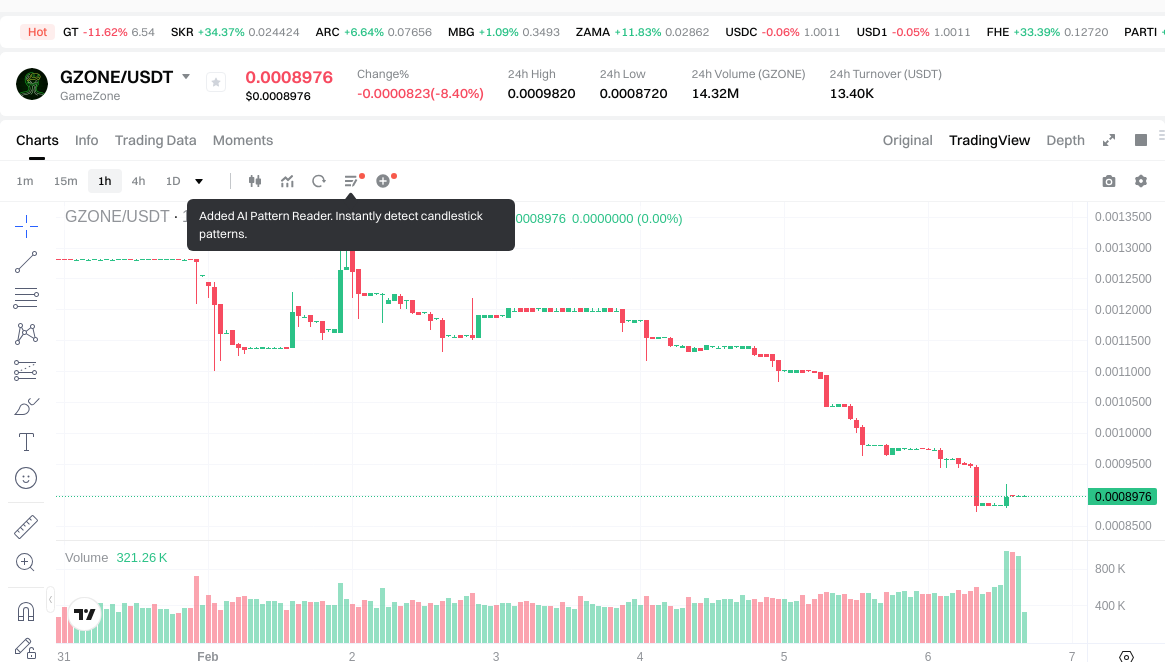
GZONE is a cryptocurrency asset in the blockchain gaming sector. As of February 6, 2026, GameZone maintains a market capitalization of approximately $376,960, with a circulating supply of around 419.12 million tokens, and a current trading price near $0.0008994. The project positions itself as an integrated center for blockchain gaming projects, focusing on funding, incubating, and developing gaming experiences that support NFT functionality. With contract deployments on both BSC and ETH networks, and approximately 1,074 token holders, GameZone represents a segment of the crypto gaming infrastructure space. This article examines GZONE's investment characteristics, historical price movements, future price considerations, and associated risks to provide analytical reference for market participants considering the question "Is GameZone (GZONE) a good investment?"
I. GameZone (GZONE) Price History Review and Current Investment Value
- 2021: GZONE reached a notable price level of $1.18 on November 18, 2021 → Representing a significant appreciation period for early investors
- 2022-2025: Multi-year downward trend → Price declined from higher levels to lower ranges, reflecting broader market conditions and sector adjustments
- 2026: Price approached lower support levels → As of February 6, 2026, GZONE traded at $0.00087241, indicating substantial decline from previous years
Current GZONE Investment Market Status (February 2026)
- GZONE current price: $0.0008994
- 24-hour trading volume: $13,340.18
- Market capitalization: $376,955.91
- Circulating supply: 419,119,309.65 GZONE (41.91% of total supply)
- Price performance: -8.4% (24H), -29.93% (7D), -41.75% (30D), -83.77% (1Y)
Click to view real-time GZONE market price
II. Core Factors Influencing Whether GZONE is a Good Investment
Supply Mechanism and Scarcity (GZONE Investment Scarcity)
- GameZone (GZONE) has a maximum supply of 1,000,000,000 tokens, with a current circulating supply of approximately 419,119,310 tokens, representing a circulation ratio of around 41.91%.
- The circulating supply relative to the maximum supply indicates a moderate level of token availability in the market. The predetermined maximum supply cap establishes a theoretical upper boundary for token issuance.
- As of February 6, 2026, the token price stands at $0.0008994, with a 24-hour trading volume of $13,340.18, reflecting the current market liquidity and trading activity.
- The fully diluted market capitalization is approximately $376,960.39, while the current market capitalization based on circulating supply is approximately $376,955.91.
- The supply structure and circulation ratio may influence price dynamics and investment considerations over time.
Institutional Investment and Mainstream Adoption (Institutional Investment in GZONE)
- The token currently has 1,074 holders recorded, indicating the existing holder base for GZONE.
- GZONE is available for trading on one exchange platform, with a 24-hour trading volume of $13,340.18.
- GameZone positions itself as a blockchain gaming platform offering early access to games, gaming tokens, NFTs, play-to-earn opportunities, and scholarships. GZONE token holders reportedly have access to new products, features, services, early game access, beta versions, and various play-to-earn games.
- Contract addresses are deployed on BSC and ETH networks, indicating multi-chain presence.
Macroeconomic Environment Impact on GZONE Investment
- GameZone operates within the broader blockchain gaming sector, which may be influenced by general market conditions affecting digital assets.
- Market sentiment indicators as of the reference date suggest a cautious environment (market_emotion: 1).
- The token's performance shows price fluctuations across different time periods: -0.2% (1H), -8.4% (24H), -29.93% (7D), -41.75% (30D), and -83.77% (1Y), reflecting various market dynamics.
- External economic factors, regulatory developments, and industry-wide trends in blockchain gaming may affect investment considerations for GZONE.
Technology and Ecosystem Development (Technology & Ecosystem for GZONE Investment)
- GameZone describes itself as an integrated center for blockchain game projects, focusing on funding, incubating, and developing play-to-earn and NFT-enabled gaming experiences.
- The platform aims to connect gaming enthusiasts with blockchain-based games, providing early access opportunities.
- GZONE holders reportedly gain access to multiple platform features including new game releases, beta versions, play-to-earn games, and NFT airdrops.
- The project operates with contract deployments on BSC (0xb6adb74efb5801160ff749b1985fd3bd5000e938) and ETH (0xb6adb74efb5801160ff749b1985fd3bd5000e938) networks.
- The platform's ecosystem encompasses gaming tokens, NFTs, scholarships, and tutorials as part of its value proposition to token holders.
III. GZONE Future Investment Forecast and Price Outlook (Is GameZone(GZONE) worth investing in 2026-2031)
Short-term Investment Forecast (2026, short-term GZONE investment outlook)
- Conservative forecast: $0.00053 - $0.00070
- Neutral forecast: $0.00070 - $0.00090
- Optimistic forecast: $0.00090 - $0.00096
Mid-term Investment Outlook (2027-2029, mid-term GameZone(GZONE) investment forecast)
- Market stage expectation: During 2027-2029, GZONE may experience gradual development with potential fluctuations in blockchain gaming sector adoption
- Investment return forecast:
- 2027: $0.00071 - $0.0011
- 2028: $0.00083 - $0.0011
- 2029: $0.00057 - $0.0014
- Key catalysts: blockchain gaming industry development trends, NFT market dynamics, platform user adoption rates
Long-term Investment Outlook (Is GZONE a good long-term investment?)
- Base scenario: $0.00091 - $0.0016 (assuming steady platform development and maintained market presence)
- Optimistic scenario: $0.0014 - $0.0016 (assuming enhanced ecosystem growth and favorable market conditions)
- Risk scenario: below $0.00057 (under adverse market conditions or reduced platform activity)
View GZONE long-term investment and price forecast: Price Prediction
2026-02-06 to 2031 Long-term Outlook
- Base scenario: $0.00091 - $0.0014 USD (corresponding to steady progress and gradual mainstream application improvement)
- Optimistic scenario: $0.0014 - $0.0016 USD (corresponding to large-scale adoption and favorable market environment)
- Transformative scenario: above $0.0016 USD (such as breakthrough ecosystem development and mainstream popularization)
- 2031-12-31 forecast high: $0.0016 USD (based on optimistic development assumptions)
Disclaimer: The above forecasts are based on current market data and historical trends. Cryptocurrency markets are highly volatile and unpredictable. These projections should not be considered as investment advice. Users should conduct their own research and consult with financial professionals before making any investment decisions.
| Year |
Predicted High Price |
Predicted Average Price |
Predicted Low Price |
Price Change |
| 2026 |
0.000960432 |
0.0008976 |
0.000529584 |
0 |
| 2027 |
0.00110552904 |
0.000929016 |
0.00070605216 |
3 |
| 2028 |
0.0010986543216 |
0.00101727252 |
0.0008341634664 |
13 |
| 2029 |
0.001364772812832 |
0.0010579634208 |
0.000571300247232 |
17 |
| 2030 |
0.001647460638869 |
0.001211368116816 |
0.001126572348638 |
34 |
| 2031 |
0.00162953239074 |
0.001429414377842 |
0.000914825201819 |
58 |
IV. GameZone Investment Strategy and Risk Management (How to invest in GameZone)
Investment Methodology (GameZone investment strategy)
-
Long-term Holding (HODL GameZone): Suitable for steady investors
Long-term holding strategy involves purchasing GZONE tokens and maintaining positions over extended periods, regardless of short-term price fluctuations. This approach may be appropriate for investors who believe in the fundamental value proposition of GameZone's blockchain gaming ecosystem and NFT-enabled gaming experiences. Given the project's focus on funding, incubating, and developing next-generation gaming projects, investors adopting this strategy should consider the multi-year development cycle typical of gaming platforms.
-
Active Trading: Relies on technical analysis and swing trading
Active trading strategies for GZONE involve capitalizing on price movements through technical analysis and market timing. With recent price volatility showing fluctuations within the range of $0.000872 to $0.000982 over 24 hours, swing traders may identify entry and exit opportunities based on support and resistance levels. However, traders should note that GZONE's trading volume of approximately $13,340 over 24 hours suggests relatively limited liquidity, which may impact execution quality and increase slippage risk.
Risk Management (Risk management for GameZone investment)
-
Asset Allocation Ratio: Conservative / Aggressive / Professional investors
Asset allocation for GZONE should reflect individual risk tolerance and investment objectives:
-
Conservative investors: Consider limiting GZONE exposure to 1-3% of cryptocurrency portfolio or 0.5-1% of total investment portfolio, given the token's high volatility and limited market capitalization of approximately $376,960.
-
Aggressive investors: May allocate 5-10% of cryptocurrency portfolio to GZONE, acknowledging higher risk-return profiles associated with lower-cap gaming tokens.
-
Professional investors: Could implement dynamic allocation strategies based on market conditions, project milestones, and gaming sector developments, potentially ranging from 3-15% of specialized blockchain gaming portfolios.
-
Risk Hedging Solutions: Multi-asset portfolio + hedging instruments
Risk mitigation strategies for GZONE investment include:
-
Portfolio diversification across multiple blockchain gaming projects and established cryptocurrencies to reduce concentration risk
-
Correlation analysis with broader gaming sector tokens and major cryptocurrencies to optimize portfolio construction
-
Position sizing based on volatility metrics, considering GZONE's recent drawdowns of 8.4% (24H), 29.93% (7D), and 41.75% (30D)
-
Implementation of stop-loss orders to limit downside exposure during adverse market conditions
-
Secure Storage: Hot/cold wallets + hardware wallet recommendations
GZONE tokens are deployed on both BSC (BNB Smart Chain) and Ethereum networks (contract address: 0xb6adb74efb5801160ff749b1985fd3bd5000e938). Storage security considerations include:
-
Hardware wallets: Ledger or Trezor devices supporting BSC and Ethereum networks provide enhanced security for long-term storage
-
Software wallets: MetaMask, Trust Wallet, or similar multi-chain wallets for active trading positions, ensuring proper network configuration
-
Cold storage: For significant holdings, consider offline storage solutions with multi-signature capabilities
-
Security practices: Regular wallet software updates, secure backup of recovery phrases, and verification of contract addresses before transactions
V. GameZone Investment Risks and Challenges (Risks of investing in GameZone)
-
Market Risk: High volatility, price manipulation
GZONE exhibits substantial price volatility, with annual decline of 83.77% from previous levels. The token's 24-hour price range between $0.000872 and $0.000982 represents approximately 12.6% volatility within a single day. With a market capitalization of approximately $377,000 and circulating supply of 419,119,309 tokens (representing 41.91% of total supply), GZONE presents characteristics typical of micro-cap cryptocurrencies, including susceptibility to sharp price movements based on relatively small trading volumes. The token's market dominance of 0.000016% indicates minimal market presence, which may amplify vulnerability to price manipulation or coordinated trading activities. Investors should exercise heightened caution regarding liquidity risk and potential difficulty executing larger orders without significant market impact.
-
Regulatory Risk: Policy uncertainty across different jurisdictions
Blockchain gaming and NFT-enabled gaming experiences face evolving regulatory landscapes globally. Different jurisdictions maintain varying stances on gaming tokens, play-to-earn mechanisms, and NFT assets. GameZone's operational model involving funding, incubation, and development of gaming projects may encounter regulatory scrutiny regarding securities classifications, gaming regulations, consumer protection laws, and cross-border transaction compliance. Changes in regulatory frameworks could materially affect GZONE's utility, trading accessibility, or project viability. The dual-chain deployment on BSC and Ethereum may introduce additional compliance considerations depending on how regulators treat multi-chain token structures.
-
Technical Risk: Network security vulnerabilities, upgrade failures
Technical risks associated with GZONE investment include:
-
Smart contract vulnerabilities: Potential security flaws in token contracts deployed on BSC and Ethereum networks (contract address: 0xb6adb74efb5801160ff749b1985fd3bd5000e938)
-
Bridge risk: Multi-chain presence introduces potential vulnerabilities in cross-chain bridge infrastructure
-
Network dependency: Reliance on underlying BSC and Ethereum network security, performance, and upgrade success
-
Project execution risk: Development challenges in incubating and launching gaming projects within GameZone's ecosystem
-
Technology obsolescence: Rapid evolution in blockchain gaming technology may render current infrastructure outdated
With approximately 1,074 token holders, the limited community size may impact network effects and reduce collective security monitoring capabilities. Investors should monitor contract audit reports, development activity, and security incident disclosures.
VI. Conclusion: Is GameZone a Good Investment?
-
Investment Value Summary: GameZone presents potential opportunities within the blockchain gaming sector but exhibits substantial short-term price volatility.
GZONE's positioning as an integrated hub for blockchain gaming projects addresses a growing market segment combining gaming, NFTs, and play-to-earn mechanics. However, the token's performance metrics reveal significant challenges, including an 83.77% decline over one year and current price of $0.0008994, approaching its recorded low of $0.00087241. The circulating market capitalization of approximately $377,000 and limited trading volume suggest early-stage market development with corresponding high-risk characteristics. The project's approach to funding, incubating, and developing gaming experiences may generate long-term value if executed successfully, but investors should weigh this potential against substantial near-term volatility and execution risks inherent in micro-cap gaming tokens.
-
Investor Recommendations:
✅ Beginners: Dollar-cost averaging + secure wallet storage
New investors considering GZONE should employ systematic investment approaches such as dollar-cost averaging to mitigate entry timing risk. Prioritize security by storing tokens in self-custody wallets (hardware wallets recommended for holdings above $500-1,000 equivalent). Limit initial exposure to amounts comfortable to lose entirely, given the token's volatility profile and micro-cap status. Thoroughly research GameZone's project developments, gaming partnerships, and ecosystem growth before committing capital.
✅ Experienced Investors: Swing trading + portfolio allocation
Investors with technical analysis capabilities may identify tactical trading opportunities based on GZONE's volatility patterns and support/resistance levels. Consider implementing position sizing strategies that account for the token's limited liquidity (24-hour volume approximately $13,340). Incorporate GZONE within a diversified blockchain gaming portfolio, maintaining exposure limits consistent with micro-cap risk profiles. Monitor developments in GameZone's incubated projects, partnership announcements, and gaming sector trends that may influence GZONE valuation.
✅ Institutional Investors: Strategic long-term allocation
Institutional participants evaluating blockchain gaming exposure might consider GZONE within venture-style allocation frameworks, recognizing the token's characteristics align more closely with early-stage venture investments than established digital assets. Conduct comprehensive due diligence on GameZone's operational team, project pipeline, competitive positioning, and tokenomics (noting 41.91% circulating supply with maximum supply of 1,000,000,000 tokens). Implement appropriate governance frameworks for micro-cap digital asset holdings, including enhanced monitoring protocols and clearly defined exit criteria based on project milestone achievements or deterioration in fundamental metrics.
⚠️ Disclaimer: Cryptocurrency investment involves substantial risk. This analysis is provided for informational purposes only and does not constitute investment advice. Investors should conduct independent research and consult qualified financial advisors before making investment decisions. Past performance does not guarantee future results.
VII. FAQ
Q1: What is GameZone (GZONE) and how does it function in the blockchain gaming ecosystem?
GameZone (GZONE) is a cryptocurrency token that serves as the utility asset for an integrated blockchain gaming platform. The platform functions as a hub for funding, incubating, and developing play-to-earn and NFT-enabled gaming experiences. GZONE token holders gain access to early game releases, beta versions, gaming tokens, NFT airdrops, scholarships, and various play-to-earn opportunities. The token is deployed on both BSC and Ethereum networks (contract address: 0xb6adb74efb5801160ff749b1985fd3bd5000e938), enabling multi-chain functionality. As of February 6, 2026, GZONE has a maximum supply of 1,000,000,000 tokens with approximately 419,119,310 tokens in circulation (41.91% circulation ratio), serving approximately 1,074 token holders across its ecosystem.
Q2: What is the current market performance of GZONE and how has it performed historically?
As of February 6, 2026, GZONE trades at $0.0008994 with a market capitalization of approximately $376,960 and 24-hour trading volume of $13,340.18. The token's performance shows significant volatility: -8.4% (24H), -29.93% (7D), -41.75% (30D), and -83.77% (1Y). Historically, GZONE reached a notable high of $1.18 on November 18, 2021, representing its peak price level. From 2022 through 2025, the token experienced a multi-year downward trend, declining substantially from previous highs. The current price of approximately $0.00087-$0.00090 represents a significant decline from historical levels, placing GZONE in the micro-cap cryptocurrency category with characteristics typical of early-stage gaming tokens.
Q3: What are the primary investment risks associated with GZONE?
GZONE presents several significant investment risks. Market risk is substantial due to high volatility (12.6% intraday range), micro-cap status (approximately $377,000 market capitalization), and limited liquidity (24-hour volume around $13,340). Regulatory risk stems from evolving frameworks governing blockchain gaming, play-to-earn mechanics, and NFT assets across different jurisdictions. Technical risks include potential smart contract vulnerabilities, cross-chain bridge security concerns, network dependency on BSC and Ethereum infrastructure, and project execution challenges in game development and incubation. The token's 83.77% annual decline and limited holder base (1,074 holders) indicate heightened volatility and potential manipulation susceptibility. The circulating supply of 41.91% suggests future token releases may impact price dynamics.
Q4: What is the price forecast for GZONE from 2026 to 2031?
Short-term forecasts for 2026 range from conservative ($0.00053-$0.00070), neutral ($0.00070-$0.00090), to optimistic ($0.00090-$0.00096) scenarios. Mid-term projections suggest gradual development: 2027 ($0.00071-$0.0011), 2028 ($0.00083-$0.0011), and 2029 ($0.00057-$0.0014). Long-term outlook for 2031 indicates a predicted high of $0.0016, average of $0.00143, and low of $0.00091 under base scenarios. Optimistic scenarios project $0.0014-$0.0016 assuming enhanced ecosystem growth and favorable market conditions, while risk scenarios suggest prices below $0.00057 under adverse conditions. These forecasts depend on blockchain gaming industry development, NFT market dynamics, platform user adoption rates, and successful execution of GameZone's incubation projects. Important note: These projections are speculative and subject to high uncertainty given cryptocurrency market volatility.
Q5: How should different investor types approach GZONE investment?
Investment approach should align with experience level and risk tolerance. Beginners should employ dollar-cost averaging strategies, utilize secure wallet storage (hardware wallets recommended for holdings above $500-1,000 equivalent), and limit initial exposure to amounts comfortable to lose entirely given GZONE's micro-cap status and 83.77% annual decline. Experienced investors may implement swing trading strategies based on technical analysis, recognizing limited liquidity constraints, while maintaining GZONE within a diversified blockchain gaming portfolio at exposure levels consistent with micro-cap risk profiles (potentially 5-10% of crypto portfolio). Institutional investors should evaluate GZONE through venture-style allocation frameworks, conducting comprehensive due diligence on operational team, project pipeline, and tokenomics, while implementing enhanced monitoring protocols and clearly defined exit criteria based on milestone achievements.
Q6: What allocation percentage is recommended for GZONE in an investment portfolio?
Allocation recommendations vary by investor type and risk tolerance. Conservative investors should limit GZONE exposure to 1-3% of cryptocurrency portfolio or 0.5-1% of total investment portfolio, given the token's high volatility, micro-cap status (approximately $377,000 market capitalization), and substantial recent drawdowns. Aggressive investors may allocate 5-10% of cryptocurrency portfolio to GZONE, acknowledging higher risk-return profiles associated with lower-cap gaming tokens and accepting potential for significant losses. Professional investors could implement dynamic allocation strategies ranging from 3-15% of specialized blockchain gaming portfolios, adjusted based on market conditions, project milestones, and gaming sector developments. All allocations should be complemented by comprehensive risk management including portfolio diversification, correlation analysis, position sizing based on volatility metrics, and implementation of stop-loss orders.
Q7: What security measures should be taken when storing GZONE tokens?
GZONE security requires multi-chain wallet compatibility supporting both BSC and Ethereum networks. Hardware wallets (Ledger or Trezor devices) provide optimal security for long-term storage, protecting against online threats while supporting multi-chain functionality. Software wallets such as MetaMask or Trust Wallet serve active trading positions but require proper network configuration and regular security updates. For significant holdings, implement cold storage solutions with multi-signature capabilities to reduce custodial risk. Essential security practices include: verifying contract address (0xb6adb74efb5801160ff749b1985fd3bd5000e938) before transactions, maintaining secure offline backups of recovery phrases, using unique strong passwords, enabling two-factor authentication where available, and avoiding sharing wallet credentials. Consider splitting holdings between hot wallets (small amounts for active use) and cold storage (majority of holdings for long-term security).
Q8: What factors could positively or negatively impact GZONE's future value?
Positive catalysts include successful development and launch of GameZone-incubated gaming projects, increased adoption of platform features by gaming communities, strategic partnerships with established gaming companies, growth in blockchain gaming sector and NFT market, expansion of holder base beyond current 1,074 holders, and favorable regulatory developments for play-to-earn models. Negative factors encompass continued downward price pressure (current 83.77% annual decline), limited liquidity and trading volume (approximately $13,340 daily), competitive pressures from established gaming platforms, regulatory restrictions on gaming tokens or NFTs, technical vulnerabilities in smart contracts or cross-chain infrastructure, failure to execute on project incubation pipeline, broader cryptocurrency market downturns, and potential additional token releases from non-circulating supply (58.09% currently not in circulation). The token's micro-cap status amplifies both positive and negative impact magnitudes.
* The information is not intended to be and does not constitute financial advice or any other recommendation of any sort offered or endorsed by Gate.