This comprehensive analysis examines whether Goose Finance (EGG) represents a viable investment opportunity in 2024-2026. Currently trading at $0.004298 with a market capitalization of $243,536 on Gate, EGG demonstrates high volatility and limited liquidity despite its operation on Binance Smart Chain. The article evaluates critical factors including historical price performance declining 54.81% annually, tokenomics with circulating supply exceeding maximum supply, and modest adoption metrics with 12,299 token holders. Through detailed price projections, risk assessments covering market, regulatory, and technical vulnerabilities, and tailored investment strategies for different investor profiles, this guide provides essential context for potential EGG token investors. The analysis concludes that EGG presents a high-risk, speculative opportunity suitable primarily for experienced DeFi investors implementing strict portfolio allocation and risk management protocols.
Introduction: Goose Finance (EGG) Investment Position and Market Outlook
Goose Finance (EGG) is a decentralized exchange token operating within the cryptocurrency ecosystem. Launched in February 2021, the project has positioned itself within the decentralized finance (DeFi) sector on Binance Smart Chain. As of February 8, 2026, EGG maintains a market capitalization of approximately $243,535, with a circulating supply of around 56.66 million tokens, and a current price at $0.004298. The token has experienced notable price fluctuations, with a 24-hour trading volume of approximately $19,999. With a holder base of 12,299 addresses, EGG represents a smaller-cap asset in the DeFi landscape. When investors consider "Is Goose Finance (EGG) a good investment?", they examine various factors including market performance, liquidity conditions, and project fundamentals. This article provides a comprehensive analysis of EGG's investment characteristics, historical price movements, future price projections, and associated investment risks to serve as a reference for potential investors.
I. Price History Review and Current Investment Value of EGG Token
- February 2021: EGG reached a notable price level during the DeFi yield farming boom. Early investors who participated in the initial launch period witnessed substantial returns as the token gained traction.
- July 2024: The token experienced a significant price correction, falling to a low point of $0.000000991998, reflecting broader market volatility and changes in DeFi investment sentiment.
- February 2026: As of the current period, EGG trades at $0.004298, showing recovery from previous lows. However, the token remains considerably below its earlier peak levels, with the price declining -54.81% over the past year.
Current EGG Investment Market Status (February 2026)
- Current EGG Price: $0.004298
- Market Sentiment (Market Emotion Index): Bearish, with recent 24-hour performance showing -3.98% decline
- 24-Hour Trading Volume: $19,999.13
- Token Circulation: 56,662,579 EGG tokens in circulation, representing 113.67% of the total supply of 49,847,578 tokens
- Market Capitalization: $243,535.76
- Price Range (24h): High $0.004478, Low $0.004209
Check real-time EGG market price
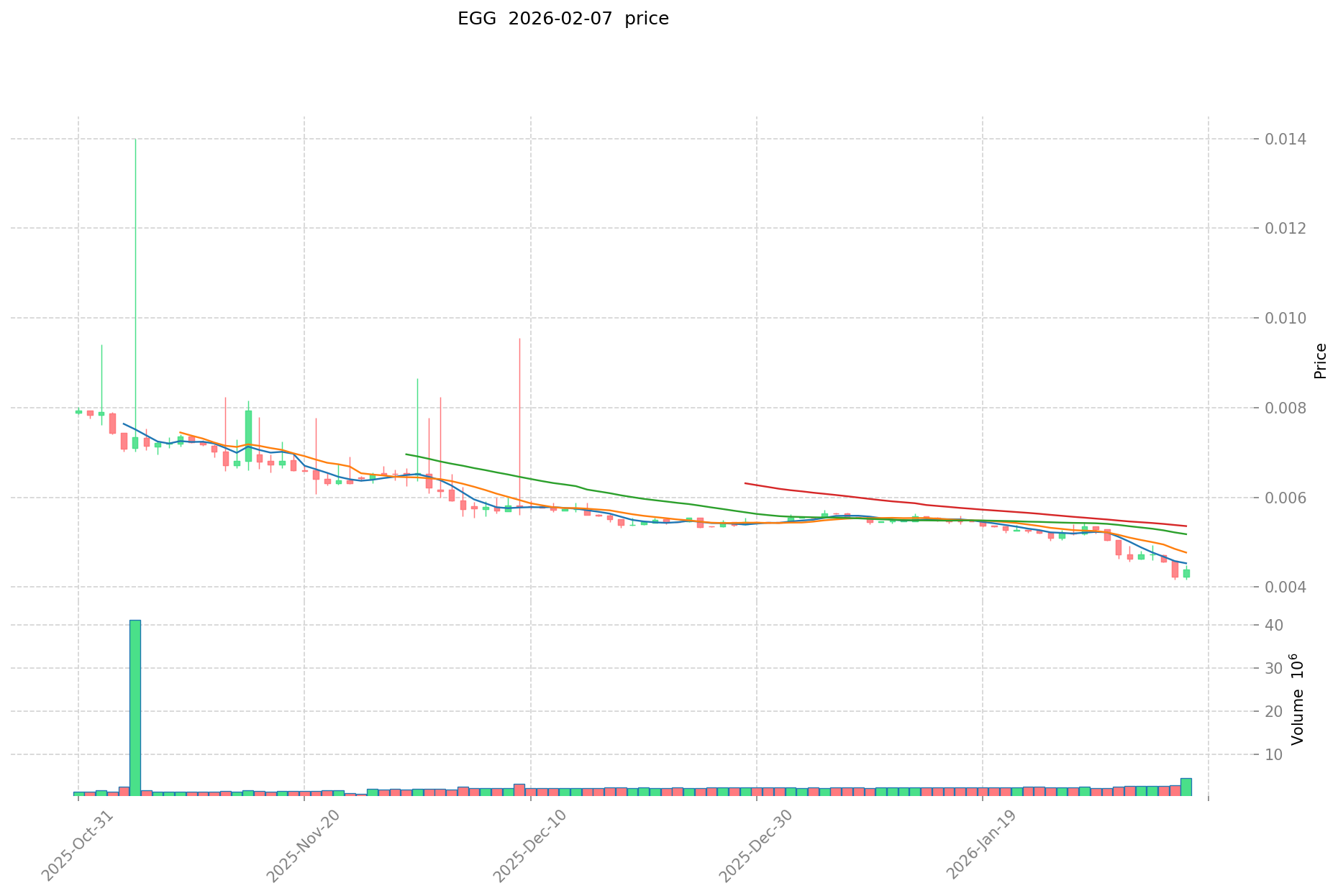
II. Core Factors Influencing Whether EGG is a Good Investment (Is Goose Finance(EGG) a Good Investment)
Supply Mechanism and Scarcity (EGG investment scarcity)
- Supply Structure → Influences price and investment value
- Goose Finance (EGG) has a maximum supply of 49,847,578 tokens, with a current circulating supply of 56,662,579 tokens. The circulating supply exceeding the maximum supply (113.67% ratio) indicates a unique tokenomics structure that may impact scarcity considerations.
- The relationship between total supply and circulating volume suggests that supply dynamics remain a factor in evaluating investment positioning, though the current market capitalization of approximately $243,536 reflects limited market depth.
- Investment Significance: Understanding the supply mechanism is relevant when assessing potential scarcity-driven value, though current market conditions show constrained liquidity with 24-hour trading volume at $19,999.
Institutional Investment and Mainstream Adoption (Institutional investment in EGG)
- Market Positioning: Goose Finance operates as a decentralized exchange on Binance Smart Chain, integrated with PancakeSwap for token earning mechanisms.
- The project has a holder base of 12,299 addresses, indicating a community-driven rather than institution-led adoption pattern.
- The market dominance stands at 0.0000085%, suggesting limited mainstream adoption relative to broader cryptocurrency markets.
Macroeconomic Environment's Impact on EGG Investment
- Market Performance Context: Recent price trends show declines across multiple timeframes: -0.22% (1H), -3.98% (24H), -9.049% (7D), -22.73% (30D), and -54.81% (1Y).
- The current price of $0.004298 reflects substantial distance from historical price ranges, with the token having experienced significant volatility.
- Market sentiment indicators suggest a cautious outlook, with technical analysis showing limited buying signals across various moving average periods.
Technology and Ecosystem Development (Technology & Ecosystem for EGG investment)
- Platform Foundation: Built on Binance Smart Chain, providing compatibility with BSC ecosystem infrastructure and lower transaction costs compared to some alternative networks.
- The integration with PancakeSwap enables liquidity provision and yield generation mechanisms, though specific technical upgrade roadmaps are not detailed in available materials.
- The decentralized exchange functionality positions EGG within the DeFi category, though the extent of ecosystem expansion and additional applications remains limited in scope based on current information.
III. EGG Future Investment Prediction and Price Outlook (Is Goose Finance (EGG) worth investing in 2026-2031)
Short-term Investment Prediction (2026, short-term EGG investment outlook)
Based on current market data, EGG exhibits characteristics of a low-liquidity, high-volatility asset. As of February 8, 2026, the token trades at approximately $0.004298, with a 24-hour decline of 3.98% and significant downward pressure reflected in 7-day (-9.05%), 30-day (-22.73%), and 1-year (-54.81%) performance metrics.
- Conservative Forecast: $0.0024 - $0.0035
- Neutral Forecast: $0.0035 - $0.0043
- Optimistic Forecast: $0.0043 - $0.0047
The short-term outlook remains cautious due to persistent selling pressure and limited trading volume ($19,999.13 in 24-hour volume). The token's circulation ratio exceeds 100%, indicating potential supply-side challenges that may constrain upward price movement.
Mid-term Investment Outlook (2027-2028, mid-term Goose Finance (EGG) investment forecast)
-
Market Stage Expectation: Consolidation phase with potential for gradual recovery, contingent upon broader DeFi market conditions and sustained activity on the Binance Smart Chain ecosystem.
-
Investment Return Forecast:
- 2027: $0.0031 - $0.0047 (representing potential stabilization around current levels with modest upside)
- 2028: $0.0039 - $0.0054 (assuming incremental improvements in platform utility and user engagement)
-
Key Catalysts: Platform development updates, integration with emerging DeFi protocols, expansion of liquidity pools, improvements in token utility within the Goose Finance ecosystem, and broader adoption trends within BSC-based decentralized exchanges.
Long-term Investment Outlook (Is Goose Finance a good long-term investment?)
Long-term prospects depend heavily on the project's ability to maintain relevance within an increasingly competitive DeFi landscape, particularly given the emergence of alternative platforms and shifting user preferences.
- Baseline Scenario: $0.0029 - $0.0067 (assumes continued operation with moderate platform activity and steady but limited growth in user base)
- Optimistic Scenario: $0.0041 - $0.0086 (assumes successful protocol upgrades, expanded partnerships, enhanced token utility, and favorable macroeconomic conditions for DeFi assets)
- Risk Scenario: $0.0010 - $0.0025 (reflects potential outcomes under adverse conditions such as sustained market downturns, increased competition, regulatory challenges, or declining platform engagement)
Click to view EGG long-term investment and price prediction: Price Prediction
2026-02-08 to 2031 Long-term Outlook
- Base Scenario: $0.0029 - $0.0067 (corresponding to steady progress and gradual adoption within niche DeFi segments)
- Optimistic Scenario: $0.0041 - $0.0086 (corresponding to broader market recovery and favorable developments in BSC ecosystem)
- Transformative Scenario: Above $0.0100 (contingent upon breakthrough ecosystem developments, major partnerships, or substantial increases in platform utility and user adoption)
- 2031-12-31 Predicted High: $0.0086 (based on optimistic development assumptions and sustained engagement within the Goose Finance platform)
Disclaimer: The above predictions are based on historical data, current market conditions, and analytical projections. Cryptocurrency markets are highly volatile and subject to numerous unpredictable factors including regulatory changes, technological developments, macroeconomic conditions, and market sentiment shifts. Past performance does not guarantee future results. Investors should conduct thorough independent research, consider their risk tolerance, and consult with qualified financial advisors before making investment decisions. This analysis does not constitute financial advice or investment recommendations.
| Year |
Predicted High Price |
Predicted Average Price |
Predicted Low Price |
Price Change |
| 2026 |
0.00467719 |
0.004291 |
0.00244587 |
0 |
| 2027 |
0.0046634588 |
0.004484095 |
0.0031388665 |
4 |
| 2028 |
0.005351318973 |
0.0045737769 |
0.003933448134 |
6 |
| 2029 |
0.005111424374595 |
0.0049625479365 |
0.00387078739047 |
15 |
| 2030 |
0.006699191586878 |
0.005036986155547 |
0.002871082108662 |
17 |
| 2031 |
0.00856740975197 |
0.005868088871212 |
0.004107662209848 |
36 |
IV. Goose Finance (EGG) Investment Strategy and Risk Management (How to invest in DeFi tokens)
Investment Methodology (EGG investment strategy)
-
Long-term Holding (HODL EGG): Suitable for conservative investors who believe in the long-term potential of decentralized finance ecosystems built on Binance Smart Chain. Given EGG's current trading price of $0.004298 and significant decline from its historical peak, this strategy requires careful consideration of the project's fundamentals and sustainability.
-
Active Trading: Relies on technical analysis and swing trading opportunities. EGG has demonstrated notable price volatility, with 24-hour fluctuations between $0.004209 and $0.004478. Traders may identify entry and exit points based on support and resistance levels, though liquidity considerations are important given the relatively modest 24-hour trading volume of approximately $19,999.
Risk Management (Risk management for EGG investment)
V. Goose Finance (EGG) Investment Risks and Challenges (Risks of investing in DeFi tokens)
-
Market Risk: EGG exhibits high volatility with significant price declines across multiple timeframes (24H: -3.98%, 7D: -9.049%, 30D: -22.73%, 1Y: -54.81%). The token has experienced substantial depreciation from its historical high of $172.51 in February 2021 to the current price of $0.004298. Limited exchange availability (2 exchanges) may contribute to liquidity constraints and increased price manipulation susceptibility.
-
Regulatory Risk: As a DeFi protocol operating on Binance Smart Chain, EGG faces evolving regulatory landscapes across different jurisdictions. Regulatory developments affecting decentralized exchanges, yield farming protocols, or BSC ecosystem could impact the project's operations and token valuation. Policy uncertainty in major markets may create compliance challenges.
-
Technical Risk: Smart contract vulnerabilities represent a persistent concern for DeFi protocols. While the project maintains a GitHub presence, investors should assess audit history and security measures. Network congestion on BSC, potential protocol upgrades, or integration issues with PancakeSwap could affect functionality. The circulating supply exceeding max supply (56,662,579 vs. 49,847,578) raises questions about token economics that require clarification.
VI. Conclusion: Is DeFi token a Good Investment?
-
Investment Value Summary: Goose Finance (EGG) represents a high-risk, high-volatility investment within the DeFi sector. While the project operates on the established Binance Smart Chain infrastructure and integrates with PancakeSwap, the significant price depreciation over the past year and modest market capitalization of approximately $243,536 suggest limited near-term growth catalysts. The token's long-term potential depends heavily on protocol development, user adoption, and broader DeFi market conditions.
-
Investor Recommendations:
✅ Beginners: Consider dollar-cost averaging with minimal allocation (1-2% of crypto portfolio). Prioritize secure wallet storage using hardware wallets. Thoroughly research DeFi mechanics and BSC ecosystem before investing.
✅ Experienced Investors: Implement swing trading strategies based on technical analysis while maintaining strict stop-loss levels. Diversify across multiple DeFi protocols to manage sector-specific risks. Monitor on-chain metrics and protocol developments.
✅ Institutional Investors: Conduct comprehensive due diligence including smart contract audits, team assessment, and competitive analysis. Consider EGG as a minor allocation within broader DeFi exposure strategy rather than core holding.
⚠️ Disclaimer: Cryptocurrency investments carry substantial risk. This analysis is for informational purposes only and does not constitute financial advice. Past performance does not guarantee future results. Investors should conduct independent research and consult financial advisors before making investment decisions.
VII. FAQ
Q1: What is the current market position of Goose Finance (EGG) as of February 2026?
As of February 8, 2026, Goose Finance (EGG) trades at $0.004298 with a market capitalization of approximately $243,536 and a 24-hour trading volume of $19,999. The token operates as a decentralized exchange protocol on Binance Smart Chain with a holder base of 12,299 addresses. The circulating supply stands at 56.66 million tokens, representing 113.67% of the maximum supply. Recent performance shows downward pressure with a 24-hour decline of 3.98%, 7-day decline of 9.05%, and a significant 54.81% decrease over the past year, indicating bearish market sentiment and limited liquidity conditions.
Q2: What are the key factors that influence EGG's investment value?
Several factors impact EGG's investment characteristics: (I) Supply dynamics - the circulating supply exceeding maximum supply creates unique tokenomics considerations; (II) Platform integration - connectivity with PancakeSwap and Binance Smart Chain infrastructure provides utility within the DeFi ecosystem; (III) Market positioning - with a market dominance of 0.0000085%, EGG represents a smaller-cap asset with limited mainstream adoption; (IV) Trading liquidity - modest 24-hour volume of approximately $20,000 suggests constrained market depth; (V) Ecosystem development - ongoing protocol functionality on BSC affects long-term viability. The combination of these factors determines price movements and investment attractiveness within the competitive DeFi landscape.
Q3: What are the price predictions for Goose Finance (EGG) from 2026 to 2031?
Price projections vary based on market scenarios: Short-term (2026) forecasts range from $0.0024-$0.0047, with conservative, neutral, and optimistic scenarios. Mid-term (2027-2028) estimates suggest $0.0031-$0.0047 for 2027 and $0.0039-$0.0054 for 2028, assuming gradual recovery and platform development. Long-term outlook through 2031 presents three scenarios: Baseline ($0.0029-$0.0067), Optimistic ($0.0041-$0.0086), and Risk ($0.0010-$0.0025). The 2031 predicted high reaches $0.0086 under favorable conditions including protocol upgrades and increased adoption. However, these predictions remain speculative and subject to high volatility, regulatory changes, technological developments, and overall cryptocurrency market conditions.
Q4: What investment strategies are suitable for EGG token holders?
Two primary approaches exist for EGG investment: (I) Long-term holding (HODL) suits conservative investors believing in DeFi ecosystem potential on Binance Smart Chain, requiring careful evaluation of project sustainability given significant historical decline; (II) Active trading leverages technical analysis and short-term price volatility, with 24-hour fluctuations between $0.004209 and $0.004478 providing swing trading opportunities. Asset allocation recommendations vary by investor profile: conservative investors should limit DeFi exposure to 1-3% of total crypto portfolio, aggressive investors may allocate 5-10%, while professional investors can implement dynamic allocation strategies. Risk management includes portfolio diversification across multiple DeFi protocols and secure storage practices using hardware wallets (Ledger, Trezor) for long-term holdings or MetaMask/Trust Wallet for active trading.
Q5: What are the primary risks associated with investing in Goose Finance (EGG)?
Three major risk categories affect EGG investment: (I) Market Risk - high volatility with substantial price declines across all timeframes (24H: -3.98%, 7D: -9.05%, 30D: -22.73%, 1Y: -54.81%), limited exchange availability (2 exchanges) creating liquidity constraints, and dramatic depreciation from historical peak of $172.51 to current $0.004298; (II) Regulatory Risk - evolving compliance requirements for DeFi protocols, uncertain policy landscape affecting decentralized exchanges, and potential jurisdictional restrictions on BSC ecosystem operations; (III) Technical Risk - smart contract vulnerabilities inherent to DeFi protocols, questions surrounding circulating supply exceeding maximum supply (56.66M vs. 49.85M tokens), potential network congestion on Binance Smart Chain, and integration dependencies with PancakeSwap. Investors must conduct thorough due diligence and maintain strict risk management protocols.
Q6: How does Goose Finance (EGG) compare to other DeFi tokens in terms of adoption and liquidity?
Goose Finance (EGG) demonstrates limited market penetration compared to established DeFi protocols. With a market dominance of 0.0000085% and market capitalization of $243,536, EGG represents a micro-cap asset within the DeFi sector. The 24-hour trading volume of approximately $19,999 indicates constrained liquidity relative to major DeFi tokens that typically experience millions in daily volume. The holder base of 12,299 addresses suggests community-driven rather than institutional adoption patterns. Platform availability on only 2 exchanges further restricts accessibility and market depth. These metrics position EGG as a niche DeFi token with limited mainstream recognition, contrasting with leading protocols that maintain broader exchange listings, deeper liquidity pools, and higher institutional participation.
Q7: What security measures should investors implement when holding EGG tokens?
Comprehensive security practices are essential for EGG token holders: (I) Storage solutions - utilize hardware wallets (Ledger, Trezor) for long-term holdings to minimize online exposure, or employ secure hot wallets (MetaMask, Trust Wallet) for active trading on Binance Smart Chain; (II) Verification protocols - always confirm the official contract address (0xF952Fc3ca7325Cc27D15885d37117676d25BfdA6 on BSC) before any transaction to prevent phishing attacks; (III) Access security - enable two-factor authentication on all exchange accounts and wallet interfaces, never share private keys or seed phrases, and maintain separate wallets for different risk levels; (IV) Transaction safety - start with small test transactions when using new addresses, review gas fees and network congestion, and monitor smart contract interactions through BSCScan for transparency.
Q8: Is Goose Finance (EGG) suitable for different types of investors?
Investment suitability varies significantly by investor profile: (I) Beginners - EGG presents substantial challenges due to high volatility, limited liquidity, and complex DeFi mechanics; newcomers should limit allocation to 1-2% of crypto portfolio, prioritize education on BSC ecosystem, and implement dollar-cost averaging strategies while using secure hardware wallet storage; (II) Experienced Investors - those familiar with DeFi protocols may explore swing trading opportunities based on technical analysis, maintaining strict stop-loss levels and diversifying across multiple protocols to manage sector-specific risks while monitoring on-chain metrics; (III) Institutional Investors - should treat EGG as a minor allocation within broader DeFi exposure strategy, conducting comprehensive due diligence including smart contract audits, team assessment, and competitive analysis rather than core holding positioning. All investor categories must acknowledge the speculative nature and substantial risk profile of this asset class.
* The information is not intended to be and does not constitute financial advice or any other recommendation of any sort offered or endorsed by Gate.