This comprehensive analysis examines whether HappyCat (HAPPY) represents a viable investment opportunity. The article evaluates the token's market performance since its 2024 launch, detailed price history showing a decline from $0.04723 to $0.0002951, and supply mechanics featuring 3.3 billion fixed tokens with 100% circulation. Key investment factors include limited exchange listings, modest trading volume of $14,961, and dependence on meme culture sustainability. The analysis provides price forecasts for 2026-2031 across conservative, neutral, and optimistic scenarios, ranging from $0.000255 to $0.000649. Risk assessment highlights market volatility, regulatory uncertainty, technical dependencies on Solana, and community engagement risks. Investment strategies tailored for different investor profiles—from beginners limiting exposure to experienced traders using active trading—emphasize diversification and risk management protocols critical for navigating this speculative asset class.
Introduction: HappyCat (HAPPY) Investment Position and Market Prospects
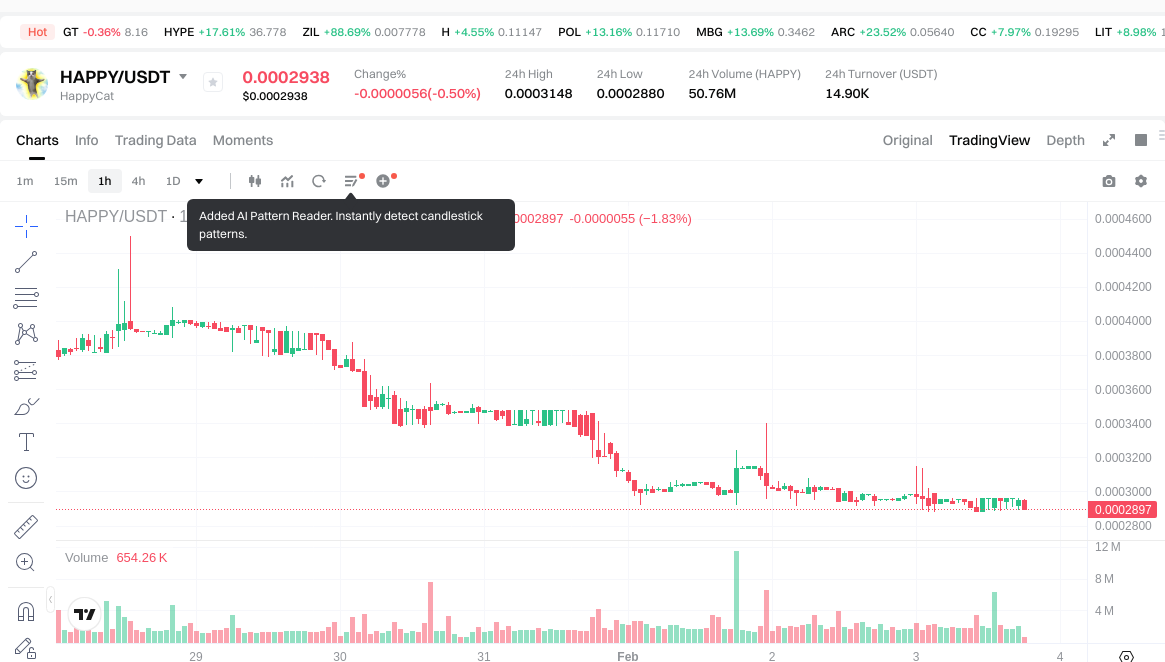
HAPPY is a cryptocurrency asset in the digital currency sector. Since its launch in 2024, the token has established its presence within the meme coin segment. As of February 2026, HappyCat holds a market capitalization of approximately $983,623, with a circulating supply of 3,333,186,743 tokens. The current price stands at around $0.0002951. Positioned as a viral meme-based token inspired by a popular internet video featuring a jumping cat, HAPPY has attracted attention from community-driven investors. This article examines HappyCat's market characteristics, historical price performance, potential price projections, and associated investment risks to provide readers with analytical perspectives on the question "Is HappyCat (HAPPY) a good investment?"
I. HappyCat (HAPPY) Price History Review and Current Investment Value
- November 2024: HAPPY reached $0.04723 on November 16, 2024, representing a notable price level during its early trading period.
- November 2024 to February 2026: The token experienced significant volatility, with prices declining from the November 2024 level to $0.000288 recorded on February 2, 2026.
- Recent Period (January-February 2026): Price movements showed fluctuations within a range, with 24-hour trading ranging between $0.000288 and $0.0003148 as of February 3, 2026.
Current HAPPY Investment Market Status (February 2026)
- Current HAPPY price: $0.0002951
- Market sentiment: Data for Fear & Greed Index not available in provided materials
- 24-hour trading volume: $14,961.61
- Institutional investor holdings: No specific institutional holding data available in provided materials
Click to view real-time HAPPY market price
II. Core Factors Influencing Whether HAPPY is a Good Investment
Supply Mechanism and Scarcity (HAPPY Investment Scarcity)
- Fixed Supply Structure → Impact on Price and Investment Value
HappyCat (HAPPY) operates with a fixed total supply of 3,333,186,743 tokens, with 100% currently in circulation. This complete circulation means there are no additional tokens scheduled for release, which eliminates future supply-side inflation pressure. The maximum supply equals the total supply, creating a static supply environment where scarcity is determined solely by market demand and holder behavior.
With 105,589 holders recorded, the token demonstrates a degree of distribution across the market. The fully diluted market capitalization matches the circulating market capitalization at approximately $983,623, reflecting the complete supply being actively tradeable.
- Investment Significance: Fixed Supply as a Long-Term Consideration
The absence of additional token emissions means that price movements are primarily driven by trading activity and market sentiment rather than supply expansion. This fixed supply structure may appeal to certain investment strategies that prioritize predictable supply economics, though it does not guarantee price appreciation or investment success.
Institutional Investment and Mainstream Adoption (Institutional Investment in HAPPY)
HappyCat (HAPPY) is listed on 6 exchanges, indicating limited exchange distribution compared to more established crypto assets. The 24-hour trading volume of approximately $14,961 represents relatively modest liquidity, which may affect ease of entry and exit for larger positions.
The project originated from a viral video meme featuring a cat jumping behind a glass door, first appearing in 2015 and subsequently popularized on platforms such as TikTok and YouTube with accompanying sound effects. The token leverages this internet culture phenomenon as its conceptual foundation.
Macroeconomic Environment Impact on HAPPY Investment
- Market Context and Volatility
As a meme-based token with a market capitalization ranking of 2,522 and a market dominance of 0.000035%, HappyCat exists within a highly competitive and volatile segment of the crypto market. The token experienced a 24-hour price decline of 1.52%, a 7-day decline of 23.03%, and a 30-day decline of 39.73% as of February 3, 2026.
The token's price of $0.0002951 represents a substantial decline from its November 16, 2024 price level, indicating significant volatility. The 24-hour price range between $0.000288 and $0.0003148 demonstrates ongoing price fluctuation within a narrow absolute range but considerable percentage movements.
- Market Sentiment and Risk Factors
The token's performance appears influenced by broader sentiment toward meme tokens and social media-driven crypto assets. With a relatively small market capitalization and limited exchange listings, HappyCat may be susceptible to liquidity constraints and higher volatility compared to more established digital assets.
Technology and Ecosystem Development (Technology & Ecosystem for HAPPY Investment)
- Blockchain Infrastructure
HappyCat operates with contract address HAPPYwgFcjEJDzRtfWE6tiHE9zGdzpNky2FvjPHsvvGZ, which can be viewed on the Solana blockchain explorer. The token's technical infrastructure relies on the Solana network's existing capabilities.
- Community and Application Context
The project maintains a presence through its official website (happycatonsol.com) and X (formerly Twitter) account (@HappyCatArcade). The token's utility and ecosystem development are primarily centered around its meme cultural significance rather than specific technological innovations or decentralized application integrations.
The absence of detailed information regarding DeFi integration, NFT applications, or payment utility suggests that the token's value proposition is primarily derived from community engagement and meme culture rather than functional technological applications.
III. HAPPY Future Investment Forecast and Price Outlook (Is HappyCat(HAPPY) worth investing in 2026-2031)
Short-term Investment Forecast (2026, short-term HAPPY investment outlook)
Based on market analysis and predictive models, the short-term outlook for HAPPY in 2026 presents the following scenarios:
- Conservative forecast: $0.000255606 - $0.00027
- Neutral forecast: $0.00028 - $0.0002938
- Optimistic forecast: $0.000295 - $0.00030849
The token currently trades at $0.0002951, with market indicators suggesting potential fluctuations within these ranges as the asset continues to establish its position in the meme token sector.
Mid-term Investment Outlook (2027-2029, mid-term HappyCat(HAPPY) investment forecast)
- Market stage expectation: HAPPY may experience gradual growth phases as the token navigates through evolving market conditions and community engagement levels.
- Investment return forecast:
- 2027: $0.00024392745 - $0.0003914885
- 2028: $0.00018008471 - $0.000464064445
- 2029: $0.0003565677258 - $0.0004213982214
- Key catalysts: Community adoption trends, broader meme token market sentiment, and trading platform accessibility may influence mid-term price movements.
Long-term Investment Outlook (Is HAPPY a good long-term investment?)
- Baseline scenario: $0.000231444869292 - $0.000458756794489 (assuming steady market conditions and maintained community interest through 2030)
- Optimistic scenario: $0.000396783297792 - $0.000649678146935 (contingent upon enhanced adoption and favorable market dynamics through 2031)
- Risk scenario: Below $0.00018 (under adverse market conditions or declining community engagement)
For detailed HAPPY long-term investment and price forecasts: Price Prediction
2026-02-03 to 2031 Long-term Outlook
- Base scenario: $0.000231 - $0.000459 USD (corresponding to steady progress and gradual mainstream application development)
- Optimistic scenario: $0.000397 - $0.00065 USD (corresponding to large-scale adoption and favorable market environment)
- Transformative scenario: Above $0.00065 USD (subject to breakthrough ecosystem developments and mainstream popularization)
- 2031-12-31 projected high: $0.000649678146935 USD (based on optimistic development assumptions)
Disclaimer: These forecasts are based on analytical models and historical data patterns. Cryptocurrency markets involve substantial risk, and actual prices may vary significantly from projections. This content does not constitute investment advice, and investors should conduct independent research and risk assessment before making investment decisions.
| Year |
Predicted High Price |
Predicted Average Price |
Predicted Low Price |
Price Change |
| 2026 |
0.00030849 |
0.0002938 |
0.000255606 |
0 |
| 2027 |
0.0003914885 |
0.000301145 |
0.00024392745 |
2 |
| 2028 |
0.000464064445 |
0.00034631675 |
0.00018008471 |
17 |
| 2029 |
0.0004213982214 |
0.0004051905975 |
0.0003565677258 |
37 |
| 2030 |
0.000458756794489 |
0.00041329440945 |
0.000231444869292 |
40 |
| 2031 |
0.000649678146935 |
0.000436025601969 |
0.000396783297792 |
47 |
IV. HappyCat Investment Strategy and Risk Management (How to invest in meme tokens)
Investment Methodology (HappyCat investment strategy)
-
Long-term holding (HODL HappyCat): This approach may suit investors who believe in the long-term cultural value of meme-based tokens. Given HappyCat's origin from a viral video and its community-driven nature, holders may accumulate tokens during price dips and wait for potential future adoption or trending cycles.
-
Active trading: Traders utilizing technical analysis can monitor HappyCat's price movements across multiple timeframes. With recent data showing 24-hour price fluctuations between $0.000288 and $0.0003148, swing trading opportunities may emerge during periods of increased volatility. However, traders should note the token's tendency for sharp price corrections, as evidenced by the 23.03% decline over the past week.
Risk Management (Risk management for HappyCat investment)
-
Asset allocation ratio:
- Conservative investors: Consider limiting meme token exposure to 1-3% of total crypto portfolio
- Moderate investors: May allocate 5-10% to speculative assets like HappyCat
- Experienced traders: Could dedicate up to 15-20% for short-term trading strategies, while maintaining strict stop-loss protocols
-
Risk hedging approach: Diversification across multiple asset classes remains important. Investors might balance meme token positions with more established cryptocurrencies, stablecoins, or traditional assets. Using dollar-cost averaging can help mitigate timing risk given HappyCat's price volatility.
-
Secure storage:
- Hot wallets: Suitable for active trading amounts on Solana-compatible wallets
- Cold storage: Hardware wallets supporting Solana tokens (such as Ledger) are recommended for long-term holdings
- Always verify the contract address (HAPPYwgFcjEJDzRtfWE6tiHE9zGdzpNky2FvjPHsvvGZ) when transferring tokens to prevent scams
V. HappyCat Investment Risks and Challenges (Risks of investing in meme tokens)
-
Market risk: HappyCat has demonstrated substantial price volatility, with a 39.73% decline over 30 days and an 89.9% decrease over one year from its peak. The token's 24-hour trading volume of approximately $14,961 indicates relatively limited liquidity compared to major cryptocurrencies, which can amplify price swings during periods of buying or selling pressure.
-
Regulatory risk: Meme tokens operate in an evolving regulatory landscape. Different jurisdictions continue to develop frameworks for cryptocurrency classification and taxation. Investors should stay informed about regulatory developments in their respective countries, as policy changes could impact token accessibility or legal status.
-
Technical risk: As a Solana-based token, HappyCat's functionality depends on the underlying blockchain infrastructure. Potential network congestion, security vulnerabilities, or protocol upgrades on Solana could affect token transactions and accessibility. Additionally, smart contract risks specific to the token's deployment should be considered.
-
Community and relevance risk: The token's value proposition is tied to the popularity of the Happy Happy Happy Cat meme. Cultural trends can shift rapidly, and sustained community engagement is not guaranteed. With 105,589 holders and a market cap of approximately $983,623, the project's relatively small scale may present liquidity challenges during market stress.
VI. Conclusion: Is meme token a Good Investment?
-
Investment value summary: HappyCat represents a community-driven meme token with cultural origins in viral internet content. While the project has established a holder base and maintains active social media presence, the token has experienced significant price volatility, declining substantially from its launch price of $0.02718. The investment thesis primarily depends on meme culture momentum and community engagement rather than fundamental utility or revenue generation.
-
Investor recommendations:
✅ Beginners: Consider starting with established cryptocurrencies before exploring meme tokens. If interested in HappyCat, limit exposure to amounts you can afford to lose entirely, and use secure Solana-compatible wallets.
✅ Experienced investors: May incorporate HappyCat as a small speculative position within a diversified portfolio. Active monitoring of community sentiment and trading volume patterns can inform entry and exit decisions.
✅ Institutional investors: Meme tokens like HappyCat typically do not align with institutional investment mandates due to high volatility, limited liquidity, and lack of fundamental value drivers.
⚠️ Disclaimer: Cryptocurrency investments carry substantial risk of loss. This analysis is for informational purposes only and does not constitute financial advice. Conduct thorough research and consider consulting financial professionals before making investment decisions.
VII. FAQ
Q1: What is HappyCat (HAPPY) and how did it originate?
HappyCat (HAPPY) is a meme-based cryptocurrency token built on the Solana blockchain, inspired by a viral internet video featuring a jumping cat behind a glass door. The original video first appeared in 2015 and gained widespread popularity on platforms like TikTok and YouTube with accompanying sound effects. The token was launched in 2024 to capitalize on this internet culture phenomenon, operating with a fixed total supply of 3,333,186,743 tokens and contract address HAPPYwgFcjEJDzRtfWE6tiHE9zGdzpNky2FvjPHsvvGZ. As of February 2026, it maintains a market capitalization of approximately $983,623 with 105,589 holders, positioning itself within the meme coin segment of the cryptocurrency market.
Q2: How has HappyCat's price performed since its launch?
HappyCat has experienced significant price volatility since its 2024 launch. The token reached a notable price level of $0.04723 on November 16, 2024, representing its early trading peak. However, the price declined substantially from that point, falling to approximately $0.000288 by February 2, 2026—a decline of over 99% from its peak. Recent data shows a 24-hour decline of 1.52%, a 7-day decline of 23.03%, and a 30-day decline of 39.73% as of February 3, 2026. The current trading price stands at around $0.0002951, with 24-hour fluctuations between $0.000288 and $0.0003148, demonstrating ongoing volatility within narrow absolute ranges but considerable percentage movements.
Q3: What are the price predictions for HappyCat in the coming years?
Price forecasts for HappyCat vary based on different scenarios. For 2026, conservative estimates range from $0.000255606 to $0.00027, neutral forecasts suggest $0.00028 to $0.0002938, and optimistic projections indicate $0.000295 to $0.00030849. Mid-term projections for 2027-2029 show potential prices ranging from $0.00024392745 to $0.0004213982214 depending on market conditions. Long-term forecasts through 2031 present a baseline scenario of $0.000231444869292 to $0.000458756794489, with an optimistic scenario reaching $0.000396783297792 to $0.000649678146935. However, these predictions are analytical models based on historical patterns and should not be considered guaranteed outcomes, as cryptocurrency markets involve substantial volatility and unpredictable factors.
Q4: What are the main risks associated with investing in HappyCat?
HappyCat presents several significant investment risks. Market risk is substantial, evidenced by the 89.9% price decline over one year and limited liquidity with only $14,961 in 24-hour trading volume, which can amplify price swings. Regulatory risk exists as meme tokens operate in an evolving legal landscape where policy changes could impact accessibility. Technical risk relates to the token's dependence on Solana blockchain infrastructure, where network issues or security vulnerabilities could affect functionality. Community and relevance risk is particularly important, as the token's value depends on sustained popularity of the Happy Happy Happy Cat meme—cultural trends that can shift rapidly. With a relatively small market cap of approximately $983,623 and 105,589 holders, liquidity challenges may arise during market stress periods.
Q5: How should different types of investors approach HappyCat?
Investment approaches should vary based on experience level and risk tolerance. Beginners should consider starting with established cryptocurrencies before exploring meme tokens, and if interested in HappyCat, limit exposure to amounts they can afford to lose entirely while using secure Solana-compatible wallets. Experienced investors may incorporate HappyCat as a small speculative position (1-10% of crypto portfolio) within a diversified portfolio, actively monitoring community sentiment and trading patterns. Conservative investors should limit meme token exposure to 1-3% of total holdings, while moderate investors might allocate 5-10% to speculative assets. Institutional investors will typically find that meme tokens like HappyCat do not align with investment mandates due to high volatility, limited liquidity, and lack of fundamental value drivers. All investors should implement strict risk management protocols including dollar-cost averaging and stop-loss strategies.
Q6: What determines HappyCat's investment value and scarcity?
HappyCat operates with a fixed total supply of 3,333,186,743 tokens, with 100% currently in circulation, meaning there are no additional tokens scheduled for release. This creates a static supply environment where scarcity is determined solely by market demand and holder behavior rather than supply expansion. The fully diluted market capitalization matches the circulating market capitalization at approximately $983,623, reflecting complete supply being actively tradeable. However, the token's value proposition is primarily derived from community engagement and meme culture rather than functional technological applications or utility. With distribution across 105,589 holders and listings on only 6 exchanges, the token demonstrates limited mainstream adoption. The absence of DeFi integration, NFT applications, or payment utility means that price movements are driven primarily by trading activity and market sentiment rather than fundamental utility or revenue generation.
Q7: Where can I trade HappyCat and how should I store it?
HappyCat is currently listed on 6 cryptocurrency exchanges, indicating limited exchange distribution compared to more established crypto assets. For active trading, investors can use hot wallets compatible with Solana tokens, which provide convenient access for frequent transactions. For long-term holdings, cold storage solutions such as hardware wallets supporting Solana tokens (like Ledger) are recommended to enhance security. It is crucial to always verify the official contract address (HAPPYwgFcjEJDzRtfWE6tiHE9zGdzpNky2FvjPHsvvGZ) when transferring tokens to prevent scams and ensure you are interacting with the legitimate HappyCat token. The token's relatively modest 24-hour trading volume of approximately $14,961 may affect ease of entry and exit for larger positions, so investors should be prepared for potential liquidity constraints when executing trades.
Q8: What investment strategies work best for meme tokens like HappyCat?
Two primary strategies apply to HappyCat investment. Long-term holding (HODL) may suit investors who believe in the long-term cultural value of meme-based tokens and are willing to accumulate during price dips while waiting for potential trending cycles. Active trading allows experienced traders to capitalize on price volatility using technical analysis across multiple timeframes, particularly during periods of increased volatility evidenced by recent 24-hour fluctuations between $0.000288 and $0.0003148. However, traders must account for the token's tendency toward sharp corrections, as shown by the 23.03% weekly decline. Risk management remains critical regardless of strategy—conservative investors should limit meme token exposure to 1-3% of portfolio, moderate investors to 5-10%, and even experienced traders should maintain strict stop-loss protocols when dedicating up to 15-20% for short-term strategies. Diversification across multiple asset classes and dollar-cost averaging can help mitigate timing risk given HappyCat's substantial price volatility.
* The information is not intended to be and does not constitute financial advice or any other recommendation of any sort offered or endorsed by Gate.