This comprehensive analysis examines whether Hydro Protocol (HDRO) represents a viable investment opportunity within the DeFi infrastructure sector. HDRO, an LSDFi platform on Injective Network combining Liquid Staking Derivatives with Real World Assets, currently trades at $0.001901 with a market capitalization of approximately $274,609 as of February 2026. The article evaluates HDRO's technology infrastructure, price history (tracking a 93.91% annual decline from its May 2024 launch), and detailed forecasts suggesting potential recovery to $0.00261-$0.003898 by 2031. Key investment considerations include tokenomics with 14.45% circulating supply, institutional adoption indicators, and macroeconomic sensitivity. The analysis presents tailored investment strategies for conservative, aggressive, and professional investors while thoroughly examining market volatility risks, regulatory uncertainties, and technical dependencies on Injective Network. Supporting data includes real-time pricing from Gate, multi-year
Introduction: Hydro Protocol (HDRO) Investment Position and Market Outlook
HDRO represents an infrastructure asset in the cryptocurrency sector, launched in 2024 to facilitate yield optimization and liquidity management on the Injective Network. As of February 7, 2026, HDRO maintains a market capitalization of approximately $274,608.96, with a circulating supply of 144,455,000 tokens and a current price around $0.001901. Positioned as a specialized LSDFi platform combining Liquid Staking Derivatives with Real World Assets, HDRO has drawn attention in discussions regarding "Is Hydro Protocol (HDRO) a good investment?" The token currently ranks 3,614 in market capitalization with a 24-hour trading volume of $20,657.61. This article examines HDRO's investment characteristics, historical price movements, future price projections, and associated risks to provide reference information for market participants.
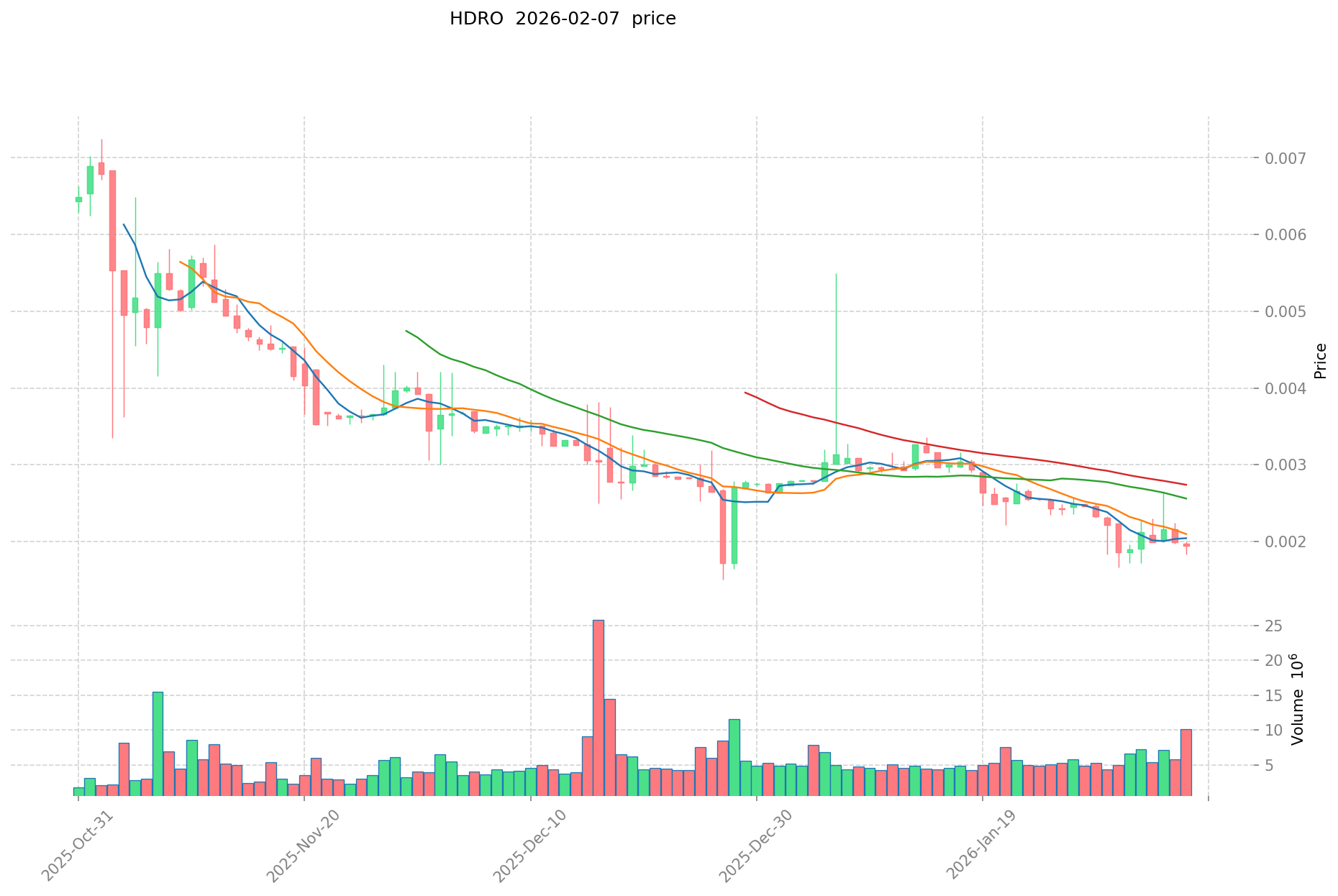
HDRO operates within the DeFi infrastructure space, offering users tools to customize yield strategies through its Real Yielding Asset (RYA) product suite. With a maximum supply capped at 1,000,000,000 tokens and approximately 14.45% currently in circulation, the token's supply dynamics present distinct tokenomics considerations. The asset experienced notable price volatility since launch, recording a peak of $0.349 on May 30, 2024, and a low of $0.0015 on December 27, 2025. Recent performance shows declines of 3.87% over 24 hours, 10.99% over 7 days, 38.11% over 30 days, and 93.91% over the past year, reflecting significant market adjustments from initial valuation levels.
I. Hydro Protocol (HDRO) Price History Review and Current Investment Value
- 2024: Token launch on May 30 at $0.2062 → Price reached approximately $0.349 during the same period
- 2024-2025: Market correction phase → HDRO experienced downward pressure alongside broader market adjustments
- 2025: Continued decline through December 27 → Price approached lower levels around $0.0015
Current HDRO Investment Market Status (February 2026)
- HDRO current price: $0.001901
- 24-hour trading volume: $20,657.61
- Market capitalization: $274,608.96
- Circulating supply: 144,455,000 HDRO (14.45% of total supply)
Click to view real-time HDRO market price
II. Core Factors Affecting Whether HDRO is a Good Investment (Is Hydro Protocol(HDRO) a Good Investment)
Supply Mechanism and Scarcity (HDRO investment scarcity)
- Fixed Supply Structure → Influences Price and Investment Value
- Hydro Protocol has a maximum supply of 1,000,000,000 HDRO tokens, with a current circulating supply of 144,455,000 tokens, representing approximately 14.45% of the total supply. This controlled release mechanism creates a supply-side constraint that may influence long-term price dynamics.
- The token's circulating supply ratio of 14.45% suggests that a significant portion of tokens remains locked or unvested, which could impact future supply dynamics as additional tokens enter circulation.
- Investment Significance: The relationship between circulating supply and total supply represents a key consideration for evaluating long-term investment positioning.
Institutional Investment and Mainstream Adoption (Institutional investment in HDRO)
- Market Position Trends: HDRO currently holds a market ranking of 3,614 with a market capitalization of approximately $274,608.955, representing 0.000076% market dominance. The 24-hour trading volume stands at $20,657.60, reflecting relatively limited institutional participation at this stage.
- The protocol is listed on one exchange, indicating early-stage market accessibility. The current price of $0.001901 represents a decline of approximately 93.91% from its listing price of $0.2062 in May 2024.
- Market Presence: The project's integration with the Injective Network positions it within a specific ecosystem, though mainstream enterprise adoption indicators remain limited in available data.
Macroeconomic Environment's Impact on HDRO Investment
- Market Volatility Exposure: HDRO has demonstrated significant price volatility, with declines of 3.87% (24H), 10.99% (7D), 38.11% (30D), and 93.91% (1Y), suggesting sensitivity to broader market conditions and risk sentiment.
- The asset's performance trajectory indicates correlation with general cryptocurrency market cycles and risk appetite trends, which are influenced by macroeconomic factors including monetary policy adjustments and liquidity conditions.
- Market Environment Considerations: Changes in global liquidity conditions and regulatory frameworks for digital assets may impact trading activity and investor interest in lower-capitalization tokens like HDRO.
Technology and Ecosystem Development (Technology & Ecosystem for HDRO investment)
- LSDFi Infrastructure: Hydro Protocol functions as an infrastructure platform enabling users to customize, select, and manage yield and liquidity strategies on the Injective Network. The protocol combines Liquid Staking Derivatives (LSD) products with Real World Assets (RWA) integration.
- Real Yielding Asset (RYA) Innovation: The protocol introduces a specialized product called Real Yielding Asset (RYA), designed to provide indexed sources of different yields across the cryptocurrency ecosystem, potentially enhancing investment utility through diversified yield optimization strategies.
- Technical Foundation: HDRO operates on the Injective blockchain infrastructure (contract address: factory/inj1etz0laas6h7vemg3qtd67jpr6lh8v7xz7gfzqw/hdro), utilizing the network's native capabilities for decentralized finance applications.
- Ecosystem Scope: The protocol's focus on LSDFi products and yield strategies positions it within the decentralized finance sector, though specific data on total value locked, active users, or ecosystem growth metrics are not provided in available materials.
III. HDRO Future Investment Forecast and Price Outlook (Is Hydro Protocol(HDRO) worth investing in 2026-2031)
Short-term Investment Forecast (2026, short-term HDRO investment outlook)
- Conservative forecast: $0.0017233 - $0.001814
- Neutral forecast: $0.001814 - $0.002200
- Optimistic forecast: $0.002200 - $0.00261216
Based on available data, the short-term outlook for HDRO in 2026 reflects a potential stabilization phase following recent declines. The conservative scenario considers continued pressure from the broader market downturn, while the optimistic range factors in possible recovery momentum should market sentiment improve.
Mid-term Investment Outlook (2027-2029, mid-term Hydro Protocol(HDRO) investment forecast)
- Expected market phase: Potential recovery and gradual adoption expansion
- Investment return forecast:
- 2027: $0.001881118 - $0.0028106116
- 2028: $0.001833647434 - $0.003466347204
- 2029: $0.00206247658638 - $0.00331789711722
- Key catalysts: Development of LSDFi product suite integration with Real World Assets (RWA), expansion within the Injective Network ecosystem, and potential adoption of the Real Yielding Asset (RYA) indexing strategy
The mid-term period may see HDRO attempting to establish a higher baseline as the protocol's infrastructure platform matures and yield optimization strategies gain traction among users.
Long-term Investment Outlook (Is HDRO a good long-term investment?)
- Base scenario: $0.001721493908366 - $0.003248101713898 (assuming steady ecosystem development and moderate user adoption)
- Optimistic scenario: $0.003248101713898 - $0.003897722056677 (assuming broader LSDFi sector growth and successful RWA integration)
- Risk scenario: Below $0.001721493908366 (under conditions of prolonged market weakness or competitive pressure)
Click to view HDRO long-term investment and price forecast: Price Prediction
2026-2031 Long-term Outlook
- Base scenario: $0.001721493908366 - $0.003248101713898 (corresponding to steady progress and gradual mainstream application uptake)
- Optimistic scenario: $0.003248101713898 - $0.003897722056677 (corresponding to large-scale adoption and favorable market environment)
- Transformative scenario: Above $0.003897722056677 (such as breakthrough progress in the ecosystem and mainstream adoption)
- 2031-12-31 forecast high: $0.003897722056677 (based on optimistic development assumptions)
Disclaimer: The forecasts provided are based on historical data analysis and current market information. Cryptocurrency markets are highly volatile and subject to numerous unpredictable factors. These projections should not be considered as investment advice, and actual results may differ materially from predictions. Investors should conduct their own research and consider their risk tolerance before making any investment decisions.
| Year |
Predicted High Price |
Predicted Average Price |
Predicted Low Price |
Price Change |
| 2026 |
0.00261216 |
0.001814 |
0.0017233 |
-4 |
| 2027 |
0.0028106116 |
0.00221308 |
0.001881118 |
16 |
| 2028 |
0.003466347204 |
0.0025118458 |
0.001833647434 |
32 |
| 2029 |
0.00331789711722 |
0.002989096502 |
0.00206247658638 |
57 |
| 2030 |
0.003342706618186 |
0.00315349680961 |
0.001892098085766 |
65 |
| 2031 |
0.003897722056677 |
0.003248101713898 |
0.001721493908366 |
70 |
IV. HDRO Investment Strategy and Risk Management (How to invest in Hydro Protocol)
Investment Strategy (HDRO investment strategy)
Long-term Holding (HODL HDRO)
For conservative investors seeking stability, long-term holding of HDRO may align with a patience-driven approach. This strategy involves acquiring tokens during perceived value periods and maintaining positions through market cycles, potentially benefiting from the protocol's infrastructure development on the Injective Network. Investors adopting this method typically focus on fundamental analysis of Hydro Protocol's LSDFi product suite and Real Yielding Asset (RYA) offerings rather than short-term price movements.
Active Trading
Active trading strategies for HDRO rely on technical analysis and swing trading methodologies. Given the token's observable price fluctuations—with 24-hour changes of -3.87% and 7-day movements of -10.99%—traders may identify entry and exit points using chart patterns, volume indicators, and support/resistance levels. The relatively modest 24-hour trading volume of approximately $20,658 suggests liquidity considerations should factor into trade execution planning.
Risk Management (Risk management for HDRO investment)
Asset Allocation Ratios
- Conservative Investors: May consider limiting HDRO exposure to 1-3% of total portfolio, prioritizing capital preservation
- Aggressive Investors: Could allocate 5-10% toward HDRO, accepting higher volatility for potential growth exposure
- Professional Investors: Might implement dynamic allocation models (3-15%) based on market conditions and risk-adjusted return metrics
Risk Hedging Solutions
A diversified approach combining multiple asset classes can help mitigate concentration risk. Investors might consider pairing HDRO positions with established cryptocurrencies, stablecoins, or traditional financial instruments. Hedging tools such as stop-loss orders or options strategies (where available) may provide additional downside protection during volatile periods.
Secure Storage
Cold and Hot Wallet Management: For HDRO tokens on the Injective Network, users should implement a tiered storage approach:
- Hot Wallets: Suitable for smaller trading amounts requiring frequent access, with enhanced security protocols including two-factor authentication
- Cold Wallets: Recommended for long-term holdings, keeping private keys offline to minimize exposure to network vulnerabilities
- Hardware Wallet Options: Devices compatible with Injective-based assets offer physical security layers for storing HDRO
V. HDRO Investment Risks and Challenges (Risks of investing in Hydro Protocol)
Market Risk
HDRO demonstrates significant price volatility characteristics. The token has experienced a 93.91% decline over one year and a 38.11% decrease over 30 days. The gap between its historical peak of $0.349 (May 30, 2024) and its record low of $0.0015 (December 27, 2025) illustrates substantial price swings. Such volatility presents challenges for portfolio stability and timing decisions. Additionally, with a relatively small market capitalization of approximately $274,609 and limited exchange listings (1 exchange), HDRO may be more susceptible to price movements from large transactions or low liquidity conditions.
Regulatory Risk
Cryptocurrency regulatory frameworks vary significantly across jurisdictions and continue evolving. Policy shifts regarding DeFi protocols, LSDFi products, or yield-generating mechanisms could impact Hydro Protocol's operational model. Investors should monitor regulatory developments in their respective regions, as changes in classification, taxation, or permissibility of certain crypto activities may affect HDRO's accessibility and valuation.
Technical Risk
As infrastructure built on the Injective Network, HDRO faces technical considerations including:
- Network Security: Potential vulnerabilities in smart contracts governing yield strategies or liquidity management could expose users to asset loss
- Protocol Upgrades: Implementation of new features or modifications to existing systems carries execution risks that may temporarily affect functionality
- Integration Dependencies: The protocol's combination of LSD products and Real World Assets (RWA) introduces complexity, where technical issues in interconnected systems could impact performance
The relatively low circulating supply of 144,455,000 tokens (14.45% of total supply) compared to the maximum supply of 1,000,000,000 also presents considerations regarding future token releases and their potential market impact.
VI. Conclusion: Is Hydro Protocol a Good Investment?
Investment Value Summary
Hydro Protocol presents a specialized infrastructure proposition within the LSDFi space on Injective Network, offering yield optimization strategies through its Real Yielding Asset (RYA) framework. The long-term investment case centers on the protocol's positioning in the evolving DeFi landscape, though short-term price action reflects substantial volatility. The token's performance history—including a 93.91% decline over one year—underscores the high-risk nature of this asset class.
Investor Recommendations
✅ Beginners: Consider dollar-cost averaging (DCA) with small, regular purchases to mitigate timing risk, combined with secure cold wallet storage for token custody. Prioritize education on Injective Network and LSDFi mechanics before commitment.
✅ Experienced Investors: May explore swing trading opportunities during identified volatility cycles while maintaining core allocation limits. Diversified portfolio construction with exposure across multiple crypto segments can balance risk.
✅ Institutional Investors: Could evaluate strategic positioning based on comprehensive due diligence of protocol fundamentals, competitive landscape analysis, and alignment with portfolio mandates for emerging DeFi infrastructure exposure.
⚠️ Notice: Cryptocurrency investments carry substantial risk, including potential total loss of capital. This analysis serves informational purposes only and does not constitute financial advice. Prospective investors should conduct independent research and consult qualified professionals before making investment decisions.
VII. FAQ
Q1: What is HDRO's current market position and how has it performed since launch?
HDRO currently ranks #3,614 by market capitalization with approximately $274,609 in total market value and a price of $0.001901 as of February 2026. Since its May 30, 2024 launch at $0.2062, the token reached a peak of $0.349 on the same day but subsequently declined 93.91% over the past year, hitting a low of $0.0015 on December 27, 2025. The asset demonstrates high volatility with recent declines of 3.87% (24H), 10.99% (7D), and 38.11% (30D), while maintaining limited liquidity with $20,658 in 24-hour trading volume across one exchange.
Q2: What technology and infrastructure does Hydro Protocol provide?
Hydro Protocol operates as an LSDFi (Liquid Staking Derivatives Finance) infrastructure platform on Injective Network, enabling users to customize yield and liquidity strategies. The protocol combines Liquid Staking Derivatives products with Real World Asset (RWA) integration through its Real Yielding Asset (RYA) product suite, which provides indexed access to different yield sources across the cryptocurrency ecosystem. With 144.45 million tokens (14.45% of the 1 billion maximum supply) currently circulating, HDRO functions as the utility token within this DeFi infrastructure environment.
Q3: What are the price forecasts for HDRO through 2031?
Short-term forecasts for 2026 range from $0.0017233 (conservative) to $0.00261216 (optimistic). Mid-term projections show gradual recovery potential: 2027 ($0.001881-$0.002811), 2028 ($0.001834-$0.003466), and 2029 ($0.002062-$0.003318). Long-term estimates for 2031 suggest a range between $0.001721 (base scenario) and $0.003898 (optimistic scenario), representing potential growth of 70% from current levels under favorable conditions. These forecasts assume steady ecosystem development and broader LSDFi sector adoption, though actual results may differ materially due to market volatility.
Q4: What are the primary investment risks associated with HDRO?
HDRO presents three major risk categories: (I) Market Risk—extreme price volatility with 93.91% yearly decline and limited liquidity across one exchange, making it susceptible to large transaction impacts; (II) Regulatory Risk—evolving DeFi and yield product regulations could affect operational models and token accessibility; (III) Technical Risk—smart contract vulnerabilities, protocol upgrade execution challenges, and complexity from LSD-RWA integration dependencies. The low circulating supply ratio (14.45%) also introduces uncertainty regarding future token release schedules and their potential market impact.
Q5: What investment strategies are appropriate for different investor types?
Conservative investors should consider 1-3% portfolio allocation using dollar-cost averaging (DCA) with cold wallet storage, focusing on long-term HODL strategies aligned with protocol infrastructure development. Aggressive investors might allocate 5-10% with active trading approaches leveraging technical analysis of the token's price fluctuations and swing trading opportunities. Professional investors could implement dynamic allocation models (3-15%) based on comprehensive due diligence of competitive positioning, risk-adjusted returns, and alignment with DeFi infrastructure investment mandates, while employing hedging tools like stop-loss orders.
Q6: How does HDRO's tokenomics structure affect investment considerations?
HDRO's fixed maximum supply of 1 billion tokens with only 14.45% (144.455 million) currently circulating creates supply-side constraints that may influence long-term price dynamics. The significant portion of locked or unvested tokens represents both opportunity—through controlled supply release—and risk—from potential future dilution as additional tokens enter circulation. This tokenomics structure requires investors to monitor vesting schedules and unlock events that could materially impact market supply-demand balance, particularly given the current limited liquidity environment.
Q7: What role does the Injective Network ecosystem play in HDRO's value proposition?
Hydro Protocol's integration with Injective Network positions it within a specific blockchain ecosystem for DeFi applications, leveraging the network's native capabilities for decentralized finance infrastructure. The protocol's value proposition depends on Injective Network's growth, technical stability, and user adoption trends. Investment consideration should include assessment of Injective's competitive positioning against other Layer-1 platforms, network security measures, and the broader ecosystem's ability to attract developers and liquidity providers that would utilize Hydro's LSDFi yield optimization tools.
Q8: Is HDRO suitable as a long-term investment compared to short-term trading?
Long-term HDRO investment suits patient, conservative investors willing to accept high volatility while betting on LSDFi infrastructure development over multi-year horizons, with forecasts suggesting potential 70% gains by 2031 under optimistic scenarios. Short-term trading may appeal to experienced traders capable of navigating substantial price swings (-3.87% daily, -38.11% monthly), though limited liquidity ($20,658 daily volume) constrains execution flexibility. The choice depends on risk tolerance, market timing capabilities, and conviction regarding the protocol's fundamental value proposition versus speculative price movements in an early-stage, high-volatility asset.
* The information is not intended to be and does not constitute financial advice or any other recommendation of any sort offered or endorsed by Gate.