Hyperbot (BOT) is an AI-powered on-chain contract trading terminal launched in September 2025, currently trading at $0.002403 with a market cap of $766,557. This comprehensive analysis evaluates BOT's investment viability through multiple dimensions: historical price performance showing significant volatility from peak $0.18925 to current levels, tokenomics with only 31.9% of total supply in circulation, and technology integration of multi-chain DEX data with whale tracking capabilities. The article examines short-term price projections ranging from $0.00157 to $0.00290, mid-term growth scenarios through 2029, and long-term outlooks potentially reaching $0.0053 by 2031 under optimistic conditions. Key investment considerations include market risks from low capitalization, regulatory uncertainties in AI-driven trading platforms, and technical vulnerabilities in multi-chain infrastructure. The guide provides actionable strategies for beginners, experienced traders, and institutional investors, emphasizing prope
Introduction: Hyperbot (BOT)'s Investment Position and Market Outlook
Hyperbot (BOT) represents a notable asset in the cryptocurrency sector, functioning as an AI-powered on-chain contract trading terminal. Since its launch in September 2025, the project has positioned itself within the decentralized finance and trading automation space. As of February 4, 2026, BOT holds a market capitalization of approximately $766,557, with a circulating supply of 319,000,010 tokens out of a maximum supply of 1,000,000,000. The current price stands at $0.002403, reflecting recent market dynamics. With its positioning as an intelligent trading solution that integrates multi-chain DEX data and whale tracking capabilities, Hyperbot has attracted attention from traders examining "Is Hyperbot (BOT) a good investment?" This article provides a comprehensive analysis of BOT's investment characteristics, historical price movements, future price projections, and associated risks to offer reference information for potential investors.
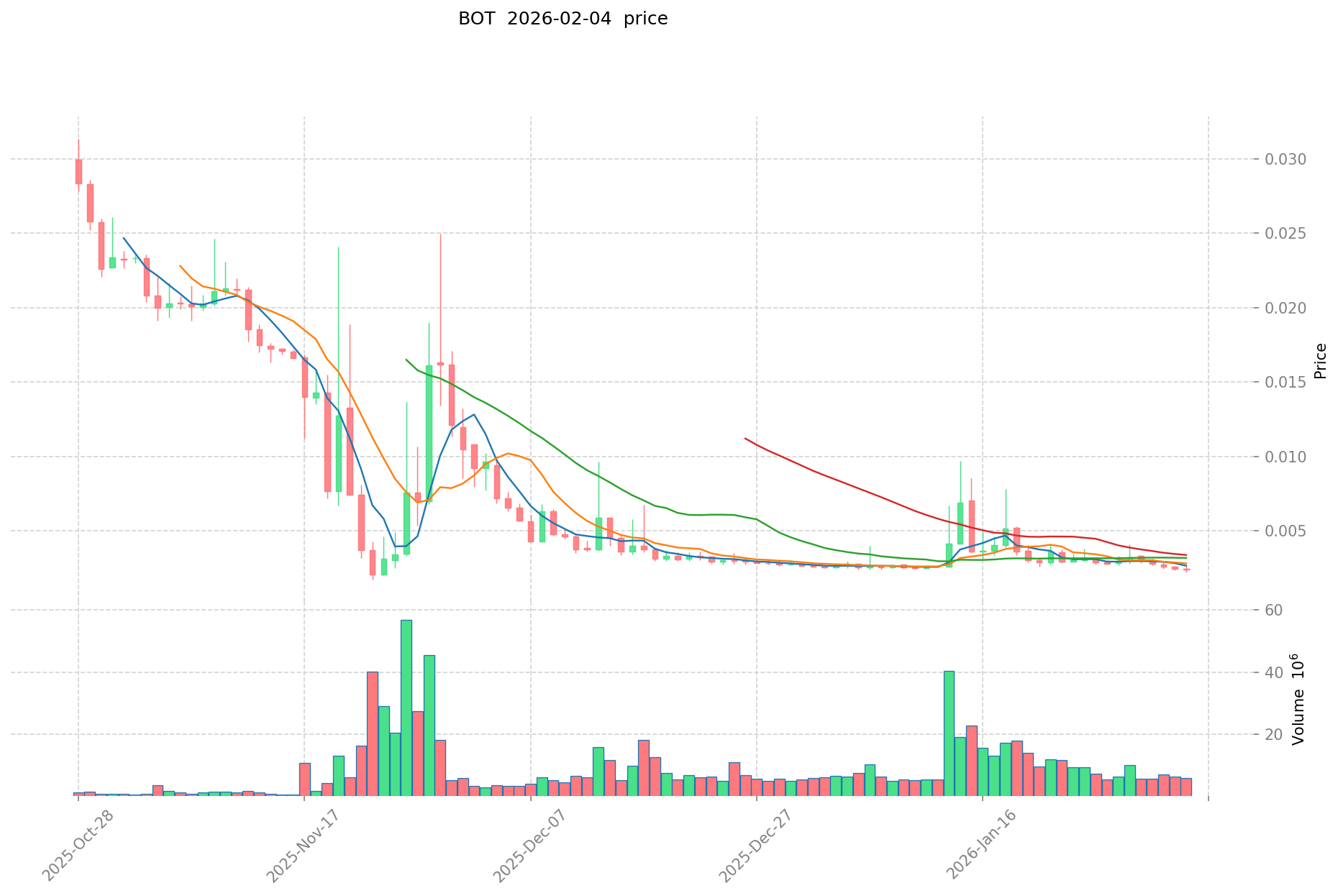
I. Hyperbot (BOT) Historical Price Review and Current Investment Value
- 2025: Token launched in late September → BOT reached trading peak at $0.18925
- Late 2025: Market correction phase → Price experienced significant pullback from peak levels
- Early 2026: Continued consolidation → Trading around $0.002403 range with elevated volatility
Current BOT Investment Market Status (February 2026)
- BOT current price: $0.002403
- Market sentiment (Fear & Greed Index): Neutral sentiment prevails amid market-wide consolidation
- 24-hour trading volume: $14,034.83
- Circulating supply ratio: 31.9% (319 million BOT out of 1 billion total supply)
Click to view real-time BOT market price
II. Core Factors Affecting Whether BOT is a Good Investment (Is Hyperbot(BOT) a Good Investment)
Supply Mechanism and Scarcity (BOT investment scarcity)
- Total supply capped at 1,000,000,000 BOT with circulating supply of 319,000,010 tokens → influences price dynamics and investment valuation
- Market cap to fully diluted valuation ratio stands at 31.9%, indicating substantial token supply yet to enter circulation
- Investment consideration: the current circulating supply represents approximately 31.9% of maximum supply, which may affect future price behavior as additional tokens enter the market
Institutional Investment and Mainstream Adoption (Institutional investment in BOT)
- Holder base has reached 7,870 addresses, indicating growing community participation
- Trading activity spans 6 exchanges, suggesting expanding market accessibility
- Social media attention reflects increasing awareness, with community discussions highlighting copy-trading functionality and AI-driven whale tracking features
Macroeconomic Environment's Impact on BOT Investment
- Trading volume of $14,034.83 within 24 hours indicates active market participation amid broader cryptocurrency market conditions
- Price performance shows -8.16% decline over 24 hours and -17.65% over 7 days, reflecting sensitivity to market sentiment shifts
- Current market dominance of 0.000088% positions BOT as an emerging asset within the broader digital asset landscape
Technology and Ecosystem Development (Technology & Ecosystem for BOT investment)
- AI-powered on-chain contract trading terminal integrates multi-chain and multi-DEX data aggregation
- Platform features include smart money tracking, whale behavior monitoring, and automated copy-trading execution systems
- Real-time on-chain data integration combined with social signal detection aims to provide trading opportunity identification tools
- Contract deployment on BSC (BEP20 standard) establishes technical infrastructure for platform operations
III. BOT Future Investment Prediction and Price Outlook (Is Hyperbot(BOT) worth investing in 2026-2031)
Short-term Investment Prediction (2026, short-term BOT investment outlook)
- Conservative Prediction: $0.00157344 - $0.002384
- Neutral Prediction: $0.002384
- Optimistic Prediction: $0.002384 - $0.00290848
Mid-term Investment Outlook (2027-2029, mid-term Hyperbot(BOT) investment forecast)
-
Market Stage Expectation: The token may experience gradual growth as the AI-driven on-chain contract trading terminal continues to develop its multi-chain and multi-DEX integration capabilities. The platform's whale tracking and smart money detection features could attract users seeking automated copy trading solutions.
-
Investment Return Prediction:
- 2027: $0.002249304 - $0.0037576608
- 2028: $0.00304185288 - $0.004386672048
- 2029: $0.00212481428544 - $0.0041737423464
-
Key Catalysts: Expansion of DEX partnerships, enhancement of AI-powered trading signal detection, growth in active users utilizing the copy trading system, and broader adoption of on-chain contract trading tools.
Long-term Investment Outlook (Is BOT a good long-term investment?)
- Baseline Scenario: $0.003625464374532 - $0.004820672410092 (assuming steady platform development and moderate user growth in the DeFi trading tools sector)
- Optimistic Scenario: $0.004402349597646 - $0.005326843013151 (assuming successful integration of advanced AI features, significant increase in trading volume, and positive market sentiment toward automated trading solutions)
- Risk Scenario: below $0.002384 (in case of intense competition from established trading platforms, technical challenges, or unfavorable regulatory developments affecting automated trading tools)
Click to view BOT long-term investment and price prediction: Price Prediction
2026-02-04 - 2031 Long-term Outlook
- Baseline Scenario: $0.003625464374532 - $0.0039840267852 (corresponding to steady progress and gradual mainstream application adoption)
- Optimistic Scenario: $0.004402349597646 - $0.004820672410092 (corresponding to large-scale adoption and favorable market conditions)
- Transformative Scenario: above $0.005326843013151 (if the ecosystem achieves breakthrough developments and mainstream popularization)
- 2031-12-31 Predicted High: $0.005326843013151 (based on optimistic development assumptions)
Disclaimer: The predictions provided are for informational purposes only and should not be considered as financial advice. Cryptocurrency markets are highly volatile and subject to various risks. Past performance does not guarantee future results. Investors should conduct their own research and consult with financial professionals before making investment decisions.
| Year |
Predicted High Price |
Predicted Average Price |
Predicted Low Price |
Price Change |
| 2026 |
0.00290848 |
0.002384 |
0.00157344 |
0 |
| 2027 |
0.0037576608 |
0.00264624 |
0.002249304 |
11 |
| 2028 |
0.004386672048 |
0.0032019504 |
0.00304185288 |
34 |
| 2029 |
0.0041737423464 |
0.003794311224 |
0.00212481428544 |
59 |
| 2030 |
0.004820672410092 |
0.0039840267852 |
0.003625464374532 |
67 |
| 2031 |
0.005326843013151 |
0.004402349597646 |
0.003874067645928 |
84 |
IV. Hyperbot (BOT) Investment Strategy and Risk Management (How to invest in Hyperbot)
Investment Methodology (Hyperbot investment strategy)
Long-term Holding (HODL Hyperbot)
For conservative investors considering long-term exposure to AI-driven on-chain trading solutions, Hyperbot represents an emerging sector within decentralized finance. Long-term holders typically focus on the fundamental value proposition of AI-powered contract trading terminals and their potential adoption across multiple blockchain ecosystems. This approach requires patience and conviction in the project's ability to deliver on its technology roadmap while navigating market cycles.
Active Trading
Active traders engaging with BOT typically employ technical analysis frameworks combined with momentum-based strategies. Given the token's observed price volatility, swing trading approaches may involve monitoring support and resistance levels, volume patterns, and correlation with broader market sentiment. Traders should consider the token's 24-hour trading volume and liquidity depth when executing position entries and exits.
Risk Management (Risk management for Hyperbot investment)
Asset Allocation Ratios
- Conservative investors: Limit exposure to 1-3% of total portfolio, focusing on established digital assets with Hyperbot as a speculative allocation
- Aggressive investors: May allocate 5-10% to emerging AI and DeFi infrastructure projects, with appropriate risk tolerance for high-volatility assets
- Professional investors: Employ dynamic allocation models based on market conditions, technical indicators, and project development milestones
Risk Hedging Strategies
Diversification across multiple asset classes remains fundamental to risk management. Investors may consider:
- Multi-asset portfolio construction combining established cryptocurrencies, stablecoins, and emerging protocol tokens
- Correlation analysis to identify assets with low correlation to BOT price movements
- Position sizing based on volatility metrics and individual risk tolerance
Secure Storage Solutions
- Hot wallets: Suitable for active trading amounts, enabling quick access to exchange platforms
- Cold wallets: Recommended for long-term holdings, providing enhanced security through offline storage
- Hardware wallets: Industry-standard devices offer robust security for significant allocations, supporting BEP20 token standards compatible with Hyperbot
V. Hyperbot (BOT) Investment Risks and Challenges (Risks of investing in Hyperbot)
Market Risk
Hyperbot exhibits characteristics common to emerging cryptocurrency projects, including substantial price volatility. The token has experienced significant price fluctuations, with observed variations across different timeframes. Market participants should be aware that low market capitalization assets may be subject to amplified price movements relative to more established digital assets. Liquidity conditions can vary across trading platforms, potentially impacting execution quality during periods of market stress.
Regulatory Risk
The regulatory landscape for AI-driven trading platforms and cryptocurrency derivatives remains in development across multiple jurisdictions. Different countries maintain varying approaches to digital asset regulation, creating uncertainty for projects operating in the decentralized finance space. Changes in regulatory frameworks, compliance requirements, or enforcement actions could impact the project's operational model or token utility. Investors should monitor regulatory developments in their respective jurisdictions and assess potential implications for cross-border blockchain projects.
Technical Risk
As an AI-powered on-chain trading terminal integrating multiple DEXs and blockchain networks, Hyperbot faces technical complexities inherent to multi-chain infrastructure:
- Smart contract vulnerabilities: On-chain protocols may contain undiscovered security flaws that could be exploited
- Integration risks: Dependencies on external DEX protocols and blockchain networks introduce third-party risk factors
- Upgrade challenges: Protocol modifications and feature implementations require careful testing to avoid disruption to existing functionality
- Network security: While the token operates on BSC infrastructure, the broader system's security depends on multiple technical components
VI. Conclusion: Is Hyperbot a Good Investment?
Investment Value Summary
Hyperbot (BOT) represents participation in the emerging intersection of artificial intelligence and decentralized trading infrastructure. The project's focus on smart money tracking, whale behavior analysis, and automated copy trading addresses specific needs within the on-chain trading ecosystem. However, as with many emerging cryptocurrency projects, the token exhibits significant price volatility and faces ongoing execution risks related to technology development, market adoption, and competitive dynamics.
Investor Recommendations
✅ Beginners:
- Consider dollar-cost averaging strategies to mitigate timing risk
- Prioritize secure storage solutions, utilizing hardware wallets for any material holdings
- Allocate only capital that can be afforded for complete loss
- Conduct thorough research on AI trading platforms and DeFi infrastructure before committing funds
✅ Experienced investors:
- Evaluate swing trading opportunities based on technical analysis and market momentum indicators
- Implement portfolio diversification across multiple sectors within the cryptocurrency ecosystem
- Monitor project development milestones and adoption metrics
- Consider position sizing relative to overall portfolio volatility targets
✅ Institutional investors:
- Assess strategic allocation potential within broader digital asset portfolios
- Evaluate risk-adjusted return profiles relative to comparable AI and DeFi infrastructure investments
- Implement appropriate due diligence frameworks covering technology, team, and market positioning
- Consider long-term thesis around AI integration in decentralized finance
⚠️ Disclaimer: Cryptocurrency investments carry substantial risk, including the potential for complete loss of capital. Market conditions can change rapidly, and past performance does not indicate future results. This content is provided for informational purposes only and does not constitute financial advice, investment recommendations, or an offer to buy or sell any securities or digital assets. Readers should conduct independent research and consult with qualified financial professionals before making investment decisions.
VII. FAQ
Q1: What is Hyperbot (BOT) and what makes it different from other trading platforms?
Hyperbot (BOT) is an AI-powered on-chain contract trading terminal that integrates multi-chain and multi-DEX data aggregation capabilities. Unlike traditional trading platforms, Hyperbot distinguishes itself through its smart money tracking features, whale behavior monitoring systems, and automated copy-trading execution. The platform operates on BSC (BEP20 standard) and provides real-time on-chain data integration combined with social signal detection, aiming to help traders identify opportunities by following successful wallet addresses and analyzing large holder movements across multiple decentralized exchanges.
Q2: Is Hyperbot (BOT) suitable for beginners or experienced traders?
Both beginner and experienced traders can utilize Hyperbot, though with different approaches. Beginners should employ dollar-cost averaging strategies, allocate only 1-3% of their portfolio to BOT, and prioritize secure storage solutions while conducting thorough research on AI trading platforms. Experienced traders may leverage the platform's advanced features for swing trading opportunities based on technical analysis, implement broader portfolio diversification strategies, and allocate 5-10% depending on their risk tolerance. The copy-trading functionality can be particularly beneficial for newcomers seeking to learn from established traders' strategies.
Q3: What are the main risks associated with investing in Hyperbot (BOT)?
The primary risks include market volatility (BOT has experienced significant price fluctuations with -8.16% decline in 24 hours and -17.65% over 7 days), regulatory uncertainty affecting AI-driven trading platforms across different jurisdictions, and technical risks such as smart contract vulnerabilities, integration dependencies on external DEX protocols, and multi-chain infrastructure complexities. Additionally, with only 31.9% of total supply currently circulating, future token releases may impact price dynamics. The project's low market capitalization ($766,557) also indicates susceptibility to amplified price movements and potential liquidity challenges.
Q4: What is the long-term price outlook for Hyperbot (BOT)?
Based on various scenarios, the long-term outlook for BOT ranges significantly. The baseline scenario projects prices between $0.003625 - $0.004821 by 2030, assuming steady platform development and moderate user growth. The optimistic scenario forecasts $0.004402 - $0.005327 by 2031, contingent upon successful AI feature integration and increased trading volume. However, a risk scenario places prices below $0.002384 if the project faces intense competition, technical challenges, or unfavorable regulations. These predictions assume continued ecosystem development, expanding DEX partnerships, and growing adoption of automated trading solutions within the DeFi sector.
Q5: How should investors store and secure their BOT tokens?
BOT token storage should follow industry-standard security practices appropriate to investment horizons. For active trading amounts, hot wallets provide quick access to exchange platforms for executing trades. Long-term holdings warrant cold wallet storage, which offers enhanced security through offline storage methods. Hardware wallets represent the industry standard for significant allocations, supporting BEP20 token standards compatible with Hyperbot. Investors should implement multi-layered security approaches, including strong authentication methods, regular security audits of wallet connections, and diversification of storage solutions based on the percentage of holdings designated for trading versus long-term retention.
Q6: What factors could drive Hyperbot (BOT) price appreciation in the future?
Several catalysts could positively influence BOT price performance: expansion of DEX partnerships increasing platform utility, enhancement of AI-powered trading signal detection improving user results, growth in active users utilizing the copy trading system demonstrating real-world adoption, successful integration of advanced whale tracking features, increased trading volume on the platform, positive market sentiment toward automated trading solutions, and broader adoption of on-chain contract trading tools within the DeFi ecosystem. Additionally, technological breakthroughs in AI-driven trading algorithms and strategic collaborations with established blockchain networks could serve as significant growth drivers for the project and token valuation.
Q7: What is the current market position and adoption status of Hyperbot?
As of February 4, 2026, Hyperbot maintains a market capitalization of approximately $766,557 with a market dominance of 0.000088%, positioning it as an emerging asset within the digital asset landscape. The project has achieved a holder base of 7,870 addresses, indicating growing community participation, and trades across 6 exchanges with 24-hour trading volume of $14,034.83. Since launching in September 2025, the token reached a peak of $0.18925 before experiencing market correction. The current circulating supply represents 319 million tokens (31.9% of maximum supply), suggesting substantial token reserves remain for future ecosystem development and potential market entry.
Q8: How does Hyperbot's technology roadmap impact its investment potential?
Hyperbot's investment potential is intrinsically linked to its technological execution across several dimensions: the development and refinement of its AI-powered trading algorithms, successful integration with multiple blockchain networks and DEX protocols, enhancement of whale tracking accuracy and real-time signal detection capabilities, and expansion of copy-trading functionality to support diverse trading strategies. The project's ability to deliver on its technology roadmap while maintaining system security, improving user experience, and scaling infrastructure to accommodate growing user bases will significantly influence long-term value proposition. Investors should monitor development milestones, platform updates, and user adoption metrics as indicators of technological progress and potential investment viability.
* The information is not intended to be and does not constitute financial advice or any other recommendation of any sort offered or endorsed by Gate.