This comprehensive guide examines whether IRISnet (IRIS) represents a suitable investment opportunity in 2024-2026. The analysis covers IRIS's current market position—trading at $0.0005772 with a market cap of $942,518—alongside its historical price performance and future projections through 2031. As a BPoS cross-chain service hub designed to bridge digital and traditional economies, IRIS offers interesting technical infrastructure potential. However, significant risks exist including limited liquidity (single exchange listing), unlimited supply inflationary pressure, and substantial year-over-year decline of 75.96%. The article provides detailed investment strategies, risk management frameworks, and price predictions across conservative to optimistic scenarios. Suitable for beginners starting with 1-3% allocations via dollar-cost averaging on Gate, experienced traders monitoring technical levels, and institutions conducting thorough due diligence before strategic allocation decisions.
Introduction: IRISnet (IRIS) Investment Position and Market Outlook
IRIS is a digital asset in the cryptocurrency space. Named after Iris, the Greek goddess of the rainbow who served as a messenger between mortals and the divine, IRISnet is positioned as a self-evolving BPoS cross-chain service hub. Developed collaboratively by Bianjie AI and the Tendermint team, the project aims to serve as a trusted bridge connecting the digital economy with the real economy, providing next-generation public blockchain infrastructure for complex distributed business applications. As of February 3, 2026, IRIS is trading at approximately $0.0005772, with a circulating supply of about 1.63 billion tokens and a market capitalization of approximately $942,518. The project supports seamless integration among public chains, consortium chains, and traditional business systems, enabling cross-chain service invocations through data and computational interoperability across heterogeneous networks. This article provides a comprehensive analysis of IRIS's investment value, historical price movements, future price projections, and associated investment risks to serve as a reference for investors considering whether IRISnet (IRIS) represents a suitable investment opportunity.
I. IRIS Price History Review and Investment Value Status
- 2021: Market volatility period → IRIS experienced significant price fluctuations with unstable performance
- April 2021: Price reached a notable level of $0.299467 → Represented a period of increased market interest
- December 2025: Market cycle adjustment → Price declined to $0.00044927
- 2025: Year-over-year decline → IRIS price decreased by approximately 75.96% over the 12-month period
Current IRIS Investment Market Status (February 2026)
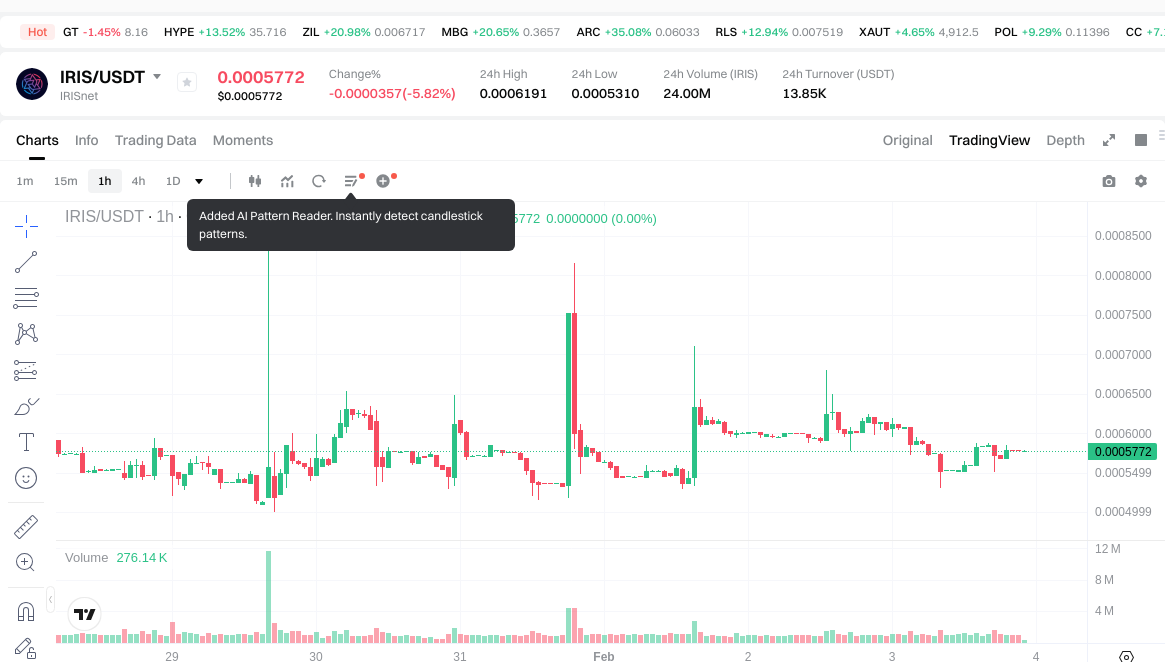
- IRIS current price: $0.0005772
- Market sentiment (Fear & Greed Index): Data indicates cautious market conditions
- 24-hour trading volume: $13,901.96
- Market capitalization: $942,518.53 with a circulating supply of 1,632,914,978.89 IRIS tokens
- Market dominance: 0.000041% of total cryptocurrency market
- Price performance: -5.82% (24H), +4.10% (7D), -19.68% (30D), -75.96% (1Y)
Click to view real-time IRIS market price
II. Core Factors Influencing Whether IRIS Is a Good Investment
Supply Mechanism and Scarcity (IRIS Investment Scarcity)
- Supply Mechanism → Influences Price and Investment Value
- IRISnet has a circulating supply of approximately 1.63 billion IRIS tokens, representing 81.89% of the total supply of 1.99 billion tokens. The maximum supply is marked as unlimited (∞), indicating potential inflationary pressure that may affect long-term scarcity considerations.
- Historical Pattern: IRIS reached a price level of $0.299467 in April 2021, significantly above the current price of $0.0005772 as of February 3, 2026, reflecting substantial price volatility.
- Investment Significance: The unlimited maximum supply may challenge the traditional scarcity narrative that supports long-term investment value in cryptocurrencies.
Institutional Investment and Mainstream Adoption (Institutional Investment in IRIS)
- Trading Availability: IRIS is currently listed on 1 exchange according to the reference data, which may limit liquidity and institutional accessibility.
- Institutional Holding Trends: Specific institutional holding data for IRIS is not available in the provided materials.
Macroeconomic Environment's Impact on IRIS Investment
- Market Position: IRIS holds a market share of 0.000041%, ranking 2548th by market capitalization, indicating its position as a relatively small-cap asset that may be more sensitive to broader market conditions.
- 24-Hour Trading Volume: $13,901.96, suggesting limited liquidity that could amplify price movements during periods of macroeconomic uncertainty.
Technology and Ecosystem Development (Technology & Ecosystem for IRIS Investment)
- Cross-Chain Service Hub: IRISnet is designed as a self-evolving BPoS (Bonded Proof-of-Stake) cross-chain service hub, developed through collaboration between Boundary Intelligence and the Tendermint team, aiming to connect digital economy and real economy infrastructure.
- Interoperability Focus: The platform supports seamless integration between public chains, consortium chains, and traditional business systems, enabling cross-network data and computational interoperability.
- Technical Infrastructure: IRISnet provides infrastructure for building complex distributed business applications, with a focus on cross-chain service invocation capabilities.
- Development Activity: The project maintains a GitHub repository (https://github.com/irisnet/irishub) and blockchain explorer (https://irishub.iobscan.io/), indicating ongoing technical development.
III. IRIS Future Investment Prediction and Price Outlook (Is IRISnet(IRIS) worth investing in 2026-2031)
Short-term Investment Prediction (2026, short-term IRIS investment outlook)
- Conservative Prediction: $0.000531 - $0.000577
- Neutral Prediction: $0.000577 - $0.000646
- Optimistic Prediction: $0.000646 - $0.000716
Mid-term Investment Outlook (2027-2029, mid-term IRISnet(IRIS) investment forecast)
- Market Stage Expectation: During the 2027-2029 period, IRIS may experience gradual price fluctuations with moderate growth potential, though price movements could remain relatively constrained compared to broader market trends.
- Investment Return Prediction:
- 2027: $0.000427 - $0.000782
- 2028: $0.000514 - $0.001029
- 2029: $0.000593 - $0.001255
- Key Catalysts: Potential factors include ecosystem development progress, cross-chain service adoption rates, and overall market sentiment toward interoperability solutions.
Long-term Investment Outlook (Is IRIS a good long-term investment?)
- Base Scenario: $0.000659 - $0.001520 (assuming steady ecosystem development and moderate adoption)
- Optimistic Scenario: $0.001064 - $0.001912 (assuming enhanced cross-chain functionality and increased network activity)
- Risk Scenario: Below $0.000531 (under adverse market conditions or limited adoption)
Click to view IRIS long-term investment and price prediction: Price Prediction
2026-2031 Long-term Outlook
- Base Scenario: $0.000531 - $0.001520 (corresponding to steady progress and gradual mainstream application improvement)
- Optimistic Scenario: $0.001064 - $0.001912 (corresponding to large-scale adoption and favorable market environment)
- Transformative Scenario: Above $0.001912 (if ecosystem achieves breakthrough progress and mainstream adoption)
- 2031-12-31 Predicted High: $0.001912 (based on optimistic development assumptions)
Disclaimer: Price predictions are speculative and subject to market volatility. Investment decisions should be made based on thorough research and risk assessment.
| Year |
Predicted High Price |
Predicted Average Price |
Predicted Low Price |
Price Change |
| 2026 |
0.000715728 |
0.0005772 |
0.000531024 |
0 |
| 2027 |
0.00078222144 |
0.000646464 |
0.00042666624 |
12 |
| 2028 |
0.0010286535168 |
0.00071434272 |
0.0005143267584 |
23 |
| 2029 |
0.001254957290496 |
0.0008714981184 |
0.000592618720512 |
50 |
| 2030 |
0.00152041561736 |
0.001063227704448 |
0.000882478994691 |
84 |
| 2031 |
0.001911896058138 |
0.001291821660904 |
0.000658829047061 |
123 |
IV. IRIS Investment Strategy and Risk Management (How to invest in IRIS)
Investment Strategy (IRIS investment strategy)
Long-term Holding (HODL IRIS): This approach may be suitable for conservative investors who believe in the project's long-term vision of bridging digital and physical economies through its cross-chain service infrastructure. Given IRIS's positioning as a BPoS cross-chain service hub, investors with a long-term horizon might consider accumulating positions during periods of market weakness.
Active Trading: Traders utilizing technical analysis may explore short-term opportunities based on IRIS's price movements. Recent data shows notable volatility, with 24-hour fluctuations ranging between $0.000531 and $0.0006191. Active traders should monitor key support and resistance levels while implementing strict stop-loss mechanisms.
Risk Management (Risk management for IRIS investment)
Asset Allocation:
- Conservative investors: Consider limiting IRIS exposure to 1-3% of total crypto portfolio
- Moderate investors: May allocate 3-7% depending on risk tolerance
- Experienced investors: Could consider up to 10% allocation within a diversified crypto portfolio
Risk Hedging: Investors should maintain a diversified portfolio across different blockchain projects and asset classes. Consider balancing IRIS holdings with more established cryptocurrencies and traditional assets to mitigate sector-specific risks.
Secure Storage:
- Hot wallets: Suitable for active trading amounts only
- Cold storage: Recommended for long-term holdings
- Hardware wallets: Provide enhanced security for larger IRIS positions
V. IRIS Investment Risks and Challenges (Risks of investing in IRIS)
Market Risk: IRIS exhibits significant price volatility. Recent data indicates a 5.82% decline over 24 hours and a 19.68% decrease over 30 days. The token has experienced substantial fluctuation from its historical high of $0.299467 (April 2021) to its historical low of $0.00044927 (December 2025). With a current market capitalization of approximately $942,518 and relatively limited trading volume of $13,901.96, the asset may be susceptible to price swings.
Regulatory Risk: As a cross-chain service infrastructure project operating across multiple jurisdictions, IRIS faces potential regulatory uncertainties. Different countries maintain varying stances on blockchain interoperability solutions and cross-chain technologies, which could impact the project's operational capacity.
Technical Risk: As a BPoS (Bonded Proof-of-Stake) cross-chain service hub developed in collaboration with Tendermint team, IRIS's functionality depends on complex technical infrastructure. Potential risks include:
- Network security vulnerabilities in cross-chain communication protocols
- Technical challenges in maintaining seamless integration across heterogeneous networks
- Risks associated with protocol upgrades and consensus mechanism modifications
VI. Conclusion: Is IRIS a Good Investment?
Investment Value Summary: IRIS presents itself as an infrastructure project focused on cross-chain interoperability between public chains, consortium chains, and traditional business systems. The project's vision of connecting digital and physical economies through a self-evolving service hub represents an interesting technical proposition. However, investors should note the current market metrics: relatively low market capitalization, limited trading volume, and recent price declines across multiple timeframes.
Investor Recommendations:
✅ Beginners: Consider starting with small allocations through dollar-cost averaging (DCA) strategy. Prioritize secure storage solutions and thoroughly research the project's technical documentation before investing.
✅ Experienced Investors: May explore tactical trading opportunities while maintaining diversified exposure across multiple blockchain infrastructure projects. Monitor technical developments and ecosystem growth metrics.
✅ Institutional Investors: Should conduct comprehensive due diligence on the project's technical architecture, team capabilities, and market positioning before considering strategic allocation.
⚠️ Disclaimer: Cryptocurrency investments carry substantial risk. The information presented is for educational purposes only and does not constitute financial advice. Investors should conduct independent research and consult with qualified financial advisors before making investment decisions.
VII. FAQ
Q1: Is IRIS a good investment for beginners in 2026?
For beginners, IRIS represents a high-risk investment opportunity that requires careful consideration. Given its current low market capitalization of approximately $942,518, limited trading volume of $13,901.96, and significant price volatility (declining 75.96% year-over-year), beginners should approach with extreme caution. If interested, start with minimal allocations (1-3% of crypto portfolio) using dollar-cost averaging (DCA) strategy, prioritize secure cold storage solutions, and thoroughly research the project's cross-chain infrastructure technology before investing.
Q2: What is IRISnet's core technology and how does it create value?
IRISnet is a self-evolving BPoS (Bonded Proof-of-Stake) cross-chain service hub developed collaboratively by Bianjie AI and the Tendermint team. The platform's core value proposition lies in enabling seamless integration among public chains, consortium chains, and traditional business systems through cross-network data and computational interoperability. This infrastructure aims to bridge the digital economy with the real economy by facilitating cross-chain service invocations across heterogeneous networks, providing foundational support for complex distributed business applications.
Q3: What are the major risks associated with investing in IRIS?
The primary risks include significant market volatility (current price $0.0005772 versus historical high of $0.299467), extremely limited liquidity with only 1 exchange listing, and substantial year-over-year decline of 75.96%. Technical risks encompass potential vulnerabilities in cross-chain communication protocols and challenges in maintaining seamless integration across diverse network architectures. Additionally, the unlimited maximum supply (∞) introduces potential inflationary pressure that may affect long-term scarcity value. Regulatory uncertainty surrounding cross-chain interoperability solutions across different jurisdictions presents another considerable risk factor.
Q4: What is IRIS's price prediction for 2027-2031?
Based on technical analysis and market conditions, IRIS price predictions show gradual growth potential with significant uncertainty. For 2027, the projected range is $0.000427-$0.000782; 2028 estimates $0.000514-$0.001029; 2029 forecasts $0.000593-$0.001255; 2030 predicts $0.000882-$0.001520; and 2031 projects $0.000659-$0.001912 under optimistic scenarios. However, these predictions are highly speculative and subject to substantial market volatility, ecosystem development progress, cross-chain service adoption rates, and broader cryptocurrency market conditions.
Q5: How does IRIS's supply mechanism affect its investment value?
IRISnet has a circulating supply of approximately 1.63 billion IRIS tokens (81.89% of total supply), with a critical caveat: the maximum supply is unlimited (∞). This unlimited supply mechanism introduces potential inflationary pressure that challenges traditional cryptocurrency scarcity narratives supporting long-term investment value. Unlike Bitcoin's fixed supply cap, IRIS's unlimited maximum supply may dilute token value over time, requiring investors to focus more on adoption metrics, ecosystem growth, and utility demand rather than relying on supply-driven scarcity for value appreciation.
Q6: What investment strategy is most suitable for IRIS?
The optimal strategy depends on risk tolerance and investment horizon. Conservative investors should limit exposure to 1-3% of total crypto portfolio using long-term holding (HODL) approach, focusing on the project's vision of bridging digital and physical economies. Moderate investors may allocate 3-7% with balanced strategies combining holding and tactical trading. Experienced investors could consider up to 10% allocation while actively trading based on technical indicators, monitoring support levels around $0.000531 and resistance near $0.0006191. All strategies should incorporate strict risk management, diversification across multiple blockchain projects, and secure storage solutions with cold wallets for long-term holdings.
Q7: How does IRIS compare to other cross-chain infrastructure projects?
IRISnet occupies a unique niche as a BPoS cross-chain service hub specifically designed to integrate public chains, consortium chains, and traditional business systems. However, its current market position is relatively weak compared to established cross-chain competitors—ranked 2548th by market capitalization with a 0.000041% market share and listing on only 1 exchange. While its collaboration with the Tendermint team provides technical credibility, investors should compare IRIS's adoption metrics, ecosystem partnerships, and technical development activity against more established interoperability solutions before making investment decisions. The project's focus on bridging real economy applications differentiates it conceptually but requires demonstrated traction to validate this positioning.
Q8: Should institutional investors consider IRIS for strategic allocation?
Institutional investors should approach IRIS with comprehensive due diligence given current market metrics. The extremely low market capitalization ($942,518), minimal trading volume ($13,901.96), and single exchange listing present significant liquidity constraints for institutional-sized positions. Before considering strategic allocation, institutions should thoroughly evaluate: technical architecture robustness and security audit history, team capabilities and development roadmap execution, partnership pipeline with enterprise clients, regulatory compliance across target jurisdictions, and competitive positioning versus established cross-chain solutions. Given these factors, IRIS currently appears more suitable for venture-style allocation in diversified blockchain infrastructure portfolios rather than core strategic holdings.
* The information is not intended to be and does not constitute financial advice or any other recommendation of any sort offered or endorsed by Gate.