LandX Finance (LNDX) is a decentralized finance token launched on Ethereum mainnet in December 2023, integrating with Layer 2 solutions including Arbitrum and Optimism. Currently priced at $0.01708 with a market capitalization of $225,435, LNDX demonstrates significant investment complexity through its 16.5% circulating supply ratio and concentrated holder base of 2,203 addresses. The token experienced an 86.94% decline over one year, despite short-term gains of 0.58% in 24-hour trading. This comprehensive analysis evaluates LNDX's tokenomics, technical infrastructure, price forecasts ranging from $0.0159-$0.0322 through 2030, and critical risk factors including market volatility, regulatory uncertainty, and technical vulnerabilities. The article provides investment strategies for conservative, aggressive, and professional investors, alongside risk management recommendations and storage solutions. Whether LNDX represents a good investment depends on individual risk tolerance and market outlook, with detailed
Introduction: LandX Finance (LNDX) Investment Position and Market Outlook
LandX Finance (LNDX) represents a notable project in the decentralized finance sector, having launched in December 2023. The token operates on the Ethereum mainnet and collaborates with layer 2 solutions including LayerZero, Arbitrum, and Optimism to enhance blockchain accessibility and efficiency. As of February 8, 2026, LNDX is priced at approximately $0.01708, with a circulating supply of around 13.20 million tokens and a market capitalization of approximately $225,435. The token's total supply stands at 70.15 million, with a maximum supply capped at 80 million tokens.
The project focuses on delivering user-friendly blockchain interactions through carefully designed smart contracts and web applications. With its open-source code deployed on Ethereum and integration with multiple layer 2 networks, LandX Finance aims to address challenges in DeFi accessibility. The token currently holds a market ranking of 3799 and maintains a dominance of 0.000048% in the overall cryptocurrency market.
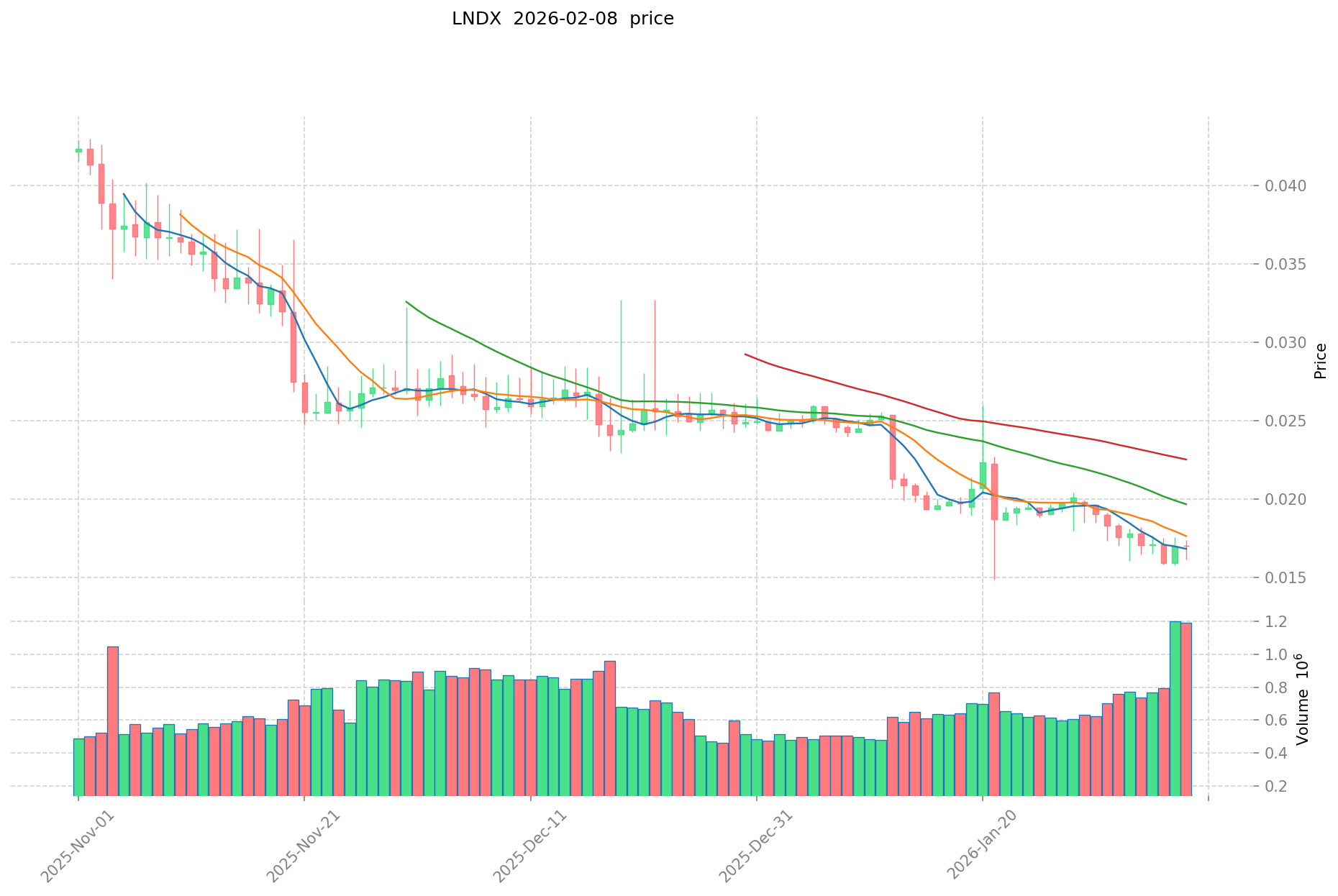
LNDX's price performance shows varied trends across different timeframes: a 0.71% increase over 1 hour, 0.58% gain in 24 hours, while experiencing a 6.26% decline over 7 days and a 29.59% decrease over 30 days. The token holder count stands at 2,203 addresses. This analysis examines LNDX's investment characteristics, historical price movements, future price considerations, and associated risks to provide reference information for market participants evaluating "Is LandX Finance (LNDX) a good investment?"
I. LNDX Price Historical Review and Current Investment Value
- December 2023: Token launch and initial listing → Price reached $7.14676 during early trading phase
- 2024-2025: Market adjustment period → LNDX experienced significant price corrections alongside broader market trends
- January 2026: Market consolidation phase → Price traded near $0.01485 level before recent recovery
Current LNDX Investment Market Status (February 2026)
- LNDX current price: $0.01708
- 24-hour trading volume: $19,074.49
- Market capitalization: $225,435.86
- Circulating supply: 13,198,820.90 LNDX (16.50% of total supply)
- Total supply: 70,149,916.77 LNDX
- Maximum supply: 80,000,000 LNDX
- Fully diluted valuation: $1,198,160.58
- Market dominance: 0.000048%
- Number of holders: 2,203
Click to view real-time LNDX market price
II. Core Factors Influencing Whether LNDX is a Good Investment
Supply Mechanism and Scarcity (LNDX Investment Scarcity)
- Supply structure: LNDX has a maximum supply of 80,000,000 tokens, with current circulating supply at 13,198,820.898519 tokens, representing approximately 16.5% of the total supply
- Scarcity dynamics: The substantial gap between circulating supply and maximum supply suggests a controlled release mechanism that may influence future supply-side pressure
- Investment consideration: The relatively low circulation ratio could impact liquidity and price volatility, which are important factors for investment assessment
Institutional Investment and Mainstream Adoption (Institutional Investment in LNDX)
- Holder distribution: LNDX currently has 2,203 token holders, indicating a developing user base
- Exchange presence: The token is listed on 1 exchange, suggesting limited mainstream trading venue access at present
- Network collaborations: LandX has established partnerships with LayerZero and Layer 2 solutions including Arbitrum and Optimism, which may support future ecosystem expansion
Macroeconomic Environment Impact on LNDX Investment
- Market volatility: LNDX has experienced significant price fluctuations, with 1-year performance showing a decline of 86.94%
- Price range analysis: The token has traded between $0.01485 and $7.14676 historically, demonstrating considerable price variance
- Current market conditions: As of February 8, 2026, LNDX is priced at $0.01708, with 24-hour change of 0.58% and 7-day change of -6.26%
Technology and Ecosystem Development (Technology & Ecosystem for LNDX Investment)
- Network infrastructure: LandX operates on the Ethereum mainnet with Layer 2 integration through partnerships with Arbitrum and Optimism
- DeFi positioning: The project aims to enhance DeFi accessibility and efficiency through user-friendly blockchain interaction design
- Smart contract architecture: The platform features open-source code and focuses on seamless, intuitive user experience
- Technical standard: LNDX utilizes the ERC20 token standard on Ethereum, with contract address 0x08A1C30BBB26425c1031ee9E43FA0B9960742539
III. LNDX Future Investment Forecast and Price Outlook (Is LandX Finance (LNDX) worth investing in 2026-2030)
Short-term Investment Forecast (2026, short-term LNDX investment outlook)
- Conservative forecast: $0.0093 - $0.0171
- Neutral forecast: $0.0171 - $0.0192
- Optimistic forecast: $0.0192 and above
Mid-term Investment Outlook (2027-2028, mid-term LandX Finance (LNDX) investment forecast)
- Market phase expectation: The token may experience gradual growth as layer 2 integrations with LayerZero, Arbitrum, and Optimism mature, potentially improving user adoption in the DeFi accessibility space.
- Investment return forecast:
- 2027: $0.0169 - $0.0229
- 2028: $0.0107 - $0.0217
- Key catalysts: Layer 2 solution deployments, DeFi platform partnerships, smart contract optimization, and broader Ethereum ecosystem developments.
Long-term Investment Outlook (Is LNDX a good long-term investment?)
- Base scenario: $0.0159 - $0.0244 (assuming steady ecosystem development and moderate market conditions)
- Optimistic scenario: $0.0211 - $0.0322 (assuming accelerated adoption of layer 2 solutions and favorable DeFi market conditions)
- Risk scenario: Below $0.0107 (under scenarios of prolonged market downturn or insufficient protocol adoption)
Click to view LNDX long-term investment and price forecast: Price Prediction
2026-02-08 - 2030 Long-term Outlook
- Base scenario: $0.0159 - $0.0237 USD (corresponding to steady progress and gradual mainstream application growth)
- Optimistic scenario: $0.0211 - $0.0262 USD (corresponding to large-scale adoption and favorable market environment)
- Transformative scenario: Above $0.0322 USD (in cases of breakthrough ecosystem developments and mainstream adoption)
- 2030-12-31 forecast high: $0.0244 USD (based on optimistic development assumptions)
Disclaimer: The forecasts provided are based on technical models and historical patterns. Cryptocurrency markets remain highly volatile and subject to regulatory, technological, and macroeconomic uncertainties. These projections should not be considered investment advice, and investors should conduct independent research and risk assessment before making any investment decisions.
| Year |
Predicted High Price |
Predicted Average Price |
Predicted Low Price |
Price Change |
| 2026 |
0.0191856 |
0.01713 |
0.0092502 |
0 |
| 2027 |
0.022878828 |
0.0181578 |
0.016886754 |
6 |
| 2028 |
0.02174941284 |
0.020518314 |
0.01066952328 |
20 |
| 2029 |
0.0262059906408 |
0.02113386342 |
0.0185977998096 |
23 |
| 2030 |
0.024380024841312 |
0.0236699270304 |
0.015858851110368 |
38 |
| 2031 |
0.032193467754047 |
0.024024975935856 |
0.017538232433174 |
40 |
IV. LNDX Investment Strategy and Risk Management (How to invest in LNDX)
Investment Methodology (LNDX investment strategy)
Long-term Holding (HODL LNDX): Suitable for Conservative Investors
Long-term holding represents a passive investment approach where investors maintain their LNDX positions through market cycles. This strategy may be appropriate for those who believe in the fundamental value proposition of LandX Finance's DeFi infrastructure. Given the token's deployment on Ethereum mainnet and integration with Layer 2 solutions including Arbitrum and Optimism, holders anticipate potential value appreciation as the platform's ecosystem develops.
Historical data shows LNDX experienced significant price fluctuation, with the token currently trading substantially below previous levels. The circulating supply represents approximately 16.5% of the total supply, which may influence long-term price dynamics as additional tokens potentially enter circulation.
Active Trading: Technical Analysis and Swing Trading
Active trading strategies involve capitalizing on short-term price movements. LNDX has demonstrated notable volatility, with 24-hour price fluctuations between $0.01616 and $0.01739. The token showed modest positive movement in the 1-hour (+0.71%) and 24-hour (+0.58%) timeframes, while experiencing declines over 7-day (-6.26%), 30-day (-29.59%), and 1-year (-86.94%) periods.
Traders utilizing this approach typically employ technical indicators and chart patterns to identify entry and exit points. The relatively low trading volume ($19,074.49 over 24 hours) suggests limited liquidity, which traders should consider when executing positions.
Risk Management (Risk management for LNDX investment)
Asset Allocation Ratio: Conservative / Aggressive / Professional Investors
Conservative Investors: May consider allocating a minimal percentage (typically 1-3%) of their total portfolio to LNDX, given the token's volatility and market position. This approach limits exposure while maintaining participation in potential upside.
Aggressive Investors: Those with higher risk tolerance might allocate 5-10% of their cryptocurrency portfolio to LNDX, accepting greater volatility in exchange for potential returns. This strategy requires close monitoring of market conditions.
Professional Investors: Institutional or experienced traders may implement dynamic allocation strategies, adjusting positions based on technical indicators, market sentiment, and fundamental developments within the LandX ecosystem.
Diversification across multiple digital assets can help mitigate concentration risk associated with LNDX holdings. Investors may consider:
- Maintaining positions in established cryptocurrencies alongside LNDX exposure
- Utilizing stablecoin allocations to preserve capital during volatile periods
- Implementing stop-loss orders to limit potential downside
- Considering correlation patterns between LNDX and broader DeFi sector movements
Secure Storage: Hot/Cold Wallets + Hardware Wallet Recommendations
As an ERC-20 token on the Ethereum network (contract address: 0x08A1C30BBB26425c1031ee9E43FA0B9960742539), LNDX can be stored using various Ethereum-compatible wallet solutions:
Cold Storage Options:
- Hardware wallets provide enhanced security through offline private key storage
- Paper wallets offer an air-gapped storage alternative for long-term holdings
Hot Wallet Solutions:
- Software wallets enable convenient access for active trading
- Web-based wallets facilitate quick transactions but carry higher security considerations
Investors should implement multi-signature authentication and regular security audits for significant holdings.
V. LNDX Investment Risks and Challenges (Risks of investing in LNDX)
Market Risks: High Volatility and Price Manipulation
LNDX has demonstrated substantial price volatility throughout its trading history. The token declined approximately 86.94% over a one-year period, with the current price at $0.01708 compared to a previous high of $7.14676 recorded on December 15, 2023. Such dramatic price movements indicate significant market risk exposure.
The token's relatively low market capitalization ($225,435.86) and limited trading volume create conditions where price movements may be influenced by relatively small trading activity. The market capitalization represents only 0.000048% of the broader cryptocurrency market, suggesting limited liquidity depth.
With only 2,203 token holders, the concentrated holder base may contribute to price volatility. Large position movements by individual holders could potentially impact market prices disproportionately.
Regulatory Risks: Policy Uncertainty Across Different Jurisdictions
As a DeFi protocol operating across multiple blockchain networks, LandX Finance faces evolving regulatory frameworks in various jurisdictions. The project's open-source nature and deployment on Ethereum mainnet subject it to regulatory considerations affecting decentralized financial services.
Different countries maintain varying approaches to cryptocurrency regulation, creating uncertainty for projects with global accessibility. Regulatory developments regarding DeFi protocols, token classifications, and cross-border financial services may impact the project's operational capabilities and token utility.
Investors should monitor regulatory developments in their respective jurisdictions and consider potential compliance requirements that may affect their ability to hold or trade LNDX.
Technical Risks: Network Security Vulnerabilities and Upgrade Failures
LandX Finance's technical infrastructure spans multiple blockchain networks, including Ethereum mainnet and Layer 2 solutions such as Arbitrum and Optimism. This multi-chain architecture introduces several technical considerations:
Smart Contract Risks: The project's smart contracts form the foundation of its DeFi functionality. Potential vulnerabilities in contract code could expose users to security risks. While the project maintains open-source code available on GitHub, investors should be aware that smart contract audits and security reviews are ongoing processes.
Bridge and Cross-chain Risks: The integration with LayerZero and various Layer 2 solutions involves bridge technology for asset transfers between networks. Cross-chain bridges have historically represented potential security vulnerabilities in the DeFi ecosystem.
Network Dependencies: The project's reliance on Ethereum mainnet and multiple Layer 2 solutions means that technical issues, congestion, or security incidents on these underlying networks could affect LNDX functionality and accessibility.
Upgrade Implementation: As the protocol evolves and implements new features, technical upgrades carry inherent risks. Implementation challenges or unexpected interactions between protocol components could temporarily or permanently affect platform functionality.
VI. Conclusion: Is LNDX a Good Investment?
Investment Value Summary
LNDX presents a complex investment proposition within the DeFi sector. The project's technical infrastructure, including deployment on Ethereum mainnet and integration with multiple Layer 2 solutions, demonstrates technological capability. However, market performance indicators reveal significant challenges, with substantial price declines over various timeframes and limited market capitalization.
The token's current circulating supply represents approximately 16.5% of the maximum supply (13,198,820.90 out of 80,000,000 tokens), indicating potential future supply increases that investors should consider in valuation assessments. The fully diluted market cap stands at approximately $1,198,160.58, suggesting the current market price reflects expectations under full token distribution scenarios.
Investor Recommendations
✅ Beginner Investors: Those new to cryptocurrency investment might consider implementing dollar-cost averaging strategies to mitigate timing risk, combined with secure wallet storage practices. Given LNDX's volatility and market position, beginners should carefully evaluate their risk tolerance and maintain appropriate position sizing.
✅ Experienced Investors: Those with cryptocurrency market experience may explore swing trading opportunities based on technical analysis, while maintaining diversified portfolio allocations. Experienced investors should closely monitor project developments, ecosystem growth metrics, and broader DeFi sector trends that may influence LNDX performance.
✅ Institutional Investors: Institutional participants considering LNDX exposure should conduct comprehensive due diligence regarding the project's technical architecture, team capabilities, competitive positioning, and regulatory compliance framework. Strategic allocation decisions should account for liquidity constraints and potential custody considerations.
⚠️ Disclaimer: Cryptocurrency investments carry substantial risk, including potential complete loss of capital. Market conditions can change rapidly, and past performance does not indicate future results. This analysis is provided for informational purposes only and does not constitute investment advice. Investors should conduct independent research and consult with qualified financial advisors before making investment decisions.
VII. FAQ
Q1: What is the current circulating supply of LNDX and how does it affect investment decisions?
LNDX currently has approximately 13.20 million tokens in circulation, representing only 16.5% of its maximum supply of 80 million tokens. This low circulation rate suggests substantial future supply releases could create downward price pressure, which investors should factor into their valuation models and risk assessments when considering position sizing.
Q2: How has LNDX performed across different time periods?
LNDX shows mixed short-term performance with gains of 0.71% (1-hour) and 0.58% (24-hour), but experiences significant declines over longer periods: -6.26% (7-day), -29.59% (30-day), and -86.94% (1-year). The token reached a peak of $7.14676 in December 2023 but currently trades at approximately $0.01708, indicating substantial price compression that investors should evaluate against their risk tolerance.
Q3: What Layer 2 solutions does LandX Finance integrate with?
LandX Finance operates on Ethereum mainnet and integrates with multiple Layer 2 solutions including LayerZero, Arbitrum, and Optimism. These integrations aim to enhance transaction efficiency and reduce costs for users, potentially improving the platform's accessibility and competitiveness within the DeFi ecosystem, though cross-chain bridge operations introduce additional technical considerations.
Q4: What is the trading liquidity situation for LNDX?
LNDX currently maintains relatively limited liquidity with 24-hour trading volume of approximately $19,074.49 and listing on 1 exchange. The token has 2,203 holders and a market capitalization of $225,435, representing 0.000048% market dominance. This constrained liquidity environment may result in wider bid-ask spreads and increased price volatility during trading activity.
Q5: What are the primary technical risks associated with LNDX investment?
LNDX faces several technical risk vectors: smart contract vulnerabilities inherent in DeFi protocols, cross-chain bridge security concerns related to LayerZero integration, dependency on underlying network performance of Ethereum and Layer 2 solutions, and potential upgrade implementation challenges. Investors should monitor security audits and technical developments while understanding that multi-chain architecture introduces additional complexity compared to single-network tokens.
Q6: What storage options are recommended for LNDX tokens?
As an ERC-20 token (contract address: 0x08A1C30BBB26425c1031ee9E43FA0B9960742539), LNDX can be stored using Ethereum-compatible wallets. For long-term holdings, hardware wallets provide enhanced security through offline private key storage. For active trading, software or web-based wallets offer convenience with appropriate security measures including multi-signature authentication and regular security reviews.
Q7: What is the long-term price outlook for LNDX through 2030?
Price projections for LNDX range from conservative scenarios of $0.0159-$0.0244 to optimistic scenarios of $0.0211-$0.0322 by 2030, assuming various ecosystem development trajectories. The 2030 predicted high stands at $0.0244 based on optimistic assumptions. However, these forecasts carry substantial uncertainty given cryptocurrency market volatility, regulatory developments, and the project's ability to achieve adoption milestones within the competitive DeFi landscape.
Q8: What investment allocation is appropriate for different investor profiles?
Conservative investors may consider limiting LNDX exposure to 1-3% of total portfolio allocation given the token's volatility profile. Aggressive investors with higher risk tolerance might allocate 5-10% of their cryptocurrency holdings to LNDX. Professional investors may implement dynamic allocation strategies adjusting positions based on technical indicators and fundamental developments. All investors should maintain diversification and implement appropriate risk management regardless of allocation size.
* The information is not intended to be and does not constitute financial advice or any other recommendation of any sort offered or endorsed by Gate.