This comprehensive analysis examines whether Levva Protocol Token (LVVA) represents a viable investment opportunity in 2026. LVVA, trading at $0.0007547 with a market cap of $943,375, powers the Open Custody Protocol enabling modular permissionless custody solutions. The article evaluates LVVA's tokenomics with 1.25 billion circulating tokens (62.5% of max supply), historical price performance showing significant volatility from $0.016799 (March 2025) to current levels, and current market accessibility across 6 exchanges including Gate. Key investment factors analyzed include supply scarcity mechanisms, institutional adoption barriers, macroeconomic influences on small-cap assets, and innovative keychain aggregation technology. The guide presents differentiated investment strategies for beginners, experienced traders, and institutions, emphasizing risk management through portfolio allocation (1-3% conservative, 5-10% aggressive). Substantial risks—including 47.99% monthly decline, limited liquidity ($52,300 d
Introduction: Levva Protocol Token (LVVA)'s Investment Position and Market Outlook
Levva Protocol Token (LVVA) represents a specialized asset within the cryptocurrency ecosystem, focusing on modular permissionless custody solutions through its Open Custody Protocol (OCP). As of February 3, 2026, LVVA maintains a market capitalization of approximately $943,375, with a circulating supply of 1.25 billion tokens out of a maximum supply of 2 billion tokens. The current trading price stands at around $0.0007547, reflecting recent market dynamics. With its positioning in keychain aggregation technology, LVVA has garnered attention from approximately 2,005 holders across 6 exchanges. The token operates on the Ethereum blockchain under the ERC-20 standard, facilitating its integration within decentralized custody infrastructure. This article provides a comprehensive analysis of LVVA's investment characteristics, historical performance patterns, future price considerations, and associated risk factors to assist investors in evaluating "Is Levva Protocol Token (LVVA) a good investment?" within the context of their portfolio strategies.
I. Levva Protocol Token (LVVA) Price History Review and Current Investment Value
- March 14, 2025: LVVA reached a price level of $0.016799 → Investors experienced notable returns during this period
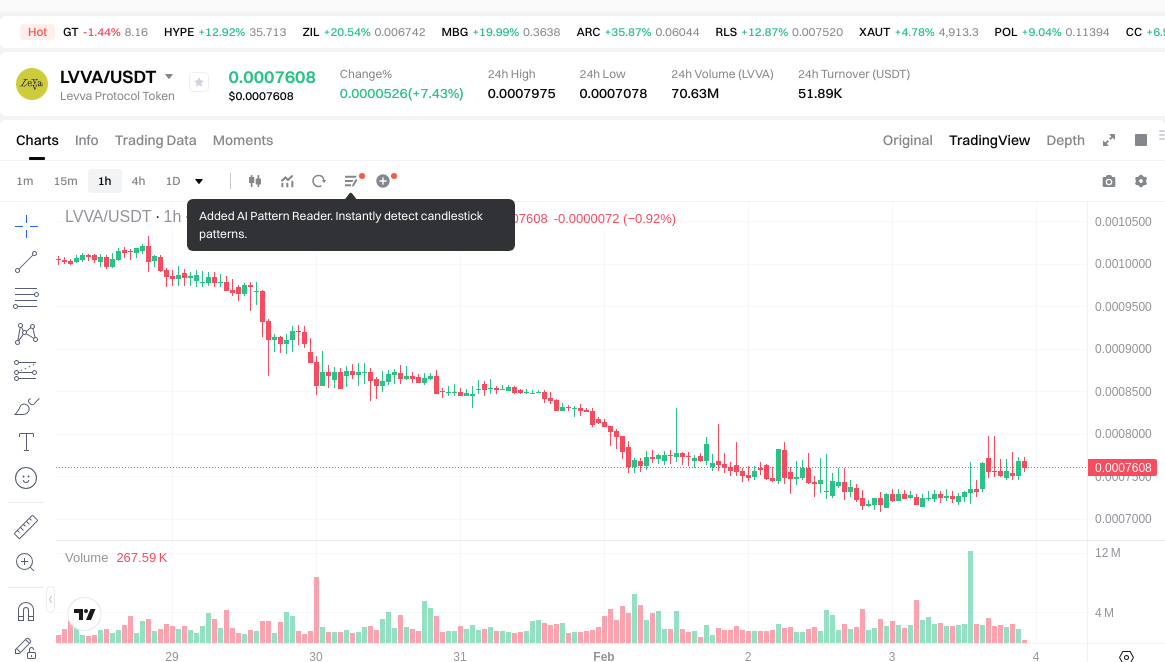
- February 2, 2026: Market conditions led LVVA to trade at $0.0007078 → Price experienced significant volatility
- Recent market cycle: From elevated levels to $0.0007078, reflecting broader market adjustments
Current LVVA Investment Market Status (February 2026)
- LVVA current price: $0.0007547
- 24-hour trading volume: $52,300.31
- Market capitalization: $943,375
- Circulating supply: 1,250,000,000 LVVA (62.5% of total supply)
Click to view real-time LVVA market price
II. Core Factors Influencing Whether LVVA Is a Good Investment
Supply Mechanism and Scarcity (LVVA investment scarcity)
- Maximum supply capped at 2,000,000,000 tokens with 1,250,000,000 tokens currently in circulation (62.5% circulating ratio) → influences price dynamics and investment considerations
- Market cap to fully diluted valuation ratio of 62.5% indicates significant unreleased supply that may affect future scarcity dynamics
- Investment implication: The fixed maximum supply provides a defined scarcity framework, though the substantial uncirculated portion (37.5%) represents potential future supply pressure
Institutional Investment and Mainstream Adoption (Institutional investment in LVVA)
- Current holder count stands at 2,005 addresses, reflecting the early-stage adoption level of the protocol
- Available trading on 6 exchanges, indicating limited but present market access for institutional and retail participants
- The ERC-20 standard implementation on Ethereum provides compatibility with established infrastructure, potentially facilitating institutional integration
Macroeconomic Environment's Impact on LVVA Investment
- Broader cryptocurrency market conditions influence LVVA's investment appeal, with market dominance at 0.000054% indicating limited correlation to major market movements
- Economic uncertainty and monetary policy shifts may affect risk appetite for smaller-cap digital assets like LVVA
- Fluctuating trading volumes ($52,300.31 in 24-hour volume as of February 3, 2026) reflect sensitivity to market sentiment and liquidity conditions
Technology and Ecosystem Development (Technology & Ecosystem for LVVA investment)
- Open Custody Protocol (OCP) introduces an innovative relayer mechanism connecting applications to modular permissionless custody protocols
- Keychain Aggregation technology enables end-users to leverage diverse key management protocols through a mesh-network-like structure
- The protocol aims to simplify developer workflows by abstracting complexity and harmonizing economics across multiple bilateral commercial relationships, potentially supporting long-term ecosystem value
III. LVVA Future Investment Forecast and Price Outlook (Is Levva Protocol Token(LVVA) worth investing in 2026-2031)
Short-term Investment Forecast (2026, short-term LVVA investment outlook)
- Conservative forecast: $0.000525 - $0.000761
- Neutral forecast: $0.000761 - $0.000943
- Optimistic forecast: $0.000943 - $0.001210
Mid-term Investment Outlook (2027-2029, mid-term Levva Protocol Token(LVVA) investment forecast)
-
Market stage expectation: During this period, LVVA may experience gradual growth as the protocol continues to develop its keychain aggregation mechanism and expand its user base. The token is projected to show moderate volatility with potential upside driven by broader adoption of custody solutions.
-
Investment return forecast:
- 2027: $0.000809 - $0.001210
- 2028: $0.000546 - $0.001443
- 2029: $0.000817 - $0.001373
-
Key catalysts: Expansion of the relayer mechanism ecosystem, increased integration with key management protocols, partnerships with custody service providers, and overall growth in the permissionless custody protocol sector.
Long-term Investment Outlook (Is LVVA a good long-term investment?)
- Base scenario: $0.000914 - $0.001762 (assuming steady protocol development and moderate market adoption through 2030-2031)
- Optimistic scenario: $0.001534 - $0.002147 (assuming accelerated adoption of keychain aggregation solutions and favorable regulatory environment for custody protocols)
- Risk scenario: Below $0.000525 (under conditions of significant market downturn, technical challenges, or increased competition in the custody protocol space)
Click to view LVVA long-term investment and price forecast: Price Prediction
2026-02-03 - 2031 Long-term Outlook
- Base scenario: $0.000914 - $0.001762 (corresponding to steady progress and gradual mainstream application growth)
- Optimistic scenario: $0.001534 - $0.002147 (corresponding to large-scale adoption and favorable market conditions)
- Transformative scenario: Above $0.002147 (if the ecosystem achieves breakthrough developments and mainstream popularization)
- 2031-12-31 forecast high: $0.002147 (based on optimistic development assumptions)
Disclaimer: The above forecasts are based on historical data and technical analysis tools. Cryptocurrency markets are highly volatile and unpredictable. These projections should not be considered as investment advice. Investors should conduct their own research and assess their risk tolerance before making any investment decisions.
| Year |
Predicted High Price |
Predicted Average Price |
Predicted Low Price |
Price Change |
| 2026 |
0.000943392 |
0.0007608 |
0.000524952 |
0 |
| 2027 |
0.00120997632 |
0.000852096 |
0.0008094912 |
12 |
| 2028 |
0.001443450624 |
0.00103103616 |
0.0005464491648 |
36 |
| 2029 |
0.00137334016512 |
0.001237243392 |
0.00081658063872 |
63 |
| 2030 |
0.001762143901056 |
0.00130529177856 |
0.000913704244992 |
72 |
| 2031 |
0.002147204975731 |
0.001533717839808 |
0.001257648628642 |
103 |
IV. LVVA Investment Strategy and Risk Management (How to invest in Levva Protocol Token)
Investment Methodology (LVVA investment strategy)
Long-term Holding (HODL LVVA): This approach may be suitable for conservative investors who believe in the long-term potential of keychain aggregation technology and the Open Custody Protocol ecosystem. Given LVVA's focus on modular permissionless custody protocols, investors with a longer time horizon might consider accumulating positions gradually.
Active Trading: Traders employing technical analysis and swing trading strategies should note LVVA's price volatility. Recent data shows 24-hour price fluctuations ranging from $0.0007078 to $0.0007975, with a 6.39% increase in the past 24 hours but a 21.07% decline over 7 days and a 47.99% decrease over 30 days. These movements suggest opportunities for active traders, though timing remains challenging.
Risk Management (Risk management for LVVA investment)
Asset Allocation Ratio:
- Conservative investors: Consider limiting LVVA exposure to 1-3% of crypto portfolio
- Aggressive investors: May allocate 5-10% depending on risk tolerance
- Professional investors: Should conduct thorough due diligence before determining position sizing
Risk Hedging Solutions: Diversification across multiple digital assets and traditional financial instruments may help mitigate LVVA-specific risks. Consider balancing LVVA holdings with more established cryptocurrencies and potentially utilizing stablecoin positions.
Secure Storage:
- Hot wallets: Suitable for active trading portions only
- Cold wallets: Recommended for long-term holdings
- Hardware wallets: Provide enhanced security for significant LVVA positions
V. LVVA Investment Risks and Challenges (Risks of investing in Levva Protocol Token)
Market Risks: LVVA demonstrates substantial price volatility, with significant price movements observed in recent periods. The token's current price of $0.0007547 represents a considerable decline from higher levels, and the relatively low market capitalization of approximately $943,375 may contribute to increased price sensitivity.
Regulatory Risks: As with other digital assets, LVVA faces potential regulatory uncertainty across different jurisdictions. The evolving regulatory landscape for custody protocols and key management solutions may impact the token's utility and market acceptance.
Technical Risks: The Open Custody Protocol's relayer mechanism and keychain aggregation technology, while innovative, carry inherent technical implementation risks. Network security vulnerabilities, protocol upgrade challenges, or integration issues with multiple key management systems could affect the ecosystem's functionality.
Liquidity Considerations: With a 24-hour trading volume of approximately $52,300 and listing on 6 exchanges, LVVA's liquidity profile suggests potential challenges for larger position entries or exits without significant price impact.
VI. Conclusion: Is Levva Protocol Token a Good Investment?
Investment Value Summary: LVVA represents exposure to the emerging keychain aggregation and modular custody protocol sector. While the technology addresses developer complexity and aggregates economics across multiple custody relationships, the token has experienced significant price declines recently, with a 47.99% decrease over the past month. The market capitalization of $943,375 and circulating supply of 1.25 billion tokens (62.5% of max supply) reflect an early-stage project with corresponding risks and potential opportunities.
Investor Recommendations:
✅ Beginners: Consider dollar-cost averaging with small amounts only, prioritize secure wallet storage, and thoroughly research the Open Custody Protocol before investing.
✅ Experienced Investors: May explore swing trading opportunities given recent volatility, maintain strict position sizing discipline, and integrate LVVA as a minor component within a diversified crypto portfolio.
✅ Institutional Investors: Should conduct comprehensive technical and commercial due diligence on the keychain aggregation use case, assess the competitive landscape, and evaluate long-term protocol adoption metrics before considering strategic allocation.
⚠️ Disclaimer: Cryptocurrency investments carry substantial risk. LVVA's price volatility, relatively small market capitalization, and early-stage development present heightened risks. This content is for informational purposes only and does not constitute investment advice. Investors should conduct independent research and consider their financial situation before making investment decisions.
VII. FAQ
Q1: What is Levva Protocol Token (LVVA) and what problem does it solve?
LVVA is the native token of the Levva Protocol, which provides modular permissionless custody solutions through its Open Custody Protocol (OCP). The protocol addresses the complexity developers face when integrating multiple key management and custody solutions by introducing a relayer mechanism that connects applications to various custody protocols. Through keychain aggregation technology, LVVA enables end-users to leverage diverse key management protocols via a mesh-network-like structure, simplifying workflows and harmonizing economics across bilateral commercial relationships. The token operates on the Ethereum blockchain as an ERC-20 standard asset, facilitating integration within decentralized custody infrastructure.
Q2: What is LVVA's current market position and trading availability?
As of February 3, 2026, LVVA maintains a market capitalization of approximately $943,375 with a current trading price of $0.0007547. The token has a circulating supply of 1.25 billion tokens (62.5% of the maximum supply of 2 billion tokens), held by approximately 2,005 addresses. LVVA is currently available for trading on 6 exchanges with a 24-hour trading volume of $52,300.31. The token's market dominance stands at 0.000054%, indicating it is a small-cap digital asset with limited correlation to major market movements.
Q3: How has LVVA's price performed historically and what is the recent trend?
LVVA has experienced significant price volatility since its market debut. The token reached a notable price level of $0.016799 on March 14, 2025, but has since declined substantially to $0.0007078 by February 2, 2026. Recent performance shows mixed signals: a 6.39% increase in the past 24 hours, but a 21.07% decline over 7 days and a 47.99% decrease over the past 30 days. This volatility reflects broader market adjustments and the early-stage nature of the project, with trading volumes fluctuating based on market sentiment and liquidity conditions.
Q4: What are the price forecasts for LVVA from 2026 to 2031?
Price projections for LVVA suggest varied scenarios across different timeframes. For 2026, conservative forecasts range from $0.000525 to $0.001210. Mid-term outlooks (2027-2029) anticipate gradual growth: 2027 ($0.000809 - $0.001210), 2028 ($0.000546 - $0.001443), and 2029 ($0.000817 - $0.001373). Long-term projections for 2030-2031 present a base scenario of $0.000914 - $0.001762 and an optimistic scenario of $0.001534 - $0.002147, with the 2031 forecast high reaching $0.002147 under favorable conditions. However, these forecasts are subject to significant uncertainty given cryptocurrency market volatility and should not be considered investment advice.
Q5: What investment strategies are suitable for LVVA?
Investment approaches for LVVA vary by investor profile. Conservative investors might consider limiting LVVA exposure to 1-3% of their crypto portfolio and employing a long-term holding (HODL) strategy with dollar-cost averaging. Aggressive investors may allocate 5-10% depending on risk tolerance and explore active trading opportunities, given the token's volatility with 24-hour price fluctuations ranging from $0.0007078 to $0.0007975. Active traders should employ technical analysis and swing trading strategies while maintaining strict position sizing discipline. All investors should prioritize secure storage solutions, with cold wallets recommended for long-term holdings and hardware wallets for significant positions.
Q6: What are the primary risks associated with investing in LVVA?
LVVA presents multiple investment risks that require careful consideration. Market risks include substantial price volatility and a relatively low market capitalization of $943,375, contributing to increased price sensitivity. Liquidity concerns arise from a modest 24-hour trading volume of $52,300 and listing on only 6 exchanges, potentially causing price impact during larger transactions. Technical risks involve the Open Custody Protocol's relayer mechanism and keychain aggregation technology implementation challenges. Regulatory uncertainty surrounding custody protocols and key management solutions across different jurisdictions adds another layer of risk. The token's recent 47.99% decline over 30 days underscores its high-risk profile.
Q7: What factors could drive LVVA's future value appreciation?
Several catalysts could potentially support LVVA's future value growth. The expansion of the relayer mechanism ecosystem and increased integration with key management protocols may drive adoption. Partnerships with custody service providers and overall growth in the permissionless custody protocol sector could enhance utility. The protocol's innovative keychain aggregation technology aims to simplify developer workflows by abstracting complexity, which could attract more developers to the ecosystem. Additionally, favorable regulatory developments for custody protocols, successful technical implementations, and broader mainstream adoption of modular permissionless custody solutions could contribute to value appreciation over the long term.
Q8: Who should consider investing in LVVA and what precautions should they take?
LVVA may appeal to different investor categories with appropriate precautions. Beginners should only invest small amounts they can afford to lose, employ dollar-cost averaging strategies, and thoroughly research the Open Custody Protocol before investing while prioritizing secure wallet storage. Experienced investors may explore swing trading opportunities given recent volatility but should maintain strict position sizing discipline and integrate LVVA as a minor component within a diversified crypto portfolio. Institutional investors should conduct comprehensive technical and commercial due diligence on the keychain aggregation use case, assess the competitive landscape, and evaluate long-term protocol adoption metrics before considering strategic allocation. All investors must recognize that LVVA's early-stage development and small market capitalization present heightened risks compared to more established digital assets.
* The information is not intended to be and does not constitute financial advice or any other recommendation of any sort offered or endorsed by Gate.