This comprehensive analysis examines whether Lily (LIY) represents a viable investment opportunity in the emerging web3 live commerce sector. Launched in January 2025, LIY currently trades at $0.002607 with a market cap of $508,365, positioning it as a micro-cap asset targeting the Asia-Pacific commerce market. The article evaluates LIY's price history, tokenomics with only 6.5% circulating supply, and technical infrastructure built on Polygon network. Price forecasts range from $0.00159027 to $0.00318054 by 2026, with long-term projections reaching up to $0.00627501916496 by 2031 under optimistic scenarios. The analysis addresses critical investment risks including market volatility, regulatory uncertainty, and technical vulnerabilities, while providing strategic recommendations for conservative, aggressive, and professional investors. Available on Gate exchange, LIY requires careful risk management and portfolio diversification for potential participants.
Introduction: Lily (LIY)'s Investment Position and Market Outlook
LIY is an emerging digital asset in the cryptocurrency sector, having been launched in January 2025. The project positions itself as a next-generation live commerce platform integrating web3 token incentive protocols, targeting the Asia-Pacific commerce market. As of February 5, 2026, Lily maintains a market capitalization of approximately $508,365, with a circulating supply of 195,000,000 tokens out of a total supply of 3,000,000,000 tokens. The current price stands at around $0.002607, representing a circulating supply ratio of 6.5%. With its focus on connecting creators, users, and commerce through token incentives, LIY has become a subject of interest among investors examining "Is Lily (LIY) a good investment?" This article provides a comprehensive analysis of LIY's investment value, historical price movements, future price projections, and associated investment risks to serve as a reference for potential investors.
I. Lily (LIY) Price History Review and Investment Value Status
- 2025: Launched on January 15, with an opening price of $0.0575
- 2025: Market correction phase → Price declined to $0.000322 on February 10
- 2025: Recovery period → Price gradually stabilized following the early volatility
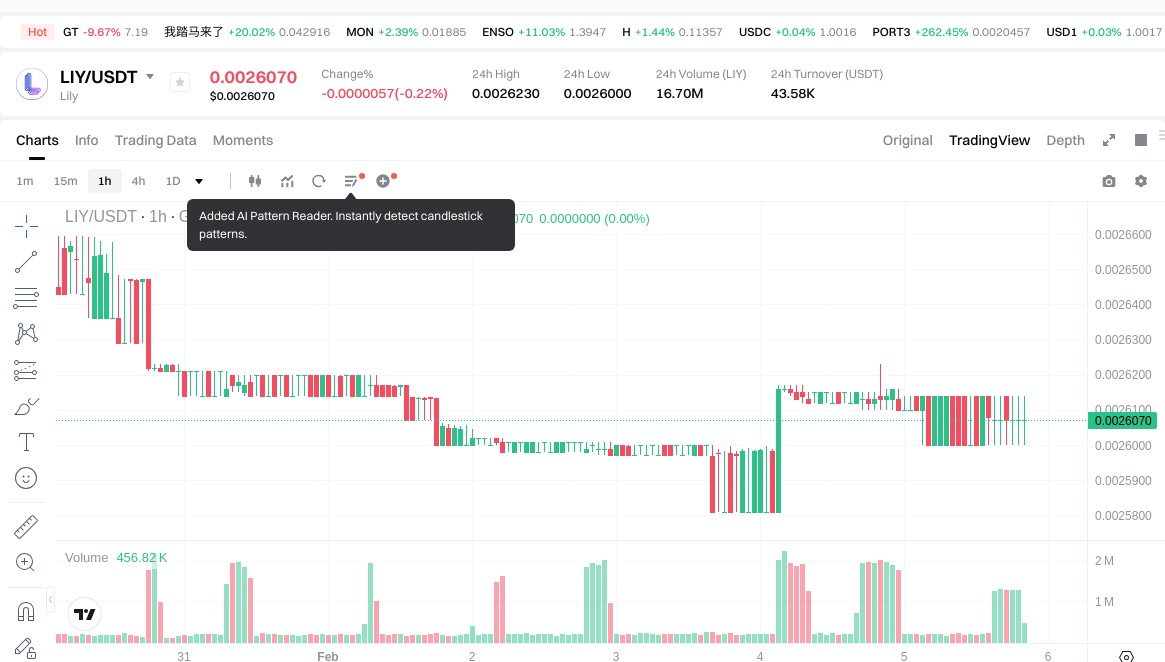
Current LIY Investment Market Status (February 2026)
- LIY current price: $0.002607
- 24-hour trading volume: $44,050.46
- Market capitalization: $508,365
- Circulating supply: 195,000,000 LIY (6.5% of total supply)
- Price change (24h): -0.22%
- Price change (7d): -1.81%
- Price change (30d): +5.55%
- Price change (1y): +80.28%
Click to view real-time LIY market price
II. Core Factors Influencing Whether LIY is a Good Investment
Supply Mechanism and Scarcity (LIY Investment Scarcity)
- Supply Structure: LIY has a maximum supply of 3,000,000,000 tokens, with a current circulating supply of 195,000,000 tokens, representing a circulation ratio of 6.5%. This relatively low circulation rate suggests a controlled token release mechanism.
- Scarcity Analysis: With only 6.5% of the total supply currently in circulation, the token supply structure may contribute to potential scarcity dynamics as the project develops and demand evolves.
- Investment Significance: The controlled supply release may serve as a factor in supporting longer-term valuation considerations, though market adoption and utility remain primary determinants of investment value.
Institutional Investment and Mainstream Adoption (Institutional Investment in LIY)
- Exchange Presence: LIY is currently listed on 2 exchanges and is available for trading on Gate.com, indicating an early stage of market accessibility.
- Holder Base: The token has 72 holders as of the latest data, representing a nascent community that may grow alongside platform development.
- Adoption Context: The project positions itself as a next-generation live commerce platform with a web3 token incentive protocol, targeting the Asia-Pacific (A.P.A.C.) web3 commerce market, though mainstream adoption metrics remain to be established.
Macroeconomic Environment and LIY Investment
- Market Position: LIY holds a market capitalization of approximately $508,365 with a market dominance of 0.00031%, indicating its status as a micro-cap asset within the broader cryptocurrency market.
- Price Performance: The token has shown a 30-day price increase of 5.55% and a 1-year performance of 80.28%, though it experienced a 7-day decline of 1.81%, reflecting varying short-term and longer-term price dynamics.
- Investment Context: As a small-cap token in the web3 commerce sector, LIY's investment profile may be influenced by broader trends in blockchain adoption, e-commerce integration, and the overall cryptocurrency market environment.
Technology and Ecosystem Development (Technology & Ecosystem for LIY Investment)
- Platform Framework: The Lily platform enables users to interact with creators, purchase goods, and earn token incentives through a web3 protocol implementation.
- Technical Infrastructure: LIY operates on the Polygon network, with its contract address verified on Polygonscan, providing transparency regarding its technical implementation.
- Ecosystem Position: The project aims to unify the web3 commerce market in the Asia-Pacific region, positioning itself within the intersection of live commerce and blockchain technology, though specific ecosystem partnerships and integration metrics are not detailed in available materials.
III. LIY Future Investment Forecast and Price Outlook (Is Lily(LIY) worth investing in 2026-2030)
Short-term Investment Forecast (2026, short-term LIY investment outlook)
- Conservative forecast: $0.00159027 - $0.002607
- Neutral forecast: $0.002607 - $0.00289377
- Optimistic forecast: $0.002607 - $0.00318054
Mid-term Investment Outlook (2027-2028, mid-term Lily(LIY) investment forecast)
- Market stage expectation: During the mid-term period, LIY may experience gradual price appreciation as the project develops its web3 live commerce ecosystem and expands its presence in the A.P.A.C. region.
- Investment return forecast:
- 2027: $0.0016205112 - $0.0041380911 (projected change of approximately 11%)
- 2028: $0.002953381662 - $0.0046761876315 (projected change of approximately 34%)
- Key catalysts: Platform user growth, creator ecosystem expansion, token incentive mechanism optimization, and strategic partnerships within the web3 commerce sector.
Long-term Investment Outlook (Is Lily a good long-term investment?)
- Base scenario: $0.00230915331241 - $0.004198460568018 by 2030 (assuming steady platform development and moderate market conditions)
- Optimistic scenario: $0.003916324017847 - $0.00627501916496 by 2031 (assuming accelerated adoption, favorable regulatory environment, and successful ecosystem expansion)
- Risk scenario: Below $0.0016205112 (under adverse market conditions, intensified competition, or regulatory challenges)
View LIY long-term investment and price prediction: Price Prediction
2026-02-05 - 2031 Long-term Outlook
- Base scenario: $0.002607 - $0.004198460568018 (corresponding to steady progress and gradual mainstream application adoption)
- Optimistic scenario: $0.003916324017847 - $0.00627501916496 (corresponding to large-scale adoption and favorable market environment)
- Transformative scenario: Above $0.00627501916496 (in case of breakthrough ecosystem developments and mainstream popularization)
- 2031-12-31 projected high: $0.00627501916496 (based on optimistic development assumptions)
Disclaimer: Price predictions are based on historical data and analytical models. Cryptocurrency markets are highly volatile and subject to numerous external factors. Past performance does not guarantee future results. This analysis is for informational purposes only and should not be considered financial advice. Investors should conduct their own research and consult with financial professionals before making investment decisions.
| Year |
Predicted High Price |
Predicted Average Price |
Predicted Low Price |
Price Change |
| 2026 |
0.00318054 |
0.002607 |
0.00159027 |
0 |
| 2027 |
0.0041380911 |
0.00289377 |
0.0016205112 |
11 |
| 2028 |
0.0046761876315 |
0.00351593055 |
0.002953381662 |
34 |
| 2029 |
0.004300862045287 |
0.00409605909075 |
0.002826280772617 |
57 |
| 2030 |
0.004702275836181 |
0.004198460568018 |
0.00230915331241 |
61 |
| 2031 |
0.00627501916496 |
0.004450368202099 |
0.003916324017847 |
70 |
IV. Lily (LIY) Investment Strategy and Risk Management (How to invest in Lily)
Investment Methodology (Lily investment strategy)
Long-term Holding (HODL Lily): Suitable for conservative investors
For investors with a long-term perspective, holding Lily tokens may align with the project's vision of building a unified web3 commerce ecosystem in the Asia-Pacific region. This approach focuses on the potential growth of the platform as it expands its live commerce infrastructure and token incentive mechanisms. Long-term holders typically avoid short-term market fluctuations and concentrate on fundamental developments such as user adoption, creator engagement, and platform expansion.
Active Trading: Relying on technical analysis and swing trading
Active traders may capitalize on Lily's price movements by utilizing technical analysis tools and market indicators. Given the token's observed volatility—with historical price ranging from $0.000322 to $0.0575—swing trading opportunities may present themselves during market cycles. Traders should monitor key support and resistance levels, volume trends, and broader market sentiment to identify potential entry and exit points.
Risk Management (Risk management for Lily investment)
Asset Allocation Ratio: Conservative / Aggressive / Professional investors
- Conservative investors: May consider allocating 1-3% of their cryptocurrency portfolio to Lily, balancing exposure with more established assets
- Aggressive investors: Could allocate 5-10% depending on risk tolerance and conviction in the project's growth trajectory
- Professional investors: May employ dynamic allocation strategies based on market conditions, technical signals, and fundamental analysis
Risk Hedging Solutions: Multi-asset portfolio + hedging instruments
Investors should consider diversifying their holdings across multiple cryptocurrency assets and traditional financial instruments to mitigate concentration risk. Portfolio construction may include:
- Combining Lily with more established cryptocurrencies to balance risk-reward profiles
- Utilizing stablecoins as a hedge against market volatility
- Monitoring correlation patterns with broader crypto market movements
Secure Storage: Hot/cold wallets + hardware wallet recommendations
Given that Lily is deployed on the Polygon network (contract address: 0x24fd25a49627ce2e4be711e76dc22234c83539fe), investors should prioritize secure storage solutions:
- Cold storage: Hardware wallets compatible with Polygon network tokens offer enhanced security for long-term holdings
- Hot wallets: Web3-enabled wallets such as MetaMask or Trust Wallet provide convenience for active trading while maintaining reasonable security standards
- Best practices: Enable two-factor authentication, verify contract addresses before transactions, and never share private keys or seed phrases
V. Lily (LIY) Investment Risks and Challenges (Risks of investing in Lily)
Market Risks: High volatility and price manipulation concerns
Lily exhibits substantial price volatility, as evidenced by its historical price range. With a relatively small market capitalization of approximately $508,365 and 24-hour trading volume of around $44,050, the token may be susceptible to significant price swings driven by limited liquidity. Lower trading volumes can amplify the impact of large buy or sell orders, potentially leading to sharp price movements. Investors should be prepared for considerable fluctuations in token value over short time periods.
Regulatory Risks: Policy uncertainty across different jurisdictions
The regulatory landscape for cryptocurrency projects, particularly those involving live commerce and token incentives, varies significantly across jurisdictions. As Lily targets the Asia-Pacific market, changes in regulatory frameworks within this region could impact the project's operations, token utility, and overall viability. Investors should monitor regulatory developments in key markets where the platform operates and consider how policy changes might affect token value and project sustainability.
Technical Risks: Network security vulnerabilities and upgrade failures
As a web3 project built on the Polygon network, Lily faces technical risks including:
- Smart contract vulnerabilities that could be exploited by malicious actors
- Dependencies on the underlying Polygon network infrastructure and its security
- Potential challenges in implementing protocol upgrades or new features
- Integration risks associated with connecting live commerce functionality with blockchain technology
Investors should assess the project's technical documentation, audit history, and development team's track record in addressing security concerns.
VI. Conclusion: Is Lily a Good Investment?
Investment Value Summary: Lily presents a novel approach to combining live commerce with web3 token incentives in the Asia-Pacific region. The project's focus on creator-user interaction and token-based rewards aligns with emerging trends in decentralized commerce platforms. However, the token exhibits significant price volatility and operates in an early-stage market with limited liquidity.
Investor Recommendations:
✅ Beginners: Consider dollar-cost averaging (DCA) strategies combined with secure wallet storage. Start with small allocations to understand the project's dynamics and market behavior before increasing exposure.
✅ Experienced Investors: May employ swing trading strategies based on technical analysis while maintaining a core long-term position. Portfolio diversification across multiple assets can help manage risk exposure.
✅ Institutional Investors: Conduct thorough due diligence on the project's business model, team credentials, and market positioning before considering strategic long-term allocation as part of a broader web3 commerce investment thesis.
⚠️ Disclaimer: Cryptocurrency investments carry substantial risk, including the potential loss of principal. This analysis is provided for informational purposes only and does not constitute investment advice. Investors should conduct independent research and consult with financial professionals before making investment decisions.
VII. FAQ
Q1: What is Lily (LIY) and how does it generate value?
Lily (LIY) is a next-generation live commerce platform integrating web3 token incentive protocols, targeting the Asia-Pacific commerce market. The platform generates value by connecting creators, users, and commerce through blockchain-based token incentives. Users can interact with creators, purchase goods, and earn LIY token rewards through platform participation. Built on the Polygon network, the project aims to unify the web3 commerce ecosystem in the A.P.A.C. region, creating value through increased platform adoption, creator engagement, and token utility within its commerce infrastructure.
Q2: Is Lily (LIY) a good investment for beginners in 2026?
For beginners, Lily represents a high-risk, speculative investment opportunity that requires careful consideration. With a current price of $0.002607 and market cap of approximately $508,365, LIY is classified as a micro-cap asset with significant volatility. The token has shown a 1-year performance of +80.28%, but also experienced sharp price fluctuations ranging from $0.000322 to $0.0575 since launch. Beginners should employ dollar-cost averaging (DCA) strategies, allocate only 1-3% of their portfolio, use secure wallet storage, and thoroughly understand the project's fundamentals before investing. The high volatility and limited liquidity make this suitable only for investors comfortable with substantial risk.
Q3: What are the key risks associated with investing in Lily (LIY)?
Lily investment carries three primary risk categories: (1) Market risks—with only $44,050 in 24-hour trading volume and limited liquidity, the token is susceptible to high volatility and potential price manipulation; (2) Regulatory risks—as a web3 commerce platform operating in the Asia-Pacific region, changes in cryptocurrency regulations across different jurisdictions could significantly impact operations and token value; (3) Technical risks—including smart contract vulnerabilities, dependencies on Polygon network security, and integration challenges between live commerce functionality and blockchain technology. Additionally, with only 6.5% of total supply currently circulating, future token releases could create selling pressure.
Q4: How does Lily's tokenomics affect its investment potential?
Lily's tokenomics structure significantly influences its investment profile. The project has a maximum supply of 3,000,000,000 tokens, with only 195,000,000 tokens currently circulating (6.5% circulation ratio). This controlled supply release mechanism may contribute to scarcity dynamics as demand evolves, potentially supporting long-term price appreciation. However, the low circulation rate also means substantial future token releases could create downward price pressure. With 72 current holders and availability on 2 exchanges, the token maintains a nascent ecosystem that requires expansion for sustained growth. The token incentive protocol within the live commerce platform provides utility, though mainstream adoption metrics remain to be established.
Q5: What is the projected price outlook for Lily (LIY) through 2031?
Based on analytical models, Lily's price projections show varying scenarios: Short-term (2026) forecasts range from $0.00159027 (conservative) to $0.00318054 (optimistic). Mid-term projections indicate potential growth to $0.0041380911 by 2027 and $0.0046761876315 by 2028, representing approximately 11% and 34% annual increases respectively. Long-term outlook (2030-2031) suggests a base scenario of $0.00230915331241-$0.004198460568018, with an optimistic scenario reaching $0.00627501916496 by 2031 (approximately 70% growth from current levels). However, these projections are contingent upon platform development, user adoption, regulatory environment, and broader market conditions. Investors should note that cryptocurrency markets are highly volatile and past performance does not guarantee future results.
Q6: What investment strategy is recommended for Lily (LIY)?
Investment strategies for Lily should align with individual risk tolerance and investment goals. Long-term holding (HODL) suits conservative investors willing to allocate 1-3% of their portfolio and focus on fundamental platform development over multiple years. Active trading strategies may appeal to experienced investors comfortable with technical analysis and swing trading, potentially allocating 5-10% based on risk tolerance. Key strategic elements include: (1) Diversification—combining Lily with established cryptocurrencies and stablecoins to balance risk; (2) Secure storage—using hardware wallets compatible with Polygon network for long-term holdings and web3-enabled wallets like MetaMask for active trading; (3) Risk management—employing dollar-cost averaging, setting clear entry/exit points, and monitoring platform developments, user growth metrics, and regulatory changes in the Asia-Pacific region.
Q7: How does Lily compare to other web3 commerce platforms?
Lily differentiates itself through its specific focus on live commerce integration with web3 token incentives in the Asia-Pacific market. Unlike traditional e-commerce platforms, Lily enables real-time creator-user interaction with blockchain-based reward mechanisms. However, comparative analysis reveals certain considerations: with a market cap of $508,365 and 0.00031% market dominance, Lily operates at a significantly smaller scale than established blockchain commerce projects. The platform's deployment on Polygon network provides scalability advantages and lower transaction costs, though ecosystem maturity remains in early stages with only 72 holders. The project's success depends on its ability to attract creators, drive user adoption, and execute its vision of unifying the A.P.A.C. web3 commerce market amid competition from both traditional e-commerce giants and emerging blockchain-based alternatives.
Q8: What factors could drive Lily's price appreciation in the coming years?
Several catalysts could influence Lily's potential price appreciation: (1) Platform adoption—increased user base and creator engagement within the live commerce ecosystem would drive demand for LIY tokens; (2) Token utility expansion—enhanced use cases for LIY within the platform's incentive mechanisms and commerce transactions; (3) Strategic partnerships—collaborations with established e-commerce platforms, payment processors, or web3 projects in the Asia-Pacific region; (4) Market conditions—favorable regulatory developments for cryptocurrency and web3 commerce, plus broader crypto market bull cycles; (5) Technical developments—successful protocol upgrades, improved user experience, and demonstrated security track record. Conversely, price depreciation risks include intensified competition, regulatory restrictions, technical vulnerabilities, failure to achieve user adoption targets, or adverse broader cryptocurrency market conditions. Investors should monitor these factors when evaluating investment timing and position sizing.
* The information is not intended to be and does not constitute financial advice or any other recommendation of any sort offered or endorsed by Gate.