This comprehensive analysis evaluates Loopring NEO (LRN) as an investment opportunity, examining its position within the NEO decentralized exchange ecosystem. The article covers LRN's historical price performance from its 2018 high of $3.40 to current levels around $0.001979, alongside current market metrics including a $224,820 market capitalization and 113,602,931 circulating tokens. Core investment factors are analyzed through supply mechanisms, technology infrastructure, and ecosystem utility within NEO's decentralized trading protocol framework. The guide presents short-term forecasts ranging from $0.001264 to $0.002765 for 2026, with long-term optimistic scenarios reaching $0.005385 by 2031, supported by detailed price prediction tables. Investment strategies tailored for conservative, experienced, and institutional investors are provided alongside comprehensive risk management approaches including portfolio allocation guidelines and secure storage recommendations. The analysis concludes with critical r
Introduction: Loopring NEO (LRN)'s Investment Position and Market Prospects
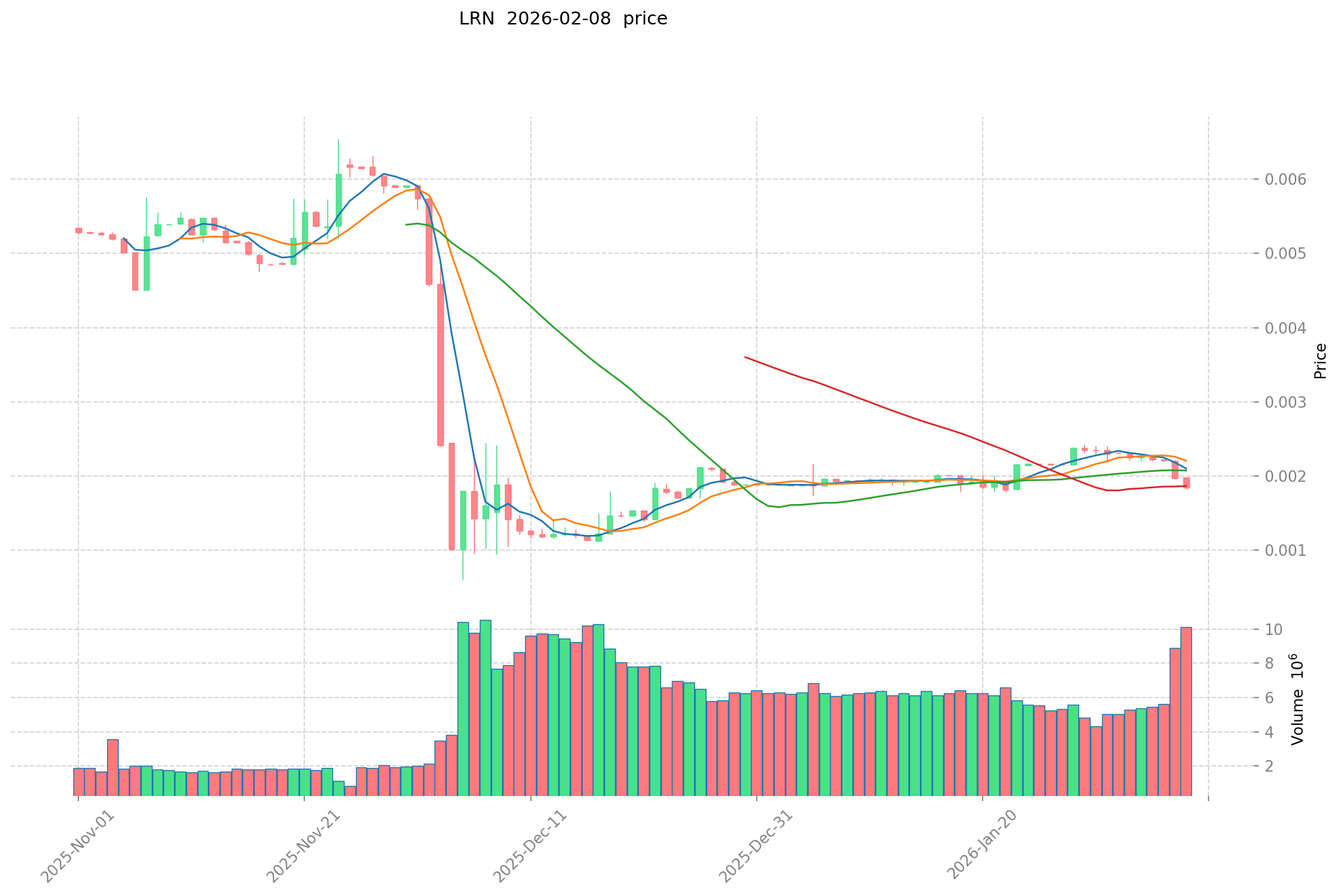
LRN is a notable asset in the cryptocurrency field. Since its launch in 2018, it has been associated with decentralized exchange protocols within the NEO ecosystem. As of February 2026, LRN has a market capitalization of approximately $224,820, with a circulating supply of about 113,602,931 tokens, and the current price is around $0.001979. Positioned as a token supporting decentralized token-to-token trading within the NEO ecosystem, LRN has attracted attention from investors discussing "Is Loopring NEO (LRN) a good investment?" This article provides a comprehensive analysis of LRN's investment value, historical trends, future price predictions, and investment risks to serve as a reference for investors.
I. LRN Price History Review and Current Investment Value
- 2018: LRN reached a notable price level of $3.40441 on November 1, 2018 → Market participants experienced significant price movement during this period
- 2025: Price declined to $0.000601091773 on May 9, 2025 → LRN experienced substantial volatility in market valuation
- 2026: Current market cycle shows price at $0.001979 as of February 8, 2026 → Price has fluctuated within a range reflecting broader market conditions
Current LRN Investment Market Status (February 2026)
- LRN current price: $0.001979
- Market sentiment: Data shows 24-hour price change of -0.15%, with price movements ranging between $0.001825 (low) and $0.001985 (high)
- 24-hour trading volume: $18,345.39
- Market capitalization: $224,820.20 with circulating supply of 113,602,931 tokens
Click to view real-time LRN market price
II. Core Factors Influencing Whether LRN is a Good Investment
Supply Mechanism and Scarcity (LRN investment scarcity)
- Total supply of 139,507,605 tokens with a circulating supply of 113,602,931 tokens → affects price dynamics and investment considerations
- Circulating ratio stands at 100.0%, indicating full circulation of max supply → impacts scarcity perception
- Historical price movement: LRN traded at $3.40 on November 1, 2018, compared to current price of $0.001979 as of February 8, 2026 → demonstrates significant historical volatility
- Investment consideration: The fully circulating supply structure may influence long-term value assessment for potential investors
Technology & Ecosystem Construction (Technology & Ecosystem for LRN investment)
- Loopring protocol deployment on NEO network → provides decentralized token exchange infrastructure
- Core technology: Decentralized exchange protocol utilizing off-chain order matching and on-chain settlement → aims to reduce transaction risks
- Multi-exchange competition mechanism → allows various exchanges to compete for order matching on the same orders
- NEO ecosystem support: LRN functions as the token supporting decentralized token-to-token trading within the NEO ecosystem → contributes to ecosystem utility
- Protocol-level application: LRN serves as the implementation of Loopring protocol on NEO blockchain → establishes technical foundation for exchange operations
III. LRN Future Investment Forecast and Price Outlook (Is Loopring NEO (LRN) Worth Investing in 2026-2031)
Short-term Investment Forecast (2026, Short-term LRN Investment Outlook)
- Conservative Forecast: $0.001264 - $0.001975
- Neutral Forecast: $0.001975 - $0.002370
- Optimistic Forecast: $0.002370 - $0.002765
Mid-term Investment Outlook (2027-2028, Mid-term Loopring NEO (LRN) Investment Forecast)
- Market Stage Expectation: The mid-term period may see moderate growth driven by potential developments in the NEO ecosystem and decentralized exchange adoption trends.
- Investment Return Forecast:
- 2027: $0.0015642 - $0.0028203
- 2028: $0.001816605 - $0.003477501
- Key Catalysts: Expansion of decentralized trading protocols on the NEO network, broader adoption of token-to-token exchanges within the NEO ecosystem, and overall market sentiment towards decentralized finance solutions.
Long-term Investment Outlook (Is LRN a Good Long-term Investment?)
- Base Scenario: $0.002277244125 - $0.00346141107 (Assuming steady progress in decentralized exchange technology and moderate growth in the NEO ecosystem)
- Optimistic Scenario: $0.00388649664 - $0.005385090272152 (Assuming increased adoption of decentralized trading solutions and favorable market conditions for blockchain-based financial infrastructure)
- Risk Scenario: Below $0.001264 (Under conditions of reduced interest in the NEO ecosystem, intensified competition from other decentralized exchange protocols, or unfavorable regulatory developments)
For more details on LRN long-term investment and price forecasts, visit: Price Prediction
2026-02-08 to 2031 Long-term Outlook
- Base Scenario: $0.002277244125 - $0.00346141107 (Corresponding to steady progress and gradual mainstream application adoption)
- Optimistic Scenario: $0.00388649664 - $0.005385090272152 (Corresponding to large-scale adoption and favorable market conditions)
- Transformative Scenario: Above $0.005385090272152 (In the event of breakthrough developments in the ecosystem and mainstream popularization)
- 2031-12-31 Predicted High: $0.005385090272152 (Based on optimistic development assumptions)
Disclaimer: The forecasts presented are based on available data and analytical models as of February 8, 2026. Cryptocurrency markets are highly volatile and subject to rapid changes in technology, regulation, and market sentiment. Past performance does not guarantee future results. This analysis is for informational purposes only and should not be construed as financial advice. Investors should conduct their own research and consult with qualified professionals before making any investment decisions.
| Year |
Predicted High Price |
Predicted Average Price |
Predicted Low Price |
Price Change |
| 2026 |
0.002765 |
0.001975 |
0.001264 |
0 |
| 2027 |
0.0028203 |
0.00237 |
0.0015642 |
19 |
| 2028 |
0.003477501 |
0.00259515 |
0.001816605 |
31 |
| 2029 |
0.00388649664 |
0.0030363255 |
0.002277244125 |
53 |
| 2030 |
0.0050190460515 |
0.00346141107 |
0.0022153030848 |
74 |
| 2031 |
0.005385090272152 |
0.00424022856075 |
0.003858607990282 |
114 |
IV. LRN Investment Strategy and Risk Management (How to invest in cryptocurrency)
Investment Methodology (LRN investment strategy)
-
Long-term Holding (HODL LRN): Suitable for conservative investors who believe in the long-term development of decentralized exchange protocols. Investors may consider accumulating positions during market downturns and holding through market cycles.
-
Active Trading: Relies on technical analysis and swing trading strategies. Given LRN's notable price volatility, traders may identify entry and exit points through chart patterns, volume analysis, and key support/resistance levels.
Risk Management (Risk management for LRN investment)
-
Asset Allocation Ratio:
- Conservative investors: Allocate no more than 1-3% of portfolio to LRN
- Aggressive investors: May allocate 5-10% depending on risk tolerance
- Professional investors: Can adjust allocation based on market conditions and technical analysis
-
Risk Hedging Solutions: Implement multi-asset portfolio diversification, combining LRN with established cryptocurrencies and traditional assets. Consider setting stop-loss orders to limit downside risk.
-
Secure Storage: Use cold wallets for long-term holdings and hot wallets for trading purposes. Hardware wallets from reputable manufacturers are recommended for storing significant amounts of LRN.
V. LRN Investment Risks and Challenges (Risks of investing in cryptocurrency)
-
Market Risk: LRN exhibits significant price volatility, with historical data showing fluctuations ranging from recent lows to substantial percentage changes within short timeframes. The relatively low market capitalization and limited exchange listings may expose investors to liquidity constraints and potential price manipulation.
-
Regulatory Risk: As a cryptocurrency associated with decentralized exchange protocols, LRN faces uncertain regulatory landscapes across different jurisdictions. Changes in cryptocurrency regulations, particularly those affecting decentralized exchanges and token classifications, could impact LRN's adoption and market value.
-
Technical Risk: Network security vulnerabilities, smart contract bugs, or failed protocol upgrades could affect the functionality and security of the Loopring protocol on the NEO network. Dependencies on the underlying NEO blockchain infrastructure present additional technical considerations.
VI. Conclusion: Is Cryptocurrency a Good Investment?
-
Investment Value Summary: LRN represents a specialized investment in decentralized exchange technology within the NEO ecosystem. While the protocol addresses important needs in cryptocurrency trading, investors should consider the token's limited market presence, relatively small market capitalization, and concentrated exchange availability.
-
Investor Recommendations:
✅ Beginners: Consider dollar-cost averaging with small amounts and prioritize secure wallet storage. Thoroughly research decentralized exchange protocols before investing.
✅ Experienced Investors: May explore swing trading opportunities while maintaining diversified portfolio allocation. Monitor technical indicators and project developments closely.
✅ Institutional Investors: Conduct comprehensive due diligence on protocol fundamentals, ecosystem development, and competitive positioning before considering strategic allocation.
⚠️ Disclaimer: Cryptocurrency investment carries substantial risk. This article is for informational purposes only and does not constitute investment advice. Investors should conduct independent research and consult with financial professionals before making investment decisions.
VII. FAQ
Q1: Is Loopring NEO (LRN) a good investment in 2026?
LRN presents a highly speculative investment opportunity with significant risks. As of February 2026, LRN trades at $0.001979 with a modest market capitalization of $224,820, representing a 99.94% decline from its 2018 high of $3.40. The token's limited exchange listings, low trading volume ($18,345 in 24 hours), and concentration within the NEO ecosystem create substantial liquidity constraints. Conservative investors should allocate no more than 1-3% of their portfolio to LRN, while beginners should thoroughly research decentralized exchange protocols before considering any investment.
Q2: What are the main risks of investing in LRN?
The primary risks include extreme market volatility, limited liquidity due to small market capitalization, regulatory uncertainty surrounding decentralized exchanges, and technical dependencies on the NEO blockchain infrastructure. Historical price performance shows LRN has experienced significant drawdowns, and the token's concentrated availability across few exchanges may expose investors to potential price manipulation. Additionally, smart contract vulnerabilities or failed protocol upgrades could negatively impact the Loopring protocol's functionality on the NEO network.
Q3: What is LRN's price prediction for 2026-2031?
Short-term forecasts for 2026 range from $0.001264 (conservative) to $0.002765 (optimistic). Mid-term projections suggest potential growth to $0.0028203 by 2027 and $0.003477501 by 2028, contingent on increased adoption of decentralized trading within the NEO ecosystem. Long-term optimistic scenarios estimate prices could reach $0.005385090272152 by 2031, representing a 114% increase from current levels. However, these projections carry substantial uncertainty and depend on favorable market conditions, technological developments, and ecosystem expansion that may not materialize.
Q4: How does LRN's tokenomics affect its investment value?
LRN has a total supply of 139,507,605 tokens with 113,602,931 currently circulating, representing a 100% circulating ratio of the maximum supply. This full circulation structure eliminates concerns about future supply inflation but also means the token lacks scarcity mechanisms that could drive price appreciation through supply constraints. The relatively large circulating supply combined with minimal market demand creates downward pressure on price discovery, making LRN heavily dependent on adoption growth rather than tokenomics-driven value accrual.
Q5: What investment strategies work best for LRN?
For conservative investors, a long-term holding (HODL) strategy with dollar-cost averaging during market downturns may minimize timing risk while building positions gradually. Experienced traders might employ swing trading strategies leveraging LRN's notable volatility, using technical analysis to identify support/resistance levels. Given the high-risk profile, position sizing is critical—conservative investors should limit exposure to 1-3% of portfolio value, while aggressive investors may allocate 5-10% depending on risk tolerance. Cold wallet storage is essential for long-term holdings to mitigate security risks.
Q6: How does LRN compare to other decentralized exchange tokens?
LRN operates as a specialized implementation of the Loopring protocol specifically within the NEO ecosystem, distinguishing it from broader decentralized exchange tokens like Uniswap (UNI) or SushiSwap (SUSHI) that operate on Ethereum or multi-chain platforms. This specialization creates both advantages (reduced competition within NEO) and disadvantages (limited market reach). The token's significantly smaller market capitalization and trading volume compared to major DEX tokens reflect its niche positioning, making it a higher-risk, potentially higher-reward investment dependent on NEO ecosystem growth rather than broader DeFi adoption.
Q7: What factors could drive LRN's price appreciation?
Key catalysts for potential price growth include expanded adoption of decentralized trading protocols within the NEO ecosystem, increased trading volume on Loopring-powered exchanges, strategic partnerships that enhance protocol utility, and favorable regulatory developments for decentralized finance. Broader market sentiment toward blockchain-based financial infrastructure and specific improvements to the NEO network could also positively impact LRN. However, these catalysts remain speculative, and investors should recognize that ecosystem-dependent tokens face concentration risk if the underlying platform fails to gain mainstream traction.
Q8: Should beginners invest in LRN?
Beginners should approach LRN investment with extreme caution. The token's high volatility, limited liquidity, and niche ecosystem positioning make it unsuitable as a first cryptocurrency investment. New investors should first gain experience with established cryptocurrencies like Bitcoin or Ethereum before considering speculative assets like LRN. If beginners choose to invest, they should start with minimal amounts they can afford to lose entirely, use secure cold wallet storage, and thoroughly research decentralized exchange technology and the NEO ecosystem. Dollar-cost averaging with very small positions can help minimize timing risk while building knowledge.
* The information is not intended to be and does not constitute financial advice or any other recommendation of any sort offered or endorsed by Gate.