This comprehensive analysis examines whether Masa Network (MASA) represents a sound investment opportunity in 2026. MASA, a decentralized AI data and LLM network launched in April 2024, has raised $18 million from institutional investors and achieved significant milestones including rapid CoinList completion and Binance MVB Accelerator participation. However, the token faces substantial challenges: current price of $0.000872 reflects a -98.42% one-year decline and -75.08% monthly decrease, with limited liquidity at $25,928.07 daily volume. The article evaluates MASA's tokenomics, technology infrastructure supporting over 1.4 million users and 48,000 node operators, and market dynamics while providing price forecasts ranging from $0.000750-$0.001809 through 2031. Detailed investment strategies, risk management approaches, and regulatory considerations guide both beginner and experienced investors in decision-making for this high-volatility, early-stage cryptocurrency asset available on Gate and other exchanges
Introduction: Masa Network (MASA) Investment Position and Market Prospects
MASA is a notable asset in the cryptocurrency sector, launched in April 2024 with a focus on decentralized AI data and LLM network applications. As of February 2026, MASA maintains a market capitalization of approximately $337,773.56, with a circulating supply of around 387.35 million tokens and a current price of approximately $0.000872. Positioned as a decentralized AI data infrastructure, MASA has gradually become a subject of discussion among investors considering "Is Masa Network (MASA) a good investment?" Masa Network has attracted investment from Digital Currency Group, Anagram, Animoca, and GoldenTree, raising $18 million. The project completed a CoinList sale in 17 minutes, securing $8.75 million, and participated in Binance MVB Accelerator S6 and Hashkey AI Accelerator. With over 1.4 million users, 48,000 node operators, and more than 40 million data points ahead of its mainnet launch, MASA demonstrates community engagement in the AI and blockchain ecosystem. This article provides a comprehensive analysis of MASA's investment characteristics, historical price trends, future price considerations, and associated investment risks for reference purposes.
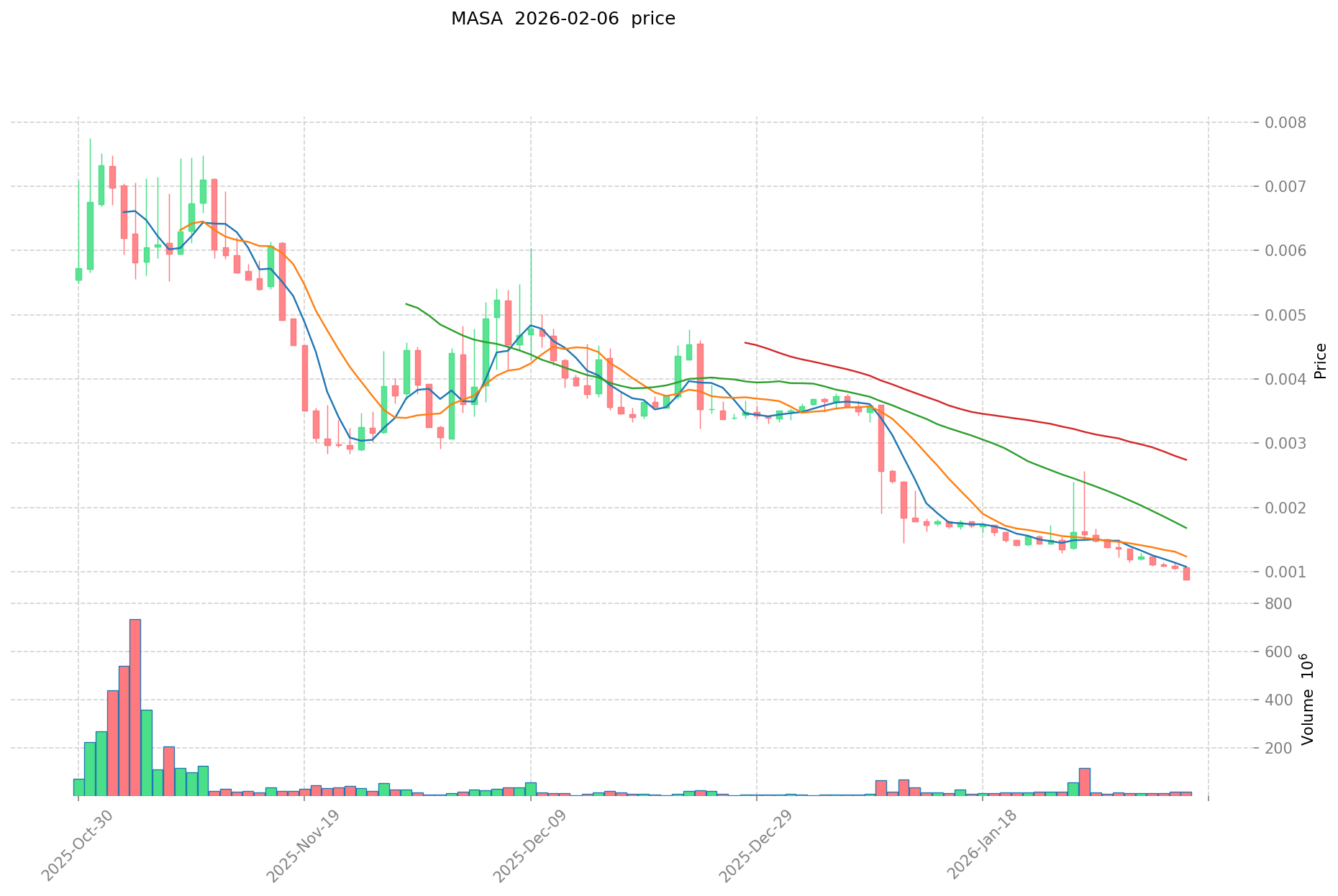
I. MASA Price History and Current Investment Status
MASA Historical Price Trends and Investment Returns
- 2024: Initial Coin Offering (ICO) at $0.079 → Early-stage investors participated in the token launch phase
- April 2024: Price movement recorded → MASA experienced notable price activity following its market debut
- 2024-2026: Market adjustment phase → Price declined from higher levels to $0.000872 as of February 7, 2026
Current MASA Investment Market Status (February 2026)
- Current MASA price: $0.000872
- 24-hour trading volume: $25,928.07
- 24-hour price change: -8.81%
- 7-day price change: -37.71%
- 30-day price change: -75.08%
- 1-year price change: -98.42%
- Market capitalization: $337,773.56
- Circulating supply: 387,355,000 MASA
- Total supply: 1,571,619,236 MASA
- Maximum supply: 1,588,866,523 MASA
- Circulating supply ratio: 24.38%
- Number of holders: 5,057
- Listed on 10 exchanges
Click to view real-time MASA market price
II. Core Factors Influencing Whether MASA is a Good Investment
Supply Mechanism and Scarcity (MASA Investment Scarcity)
- Supply structure: MASA has a maximum supply of 1,588,866,523 tokens, with a circulating supply of 387,355,000 tokens, representing approximately 24.38% of the total supply.
- Current circulation ratio indicates that a substantial portion of tokens remains undistributed, which may affect future price dynamics as additional tokens enter circulation.
- Investment implication: The relatively low circulation ratio suggests potential dilution risks as more tokens are released into the market, which investors should consider when evaluating long-term scarcity.
Institutional Investment and Mainstream Adoption (Institutional Investment in MASA)
- Funding background: Masa Network has raised $18 million from institutional investors including Digital Currency Group, Anagram, Animoca, and GoldenTree.
- Market milestones: The project achieved notable momentum during its CoinList sale, which sold out in 17 minutes and raised $8.75 million.
- Ecosystem participation: Masa Network graduated from the Binance Most-Valuable-Builder Accelerator S6 and participated in Hashkey's AI Accelerator, indicating recognition within established blockchain ecosystems.
- Current holder base: The token has approximately 5,057 holders as of February 2026, reflecting early-stage adoption.
Macroeconomic Environment's Impact on MASA Investment
- Market positioning: Masa operates within the decentralized AI data and LLM network sector, which is influenced by broader trends in artificial intelligence adoption and blockchain infrastructure demand.
- Price performance context: MASA has experienced significant volatility, with the price declining approximately 98.42% over a one-year period and 75.08% over 30 days, reflecting both macroeconomic pressures and project-specific market dynamics.
- Trading activity: The 24-hour trading volume of $25,928.07 suggests relatively limited liquidity compared to more established cryptocurrencies.
Technology and Ecosystem Development (Technology & Ecosystem for MASA Investment)
- Platform function: Masa functions as a decentralized AI data and LLM network where users can own, share, and monetize their data and computational resources to support AI applications.
- User base: Prior to mainnet launch, Masa accumulated over 1.4 million unique users, 48,000 node operators, and over 40 million data points.
- Technical standard: MASA is deployed as an ERC-20 token on the Ethereum blockchain.
- Exchange availability: The token is listed on 10 exchanges, with trading supported on platforms including Gate.com.
III. MASA Future Investment Forecast and Price Outlook (Is Masa Network(MASA) worth investing in 2026-2031)
Short-term MASA Investment Outlook (2026)
- Conservative forecast: $0.000452 - $0.000811
- Neutral forecast: $0.000870 - $0.000966
- Optimistic forecast: $0.001023 - $0.001061
Mid-term Masa Network(MASA) Investment Forecast (2027-2029)
-
Market stage expectation: Masa Network may experience gradual growth driven by decentralized AI data network expansion and increasing node operator participation. The platform's integration with AI applications and data monetization mechanisms could support price appreciation during this period.
-
Investment return forecast:
- 2027: $0.000811 - $0.001024
- 2028: $0.000905 - $0.001124
- 2029: $0.000784 - $0.001250
-
Key catalysts: Network adoption momentum, AI application integration progress, node operator ecosystem growth, and mainstream recognition of decentralized AI data solutions.
Long-term Investment Outlook (Is MASA a good long-term investment?)
- Base scenario: $0.000750 - $0.001310 (assuming steady ecosystem development and moderate market conditions)
- Optimistic scenario: $0.001466 - $0.001809 (assuming accelerated adoption and favorable market environment)
- Risk scenario: Below $0.000750 (under adverse market conditions or delayed development progress)
Click to view MASA long-term investment and price prediction: Price Prediction
2026-02-07 to 2031 Long-term Outlook
- Base scenario: $0.000750 - $0.001310 (corresponding to steady progress and mainstream application growth)
- Optimistic scenario: $0.001466 - $0.001809 (corresponding to large-scale adoption and favorable market conditions)
- Transformative scenario: Above $0.001809 (if ecosystem achieves breakthrough developments and mainstream adoption)
- 2031-12-31 predicted high: $0.001809 (based on optimistic development assumptions)
Disclaimer: Price predictions are based on historical data and market analysis tools, and do not constitute investment advice. Cryptocurrency markets are highly volatile and subject to various risks. Investors should conduct independent research and consider their risk tolerance before making investment decisions.
| Year |
Predicted High Price |
Predicted Average Price |
Predicted Low Price |
Price Change |
| 2026 |
0.0010614 |
0.00087 |
0.0004524 |
0 |
| 2027 |
0.001023642 |
0.0009657 |
0.000811188 |
10 |
| 2028 |
0.00112397823 |
0.000994671 |
0.00090515061 |
14 |
| 2029 |
0.0012500030457 |
0.001059324615 |
0.0007839002151 |
21 |
| 2030 |
0.001466423064544 |
0.00115466383035 |
0.000750531489727 |
32 |
| 2031 |
0.001808549957477 |
0.001310543447447 |
0.000969802151111 |
50 |
IV. MASA Investment Strategy and Risk Management (How to invest in Decentralized AI Networks)
Investment Methodology (MASA investment strategy)
- Long-term Holding (HODL MASA): Suitable for conservative investors who believe in the long-term potential of decentralized AI data networks. This approach minimizes trading costs and reduces exposure to short-term volatility.
- Active Trading: Relies on technical analysis and swing trading strategies. Given MASA's historical volatility, traders may capitalize on price fluctuations by monitoring key support and resistance levels.
Risk Management (Risk management for MASA investment)
- Asset Allocation Ratio:
- Conservative investors: Allocate 1-3% of portfolio to MASA
- Aggressive investors: Allocate 5-10% of portfolio to MASA
- Professional investors: May allocate higher percentages based on risk tolerance and market analysis
- Risk Hedging Solutions: Diversify with a multi-asset portfolio including established cryptocurrencies and consider hedging tools such as stablecoins or derivatives.
- Secure Storage: Utilize cold wallets for long-term holdings and hardware wallets (such as Ledger or Trezor) for enhanced security. Hot wallets should only be used for active trading with minimal balances.
V. MASA Investment Risks and Challenges (Risks of investing in Decentralized AI Networks)
- Market Risk: MASA exhibits high volatility, with 24-hour price changes reaching -8.81%, 7-day changes of -37.71%, and 30-day fluctuations of -75.08%. The token has experienced a -98.42% decline over one year. Such volatility exposes investors to substantial price swings and potential manipulation risks in lower liquidity environments.
- Regulatory Risk: The regulatory landscape for decentralized AI networks and data tokenization remains uncertain across different jurisdictions. Changes in policy regarding data privacy, AI regulations, or cryptocurrency classification could impact MASA's operations and token value.
- Technical Risk: As a decentralized network, MASA faces potential security vulnerabilities, smart contract risks, and challenges related to network upgrades. The success of the mainnet launch and ongoing technical development are critical factors that could affect the project's viability.
VI. Conclusion: Is Decentralized AI Network Token a Good Investment?
- Investment Value Summary: MASA represents participation in the emerging decentralized AI data economy. While the project has raised $18 million from prominent investors and achieved notable milestones such as a rapid CoinList sale, the token has experienced substantial price volatility and depreciation since its all-time high.
- Investor Recommendations:
✅ Beginners: Consider dollar-cost averaging (DCA) strategies and prioritize secure wallet storage. Start with minimal allocations to understand market dynamics.
✅ Experienced Investors: Implement swing trading strategies combined with portfolio diversification. Monitor technical indicators and project development milestones.
✅ Institutional Investors: Evaluate strategic long-term allocation based on comprehensive due diligence of the decentralized AI data market and MASA's competitive positioning.
⚠️ Disclaimer: Cryptocurrency investment carries high risk. This content is for informational purposes only and does not constitute investment advice. Conduct thorough research and consult with financial professionals before making investment decisions.
VII. FAQ
Q1: Is Masa Network (MASA) a good investment for beginners in 2026?
MASA carries significant risks for beginners due to its extreme volatility and -98.42% decline over the past year. For new investors, MASA should only represent 1-3% of a diversified portfolio, utilizing dollar-cost averaging (DCA) strategies to mitigate timing risks. The token's low liquidity ($25,928.07 in 24-hour volume) and substantial price fluctuations (-75.08% in 30 days) make it unsuitable as a primary investment. Beginners should prioritize secure cold wallet storage and thoroughly research decentralized AI data networks before allocating capital to MASA.
Q2: What are the main factors that could drive MASA price growth in 2027-2029?
The primary growth catalysts include mainstream adoption of decentralized AI data networks, expansion of the node operator ecosystem beyond the current 48,000 operators, and successful integration with AI applications requiring data monetization solutions. Additional factors include increased institutional recognition following the $18 million funding round, progress in network development post-mainnet launch, and favorable regulatory developments for AI data tokenization. Price forecasts suggest potential growth to $0.001024-$0.001250 by 2029, contingent upon these catalysts materializing.
Q3: How does MASA's token supply structure affect its investment potential?
MASA's circulating supply represents only 24.38% of the maximum supply (387.35M out of 1,588.87M tokens), creating substantial dilution risk as additional tokens enter circulation. This low circulation ratio means future token releases could suppress price appreciation even if demand increases. Investors should monitor the token unlock schedule and distribution plans, as the remaining 75.62% of supply represents significant selling pressure potential. This supply overhang differentiates MASA from projects with higher circulating ratios and should be factored into long-term investment thesis.
Q4: What are the primary risks of investing in MASA compared to established cryptocurrencies?
MASA faces heightened market risk with extreme volatility (-98.42% annual decline), regulatory uncertainty in AI data tokenization across jurisdictions, and technical risks associated with mainnet operations and smart contract security. The token's limited liquidity and relatively small holder base (5,057 holders) increase susceptibility to price manipulation. Additionally, the project's success depends on unproven market demand for decentralized AI data networks, competitive positioning against centralized alternatives, and execution of technical roadmap milestones. These risks significantly exceed those of established cryptocurrencies with proven track records.
Q5: How should experienced traders approach MASA investment strategies?
Experienced investors may implement swing trading strategies capitalizing on MASA's high volatility, utilizing technical analysis to identify support levels around $0.000452 and resistance near $0.001061. Active traders should maintain strict stop-loss orders given the token's propensity for sharp declines (-37.71% in 7 days). Position sizing should remain conservative at 5-10% of portfolio maximum, with diversification across multiple blockchain sectors. Traders should monitor project milestones including mainnet developments, partnership announcements, and node operator growth metrics as potential catalysts for short-term price movements.
Q6: What distinguishes MASA's investment profile from other AI-focused blockchain projects?
MASA's unique positioning centers on decentralized data ownership and monetization for AI applications, differentiating it from AI computation networks or AI-powered trading platforms. The project's institutional backing from Digital Currency Group, Anagram, and Animoca Brands provides credibility, while participation in Binance MVB Accelerator S6 signals ecosystem recognition. However, MASA's extreme price depreciation and low market capitalization ($337,773.56) indicate it remains a speculative, early-stage investment compared to more established AI blockchain projects with proven utility and higher trading volumes.
Q7: Should institutional investors consider MASA for strategic allocation in 2026?
Institutional investors may consider minimal strategic allocation (under 2% of crypto portfolio) as speculative exposure to the decentralized AI data economy, contingent upon comprehensive due diligence of market viability and competitive landscape. The $18 million institutional funding round demonstrates venture capital interest, but the subsequent -98.42% price decline warrants cautious evaluation of valuation timing. Institutions should assess MASA's competitive moat against centralized data providers, regulatory risk exposure across operating jurisdictions, and technical execution capability before committing capital. Traditional risk-adjusted return metrics currently do not support significant institutional allocation given the project's early stage and market volatility.
Q8: What price scenarios should investors prepare for between 2026-2031?
Investors should prepare for three scenarios: Base scenario ($0.000750-$0.001310) assumes steady ecosystem development and moderate market conditions; Optimistic scenario ($0.001466-$0.001809) requires accelerated adoption and favorable AI regulation; Risk scenario (below $0.000750) reflects potential project failure or adverse market conditions. The wide range reflects fundamental uncertainty in decentralized AI data market development. Conservative investors should base decisions on the risk scenario, while allocating only capital they can afford to lose. The 2031 optimistic target of $0.001809 represents approximately 107% upside from current levels but requires multiple positive catalysts to materialize.
* The information is not intended to be and does not constitute financial advice or any other recommendation of any sort offered or endorsed by Gate.