Is NBOT (NBOT) a good investment?: A Comprehensive Analysis of Risks, Returns, and Market Potential
Introduction: NBOT (NBOT) Investment Status and Market Outlook
NBOT represents a digital asset within the cryptocurrency ecosystem, emerging from the Bodhi team's evolution of their blockchain initiatives. As of February 09, 2026, NBOT maintains a market capitalization of approximately $183,458.88, with a circulating supply of 21,332,428 tokens and a current trading price around $0.0086. The token operates within the DeFi prediction market and synthetic asset trading sectors, particularly through the Deerfi platform. With a market ranking of 4058 and a relatively modest market share of 0.000034%, NBOT presents a case study in niche-focused blockchain projects. This article examines NBOT's investment characteristics, historical price movements, future outlook considerations, and associated risks to provide analytical perspective for those researching cryptocurrency investment options.
I. NBOT Price History Review and Current Investment Value Status
NBOT Historical Price Trends and Investment Returns (NBOT Investment Performance)
- 2019: Token launch and early trading phase → NBOT experienced significant price volatility in its initial market period
- June 2019: Price reached $0.076389 → Represented a notable valuation level during the token's early trading history
- March 2020: Price declined to $0.00190929 → Market value decreased significantly during this period
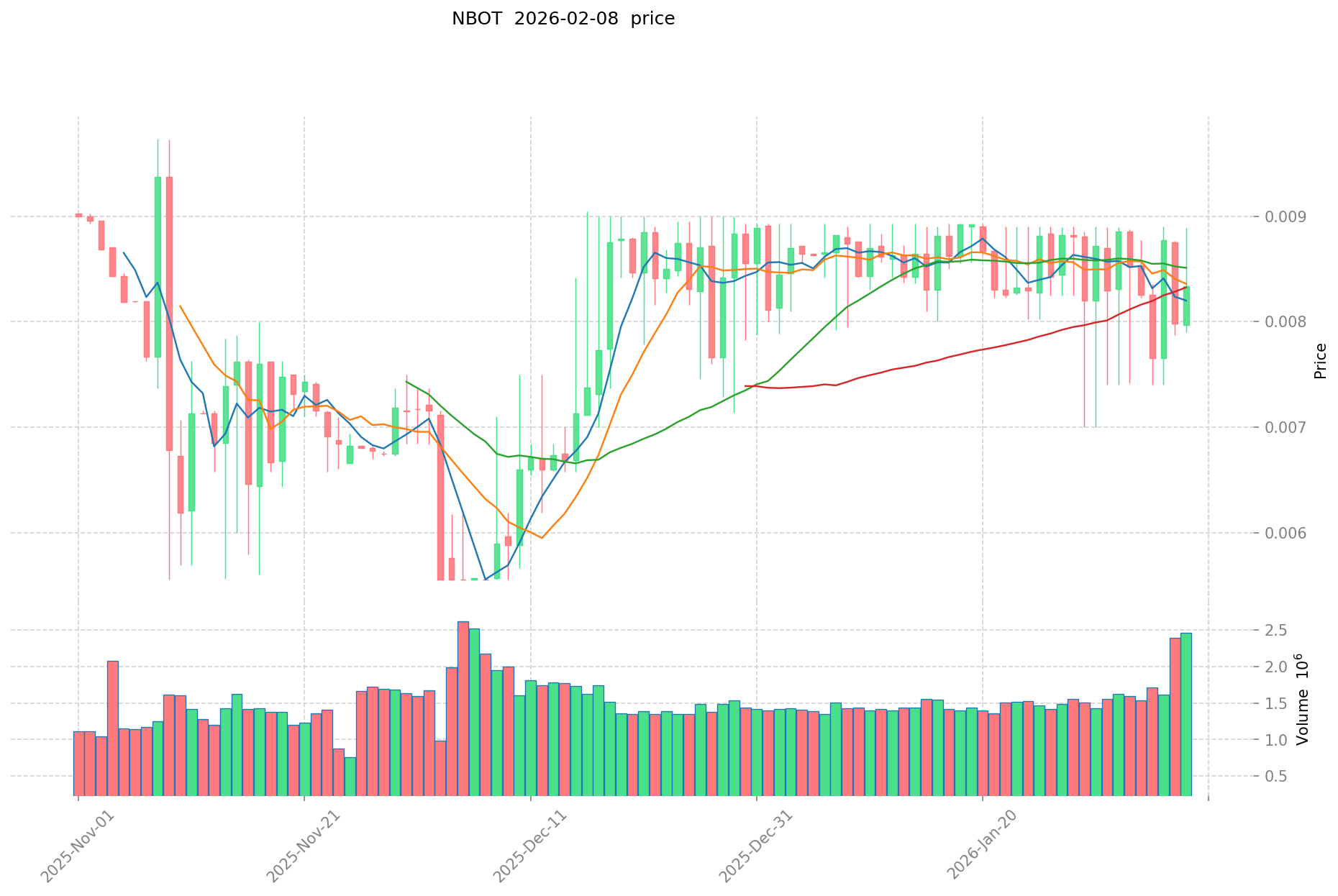
- 2025-2026: Recent performance shows mixed signals → Year-over-year change indicates an increase of approximately 127.45%, while 24-hour movement shows a decrease of 2.59%
Current NBOT Investment Market Status (February 2026)
- NBOT current price: $0.0086
- Market sentiment: Data suggests neutral to cautious market positioning based on recent price movements
- 24-hour trading volume: $12,436.02
- Market capitalization: $183,458.88 with circulating supply of 21,332,428 tokens
Click to view real-time NBOT market price
II. Core Factors Influencing Whether NBOT is a Good Investment
Supply Mechanism and Scarcity
- Supply structure: NBOT has a maximum supply of 100,000,000 tokens, with approximately 21.33% currently in circulation (21,332,428 tokens)
- Historical price performance: NBOT reached a notable price point of $0.076389 on June 24, 2019, and experienced a lower point of $0.00190929 on March 13, 2020
- Investment consideration: The fixed maximum supply and relatively low circulation ratio may contribute to potential scarcity characteristics
Project Development and Ecosystem
- Platform foundation: NBOT operates on the Naka chain, an independent blockchain platform launched by the Bodhi team in January 2019
- Token consolidation: NBOT was created through the merger of two previous Bodhi team projects - Bodhi Token (BOT) and Bodhi On Ethereum (BOE), at conversion rates of 1 BOT = 0.59 NBOT and 1 BOE = 0.41 NBOT
- DeFi integration: The team has developed DeFi ecosystem applications around NBOT, including deerfi.com, a synthetic asset exchange platform
- Application features: The platform supports crypto-denominated financial derivatives trading, with initial support for NBOT (ERC20), allowing holders to take long positions on BTC and ETH without forced liquidation risks
- Liquidity provision: NBOT holders can join liquidity pools for Deerfi Long, earning fee income from platform usage
Market Performance Indicators
- Current price: $0.0086 as of February 9, 2026
- Trading activity: 24-hour trading volume of $12,436.02
- Market presence: Listed on 1 exchange with 787 holders
- Recent performance: Price changes include -0.22% (1H), -2.59% (24H), +0.95% (7D), +2.08% (30D), and +127.45% (1Y)
- Market capitalization: Approximately $183,458.88 with a fully diluted valuation of $860,000
Technical Infrastructure
- Contract deployment: NBOT has a contract address on the Ethereum network (0x09Ccd2DA5dCDd0510268d4979e792381337138b8)
- Verification: The contract can be verified through Etherscan
III. NBOT Future Investment Forecast and Price Outlook (Is NBOT (NBOT) worth investing in 2026-2031)
Short-term Investment Forecast (2026, short-term NBOT investment outlook)
- Conservative forecast: $0.005504 - $0.0086
- Neutral forecast: $0.0086
- Optimistic forecast: $0.0086 - $0.009374
Mid-term Investment Outlook (2027-2029, mid-term NBOT (NBOT) investment forecast)
- Market stage expectation: The token is anticipated to experience moderate fluctuations as it navigates through evolving market dynamics and ecosystem developments.
- Return forecast:
- 2027: $0.008987 (average), ranging from $0.00862752 to $0.01240206
- 2028: $0.01069453 (average), ranging from $0.0093042411 to $0.011763983
- 2029: $0.0112292565 (average), ranging from $0.006176091075 to $0.01549637397
- Key catalysts: Potential factors may include platform upgrades, expansion of DeFi ecosystem functionalities, and broader market sentiment shifts in the cryptocurrency sector.
Long-term Investment Outlook (Is NBOT a good long-term investment?)
- Base scenario: $0.00681503576985 - $0.01857431317665 (assumes steady ecosystem growth and moderate market conditions through 2030)
- Optimistic scenario: $0.015968564205825 - $0.019641333973164 (assumes accelerated adoption, favorable regulatory environment, and significant technological advancements by 2031)
- Risk scenario: Below $0.006 (under adverse market conditions, regulatory challenges, or decreased liquidity)
View NBOT long-term investment and price forecast: Price Prediction
2026-02-09 - 2031 Long-term Outlook
- Base scenario: $0.00681503576985 - $0.01857431317665 (corresponding to stable progress and gradual mainstream application growth)
- Optimistic scenario: $0.015968564205825 - $0.019641333973164 (corresponding to large-scale adoption and favorable market environment)
- Transformative scenario: Above $0.02 (if the ecosystem achieves breakthrough developments and mainstream adoption)
- 2031-12-31 predicted high: $0.019641333973164 (based on optimistic development assumptions)
Disclaimer: The forecasts presented are derived from historical data patterns and market analysis models. Cryptocurrency investments carry inherent risks, including high volatility and potential loss of capital. These projections do not constitute financial advice, and investors should conduct independent research and consider their risk tolerance before making investment decisions.
| Year | Predicted High Price | Predicted Average Price | Predicted Low Price | Price Change |
|---|---|---|---|---|
| 2026 | 0.009374 | 0.0086 | 0.005504 | 0 |
| 2027 | 0.01240206 | 0.008987 | 0.00862752 | 4 |
| 2028 | 0.011763983 | 0.01069453 | 0.0093042411 | 24 |
| 2029 | 0.01549637397 | 0.0112292565 | 0.006176091075 | 30 |
| 2030 | 0.01857431317665 | 0.013362815235 | 0.00681503576985 | 55 |
| 2031 | 0.019641333973164 | 0.015968564205825 | 0.00814396774497 | 85 |
IV. NBOT Investment Strategy and Risk Management (How to invest in NBOT)
Investment Methodology (NBOT investment strategy)
Long-term Holding (HODL NBOT): This approach may suit conservative investors who believe in the long-term development of the Naka chain ecosystem and the DeFi prediction market. Given NBOT's historical price fluctuations and relatively small market capitalization, long-term holders should be prepared for extended periods of price volatility.
Active Trading: This strategy relies on technical analysis and swing trading. Traders may utilize the 24-hour trading volume data and price range (high: $0.008885, low: $0.007631) to identify entry and exit points. However, with limited exchange availability (1 exchange) and relatively low liquidity ($12,436 in 24-hour volume), executing large trades may present challenges.
Risk Management (Risk management for NBOT investment)
Asset Allocation Ratio:
- Conservative investors: Consider allocating no more than 1-2% of portfolio to NBOT due to its small market cap and limited liquidity
- Aggressive investors: May allocate 3-5% while maintaining awareness of concentration risk
- Professional investors: Should conduct thorough due diligence on the Naka chain ecosystem and DeFi platform performance before determining allocation
Risk Hedging Solutions: Investors may consider diversifying across multiple blockchain assets and DeFi tokens to reduce single-asset exposure. Portfolio diversification across different market cap tiers and use cases can help mitigate concentration risk.
Secure Storage:
- Hot wallets: Suitable for active trading portions, with NBOT available as an ERC-20 token on Ethereum
- Cold storage: Recommended for long-term holdings
- Hardware wallets: Compatible Ethereum-supporting hardware wallets (such as Ledger or Trezor) can provide enhanced security for NBOT storage
V. NBOT Investment Risks and Challenges (Risks of investing in NBOT)
Market Risk: NBOT exhibits considerable price volatility, with 1-hour, 24-hour, 7-day, and 30-day price changes ranging from -2.59% to 2.08%. The relatively small market capitalization ($183,458) and limited trading volume may increase vulnerability to price manipulation or significant swings from large transactions. The circulating supply represents 21.33% of the total supply, with potential token release implications for future price action.
Regulatory Risk: As a DeFi-related token operating across prediction markets and synthetic asset trading platforms, NBOT may face varying regulatory approaches in different jurisdictions. Policy changes regarding decentralized finance, prediction markets, or derivative trading could impact the project's operations and token utility.
Technical Risk: The project's reliance on the Naka chain infrastructure and integration with Ethereum as an ERC-20 token introduces multiple technical dependencies. Network security vulnerabilities, smart contract risks on the Deerfi platform, or issues with cross-chain operations could affect token functionality and investor holdings. The relatively small holder base (787 holders) suggests limited network effects and potential liquidity challenges.
VI. Conclusion: Is NBOT a Good Investment?
Investment Value Summary: NBOT presents a specialized opportunity within the DeFi prediction market and synthetic asset trading space. The token's merger history from BOT and BOE, along with its integration into the Deerfi ecosystem, provides specific utility for users interested in coin-margined derivative trading. However, the limited market capitalization, low liquidity, and narrow exchange availability indicate early-stage project characteristics with corresponding risk profiles.
Investor Recommendations:
✅ Beginners: Consider starting with small, periodic investments (dollar-cost averaging) and prioritize secure wallet storage using reputable Ethereum-compatible solutions. Given the project's limited liquidity, new investors should thoroughly research the Naka chain and Deerfi platform before committing capital.
✅ Experienced Investors: May explore swing trading strategies while monitoring the token's price action across different timeframes. Portfolio allocation should reflect the token's risk characteristics, and investors should track developments in the Deerfi ecosystem and broader DeFi prediction market sector.
✅ Institutional Investors: Should conduct comprehensive due diligence on the Bodhi team's track record, Naka chain technical architecture, and Deerfi platform adoption metrics before considering strategic allocation. The project's niche positioning may offer portfolio diversification benefits within a broader DeFi investment strategy.
⚠️ Disclaimer: Cryptocurrency investments carry substantial risk. This analysis is for informational purposes only and does not constitute investment advice. Investors should conduct independent research and consider their risk tolerance before making investment decisions.
VII. FAQ
Q1: What is NBOT and what makes it different from other cryptocurrency investments?
NBOT is a digital asset token created through the merger of two previous Bodhi team projects (BOT and BOE) that operates on the Naka chain for DeFi prediction markets and synthetic asset trading. NBOT differentiates itself through its integration with the Deerfi platform, which enables crypto-denominated financial derivatives trading with unique features like long positions on BTC and ETH without forced liquidation risks. The token serves dual purposes: facilitating platform transactions and enabling holders to participate in liquidity pools to earn fee income from Deerfi Long platform usage.
Q2: How does NBOT's current market performance compare to its historical price movements?
NBOT shows significant volatility between historical peaks and current valuation. The token reached a notable price of $0.076389 in June 2019 but declined to $0.00190929 by March 2020. As of February 2026, NBOT trades at approximately $0.0086, representing substantial recovery from its low point but still significantly below historical highs. Recent performance indicators show a year-over-year increase of 127.45%, though short-term movements remain mixed with a 24-hour decrease of 2.59% and modest gains over weekly and monthly periods.
Q3: What are the primary use cases and utilities of NBOT within its ecosystem?
NBOT serves as the foundational asset for the Deerfi synthetic asset exchange platform, enabling users to trade crypto-denominated financial derivatives. Token holders can utilize NBOT to take long positions on major cryptocurrencies like BTC and ETH through a unique mechanism that eliminates forced liquidation risks. Additionally, NBOT holders can join liquidity pools for Deerfi Long, providing platform liquidity while earning fee income generated from trading activities. The token operates as an ERC-20 standard on Ethereum, ensuring compatibility with existing DeFi infrastructure and wallet solutions.
Q4: What investment risks should potential NBOT investors consider?
NBOT carries several notable risk factors: market risk from substantial price volatility and a relatively small market capitalization of approximately $183,458, which may expose the token to manipulation or significant price swings; liquidity risk evidenced by limited trading volume ($12,436 in 24 hours) and availability on only one exchange; regulatory risk associated with DeFi platforms, prediction markets, and derivative trading that could face evolving policy frameworks across jurisdictions; and technical risk from dependencies on both Naka chain infrastructure and Ethereum network security, plus smart contract vulnerabilities on the Deerfi platform.
Q5: What allocation strategy is appropriate for different types of NBOT investors?
Conservative investors should limit NBOT allocation to 1-2% of total portfolio value given the token's small market cap and limited liquidity characteristics. Aggressive investors comfortable with higher risk exposure may consider 3-5% allocation while maintaining awareness of concentration risks and implementing appropriate diversification. Professional investors should conduct comprehensive due diligence on the Naka chain ecosystem, Bodhi team track record, and Deerfi platform adoption metrics before determining allocation percentages. All investor categories should prioritize secure storage solutions, utilizing hardware wallets for long-term holdings and limiting hot wallet exposure to active trading portions only.
Q6: How does NBOT's supply structure affect its investment characteristics?
NBOT features a maximum supply cap of 100,000,000 tokens with approximately 21.33% (21,332,428 tokens) currently in circulation, creating potential scarcity dynamics as adoption increases. The token originated from consolidating two predecessor projects at specific conversion rates (1 BOT = 0.59 NBOT and 1 BOE = 0.41 NBOT), establishing its initial supply distribution. The relatively low circulation ratio compared to maximum supply suggests significant unreleased tokens that could impact future price action if introduced to circulation. Investors should monitor token release schedules and vesting periods to anticipate potential supply-side pressure on market pricing.
Q7: What factors could drive NBOT price appreciation in the medium to long term?
Several catalysts could influence NBOT valuation trajectory: platform upgrades and feature expansion on Deerfi that increase user adoption and trading volume; broader ecosystem development on the Naka chain attracting additional projects and users; general market sentiment shifts favoring DeFi prediction markets and synthetic asset platforms; technological advancements improving platform security, scalability, and user experience; regulatory clarity providing operational certainty for decentralized financial derivatives trading; and potential exchange listings expanding liquidity and accessibility. Price forecasts project average valuations ranging from $0.008987 in 2027 to potentially $0.015968 by 2031 under optimistic adoption scenarios, though actual outcomes depend on execution and market conditions.
Q8: Where can investors trade NBOT and what are the liquidity considerations?
NBOT currently trades on one exchange with 24-hour trading volume of approximately $12,436, indicating relatively limited liquidity compared to larger market cap tokens. As an ERC-20 token on Ethereum (contract address: 0x09Ccd2DA5dCDd0510268d4979e792381337138b8), NBOT maintains compatibility with Ethereum-based decentralized exchanges and can be stored in any Ethereum-supporting wallet. The limited exchange availability and holder base (787 holders) suggest potential challenges executing large trades without significant price impact. Investors planning substantial positions should implement strategies like time-weighted average price execution and monitor order book depth to minimize slippage during transactions.
Share
Content
Introduction: NBOT (NBOT) Investment Status and Market Outlook
I. NBOT Price History Review and Current Investment Value Status
II. Core Factors Influencing Whether NBOT is a Good Investment
III. NBOT Future Investment Forecast and Price Outlook (Is NBOT (NBOT) worth investing in 2026-2031)
IV. NBOT Investment Strategy and Risk Management (How to invest in NBOT)
V. NBOT Investment Risks and Challenges (Risks of investing in NBOT)
VI. Conclusion: Is NBOT a Good Investment?
VII. FAQ
How to Buy Cryptocurrency


Trending Cryptocurrencies



2025 SUI coin: price, buying guide, and Staking rewards

How to Buy Crypto: A Step-by-Step Guide with Gate.com

HNT Price in 2025: Helium Network Token Value and Market Analysis

What is SwissCheese (SWCH) and How Does It Democratize Investment?
Cardano (ADA) Price Analysis and Outlook for 2025

How to Invest in Metaverse Crypto

Top 10 Solana Meme Coins to Watch

What is GALO: A Comprehensive Guide to Global Automated Logistics Optimization

What is Balancer

What is SLICE: A Comprehensive Guide to Understanding This Powerful Data Analysis Framework

What is LKI: A Comprehensive Guide to Understanding Lymphokine-Activated Killer Cells and Their Role in Immunotherapy